NetSuite vs VEA
NetSuite and VEA pull you in two different directions. NetSuite targets enterprise ERP with deep integration, while VEA offers a lean, per-user plan and fast onboarding. Here’s how to pick between them.
Best for: Global enterprises needing ERP, CRM, and ecommerce in one system, Organizations with 500+ employees and complex workflow
Best for: Solopreneurs and small teams needing predictability, Startups seeking fast onboarding and simple pricing
Powerful ERP, Difficult Implementation, High Cost.
We recognize NetSuite’s position as a dominant AI Cloud ERP, capable of handling complex integrations and large-scale data requirements for over 43,000 customers. Overall, the significant costs, mandatory reliance on outside consultants, and consistent reports of poor customer support and outdated usability prevent us from recommending this solution without major reservations.
Pros
- Comprehensive AI Cloud ERP designed for scalable, complex enterprises.
- Provides a single source of truth across ERP, CRM, and ecommerce data.
- Proven market adoption with over 43,000 current customers.
- Powered by a robust and powerful Oracle database backend.
Cons
- Extremely high costs and aggressive, unpredictable annual renewal price hikes.
- Outdated, bulky, and unintuitive user interface (UI).
- Customer support is frequently non-existent, unresponsive, or rude.
- Difficult integration API throws frequent, non-specific errors.
AI-powered operations with solid basics.
We found VEA AI to be a promising platform for automating back-office tasks, especially for service businesses. Overall, it offers a clear value proposition with tiered pricing, but the external user feedback we could gather is limited to a telehealth service, not the core AI software.
Pros
- Clear tiered pricing structure with defined features per plan
- Promises to automate routine tasks and save 20+ hours per week
- Provides real-time financial clarity and operational dashboards
- All-in-one platform aiming to replace multiple software tools
Cons
- External reviews do not correspond to the AI business platform
- No verified user feedback on the core AI software's performance or reliability
- Limited information on integrations or onboarding process from external sources
- Pricing starts at $24.95 per user, which may be high for small teams
AboutNetSuite
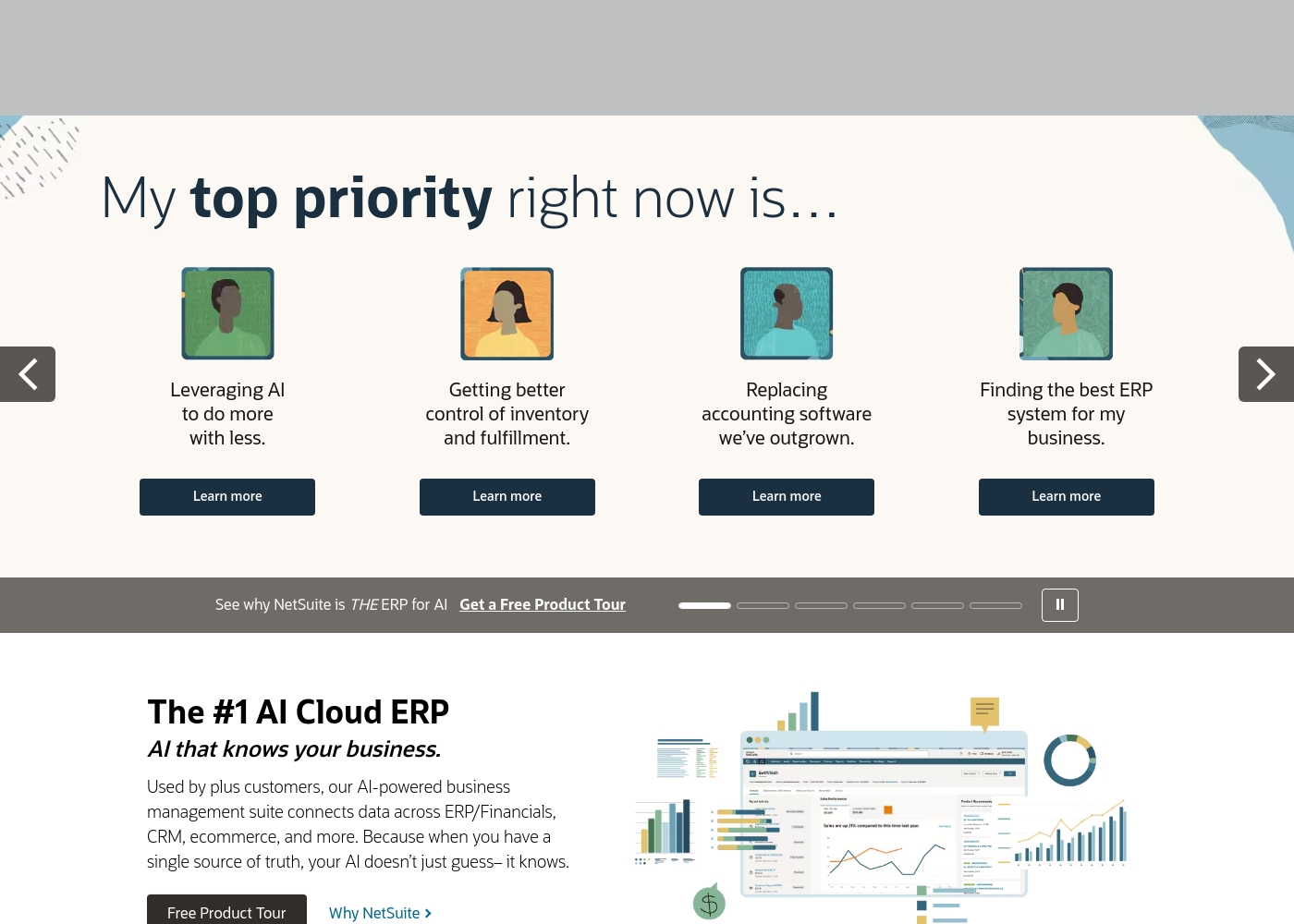
NetSuite is clearly positioned as an AI-powered business management suite. It's known widely as the #1 AI Cloud ERP. This powerful suite is designed to connect key functional areas of your enterprise.
It expertly handles everything from ERP/Financials to CRM and ecommerce data. Over 43,000 customers rely on these integrated products to help fuel their essential growth. 💡
AboutVEA
VEA AI is an all-in-one business management platform. It's designed for service business owners who want to stop micromanaging. The platform uses AI agents to automate tasks like project tracking, client management, and accounting. It aims to replace a stack of separate tools with a single, intelligent system. 💡
Highlights
Feature Comparison
Features Overview
We highlight the main differences and pick a winner for each feature.
AI Analytics
Both offer AI analytics, but NetSuite leans into enterprise-scale intelligence.
NetSuite provides AI-powered intelligence across ERP, Financials, CRM, and ecommerce. It’s backed by a large customer base and a unified data pool. The AI gives recommendations from a single source of truth. VEA adds AI analytics inside a lean dashboard for small teams. The big trade-off is scale and depth. Real-world impact: enterprises get deeper forecasts; small teams get quick, actionable insights.
ERP Depth
NetSuite covers enterprise-grade ERP and deep integrations; VEA focuses on lean ops.
NetSuite handles comprehensive ERP and Financials with CRM and ecommerce data. It’s designed for large organizations with complex needs. The trade-off is cost and setup time. VEA stays focused on essential ops with a simple dashboard and no-contract pricing. Real-world impact: NetSuite handles scale; VEA wins for speed-to-value.
Data Integration
NetSuite offers deep integration across core business areas; VEA keeps it simple.
NetSuite links ERP, Financials, CRM, and ecommerce data in one system. This creates a unified view for executives and admins. VEA centralizes customers, invoicing, work orders, and scheduling in one dashboard. The key trade-off: depth versus simplicity. Real-world impact: NetSuite shines for complex data flows; VEA is faster to configure.
Unified View
VEA provides an all-in-one dashboard; NetSuite uses module-based access.
VEA brings customers, invoicing, work orders, and scheduling under one pane. The AI analytics surface decisions directly in the dashboard. NetSuite consolidates data across functions but may feel module-heavy. Real-world impact: VEA reduces tool-switching; NetSuite offers deeper enterprise-wide coherence.
Onboarding & Implementation
VEA wins for quick starts; NetSuite leans on customized implementation.
VEA offers a 4-step quick start with templates and AI-driven setup. It’s designed for fast time-to-value. NetSuite requires a customized ERP implementation with a guided tour. Real-world impact: VEA is ideal for lean teams; NetSuite suits organizations with complex processes.
Pricing Clarity
VEA uses transparent per-user pricing; NetSuite pricing is customized.
VEA charges $24.95 per user per month with no contracts. You can scale by adding users. NetSuite pricing is not publicly listed and requires a tailored quote. Real-world impact: VEA offers budgeting predictability; NetSuite can grow with more complex needs.
Customization & Extensions
NetSuite shines with deep customization; VEA keeps it lean.
NetSuite supports extensive ERP customization for large ops. It often requires specialized consultants for changes. VEA provides built-in tools with templates and straightforward extensions. Real-world impact: NetSuite fits unique, high-complexity needs; VEA minimizes friction for smaller teams.
Support & SLAs
NetSuite requires negotiated terms; VEA data is limited here.
NetSuite terms and SLAs are part of the signed contract. Public details are scarce. VEA’s public support details are not specified in the data. Real-world impact: enterprise buyers should negotiate support; lean teams should confirm service expectations.
NetSuite operates primarily on a customized enterprise model. Because it is a powerful AI Cloud ERP solution, you won't find standard, predefined pricing tiers. Pricing requires a direct quote based on your specific business size and needs.
Custom ERP Implementation
Best For: Businesses needing a scalable, integrated ERP solution or replacing outgrown accounting software Other Features:
- Connects data across ERP/Financials, CRM, and ecommerce
- AI-powered business management suite
- Used by 43,000+ customers
- Provides a single source of truth
This is the right choice if you need a comprehensive system that leverages AI to connect all your data. It's designed to help growing companies move past disparate systems and gain better control over operations like inventory and fulfillment.
VEA costs between $24.95 and $59.95 per user, per month on an annual plan with 3 plans available: Business Class at $24.95, First Class at $39.95, and Private Jet at $59.95.
Take a look below to compare the features included with each options:
Business Class
Price: $24.95 per user, per month (billed annually) Best For: Team alignment and task tracking Other Features: Task tracking, team alignment, smoother operations
- Stop the chaos
- Get your team aligned
- Tasks tracked
- Operations running smoothly without constant check-ins
- AI agents handle grunt work
- Eliminate $15/hour tasks
- Help team move faster
- Focus on what matters
- AI experts analyze your business
- Flag problems before they cost money
- Guide major decisions with trusted data
Pricing Notes
- NetSuite pricing requires a direct quote and is tied to modules and users.
- VEA pricing is per-user with no listed annual option.
Pricing Head-to-Head
User Reviews
User reviews for NetSuite present a stark contrast to its marketed position, frequently highlighting issues with pricing, support, and usability. Many users describe the system as unintuitive, bulky, and slow, noting that the interface feels decades outdated; one reviewer suggested the UI looks like it is from the 1980s.
This complexity often necessitates hiring expensive consultants, even for routine tasks. Pricing is a major pain point; users report that the software is significantly more expensive than competitors, with costs frequently reaching tens or hundreds of thousands annually, and aggressive price increases during renewals are common.
I wasted thirty minutes getting the runaround about pricing. When they finally gave a quote, the rep was extremely rude and said my business wasn't a 'good fit' due to the high starting price. Poor customer service is unacceptable for an enterprise product like this.
On Trustpilot, VEA (Health) holds a 4.1/5 rating with five reviews in the last 12 months, all positive. Users consistently praise the straightforward ordering process, quick shipping (often 3-4 days), and secure packaging.
📦 Several highlight clear communication and responsive support for questions. One reviewer noted feeling tangible benefits like better energy.
The thing I appreciated most was how normal and straightforward everything felt. No weird process, no pressure, just clear communication and quick shipping. Made the whole experience really comfortable.
Our Verdict
NetSuite and VEA are both strong, but the winner depends on your needs. NetSuite excels for enterprises needing deep ERP and data integration. VEA wins for lean teams needing fast setup and predictable pricing. If you’re evaluating, start with your team size and growth plans. NetSuite is the clear pick for large, complex ops; VEA shines for small teams aiming for simplicity. If you’re balancing cost and scale, choose VEA now and consider NetSuite as you grow.
Frequently Asked Questions
Which is better for small teams: NetSuite or VEA?
For tiny teams, VEA offers predictable pricing and quick setup. NetSuite targets larger, more complex operations. If you’re growing fast, start with VEA and reassess later.
Does NetSuite have features like VEA's AI analytics?
NetSuite has AI-powered capabilities across ERP and related areas. VEA includes AI analytics in a unified dashboard. Both offer AI, but NetSuite targets broader enterprise scope.
Is VEA worth the extra cost over NetSuite?
VEA is cheaper and simpler for lean teams. NetSuite delivers deeper enterprise features at higher cost. Your decision depends on scale and complexity.
Can I migrate from NetSuite to VEA easily?
Migration details aren’t explicitly stated. Expect planning, data migration, and onboarding needs. Start with a trial or tour to scope the effort.
Does NetSuite offer a free trial?
NetSuite doesn’t provide a typical free trial. You can sign up for a Free Product Tour to explore features.
How does VEA handle onboarding and migration?
VEA offers a 4-step quick start setup. It’s designed for fast onboarding, with templates and AI guidance.
Ready to Choose?
Both tools have their strengths. Choose based on your specific needs.