Navan vs Travel Code
Navan and Travel Code both aim to simplify corporate travel, but they target different teams. Navan is a free hub for small companies, while Travel Code offers predictable, flat-rate pricing for mid-market finance. This comparison breaks down which tool is right for your budget and needs.
Best for: Companies with frequent business travelers, Finance teams seeking to automate expense reporting
Best for: Mid-market finance teams (100-2,000 employees), Companies juggling a legacy TMC, expense tool, and card program
A solid travel hub, with some expense hiccups.
We find Navan is a capable all-in-one platform for corporate travel and expenses, especially for small to mid-sized companies. Overall, its strong booking interface and helpful support are weighed down by inconsistent expense processing and a lack of public pricing clarity.
Pros
- Free plan available for companies up to 300 employees.
- Unified platform for both travel booking and expense reporting.
- Generally praised for a straightforward and easy-to-use interface.
- Customer support is noted as responsive and helpful in resolving issues.
Cons
- Expense reimbursements can be slow or contain processing errors.
- Enterprise pricing requires contacting sales; no transparent public rates.
- Initial setup and platform rollout may be complex for some organizations.
- May not be ideal for teams needing niche, deep accounting integrations without confirmation.
Unified travel platform for modern finance.
We find Travel Code to be a solid, unified solution for companies looking to consolidate their travel, expense, and card management. It offers clear value through its single ledger and onboarding speed. Overall, it's a compelling option for mid-market teams aiming to replace multiple point solutions.
Pros
- Unified platform for travel, expenses, and cards on a single ledger.
- Transparent, predictable flat-rate pricing without per-seat fees.
- Promises fast onboarding from legacy systems (around 9 days).
- Automated reconciliation and a dedicated tool for recovering unused credits.
Cons
- External review data was unavailable, so user sentiment is unverified.
- Pricing may be less cost-effective for very small teams beyond the free tier.
- Dependence on a single vendor for core financial processes.
- The promised speed and savings may vary based on individual company complexity.
AboutNavan
Navan is a comprehensive platform for managing business travel and expenses. It’s designed for companies of all sizes, from small businesses to large enterprises. The platform serves various industries, including technology, healthcare, and retail. 💡 It aims to be a single solution for booking trips and handling the related costs.
AboutTravel Code
Travel Code is a unified corporate travel, expense, and card management platform. 🧳 It’s built for mid-market finance and travel teams who want to eliminate vendor sprawl and gain full visibility into spend. Think of it as your modern command center for all business travel.
Highlights
Feature Comparison
Features Overview
We highlight the main differences and pick a winner for each feature.
Ease of Use
Navan focuses on a simple booking interface. Travel Code emphasizes policy-first compliance for finance.
Navan's platform is generally praised for a straightforward and easy-to-use interface for travelers. The goal is to make finding and booking trips simple in one place. Travel Code shows compliant options first during booking. Out-of-policy choices are flagged for approval, creating a structured flow for travelers. The key difference is traveler freedom versus financial control. Navan offers a smoother booking experience, while Travel Code embeds policy enforcement directly into the search. For a quick trip, Navan's simplicity shines. For complex policy adherence, Travel Code's structured approach is better.
Expense Management
Travel Code offers deep automation. Navan provides a basic, unified link.
Navan connects travel bookings directly to expense reports. This reduces manual data entry and helps create cleaner financial records. Travel Code provides automated, line-by-line OCR with 99.2% accuracy. It auto-matches expenses to bookings, card payments, and your general ledger. The trade-off is depth versus simplicity. Navan's integration is seamless but basic. Travel Code's system is more complex but cuts the financial close cycle from 10 days to 3. If your team manually reconciles receipts, Travel Code is a major upgrade. For simpler expense needs, Navan's unified approach works well.
Pricing Value
Navan has a free tier for small teams. Travel Code's flat rate is cost-effective at scale.
Navan offers a free plan for companies up to 300 employees. Larger organizations get a custom quote for the Enterprise plan. Travel Code uses flat-rate monthly plans ($0, $85, $247) that cover unlimited travelers. There are no per-seat fees, making costs predictable. The key is team size. Navan is unbeatable for small businesses. Travel Code's flat rate becomes a better value as your employee count grows beyond 300. A team of 150 would pay $0 on Navan. A team of 500 would pay a flat fee on Travel Code, avoiding per-seat costs.
Travel Booking
Navan offers global inventory. Travel Code adds proactive savings tools.
Navan provides access to global travel inventory and exclusive rates. Travelers can find and book what they need in one place. Travel Code books across 500+ airlines and 2.5M hotels. It includes RateGuard, which watches for fare drops and auto-rebooks within rules. The difference is reactive versus proactive. Navan gives you the tools to book. Travel Code actively works to save money after booking. For companies where fare volatility is high, Travel Code's RateGuard can generate significant savings.
Security & Compliance
Travel Code publishes clear certifications. Navan's details are not public.
Navan's website does not provide specific details on security protocols or certifications. You must request this information from their team. Travel Code is SOC 2 Type II and GDPR audited annually. It holds IATA/ARC accreditation and offers multi-region data residency. The contrast is transparency. Travel Code provides a full diligence package upfront. Navan requires direct inquiry for security documentation. For regulated industries or public companies, Travel Code's clear compliance posture is a major advantage.
Customer Support
Both offer 24/7 support. Travel Code adds priority tiers and a dedicated manager.
Navan includes 24/7 travel support with its free plan. The Enterprise plan adds a Dedicated Customer Success Manager. Travel Code provides 24/7 in-platform support on all plans. Premium and Pro plans offer priority support, and Pro includes a dedicated account manager. The structure is similar, but Travel Code has more defined tiers. Navan's support is noted as responsive in reviews. Both tools have capable support, but Travel Code's tiered system offers clearer escalation paths for larger teams.
Integration Ecosystem
Navan has strong HRIS links. Travel Code leads with accounting depth.
Navan offers over 30 seamless HRIS integrations. This is a key feature for connecting with systems like Workday or BambooHR. Travel Code connects to major accounting platforms like QuickBooks, NetSuite, Sage Intacct, and SAP. It also supports HRIS via SCIM. The difference is core focus. Navan's integrations are built for HR and employee data flow. Travel Code's are built for finance and the general ledger. If your primary pain point is expense reporting to your accounting software, Travel Code's integrations are more direct.
Scalability
Navan scales from free to custom enterprise. Travel Code is built for predictable mid-market growth.
Navan's free plan scales up to 300 employees. Beyond that, the Enterprise plan has no stated seat limit but requires custom pricing. Travel Code's flat-rate plans are designed for 100-2,000 employees. The pricing stays the same as you add more travelers. The key difference is cost predictability. Navan's pricing changes at scale. Travel Code's cost is fixed per plan, making budgeting easier. For a team growing from 200 to 800 employees, Travel Code's pricing model avoids cost surprises.
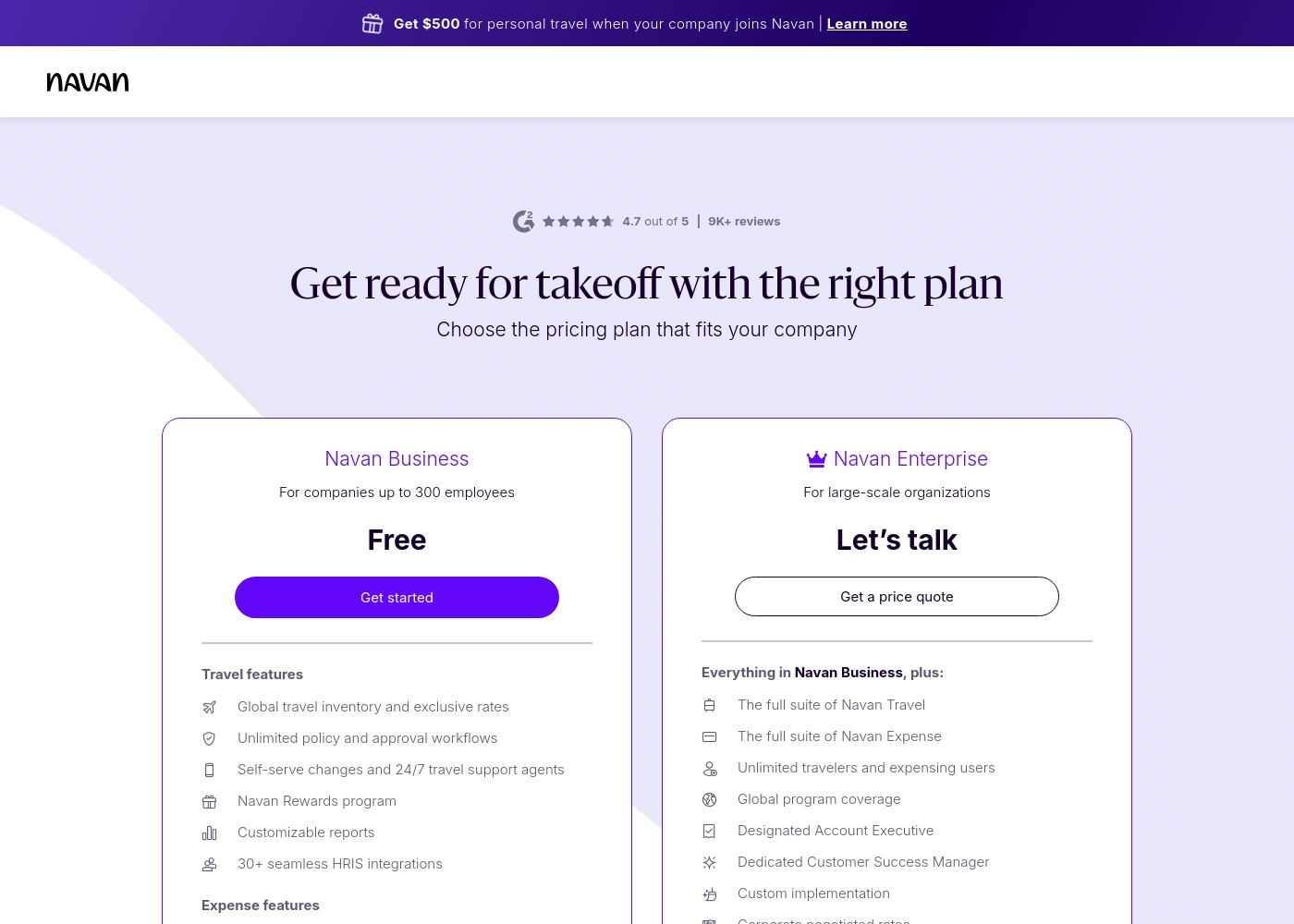
Navan costs between $0 and a custom quote with 2 plans: Navan Business at Free and Navan Enterprise at a custom price.
Here is a breakdown of the available plans and their core features for your team.
Navan Business
Price: Free Best For: Companies up to 300 employees Other Features: Global travel inventory, unlimited policy workflows, 24/7 support, Navan Rewards, 30+ HRIS integrations
- Global travel inventory and exclusive rates
- Unlimited policy and approval workflows
- Self-serve changes and 24/7 support
- Navan Rewards program
- Customizable reports
- Full suite of Navan Travel & Expense
- Unlimited travelers and expensing users
- Global program coverage
- Designated Account Executive
- Dedicated Customer Success Manager
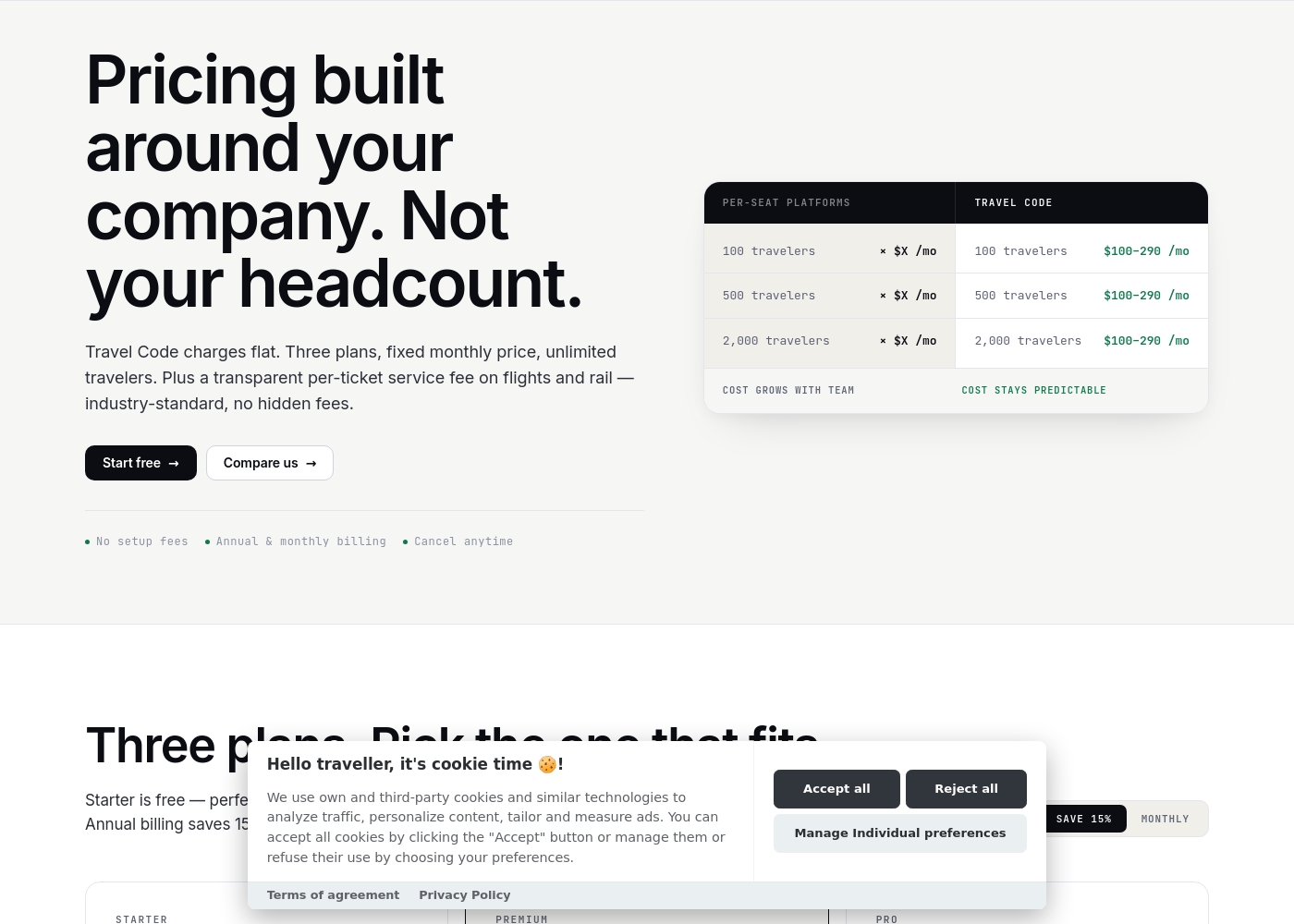
Travel Code pricing: Travel Code offers flat-rate monthly plans starting at $0 for small teams, with paid tiers at $85 and $247 per month on annual billing. Unlike per-seat models, these plans support unlimited travelers for a predictable fixed price plus transparent ticket service fees. Plans range: $0–$800/month Billing options: Free plan, Monthly subscription, Yearly subscription, Usage-based pricing
Pricing Notes
- Navan's free plan is for companies up to 300 employees, making it ideal for small businesses.
- Travel Code's flat-rate plans ($85, $247) include unlimited travelers, offering predictable costs for growing teams.
- Both platforms have a free entry point, but Navan's is based on employee count while Travel Code's is a limited plan.
- Navan's Enterprise pricing is opaque and requires a sales quote. Travel Code's public pricing is transparent.
Pricing Head-to-Head
User Reviews
Trustpilot reviews for Navan paint a mixed picture. 👍 Many users praise the platform's ease of use, highlighting how simple it is to book travel and manage expenses.
The responsive customer support is frequently noted as a major plus, helping resolve issues quickly. 👎 However, a recurring theme involves delays in expense reimbursements and occasional errors in processing payments.
Booking travel has never been easier. The platform is intuitive, and I love earning rewards for my business trips. It's a huge time-saver.
We were unable to access specific user reviews from Trustpilot or Capterra due to a 403 error and a missing URL. This means we cannot synthesize a balanced external sentiment summary based on actual user feedback. Our assessment is therefore based solely on the provided website and pricing details. We advise checking these review sites directly for the latest user experiences.
Our Verdict
For most small businesses, Navan is the clear winner. Its free plan for up to 300 employees is unbeatable for getting started. Navan's superpower is its simple, unified experience. It makes booking and basic expense tracking easy for teams without deep financial complexity. Travel Code's superpower is its financial engine. It automates reconciliation, recovers credits, and provides a single ledger for finance teams. The deciding factor is your team's size and pain point. If you're small and need simplicity, pick Navan. If you're mid-market and need to fix a broken financial process, pick Travel Code. Bottom line: Choose Navan if you're a small business wanting a free, all-in-one travel tool. Choose Travel Code if you're a finance team ready to consolidate vendors and automate your books.
Frequently Asked Questions
Which is better for small teams: Navan or Travel Code?
Navan is better for very small teams. Its free plan supports up to 300 employees. Travel Code's free tier is also for small teams, but its main value is for mid-market companies.
Does Travel Code have a free plan like Navan?
Yes, Travel Code offers a free Starter plan. However, its core pricing is based on flat monthly subscriptions for paid tiers, unlike Navan's per-seat Enterprise model.
Can I migrate from Navan to Travel Code easily?
Travel Code promises fast onboarding from legacy systems, often in about 9 days. They use an AI Policy Builder to read existing policies. Direct migration ease from Navan isn't specified.
Which tool saves more money on travel?
Travel Code has proactive savings tools like RateGuard and credit recovery. Companies report an average 12% cost reduction. Navan provides access to exclusive rates but doesn't automate savings post-booking.
Is Travel Code's pricing more transparent than Navan's?
Yes, Travel Code publishes its flat monthly rates. Navan's Enterprise pricing is not public and requires contacting their sales team for a custom quote.
Which platform has better expense reporting?
Travel Code has more advanced expense reporting with automated OCR, auto-matching, and VAT splits. Navan links bookings to reports but with less automated detail.
Ready to Choose?
Both tools have their strengths. Choose based on your specific needs.