Mozello vs Ycode
Mozello and Ycode both build websites, but they target totally different types of users. Mozello is designed for individuals prioritizing speed and built-in multilingual support. Ycode offers deep visual design control and superior scalability for complex, high-traffic projects. Choose wisely based on your project's complexity and long-term stability needs.
Best for: Solo entrepreneurs launching a simple online store quickly, Activists or bloggers needing fast, multilingual sites
Best for: Designers needing total control over layout and interactions, Teams requiring robust content management systems (CMS) and rapid scaling
Simplistic builder, high risk of deletion.
We found Mozello to present an appealing, easy-to-use interface and attractive pricing, including lifetime free domain renewals. However, recurring external reports of sites being randomly deleted without professional explanation raise serious concerns regarding data integrity and platform reliability. Overall, we cannot recommend Mozello for professional or long-term projects due to the documented risk of unprompted data loss.
Pros
- Extremely easy to use (minimal learning curve)
- Strong free plan includes 0% e-commerce transaction fees
- Premium plans include free lifetime domain renewals
- AI tools available for content generation
Cons
- High risk of random site deletion without warning or explanation
- Reseller program allegedly failed to provide true white-label service
- Branding/links remain visible even after paying for removal
- Unsatisfactory communication regarding account termination
Powerful visual editor with smart pricing.
We see Ycode successfully bridges the gap between powerful design tools and affordability, offering extensive features like an integrated CMS and team collaboration without excessive cost. Overall, this platform presents a compelling alternative for designers and founders seeking complete control over their complex projects.
Pros
- Extremely competitive pricing structure beginning at $5/month annually.
- Comprehensive Free plan perfect for development and testing new projects.
- Total design autonomy via an intuitive visual editor, requiring no code.
- Integrated CMS simplifies content structuring and data management.
Cons
- Custom code integration is restricted to Basic and Pro plans.
- The Mini plan is significantly limited in scope (only 5 published pages).
- No explicit refund policy or money-back guarantee is provided.
AboutMozello
Mozello is an incredibly easy-to-use website and online store builder. It is often described as being as easy as writing an e-mail. This platform is designed for entrepreneurs, bloggers, and small businesses that need a high-performing site without specialized help. Mozello handles all complex technical details, including domain registration and web hosting. You get all the essential features needed for a professional online presence.
Starting your project is stress-free; you can begin building immediately for free, and you never need to provide a credit card to try it. Whether you need a simple portfolio or a powerful store, you can achieve professional results in hours or days. 💡
AboutYcode
Ycode is a comprehensive, all-in-one website builder and integrated CMS. It's built specifically for designers, creators, and founders who want professional results without relying on code. Using its intuitive visual editor, you gain complete design control to craft beautiful, fully responsive websites. You can publish your creations instantly and manage everything easily from one reliable platform. ✅
Highlights
Feature Comparison
Features Overview
We highlight the main differences and pick a winner for each feature.
Platform Reliability
Mozello users report site loss issues; Ycode emphasizes stable infrastructure.
Mozello has concerning user reports of spontaneous site deletions and login access problems. This lack of stability severely undermines confidence in Mozello for any critical business venture. Ycode is built on robust infrastructure focusing on scalability and speed for high-traffic sites. Ycode’s platform ensures more peace of mind for designers building long-term, complex projects. If site uptime and security are vital, Ycode is the dependable choice.
Design Customization
Ycode offers visual editor mastery; Mozello is basic and template-driven.
Mozello provides a straightforward builder focusing purely on speed and mobile responsiveness. It uses simple templates to get basic sites online fast without any tinkering. Ycode features a powerful visual editor granting total, pixel-perfect design autonomy. Ycode lets users build complex interactions like scroll effects without writing any code. For designers prioritizing unique, custom layouts, Ycode is overwhelmingly superior.
Content Structure
Ycode has a powerful integrated CMS; Mozello uses basic content pages.
Mozello manages simple pages and product counts effectively for very basic needs. Ycode offers a full integrated CMS supporting collections and thousands of items per site. The Ycode structure is essential for blogs, directories, or any data-heavy content. Ycode simplifies managing large amounts of data and performing bulk content updates quickly.
Team Collaboration
Ycode includes unlimited free team members; Mozello lacks explicit features.
Mozello does not detail explicit real-time collaboration or user role management features on its plans. Ycode features seamless team collaboration and allows unlimited free collaborators on every single plan. This Ycode policy avoids the expensive per-seat charges common on many rival platforms. For marketing agencies or design teams, Ycode offers massive cost savings and better workflow capabilities.
E-commerce Readiness
Mozello has dedicated built-in sales tools; Ycode focuses on site building.
Mozello includes a built-in shopping cart and direct support for popular payment gateways like Stripe. Mozello is ready out-of-the-box for entrepreneurs needing to start selling physical products instantly. Ycode requires leveraging the integrated CMS structure to manage products and likely needs external e-commerce integrations. Choose Mozello if simple, immediate online selling is your primary goal.
Learning Curve
Mozello is faster to launch; Ycode has a steeper, yet rewarding curve.
Mozello is explicitly marketed for zero-tech-skill users and promises a simple, four-step launch process. It takes care of hosting headaches, allowing faster time-to-publish for basic sites. Ycode's powerful visual editor and CMS require more initial setup and learning investment. The trade-off is Ycode's scalability and professional result versus Mozello's immediate simplicity. If time is extremely short, Mozello wins the speed race.
Multilingual Scaling
Mozello makes multilingual easy; Ycode offers ultimate control on Pro plans.
Mozello supports multilingual websites across its paid tiers with accessible setup. Ycode uses tiered limits: 2 languages on Mini, 3 on Basic, and unlimited on its Pro plan. This Ycode structure allows massive global scaling for large organizations and international firms. For simple two- or three-language sites, both Mozello and Ycode offer good solutions.
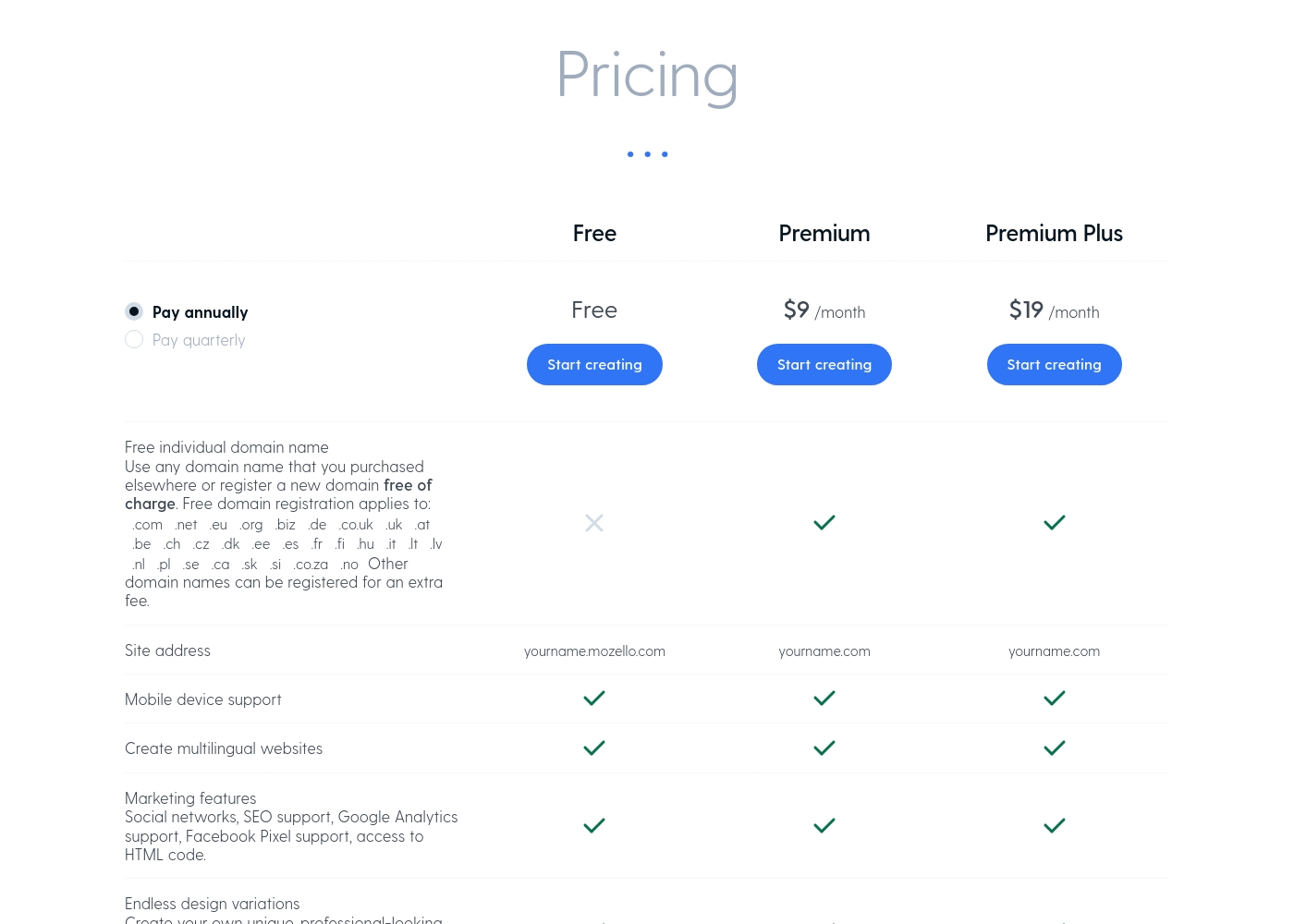
Mozello costs between $9 and $24 per month with three plans: Free (at $0), Premium (at $9/month billed annually), and Premium Plus (at $19/month billed annually). The platform makes pricing straightforward. You choose between three levels that fit your project scope. These plans scale features based on your storage and e-commerce needs. Let's explore what each plan offers you.
Free
Price: Free Best For: Individuals and beginners getting started with a basic web presence. Other Features:
- 0.5 GB of storage space.
- Mobile device support and multilingual websites.
- Basic online store for up to 5 products.
- Marketing tools including SEO support and HTML code access.
The Free plan is the best way to test out Mozello's simple website builder. You can publish a functional website immediately and start selling a small number of items. It's a fantastic choice for small personal projects or tiny shops just starting out. You'll need to use the Mozello subdomain for this plan.
- 0.5 GB storage space
- Mobile device support
- Create multilingual websites
- Online store (5 products, 1 option, 5 variants)
- 0% transaction fee
- Free individual domain name and renewals
- 50 GB storage space
- Remove Mozello branding
- Online store (15 products, 1 option, 20 variants)
- 0% transaction fee
- Free individual domain name and renewals
- Unlimited storage space
- Remove Mozello branding
- Online store for unlimited items (3 options, Unlimited variants)
- 0% transaction fee
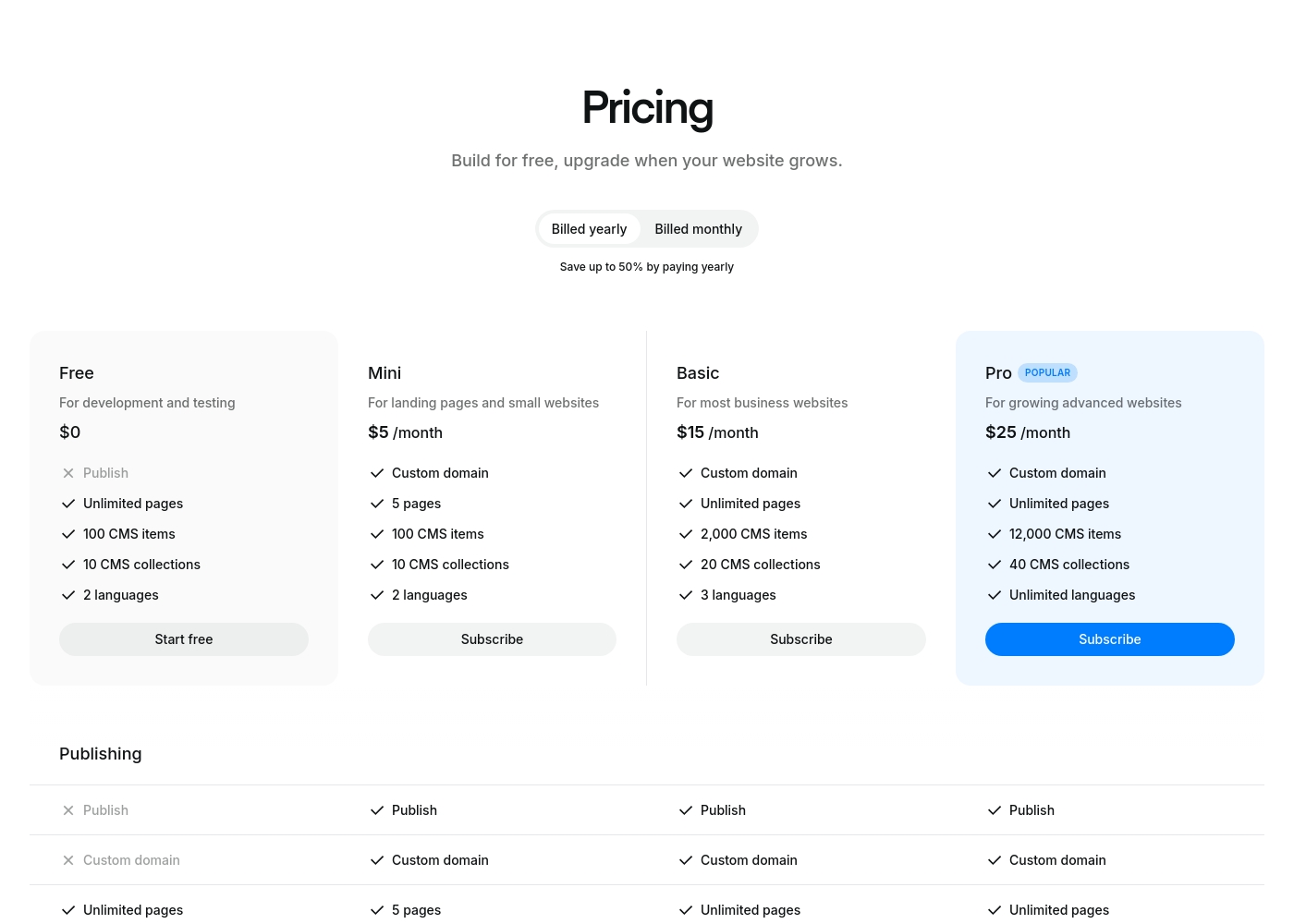
Ycode costs between $0 and $30 per month, with four plans: Free at $0, Mini at $5/month (billed yearly), Basic at $15/month (billed yearly), and Pro at $25/month (billed yearly).
Here’s a breakdown of what each tier offers so you can choose the best fit for your project.
Free
Price: $0 Best For: development and testing Other Features: Unlimited pages on a ycode.site domain, 100 CMS items, 10 CMS collections, 2 languages, 1K monthly visits.
- Publish to ycode.site
- Unlimited pages
- 100 CMS items
- 10 CMS collections
- 2 languages
- Custom domain
- 5 pages
- 100 CMS items
- 10 CMS collections
- 2 languages
- Custom domain
- Unlimited pages
- 2,000 CMS items
- 20 CMS collections
- 3 languages
- Custom domain
- Unlimited pages
- 12,000 CMS items
- 40 CMS collections
- Unlimited languages
Pricing Notes
- Ycode offers significant savings (up to 50%) when users commit to annual billing rates.
- Ycode includes unlimited free collaborators on all plans, avoiding expensive user seat costs.
- Mozello's lowest paid plan ($9/month) allows unlimited pages, unlike Ycode's Mini plan (5 pages).
- Mozello limits product counts and variants even on its paid e-commerce tiers.
- Both Mozello and Ycode offer permanent Free plans for development and testing.
Pricing Head-to-Head
User Reviews
User feedback on Mozello is extremely polarized. While some users praised the platform, noting that it is "really easy to make an website," the most serious complaints focus on critical reliability and business integrity issues.
Several paying and non-paying users reported that Mozello randomly deletes entire websites with no warning, explanation, or clear cause—sometimes citing ‘inactivity,’ even after significant effort was invested. Users view this data loss as genuinely risky, suggesting the fundamental infrastructure might not be stable.
It’s really easy to make an website here. The system is much better than platforms like Weebly. I highly recommend Mozello if you are looking for a simple, functional builder.
Ycode is strongly positioned as a high-value and professional alternative to established web development platforms, frequently emphasizing user satisfaction and powerful design capabilities. The company maintains that thousands of users worldwide praise its innovation and supportive environment.
This platform aims to cut through complexity by combining powerful features with an intuitive, user-friendly interface. Key themes promoted internally include superior user interface design and competitive pricing compared to rivals like Webflow, alongside strong functionality for animation and visual effects.
Our Verdict
Choosing between Mozello and Ycode is a battle of speed versus professional power. If you need ultimate stability and growth potential, Ycode is the clear winner for your investment. Mozello is fantastic for quick launches, but its reliability record should concern serious builders. Mozello’s superpower is making website building ridiculously easy and fast. It includes hosting and domain management automatically, perfect for zero-tech-skill users. Mozello delivers simple, responsive, multilingual sites and includes basic e-commerce functionality readily available. It’s ideal for getting a personal or small business site live today. Ycode, conversely, is for those who demand professional results and precise control. Its integrated CMS handles massive content structuring, unlike Mozello’s basic setup. Crucially, Ycode supports unlimited free collaborators, saving agencies significant monthly costs. Ycode unlocks deeper visual customization and better overall site scalability. The critical difference lies in stability and complexity; Mozello requires you to accept higher risk for speed. Ycode provides robust infrastructure, strong enough to handle 300,000 monthly visits without stability concerns. Ycode gives you the platform to truly scale your business without worrying about site loss. If you are a solo entrepreneur rushing to launch a simple store, pick Mozello for speed. If you are a designer or an agency building a complex, high-traffic business site, invest confidently in Ycode. Ycode is the safer, more powerful choice for professional, long-term growth projects.
Frequently Asked Questions
Which is better for e-commerce: Mozello or Ycode?
Mozello is better for simple e-commerce setup with built-in tools. Mozello offers a cart and payment gateway support like Stripe and PayPal. Ycode focuses more on site structure and requires integrating e-commerce functionality separately.
Does Mozello support custom code like Ycode?
No, Mozello does not focus on custom code integration or advanced developer features. Ycode allows custom code (HTML, CSS, JS) integration on its Basic and Pro plans. Ycode gives experienced users more flexibility in development.
Why is Ycode better for teams than Mozello?
Ycode is significantly better because it includes unlimited free collaborators on all tiers. This eliminates the high per-seat costs common with other platforms. Mozello does not feature detailed team collaboration tools.
How does Mozello's reliability compare to Ycode?
Mozello has a poor reliability reputation, with users reporting site deletions and access issues. Ycode emphasizes stability and scalability for high-traffic sites. Ycode is the much safer option for critical long-term projects.
Which platform is cheaper overall?
Ycode's lowest annual paid plan starts at just $5/month, cheaper than Mozello's $9/month plan. However, Ycode's cheapest plan only allows 5 pages. Mozello provides a fully functional, unlimited-page site at its entry price.
Is Ycode easier to use than Mozello?
Mozello is generally easier for beginners due to the automatic handling of hosting and domain setup. Ycode, while intuitive, offers much deeper design control and structure. This power means Ycode has a steeper, though rewarding, learning curve.
Ready to Choose?
Both tools have their strengths. Choose based on your specific needs.