Motion vs Process Street
Motion and Process Street tackle automation very differently despite both being powerful. Motion manages time and tasks with AI scheduling and custom AI Employees for efficiency. Process Street enforces policies and compliance through standardized, auditable workflows. The choice depends entirely on whether your priority is speed or control.
AI scheduling that manages your work.
We observed that Motion delivers on its promise of powerful, AI-driven task management and scheduling. Users consistently report massive time savings and reduced cognitive load, but the complex credit and seat pricing structure requires careful study. Overall, Motion is a transformative tool for dedicated users who commit to mastering its full capabilities.
Pros
- Reduces mental load using intelligent auto-scheduling and task prioritization.
- Integrates tasks, projects, and calendar into a single, cohesive productivity suite.
- Helps teams break down major goals into manageable, achievable steps for progress.
- High-quality AI note-taker joins meetings and summarizes them effectively.
Cons
- High price point ($50/month cited as excessive by some single users).
- Steep learning curve requires significant upfront time to fully master the system.
- Reported UX/UI glitches, such as obstructive task preview pop-ups.
- Users note that the mobile app and notification features need improvement.

AI-Powered Compliance and Operational Standardization
We find Process Street highly effective for organizations needing to enforce strict operational policies and ensure consistency across large, distributed teams. Overall, the powerful combination of AI automation and centralized document control makes this an essential tool for compliance-driven scaling.
Pros
- AI-enforced workflows guarantee policy compliance.
- Cora AI agent monitors regulations and flags risks 24/7.
- Centralizes policies into live, audit-ready workflows (DOCS).
- Drives consistency and accountability across global teams.
Cons
- Pricing is not publicly disclosed, requiring custom quotes.
- No transparent tiers or fixed subscription costs available.
- Specific features and user limits depend on individualized packages.
- May be overwhelming or costly for very small teams without complex compliance needs.
AboutMotion
Motion transforms how teams work by offering the world's first AI workforce at your fingertips. ✨ This platform goes far beyond simple automation; it lets you create and deploy enterprise-grade AI Employees specifically built for your business needs. It merges an entire productivity suite—including AI Projects, AI Calendar, and AI Tasks—where all your work is managed and recorded. Motion is trusted by over a million top performers and teams who want a single, powerful platform for managing work efficiently.
AboutProcess Street
Process Street is the compliance operations platform. It helps your business automate consistency and ensure everything is documented correctly.
It's trusted by over a million users to standardize workflows and prove their execution. This tool uses AI to automate essential business processes and enforce policies rigidly.
It ensures you can always deliver audit-ready proof, consistently. The platform handles policy control (DOCS), workflow automation (OPS), and managing risk with its 24/7 AI compliance agent, CORA.
Highlights
Feature Comparison
Features Overview
We highlight the main differences and pick a winner for each feature.
Core Purpose & Focus
Motion prioritizes AI efficiency; Process Street ensures compliance control.
Motion acts as an AI workforce and a complete productivity suite. It handles tasks, projects, and calendar management automatically. The goal is faster results and reducing human cognitive load. Process Street is a compliance operations platform. It turns policies into standardized, auditable workflows. Its entire focus is operational integrity and policy enforcement. Motion gives speed and adaptability for tasks. Process Street provides control and governance over repeatable processes. You choose between AI autonomy or managed policy compliance. If your business is highly regulated, Process Street provides the necessary framework. Motion is better suited for maximizing output across general teams.
AI Capabilities
Motion builds custom AI Employees; Process Street uses AI for policy control.
Motion lets you build custom AI Employees using simple natural language. These agents perform complex, end-to-end tasks across the platform. It leverages AI for auto-scheduling and prioritization. Process Street features Cora, an AI compliance agent. Cora monitors workflows, enforces rules, and flags risks proactively. It ensures actions remain compliant and audit-ready. Motion’s AI executes work autonomously for productivity gains. Process Street’s AI enforces rules and manages organizational risk. Motion is about doing; Process Street is about controlling. Motion clearly offers broader, customizable AI execution capabilities for daily work tasks.
Governance & Compliance
Process Street delivers audit-ready governance; Motion focuses on security and efficiency.
Motion is SOC 2 Type 2 compliant for security and data handling. It supports team coordination and project tracking internally. Motion does not focus on external regulatory standard compliance. Process Street centralizes policies with full governance for standards like SOC 2, ISO 9001, and FDA. It consistently delivers audit-ready proof documentation automatically. Workflows inherently enforce necessary policy adherence. If policy enforcement and external audits are crucial, Process Street is the unequivocal choice. Motion optimizes internal efficiency rather than adhering to wide regulation standards. Users credit Process Street with reducing errors and making complicated audits much smoother.
Workflow Management
Motion auto-schedules tasks; Process Street enforces linear, repeatable process steps.
Motion’s AI automatically prioritizes tasks and updates calendars instantly. It balances deadlines, dependencies, and complex logistics automatically. This drastically reduces constant manual coordination. Process Street turns SOPs into live, enforceable workflow steps. It ensures every step is completed in order with clear ownership. This strict enforcement creates predictable, standardized outcomes every time. Motion manages *when* the task happens for optimization. Process Street strictly defines *how* the process is executed correctly. Both tools excel at managing workflows, but with different goals. If standardization is paramount, Process Street provides that rigid structure that prevents skipping critical steps.
Pricing Clarity
Motion provides clear, usage-based tariffs; Process Street requires contacting sales for details.
Motion pricing is tiered based on Seats and the number of monthly AI Credits consumed. Plans range from $29 to $599 monthly, billed annually. The pricing structure is accessible and transparent. Process Street pricing is highly non-transparent, ranging vaguely from 1 to 9001. Specific plan tiers or feature limits are not published publicly. Users must likely contact sales for an accurate quote. Motion provides a clear free trial option for evaluation. Process Street does not explicitly state free trial availability in the data provided. Motion’s upfront clarity offers better budget control starting out. Process Street focuses on enterprise scale, which often leads to customized, less transparent pricing models.
Integrated Productivity
Motion is an all-in-one suite; Process Street is specialized workflow management.
Motion is a comprehensive productivity suite and AI workplace. It includes AI Projects, Calendar, Docs, Sheets, and Notes. The AI uses context from all these integrated tools. Process Street focuses strictly on workflow management and centralized policies. It transforms policy documents into live, searchable SOPs. It doesn't offer native calendar or project management tools. Motion offers maximum integration within its ecosystem. Process Street is specialized and relies on external integrations. If you need a centralized collaboration hub, Motion delivers. Process Street excels at integrating controls into existing tools, acting as a governance layer.
Customer Support
Process Street advertises faster support; Motion offers high-tier priority support.
Motion offers Priority Business Support only starting at the expensive AI Employees Plus tier. Billing and subscription support is generally reported as responsive by users. Specialized Enterprise plans use a dedicated engineer. Process Street advertises a very swift 5-minute average support response time. They also report an impressive 98% customer rating for service quality. Users frequently praise Process Street support responsiveness. Process Street's advertised swift support across the board suggests better general availability. Motion reserves their highest support levels for top-tier plans. For immediate tactical help, Process Street seems to offer superior responsiveness based on user reports.
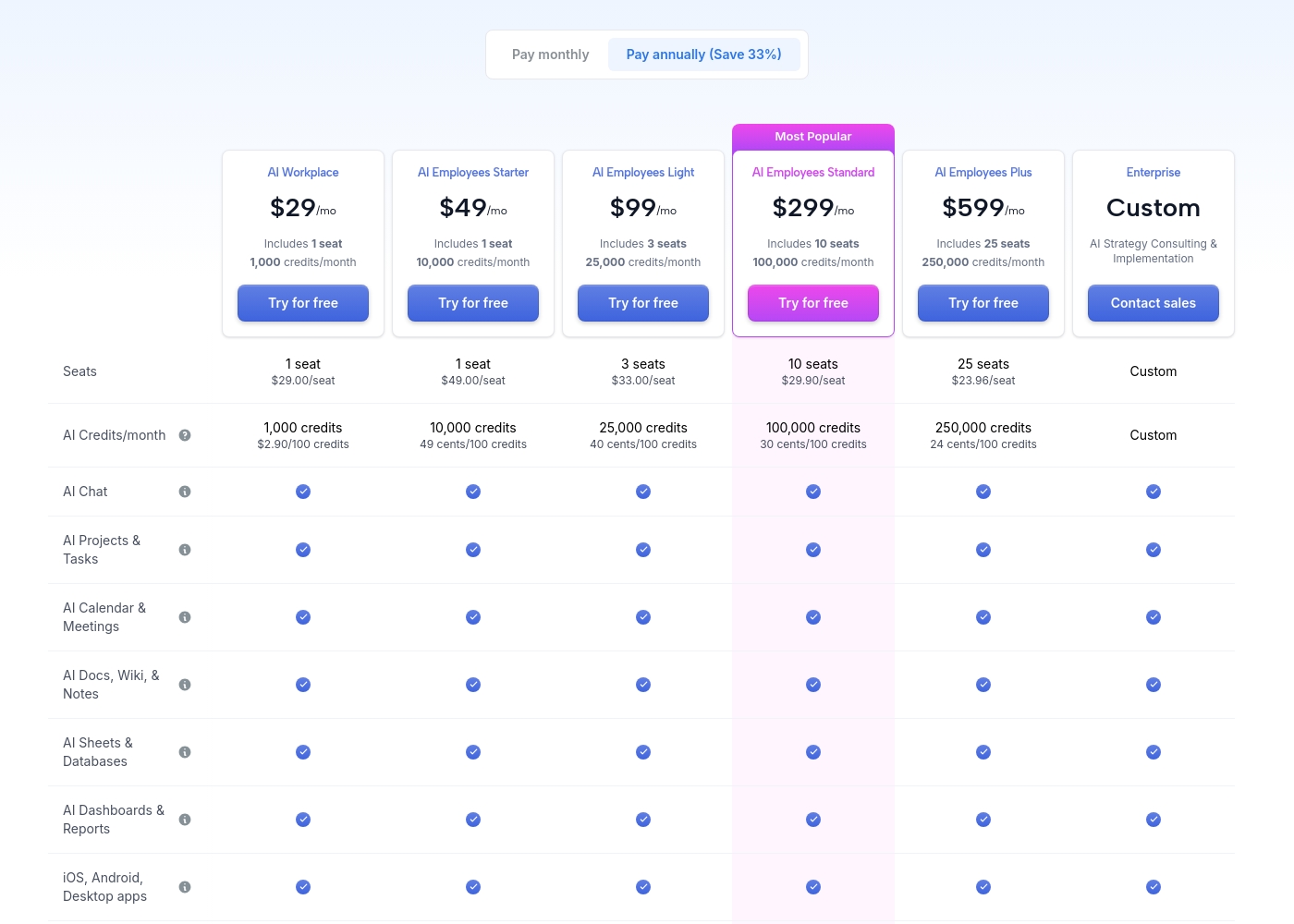
Motion costs between $29 and $599 per month (when billed annually) with 5 primary subscription plans: AI Workplace ($29/mo), AI Employees Starter ($49/mo), AI Employees Light ($99/mo), AI Employees Standard ($299/mo), and AI Employees Plus ($599/mo). There is also a custom Enterprise option.
The prices shown reflect annual billing, which gives you a savings of 33% compared to paying monthly. All plans offer a free trial period.
AI Workplace
Price: $29/mo (billed annually) Websites Supported: Not explicitly stated Best For: Individuals and small startups starting AI integration Refund Policy: Not explicitly stated Other Features:
- Includes 1 seat
- 1,000 credits/month ($2.90 per 100 credits)
- 3 integration connections
- Access to core AI tools (Chat, Projects, Calendar, Docs, Sheets, Dashboards)
- 1 seat
- 1,000 credits/month
- 3 integration connections
- AI Chat, Projects & Tasks, Calendar & Meetings, Docs, Wiki & Notes, Sheets & Databases, Dashboards & Reports
- iOS, Android, Desktop apps
- 1 seat
- 10,000 credits/month
- 5 integration connections
- Everything in AI Workplace
- 3 seats
- 25,000 credits/month
- 10 integration connections
- Everything in AI Employees Starter
- 10 seats (Most Popular)
- 100,000 credits/month
- 20 integration connections
- HTTP Blocks
- Everything in AI Employees Light
Process Street costs between Not explicitly stated and Not explicitly stated per Not explicitly stated with Not explicitly stated plans: Not explicitly stated at Not explicitly stated.
The specific tiers and features included in Process Street's subscription models are not publicly listed in this documentation. Interested users are directed to contact their team for specific pricing.
Pricing Details Available Upon Contact
Price: Not explicitly stated Websites Supported: Not explicitly stated Best For: Businesses requiring streamlined compliance, AI-powered automation, and strict operational standardization. Refund Policy: Not explicitly stated Other Features:
- The Cora AI compliance agent monitors regulations and flags risks 24/7.
- Automated workflows (OPS) turn policies into repeatable, trackable tasks.
- Centralized document control (DOCS) manages policies for ISO 9001 (and others).
- Real-time visibility into task status and workflow tracking.
- AI-powered intelligence helps generate new workflows quickly.
- Cora AI compliance agent
- Automated workflows (OPS)
- Centralized policy control (DOCS)
- AI-enforced operational consistency
- Knowledge management

Pricing Notes
- Motion pricing is transparent, ranging from $29/month for solo users up to $599/month for large teams (annually billed).
- Motion uses a usage-based model requiring careful management of AI Credits alongside seats for continuous operation.
- Annual billing for Motion offers substantial savings, advertised at 33% compared to monthly rates.
- Process Street pricing is highly non-transparent and custom, ranging vaguely from 1 to 9001, requiring sales engagement.
- Motion clearly offers a free trial, while Process Street does not specify trial availability.
Pricing Head-to-Head
User Reviews
Motion receives overwhelmingly positive feedback, primarily focused on its powerful auto-scheduling and prioritization features. Users frequently praise the application for reducing mental load and decision fatigue by automatically organizing tasks and project workflows.
Many reviewers, including those dealing with complex schedules or ADHD, state that Motion has revolutionized their workflow, saving significant time and boosting productivity. The ability to break down complex goals into achievable tasks is consistently highlighted as a major benefit, making Motion a game-changer for project management teams and individuals alike.
I was recently diagnosed with ADHD, and Motion has made a huge difference in how I structure my day. It removes the stress of figuring out what to do next. It has been well worth the time invested in learning the system, as the benefits are truly clear.
We aimed to synthesize external user sentiment for Process Street, balancing insights from both Trustpilot and Capterra. Although we located the Capterra listing URL, the provided materials did not contain specific textual snippets or testimonials from real users.
This severely limits our ability to report on recurring community themes regarding critical aspects like customer support responsiveness, the learning curve, or implementation success across various industries. Since Process Street employs a quote-based, non-public pricing model, external user feedback is crucial for assessing perceived value for money that customers experience after implementation.
Our Verdict
Motion and Process Street are powerful automation tools, but cater to completely different worlds. The decision hinges entirely on where your biggest pain point lies. If maximizing individual output and saving time is key, Motion is your winner. Motion excels at intelligently managing your workload and complex time logistics. Its superpower lies in the custom AI workforce, created easily with natural language prompts. Motion integrates projects, tasks, and the calendar into one seamless, AI-driven suite. Teams gain incredible speed by letting Motion re-prioritize when plans inevitably shift. Process Street is the expert in operational governance and enforced control. Its core strength is turning chaotic, scattered policies into live, audit-ready workflows. Process Street ensures you meet standards like SOC 2 or ISO 9001 automatically. The Cora AI compliance agent flags operational risks before they become costly audit findings. The deciding factor is autonomy versus required enforcement. Motion provides AI *autonomy* for speed and productivity gains for the human user. Process Street gives enforced *control* and clear accountability across standardized processes. Check if you need an integrated productivity suite (Motion) or specialized process compliance tooling (Process Street). If you want an AI employee to handle scheduling, choose Motion and its transparency. For strict process enforcement and guaranteed auditability, Process Street is the necessary structured solution.
Frequently Asked Questions
Which is better for core productivity and task scheduling: Motion or Process Street?
Motion is significantly better for core productivity automation. Motion automatically schedules tasks, prioritizes work, and integrates projects and calendars seamlessly. Process Street focuses primarily on policy enforcement, not personal time management.
Can Motion handle compliance documentation like Process Street?
Motion is SOC 2 Type 2 compliant for security and data handling. Process Street, however, is built specifically to provide audit-ready proof for regulated standards. If ISO 9001 or FDA compliance is needed, Process Street is the correct tool.
Does Process Street use AI for task scheduling like Motion?
No, Process Street does not offer AI-powered task scheduling or time management features like Motion. Process Street uses the Cora AI agent exclusively to monitor workflows and enforce compliance controls.
How transparent is the pricing for Motion vs Process Street?
Motion's pricing is transparent, providing clear annual tiers based on seats and monthly AI Usage Credits. Process Street's pricing is non-transparent and highly variable. You must contact their sales team for a specific quote or estimate.
Which tool is better for creating custom AI agents?
Motion is vastly superior for custom AI agent creation. Users can create custom AI Employees and Skills using natural language instructions. Process Street's AI involvement is limited to risk monitoring and compliance enforcement.
Do Motion and Process Street offer dedicated mobile applications?
Motion explicitly provides dedicated apps for iOS, Android, and Desktop with all its paid plans. Mobile functionality for Process Street is not specified in the information provided.
Ready to Choose?
Both tools have their strengths. Choose based on your specific needs.