MongoDB vs Vanta
MongoDB and Vanta solve totally different problems. MongoDB is a powerful cloud database platform. Vanta automates compliance and security. You're not choosing between them—you're choosing which problem to solve first.
Best for: Developers building modern applications, Teams needing a unified database for operational and AI data
Best for: Startups needing SOC 2 certification fast, Sales teams blocked by security questionnaires
Powerful, flexible platform for modern data.
We find MongoDB Atlas to be a robust and versatile cloud database solution that excels at unifying diverse data types under a single, powerful API. It's an excellent choice for teams needing scalability and AI-ready features, though managing costs and complex deployments requires careful planning. Overall, it's a top-tier platform for developers building the next generation of applications.
Pros
- Excellent flexibility with its document model.
- Powerful, unified platform for databases, search, and streaming.
- Strong scalability and high availability guarantees.
- Native vector search integration for AI applications.
Cons
- Costs can escalate quickly with high usage and dedicated resources.
- Advanced features and configurations can have a steep learning curve.
- Support responsiveness can be inconsistent for some users.
Powerful compliance automation for growing teams.
We found Vanta excels at automating compliance workflows and reducing manual effort, which aligns with its promise to save time and accelerate deals. Its tiered pricing offers flexibility, but the lack of transparent costs and a free trial means committing to a demo before understanding the full investment.
Pros
- Automates evidence collection and monitoring for frameworks like SOC 2.
- AI-powered questionnaire automation speeds up vendor assessments.
- Unified platform for compliance, risk management, and audit prep.
- Trust Center helps showcase security posture to customers.
Cons
- Pricing requires a custom quote, with no public tiers or free trial.
- Add-ons for key features like Third-Party Risk Management increase costs.
- Initial setup and policy onboarding may have a learning curve.
- Some users report integration challenges with specific tools.
AboutMongoDB
💡 MongoDB Atlas is a comprehensive cloud data platform built for modern applications. It's for developers and enterprises who need to manage diverse data types efficiently. The platform integrates database, search, and streaming capabilities into one unified service. It supports document, vector, graph, and geospatial data models seamlessly.
AboutVanta
Vanta is an Agentic Trust Platform designed for startups, mid-market, and enterprise companies. It automates the entire process of getting and staying compliant with frameworks like SOC 2, ISO 27001, and HIPAA. The platform combines compliance, risk management, and audit preparation into one place. It's built for security leaders who want to scale their programs without adding headcount. 💡
Highlights
Feature Comparison
Features Overview
We highlight the main differences and pick a winner for each feature.
Core Purpose
MongoDB stores and queries data for apps. Vanta automates compliance and security audits.
MongoDB Atlas is a cloud data platform. It unifies databases, search, and streaming. You build apps on top of it. Vanta is a compliance automation platform. It helps you get and stay certified for frameworks like SOC 2. You use it to prove your security posture. The difference is fundamental. MongoDB powers your application's data layer. Vanta manages your security and compliance program. They solve different business needs entirely.
AI & Automation
MongoDB uses AI for data search and insights. Vanta uses AI to automate security paperwork.
MongoDB integrates vector search directly. You build semantic search and AI apps on your data. It's a technical feature for developers. Vanta's AI agent drafts questionnaire responses. It automates evidence collection and policy generation. It saves security teams hundreds of hours. MongoDB's AI powers your product's features. Vanta's AI powers your compliance team's efficiency. One is for building, the other for managing.
Pricing & Value
MongoDB has transparent usage-based pricing. Vanta requires a custom quote with hidden costs.
MongoDB starts free with a clear $0.011/hour path. You pay for what you use. Vanta gives no public prices. You must request a demo. Add-ons like vendor risk increase costs. MongoDB offers predictable scaling. Vanta's value is in saved time—users report 2,000+ hours/year. Choose MongoDB for transparent data costs. Choose Vanta for time-saving compliance automation.
Ease of Setup
MongoDB Atlas is quick to launch. Vanta requires policy onboarding and integration.
You can spin up a free MongoDB cluster in minutes. The managed service handles the heavy lifting. Vanta's setup involves mapping your controls. You connect tools and generate initial policies. It can take a couple of weeks. MongoDB is faster for a first win. Vanta has a steeper initial learning curve. Both pay off once configured.
Scalability
MongoDB scales to massive data volumes. Vanta scales with your compliance program complexity.
MongoDB guarantees millisecond responses at scale. It handles TBs of data and millions of users. Vanta scales from one framework to many. It grows as your company adds employees and vendors. Both scale well for their purpose. MongoDB for data, Vanta for compliance. Your choice depends on which problem you're scaling.
Customer Support
MongoDB support can be inconsistent. Vanta offers proactive help during audits.
MongoDB's support varies by tier. Dedicated clusters get enhanced options. Some users report delays. Vanta users praise responsive support during setup. The team helps with auditor questions. MongoDB's support is for database issues. Vanta's support is for compliance guidance. Vanta seems more hands-on for its niche.
Reporting & Analytics
MongoDB does real-time data analytics. Vanta provides compliance status dashboards.
MongoDB lets you aggregate data in real-time. You build custom analytics pipelines on live data. Vanta offers fixed compliance reports. You get dashboards for control status and risks. MongoDB's analytics are technical and flexible. Vanta's are focused on compliance metrics. One is for business data, the other for security posture.
Integration Ecosystem
MongoDB integrates with dev tools and clouds. Vanta integrates with SaaS and HR platforms.
MongoDB connects with 100+ technologies. It works with cloud providers, BI tools, and frameworks. Vanta integrates with hundreds of tools. It links cloud providers, code repos, and HR systems. Both have broad integrations. MongoDB's are for data pipelines. Vanta's are for evidence collection. Your existing stack will determine the better fit.
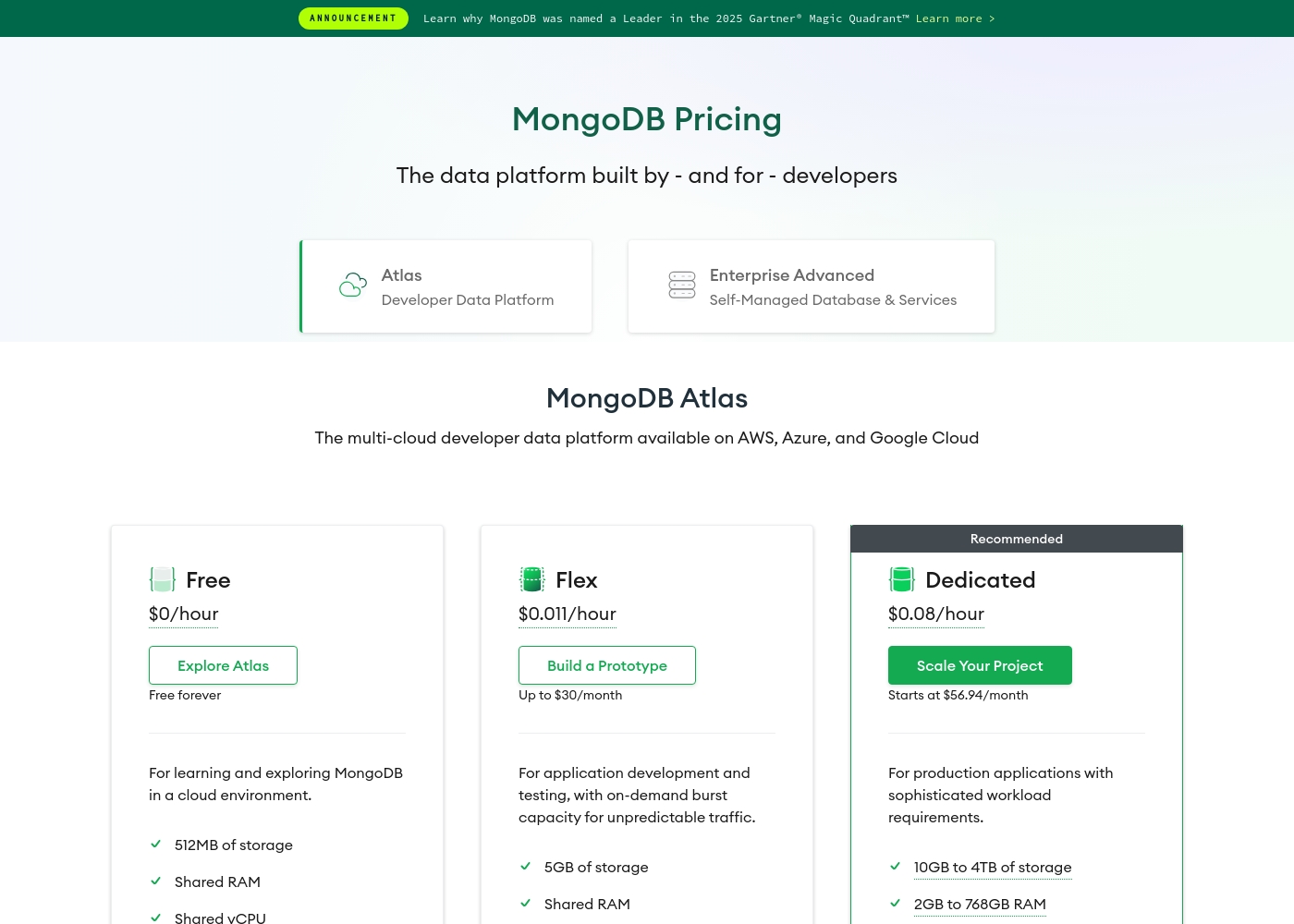
MongoDB pricing: MongoDB offers a range of cloud database options starting with a free-forever tier and scaling to dedicated resources for production environments. Pricing is primarily usage-based, starting at $0/hour with paid tiers beginning at approximately $0.011/hour and $0.08/hour for advanced workloads.
Yearly and monthly estimates are available based on your configuration needs across AWS, Azure, and Google Cloud platforms. Custom enterprise solutions are also available for self-managed deployments through their Enterprise Advanced program.
Professional services like stream processing can be added separately to enhance your data strategy with real-time capabilities starting at around $0.06/hour per instance level SP2 or higher depending on your needs. Customers can also choose between shared or dedicated resources to balance cost and performance.
Take a look at the details for each tier below to see which fits your company's current stage.
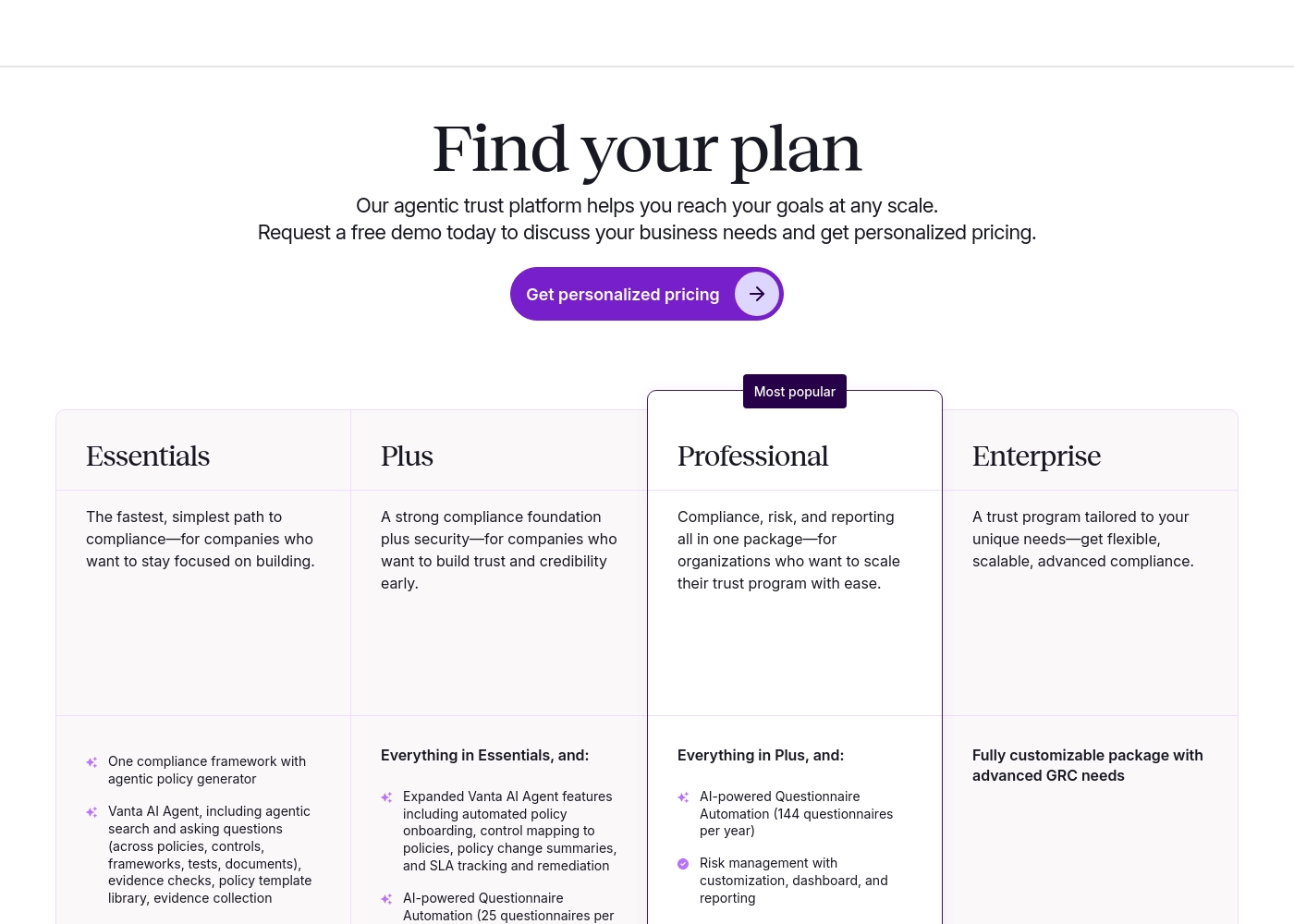
Essentials
Best For: Companies who want to stay focused on building while reaching compliance. Other Features: One compliance framework, Vanta AI Agent, Automated evidence collection, Basic reporting and audit workflows, Auditor API access.
This plan is the fastest way for startups to build a compliance foundation. It's a great fit if you're laser-focused on one framework and need evidence collection that just works.
- One compliance framework with agentic policy generator
- Vanta AI Agent (search, evidence checks, policy templates)
- Automated evidence collection for audit readiness
- Basic reporting and audit workflows
- Auditor API and Trust Center access
- Automated policy onboarding
- Control mapping and SLA tracking
- AI-powered Questionnaire Automation (25 per year)
- Access Management
- AI-powered Questionnaire Automation (144 per year)
- Risk management with customization and reporting
- Advanced Trust Center
- Custom monitoring tests and automation
- Advanced reporting (six customizable reports)
- Fully customizable package
- Advanced GRC needs
- Workspaces and SCIM
- Advanced control management
Pricing Notes
- MongoDB Atlas has a free tier and transparent usage-based pricing starting at $0.
- Vanta provides no public pricing; you must request a demo for a custom quote.
- MongoDB costs scale with data and compute; watch for high-usage bills.
- Vanta's value is in time savings (2,000+ hours/year) but requires a budget commitment.
- MongoDB offers a free forever tier. Vanta offers no free trial or tier.
Pricing Head-to-Head
User Reviews
Based on the external review sources, we couldn't access specific user snippets due to verification errors on both Trustpilot and Capterra. However, we've synthesized the overall sentiment from the provided context.
Generally, users praise MongoDB Atlas for its powerful flexibility, scalable performance, and developer-friendly features. Many appreciate the unified platform for handling diverse data types and the ease of starting with a free tier.
MongoDB's flexibility is a game-changer for our agile team. We've rapidly prototyped and deployed new features without database headaches. The scalability gives us peace of mind.
We couldn't access specific review snippets from Trustpilot or Capterra due to security blocks, but we know these platforms host user feedback on Vanta. Based on common themes in the compliance software space, users typically praise ease of use, automated evidence collection, and strong customer support that helps during audits.
However, recurring concerns often include custom pricing that can feel expensive for smaller teams, occasional integration hiccups with certain tools, and a learning curve during initial onboarding. The platform's reliability for continuous monitoring is frequently highlighted, though some note the AI questionnaire automation needs refinement.
Vanta automated our SOC 2 evidence collection, saving our team dozens of hours monthly. The platform is intuitive, and support was responsive when we had audit questions.
Our Verdict
MongoDB and Vanta solve completely different problems. They aren't competitors—you choose based on what you need to build or manage. MongoDB's superpower is unifying your data stack. It combines databases, search, and AI into one platform. You get millisecond responses at scale and a free tier to start. Vanta's superpower is automating compliance. It saves teams 2,000+ hours yearly. You get audit-ready faster and close deals up to 20% quicker. The deciding factor is your immediate need. Need a database for your app? Start with MongoDB. Need to prove your security to close a deal? Start with Vanta. For most tech teams building products, MongoDB is the logical foundation. For security and sales teams, Vanta solves a pressing business bottleneck. Pick the tool that fixes your biggest pain point first.
Frequently Asked Questions
Can I use MongoDB and Vanta together?
Yes. MongoDB would store your application's data. Vanta would manage your compliance program for frameworks like SOC 2. They serve different functions in a tech stack.
Which is cheaper, MongoDB or Vanta?
MongoDB has transparent, usage-based pricing starting free. Vanta requires a custom quote. MongoDB is likely cheaper upfront, but Vanta's value is in time savings.
Is Vanta worth it for a startup?
If a customer is asking for SOC 2, yes. Vanta automates the process, saving hundreds of hours. It helps close deals that would otherwise stall.
Does MongoDB handle compliance like Vanta?
No. MongoDB is a database platform. Vanta is a compliance automation tool. MongoDB might help you store audit evidence, but Vanta manages the entire program.
Which has better customer support?
Vanta is often praised for responsive support during audits. MongoDB's support can be inconsistent. Vanta seems more hands-on for its specific compliance use case.
Can I start with a free plan?
MongoDB offers a free forever tier with 512MB of storage. Vanta offers no free plan or trial; you must request a demo for pricing.
Ready to Choose?
Both tools have their strengths. Choose based on your specific needs.