MongoDB vs Utho
MongoDB and Utho both aim to power your applications, but they serve very different needs. MongoDB is a mature, feature-rich data platform for AI and analytics. Utho is a budget-focused cloud server provider targeting cost-sensitive markets. This comparison helps you see which fits your project.
Best for: Developers building AI-powered applications with vector search, Teams needing a unified platform for databases, search, and streaming
Best for: Budget-conscious startups in India looking for basic cloud hosting, Developers needing simple, affordable virtual servers for testing
Powerful, flexible platform for modern data.
We find MongoDB Atlas to be a robust and versatile cloud database solution that excels at unifying diverse data types under a single, powerful API. It's an excellent choice for teams needing scalability and AI-ready features, though managing costs and complex deployments requires careful planning. Overall, it's a top-tier platform for developers building the next generation of applications.
Pros
- Excellent flexibility with its document model.
- Powerful, unified platform for databases, search, and streaming.
- Strong scalability and high availability guarantees.
- Native vector search integration for AI applications.
Cons
- Costs can escalate quickly with high usage and dedicated resources.
- Advanced features and configurations can have a steep learning curve.
- Support responsiveness can be inconsistent for some users.
Affordable pricing, but critical stability risks.
We observe Utho presents an ambitious, affordable, usage-based cloud model designed for significant cost savings. However, numerous user reports criticize fundamental infrastructure reliability, citing critical failures like filesystem corruption and unscheduled outages. Overall, given the severe risk to stability and integrity issues reported by users, we cannot endorse Utho for professional or production deployment at this time.
Pros
- Usage-based pricing structure with a predictable monthly cap.
- Advertised up to 60% cost reduction compared to global competitors.
- Promises high performance, claiming operations are 2x faster.
- Offers core Shared CPU plans starting from $17.48 per month.
Cons
- Servers reported as critically unreliable and unsuitable for production use.
- Users report critical failures like filesystem corruption and read-only VPS errors.
- Reported billing conflicts with advertised hourly rate (instant monthly billing upon creation).
- Marketing claims (GPU access, free trial periods) reported as false or misleading after sign-up.
AboutMongoDB
💡 MongoDB Atlas is a comprehensive cloud data platform built for modern applications. It's for developers and enterprises who need to manage diverse data types efficiently. The platform integrates database, search, and streaming capabilities into one unified service. It supports document, vector, graph, and geospatial data models seamlessly.
AboutUtho
Utho is India’s first robust cloud platform, trusted by over 22,000 users and growing. It provides a full spectrum of cloud server solutions designed for businesses and developers alike. This platform focuses on offering unbeatable value and high performance for your operations.
They deliver a seamless cloud experience tailored entirely to your specific requirements. Utho works through partnerships with top-tier datacenters, ensuring your needs are prioritized within a reliable infrastructure. 💡
Highlights
Feature Comparison
Features Overview
We highlight the main differences and pick a winner for each feature.
Core Service & Focus
MongoDB is a specialized data platform. Utho is a general-purpose cloud server provider.
MongoDB Atlas is a comprehensive cloud data platform. It combines operational databases, vector search, and stream processing. It's built for developers needing a unified data layer for modern apps. Utho provides raw cloud infrastructure. You get virtual servers, storage, and managed services like Kubernetes. It's focused on being a cost-effective alternative to major cloud providers. The key difference is scope. MongoDB solves complex data challenges. Utho solves basic compute and hosting needs at a lower price.
AI & Advanced Analytics
MongoDB has native AI features. Utho does not.
MongoDB Atlas natively integrates vector search. You can build semantic search, recommendation engines, and AI applications. It also supports real-time analytics directly on operational data. Utho is an infrastructure provider. It doesn't offer built-in database analytics or AI-specific features. You would need to install and manage third-party tools on its servers. MongoDB is the clear winner for teams building intelligent, data-driven applications. Utho is just the hosting layer.
Pricing & Cost Control
Both offer usage-based pricing, but MongoDB's costs can scale high. Utho promotes deep discounts.
MongoDB pricing is usage-based, starting free. Costs can escalate quickly with high storage, RAM, and dedicated resources. You need to monitor usage carefully to avoid surprises. Utho advertises up to 60% cost reduction vs. big clouds. Plans start at $17.48/month. Billing is hourly but capped monthly at 672 hours. Utho's value proposition is pure cost savings. MongoDB's cost reflects its advanced platform capabilities. Your choice depends on if you need the data platform or just cheap servers.
Reliability & Production Readiness
MongoDB offers enterprise-grade SLAs. Utho has severe reported reliability issues.
MongoDB Atlas offers 99.995% uptime on dedicated tiers. It's trusted for mission-critical apps by thousands of companies. The managed service handles maintenance and scaling. User reviews for Utho are alarming. They report filesystem corruption, system freezes, and read-only VPS errors. Some call it critically unreliable for production. For any serious production workload, MongoDB is the safer choice. Utho's reported stability problems pose a significant risk.
Deployment & Management
MongoDB is a managed service. Utho offers more hands-on server control.
MongoDB Atlas is fully managed. It handles patching, backups, and scaling automatically. You focus on your application code, not database administration. With Utho, you get server instances. You manage the OS, software stack, and security. Deployment takes 30 seconds, but ongoing management is your responsibility. Choose MongoDB if you want to outsource infrastructure management. Choose Utho if you want low-level control and don't mind the ops work.
Target Audience
MongoDB targets developers and data teams. Utho targets cost-sensitive businesses in India.
MongoDB is ideal for developers building complex applications. It's perfect for teams needing scalability, AI features, and a unified data platform. Enterprises use it for critical systems. Utho explicitly targets startups, SMEs, and enterprises in India. Its main draw is significant cost savings. It's for those prioritizing price over advanced features. Your project's needs dictate the fit. Advanced data needs point to MongoDB. Tight budget points to Utho.
Scalability
Both claim easy scaling, but MongoDB's is proven at a larger scale.
MongoDB Atlas scales seamlessly. You can go from a free tier to a massive dedicated cluster with terabytes of data. It's designed for global-scale applications. Utho allows you to scale compute, storage, and network resources. You can deploy across global footprints with consistent pricing. Both offer scaling, but MongoDB's platform is battle-tested at a much larger scale for complex data workloads. Utho's scaling is for basic server resources.
Customer Support
MongoDB has tiered support. Utho promises 24/7 human help.
MongoDB offers documentation, community forums, and paid support plans. Response times and depth depend on your subscription tier. Utho advertises dedicated 24/7 human support via live chat, phone, and email. This is a key promise, especially for those without in-house IT. Utho's support promise is more accessible. However, support can't fix fundamental platform reliability issues, which are a major concern for Utho.
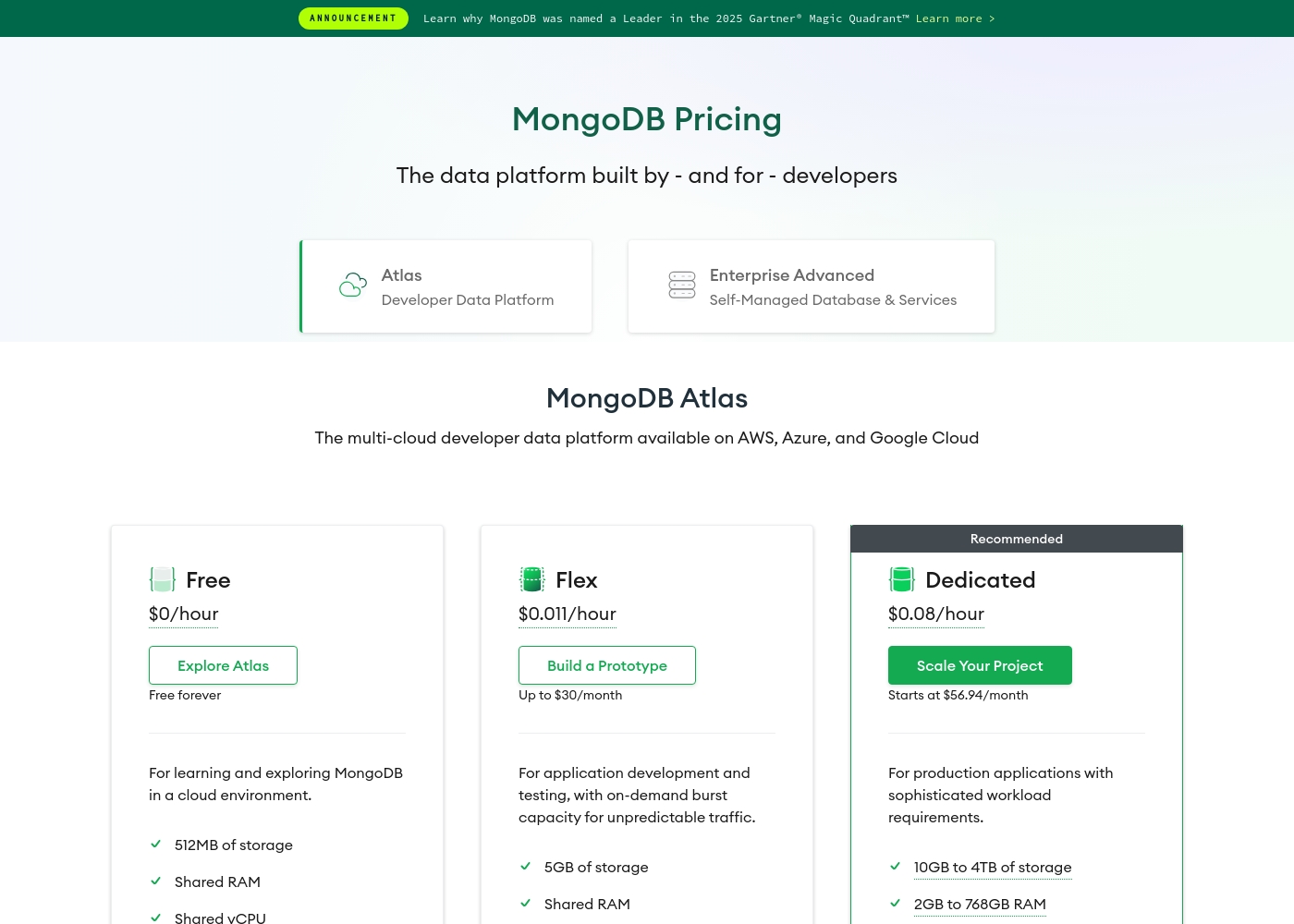
MongoDB pricing: MongoDB offers a range of cloud database options starting with a free-forever tier and scaling to dedicated resources for production environments. Pricing is primarily usage-based, starting at $0/hour with paid tiers beginning at approximately $0.011/hour and $0.08/hour for advanced workloads.
Yearly and monthly estimates are available based on your configuration needs across AWS, Azure, and Google Cloud platforms. Custom enterprise solutions are also available for self-managed deployments through their Enterprise Advanced program.
Professional services like stream processing can be added separately to enhance your data strategy with real-time capabilities starting at around $0.06/hour per instance level SP2 or higher depending on your needs. Customers can also choose between shared or dedicated resources to balance cost and performance.
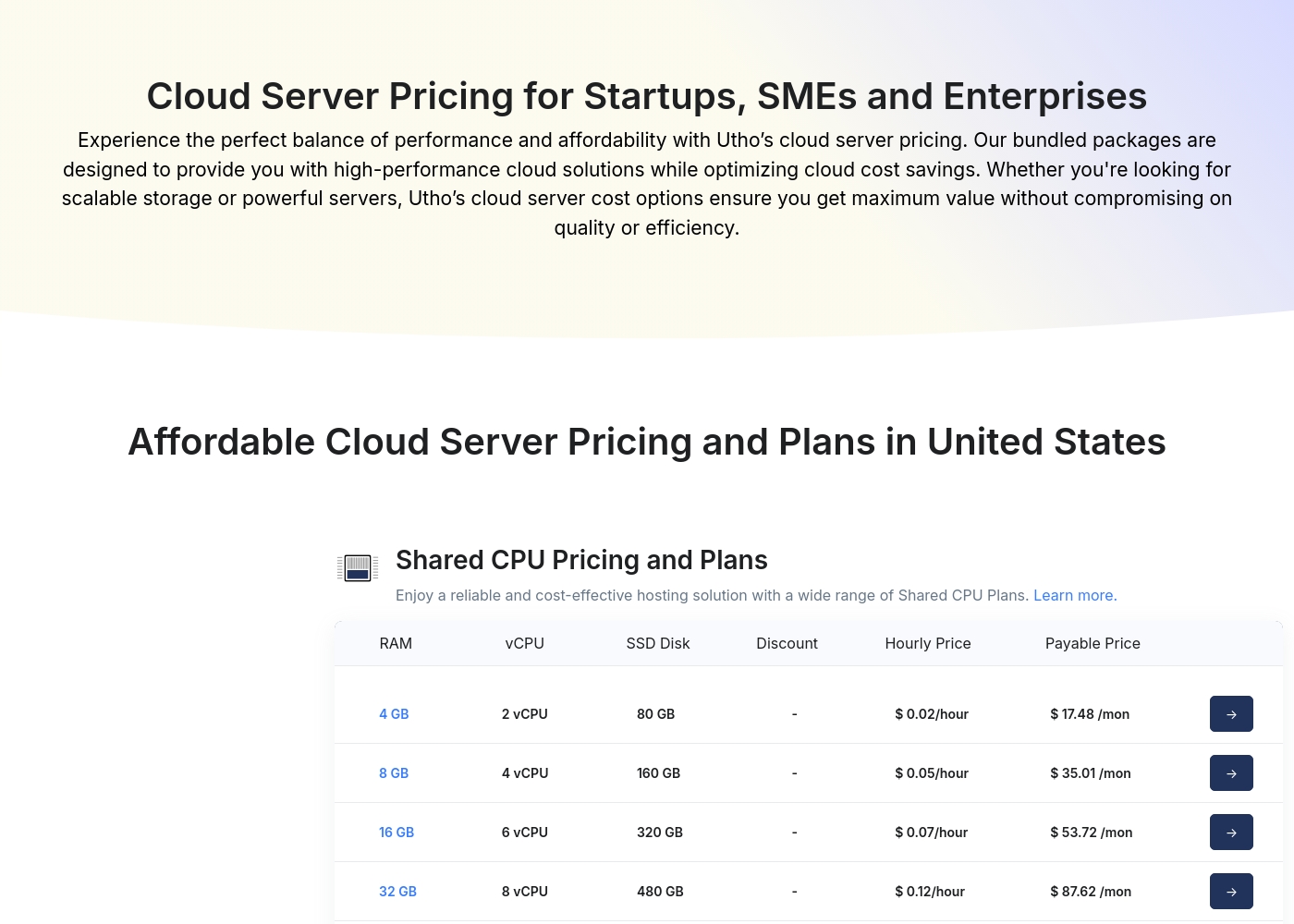
Utho costs between $17.48 and $87.62 per month for Shared CPU plans, with four tiers: 4 GB RAM at $17.48, 8 GB RAM at $35.01, 16 GB RAM at $53.72, and 32 GB RAM at $87.62.
Utho offers many different cloud products; the rates below detail the core Shared CPU tier options.
4 GB RAM Shared CPU Plan
Price: $17.48 per month ($0.02 per hour) Other Features:
- 2 vCPU
- 80 GB SSD Disk
- 4 GB RAM
- 2 vCPU
- 80 GB SSD Disk
- Billed hourly at $0.02
- 8 GB RAM
- 4 vCPU
- 160 GB SSD Disk
- Billed hourly at $0.05
- 16 GB RAM
- 6 vCPU
- 320 GB SSD Disk
- Billed hourly at $0.07
- 32 GB RAM
- 8 vCPU
- 480 GB SSD Disk
- Billed hourly at $0.12
Pricing Notes
- MongoDB offers a generous 'free forever' tier for prototyping.
- Utho's trial is a 30-day money-back guarantee, not a usage-based free tier.
- MongoDB's costs can spike unpredictably with high resource consumption.
- Utho promotes cost savings of up to 60% compared to major cloud providers.
- Utho's hourly billing is capped at 672 hours per month, providing cost predictability.
- Both require careful monitoring, but for different reasons: MongoDB for usage, Utho for hidden limits.
Pricing Head-to-Head
User Reviews
Based on the external review sources, we couldn't access specific user snippets due to verification errors on both Trustpilot and Capterra. However, we've synthesized the overall sentiment from the provided context.
Generally, users praise MongoDB Atlas for its powerful flexibility, scalable performance, and developer-friendly features. Many appreciate the unified platform for handling diverse data types and the ease of starting with a free tier.
MongoDB's flexibility is a game-changer for our agile team. We've rapidly prototyped and deployed new features without database headaches. The scalability gives us peace of mind.
Users universally describe Utho as unreliable and potentially deceptive based on the limited, but critical, feedback on Trustpilot (4 reviews, scoring 2.6). Recurring issues center on core stability: engineers reported catastrophic failures like filesystem corruption, VPS going spontaneously into read-only mode, and unexpected system freezes without any alerts or monitoring.
One user migrated back to their previous provider overnight to avoid total downtime, calling Utho immature for production usage. Furthermore, customers raised serious concerns regarding billing integrity and marketing accuracy.
I switched hoping to reduce costs, but Utho created critical, high-risk issues within days. My VPS went into read-only mode without warning, completely freezing the system. This cheap infrastructure nearly took my entire business down; stay away from Utho for production use.
Our Verdict
This isn't a close call. MongoDB and Utho serve fundamentally different needs, but one is clearly safer and more capable. MongoDB Atlas is a powerhouse for modern application development. Its superpower is unifying databases, AI vector search, and real-time streams on one platform. It's built for scale and complexity. Utho's superpower is its low price point. It promises cloud servers at a deep discount. Its focus is on raw compute, not advanced data services. The deciding factor is reliability and need. If you're building anything serious, MongoDB's proven platform is worth the cost. If you're on an extreme budget and can tolerate major risks, Utho is an option. For most developers and businesses, **MongoDB is the clear recommendation.** Choose Utho only if you need the cheapest possible server and have the stomach for the reported stability issues.
Frequently Asked Questions
Is MongoDB or Utho better for a new startup?
It depends entirely on your tech stack. Choose MongoDB Atlas if your startup needs a built-in database with AI features. Choose Utho only if you need the absolute cheapest virtual servers and can manage everything yourself.
Can I use Utho to host my MongoDB database?
Technically, yes. You could install MongoDB on a Utho server. However, you'd lose all of Atlas's managed benefits like backups, scaling, and security patches. It's much more work and risk.
Which is more expensive, MongoDB or Utho?
Utho has a lower starting price ($17.48/month) for a server. MongoDB starts free but costs can scale high for production data needs. For pure hosting cost, Utho is cheaper. For data platform value, MongoDB may be more cost-effective.
Is Utho reliable for production websites?
User reviews are very concerning. They report critical failures like filesystem corruption and system freezes. We cannot recommend Utho for production use based on these reports. MongoDB Atlas is designed for production workloads.
Does MongoDB have cloud servers like Utho?
No. MongoDB Atlas is a managed data platform, not an IaaS provider. You don't get a raw virtual server. You get a fully managed database service. Utho provides raw cloud servers (VMs).
Which one is easier for beginners?
For learning basic cloud servers, Utho might seem simpler. For learning modern application development, MongoDB Atlas's free tier and documentation are excellent. It depends on what you're trying to learn.
Ready to Choose?
Both tools have their strengths. Choose based on your specific needs.