Microsoft Azure vs Utho
Microsoft Azure offers unmatched global reach and powerful enterprise AI tools. Utho promises massive cost savings and lightning-fast cloud server deployment. This comparison pits established enterprise stability against aggressive budget pricing flexibility.
Best for: Enterprise organizations with 500+ employees., Teams focused on building enterprise-scale Generative AI applications.
Best for: Startups focused strictly on achieving maximum cloud hosting cost reduction., Developers needing rapid 30-second server deployment and simple management.
Powerful features, deeply problematic user experience.
Microsoft Azure offers powerful global infrastructure for AI, HPC, and large-scale data migration. However, external feedback reflects serious issues regarding customer support, billing transparency, and reliability protocols, especially concerning data retention. Overall, we see transformative technological potential, but the reported operational and service problems demand caution before heavy investment.
Pros
- Accelerates high-scale Generative AI solutions and deployment capabilities.
- Unmatched global reach across more worldwide regions than any other provider.
- Offers infrastructure flexibility through Azure Arc for hybrid environments.
- Streamlines migration for extensive legacy databases like SQL Server and SAP.
Cons
- Customer support is widely reported as unresponsive, slow, and purposefully difficult to access.
- Billing structure is confusing and often results in unexpected or deceptive hidden fees.
- Service unreliability causes downtime and high user stress.
- Policy allows automatic, permanent data deletion 90 days after an invoice is overdue.
Affordable pricing, but critical stability risks.
We observe Utho presents an ambitious, affordable, usage-based cloud model designed for significant cost savings. However, numerous user reports criticize fundamental infrastructure reliability, citing critical failures like filesystem corruption and unscheduled outages. Overall, given the severe risk to stability and integrity issues reported by users, we cannot endorse Utho for professional or production deployment at this time.
Pros
- Usage-based pricing structure with a predictable monthly cap.
- Advertised up to 60% cost reduction compared to global competitors.
- Promises high performance, claiming operations are 2x faster.
- Offers core Shared CPU plans starting from $17.48 per month.
Cons
- Servers reported as critically unreliable and unsuitable for production use.
- Users report critical failures like filesystem corruption and read-only VPS errors.
- Reported billing conflicts with advertised hourly rate (instant monthly billing upon creation).
- Marketing claims (GPU access, free trial periods) reported as false or misleading after sign-up.
AboutMicrosoft Azure
Azure is a comprehensive cloud platform designed for limitless innovation. It facilitates solutions across everything from application development to robust data transformation. The platform specifically serves developers, IT professionals, data analysts, and organizational leaders. Azure provides the global infrastructure needed to go beyond the limits of on-premises datacenters. It offers more worldwide regions than any other provider. 💡
AboutUtho
Utho is India’s first robust cloud platform, trusted by over 22,000 users and growing. It provides a full spectrum of cloud server solutions designed for businesses and developers alike. This platform focuses on offering unbeatable value and high performance for your operations.
They deliver a seamless cloud experience tailored entirely to your specific requirements. Utho works through partnerships with top-tier datacenters, ensuring your needs are prioritized within a reliable infrastructure. 💡
Highlights
Feature Comparison
Features Overview
We highlight the main differences and pick a winner for each feature.
Reliability & Stability
Microsoft Azure is generally stable, but Utho is reported as critically unstable for production use.
Microsoft Azure is a large, established platform suitable for mission-critical deployments. Users occasionally report issues with unreliability causing high stress. Utho users report catastrophic failures, including filesystem corruption and VPS going read-only. Customers warn that Utho is immature and unsuitable for production workloads. This stability difference is the most critical factor between the two providers. You cannot trust Utho with core, mission-critical operations at this time. For guaranteed data integrity and uptime, Microsoft Azure provides the necessary established infrastructure. Avoid Utho for anything crucial.
AI & Generative Tools
Microsoft Azure provides powerful dedicated AI infrastructure. Utho has no mature or stable equivalent tools.
Microsoft Azure accelerates AI using Azure AI Foundry and private access to Azure OpenAI models. You can easily build and deploy world-class generative AI solutions at enterprise scale. Azure's toolkit ensures proper governance and safety standards for AI content. Utho lacks specific managed AI tools in its core offering. Users have complained that advertised GPU instances are listed as unavailable BETA services after signup. Microsoft Azure is engineered end-to-end to support complex AI development from data management to deployment. Utho simply does not compete in this specialized arena. If your roadmap includes high-scale LLM training or custom agent creation, Microsoft Azure is the necessary platform choice.
Global Scale & Reach
Microsoft Azure leads with superior global infrastructure. Utho ensures consistent pricing across its global data footprints.
Microsoft Azure operates in the most worldwide regions compared to any other cloud provider. This massive reach ensures minimum latency for global application delivery. Azure Arc allows seamless management across these diverse geographic deployments. Utho also offers global footprints, allowing deployment anywhere, anytime. Utho is praised because it maintains consistent, predictable pricing across all global locations. If maximum infrastructure coverage and region availability are a priority, Microsoft Azure's scale is unmatched. Utho is better for cost-predictable international expansion. Large multinational corporations will rely on Microsoft Azure's established regional presence for regulatory needs and low-latency access.
Customer Support
Utho guarantees dedicated human 24/7 support. Microsoft Azure support is widely reported as unresponsive and slow.
Microsoft Azure customer support is notoriously difficult to access, unresponsive, and slow to resolve issues. Users report urgent tickets sometimes take weeks for a meaningful response. Utho specifically promises a dedicated 24/7 human support team available via chat, phone, and email. They focus on delivering reliable, human-first assistance. While Utho's promised support is a huge advantage, their critical instability issues may test that team severely. Microsoft Azure’s sheer size makes personalized support difficult. If having reliable human contact channels is essential for your operations, Utho makes a very attractive promise here.
Pricing Clarity
Both platforms receive heavy user complaints regarding pricing deception. Utho provides a fixed monthly cap.
Microsoft Azure uses complex, consumption-based pricing highly customized to instance size and usage. Many users report confusing bills and unexpected, hidden fees. Utho bills hourly but caps usage fees at 672 hours per month for predictability. However, users complain Utho often bills the full month instantly, contradicting hourly rates. Neither Microsoft Azure nor Utho is lauded for pricing transparency according to user reviews. Both require detailed monitoring to avoid surprises. Utho's hard monthly cap does offer financial certainty for demanding workloads that Microsoft Azure doesn't easily provide.
Deployment Speed
Utho focuses on extreme simplicity and speed. Microsoft Azure offers quick VM deployment and managed services.
Microsoft Azure allows users to provision Windows or Linux Virtual Machines in seconds. Developers can also utilize serverless computing with Azure Functions for app optimization. Utho aims for unrivaled simplicity, claiming users can deploy new cloud servers in just 30 seconds. This removes the administrative friction often associated with cloud setup. Utho is built for speed and simplicity right out of the box, whereas Microsoft Azure deployment depends on choosing the correct managed service. If you value rapid iteration and reduced administrative time for infrastructure spin-up, Utho offers the clearer advantage.
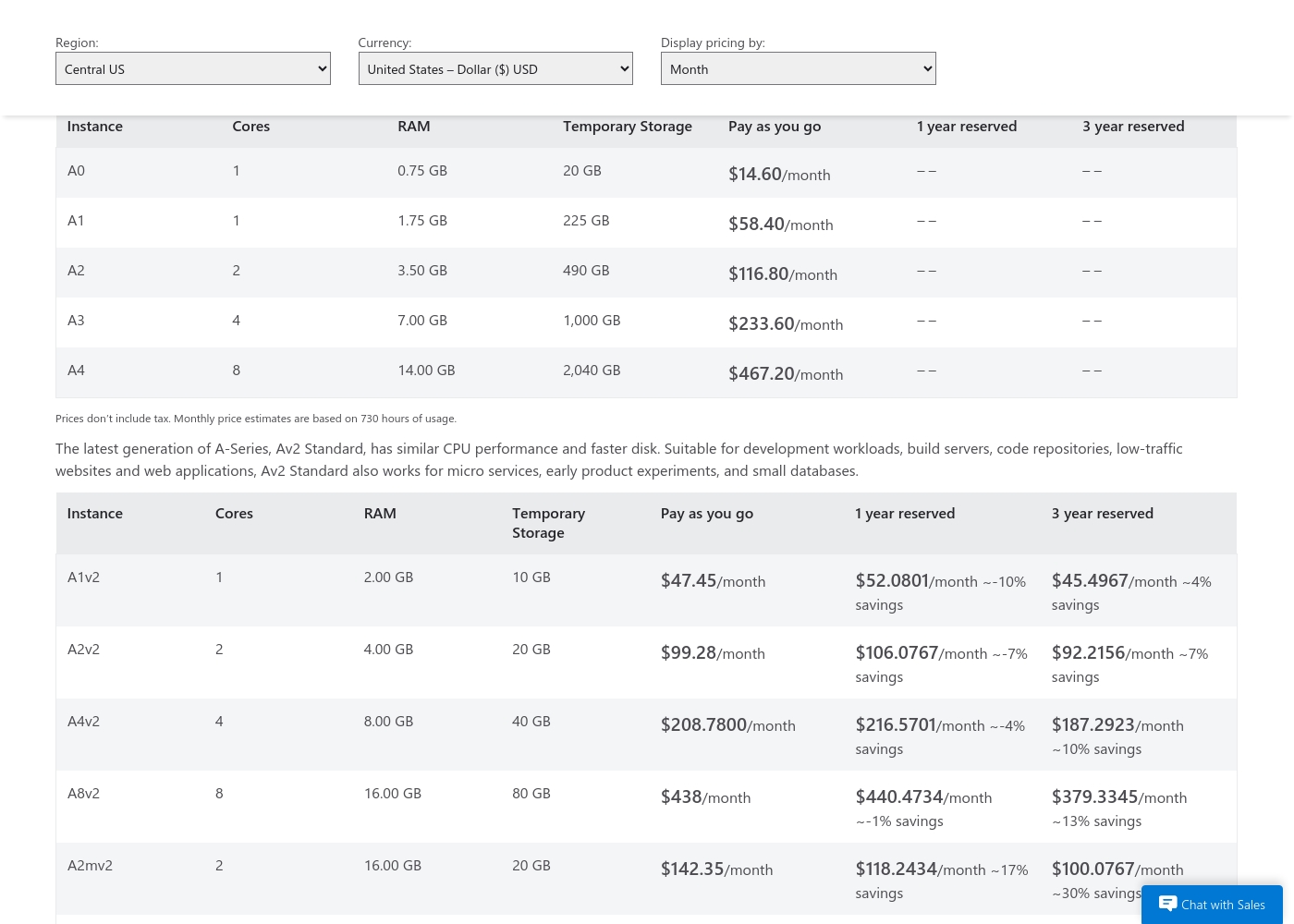
Microsoft Azure costs between $14.60/month and $467.20/month with four main instance categories: General Purpose A-Series, Av2 Standard, Memory Intensive, and Network Optimized.
We provide monthly price estimates based on 730 hours of usage. The cost you pay is determined by factors like instance size, region, and whether you choose reserved commitment or Pay as you go.
General Purpose (A-Series A0–A4)
Price: $14.60/month (A0) to $467.20/month (A4) Best For: Websites, small-to-medium databases, and other everyday applications Other Features:
- Instances range from 1 to 8 cores
- RAM options from 0.75 GB to 14.00 GB
- Temporary storage up to 2,040 GB
- 1 Core
- 0.75 GB RAM
- 20 GB Temporary Storage
- Best for everyday applications and testing
- 1 Core
- 2.00 GB RAM
- 10 GB Temporary Storage
- Similar CPU performance to A-Series
- Faster disk for low-traffic sites
- 8 Cores
- 56.00 GB RAM
- 2,040 GB Temporary Storage
- Ideal for large databases and high-throughput applications
- 16 Cores
- 224.00 GB RAM
- 2,000 GB Temporary Storage
- Designed for high performance computing (HPC)
- Uses Intel Xeon E5-2667 v3 processor
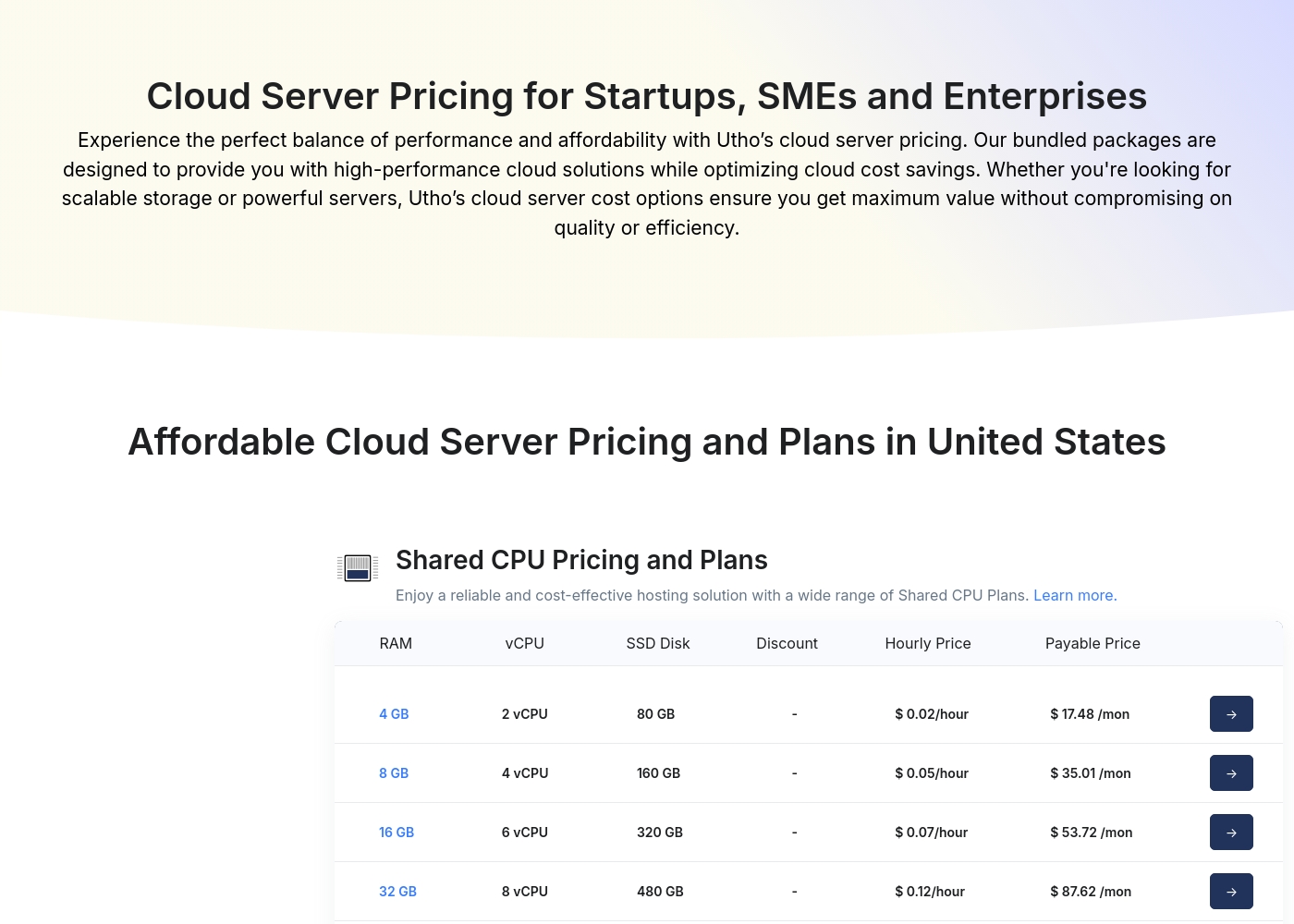
Utho costs between $17.48 and $87.62 per month for Shared CPU plans, with four tiers: 4 GB RAM at $17.48, 8 GB RAM at $35.01, 16 GB RAM at $53.72, and 32 GB RAM at $87.62.
Utho offers many different cloud products; the rates below detail the core Shared CPU tier options.
4 GB RAM Shared CPU Plan
Price: $17.48 per month ($0.02 per hour) Other Features:
- 2 vCPU
- 80 GB SSD Disk
- 4 GB RAM
- 2 vCPU
- 80 GB SSD Disk
- Billed hourly at $0.02
- 8 GB RAM
- 4 vCPU
- 160 GB SSD Disk
- Billed hourly at $0.05
- 16 GB RAM
- 6 vCPU
- 320 GB SSD Disk
- Billed hourly at $0.07
- 32 GB RAM
- 8 vCPU
- 480 GB SSD Disk
- Billed hourly at $0.12
Pricing Notes
- Microsoft Azure costs are volatile; Reserved plans (1 or 3 years) offer guaranteed savings over Pay as you go rates.
- Utho promises up to 60% cost reduction compared to major global cloud providers.
- Utho's usage is capped at 672 hours monthly, preventing price overruns for heavy use.
- Both Microsoft Azure and Utho face widespread customer complaints regarding deceptive billing practices and unexpected charges.
Pricing Head-to-Head
User Reviews
External feedback drawn exclusively from Trustpilot is overwhelmingly critical, resulting in a significantly low TrustScore of 1.5. The primary source of frustration is customer service, which users frequently describe as unresponsive, difficult to reach, and lacking competence, sometimes taking weeks to address urgent tickets.
Many customers report opaque pricing and billing practices, including unexpected fees and continuous charging even after they deleted services entirely. Serious issues related to reliability and data security also emerged: multiple users noted account data was automatically and permanently deleted due to an overdue 90-day invoice policy, even when they struggled to make the payment through the system.
Azure's pricing is completely deceptive, hitting me with totally unexpected fees. I strongly advise everyone to avoid it. It’s definitely going to rip you off eventually.
Users universally describe Utho as unreliable and potentially deceptive based on the limited, but critical, feedback on Trustpilot (4 reviews, scoring 2.6). Recurring issues center on core stability: engineers reported catastrophic failures like filesystem corruption, VPS going spontaneously into read-only mode, and unexpected system freezes without any alerts or monitoring.
One user migrated back to their previous provider overnight to avoid total downtime, calling Utho immature for production usage. Furthermore, customers raised serious concerns regarding billing integrity and marketing accuracy.
I switched hoping to reduce costs, but Utho created critical, high-risk issues within days. My VPS went into read-only mode without warning, completely freezing the system. This cheap infrastructure nearly took my entire business down; stay away from Utho for production use.
Our Verdict
The decision between Microsoft Azure and Utho is simple: established power versus radical cost savings. For organizations needing reliable production stability, Microsoft Azure is the only choice here. You can’t risk your business on a critically unstable platform like Utho. Microsoft Azure's superpower is its industrial strength and unparalleled feature set for the modern enterprise. It offers superior infrastructure for Generative AI, HPC, and legacy migrations like SAP and Oracle. If innovation and vast scale are key, Microsoft Azure provides the necessary global foundation for growth. Utho’s strength is aggressive affordability, targeting up to 60% cost reduction by offering cheap capacity. Utho also focuses on user speed, allowing you to deploy cloud services in just 30 seconds. Furthermore, Utho promises dedicated 24/7 human support, addressing a major weakness of Microsoft Azure. The deciding factor must remain infrastructure stability, particularly for core business applications. User reports detailing catastrophic failures make Utho impractical for professional use. You must prioritize operational resilience over the lure of deep cost savings. Choose Microsoft Azure if you require enterprise scale, AI tools, and stability for mission-critical tasks. Only select Utho if you need capacity for non-critical testing or strictly development environments where failures won't impact customers.
Frequently Asked Questions
Which platform is easier for new projects: Microsoft Azure or Utho?
Utho is designed for quick starts, claiming new servers deploy in just 30 seconds. Microsoft Azure is complex due to its massive feature array, requiring a higher learning investment. For speed and simplicity, Utho is the initial winner.
Does Utho offer the advanced AI technology that Microsoft Azure has?
No, Microsoft Azure has dedicated, mature tools like Azure AI Foundry and Azure OpenAI models. Utho lacks specified advanced AI services. Utho users reported advertised GPU resources were unavailable or stuck in beta.
Which cloud provider has better customer support: Microsoft Azure or Utho?
Utho promises dedicated 24/7 human support via multiple channels. Microsoft Azure support is widely criticized by users as unresponsive, slow, and purposefully difficult to access. Utho wins based on its explicit support guarantee.
Is Utho reliable enough for running mission-critical production workloads?
Based on user reports, absolutely not. Utho users report critical issues like filesystem corruption and service freezes. Microsoft Azure is considerably more stable and fit for production use.
Can I migrate legacy systems like SAP easily with Utho or Microsoft Azure?
Microsoft Azure excels here, providing seamless tooling for migrating SAP, Oracle, and SQL Server with few code changes. Utho uses human specialists to guide migration, offering less automated scale.
If I stop using a service on Microsoft Azure, will I still be charged?
Yes, unless the instance is in the 'Stopped (Deallocated)' state, you will still be charged. Microsoft Azure bills for allocated cores even if processing is stopped.
Ready to Choose?
Both tools have their strengths. Choose based on your specific needs.