McAfee VPN vs OpenVPN
McAfee VPN and OpenVPN have fundamentally different goals and audiences for security. McAfee VPN focuses on simple, hands-free protection for individual consumers. OpenVPN delivers robust, enterprise-grade Zero Trust security for sophisticated organizations. This comparison shows exactly which tool fits your specific needs.
Best for: Individuals needing basic, hands-free protection, Users who frequently connect to unsecured public Wi-Fi networks
Best for: Organizations requiring HIPAA/SOC 2/GDPR compliance, Teams needing Zero Trust Network Access (ZTNA)
Necessary Features, Dangerous Billing Practices
We found that McAfee VPN offers necessary features like strong encryption and convenient automatic protection for unsecure public networks, fulfilling core security needs. However, this promising feature set is severely undermined by aggressive billing practices and overwhelming negative feedback concerning system performance and customer support infrastructure. Overall, we advise extreme caution due to the high reported risk of subscription issues and intrusive software design.
Pros
- Includes robust bank-grade encryption to protect sensitive data.
- Automatic protection activates instantly on unsecure public networks.
- Supports major operating systems including Windows, Mac, Android, and iOS.
- Available as an affordable standalone annual subscription ($29.99/year).
Cons
- Widespread reports of intrusive pop-ups and resource consumption that slow down computers.
- Major complaints concerning unauthorized and aggressive auto-renewal charges.
- Customer support is widely reported as non-existent or unhelpful.
- Significant difficulty securing authorized refunds or canceling subscriptions.
Flexible security built for compliance.
We see OpenVPN provides a strong foundation for Zero Trust access, featuring flexible deployment options and robust security controls that meet strict compliance goals like HIPAA and SOC 2. Overall, it is a feature-rich solution economical for businesses, but they must weigh the compliance focus against reported issues related to functional reliability and performance lag.
Pros
- Provides flexible security solutions (CloudConnexa or Access Server).
- Robust Zero Trust features and access controls are implemented.
- Meets strict regulatory compliance standards (HIPAA, SOC 2).
- Feature-rich Free plan is available for up to three seats.
Cons
- External users report serious issues with platform lag and poor UX.
- Setup and onboarding can be difficult and time-consuming.
- Customer support responsiveness is reported as inadequate by users.
- Self-hosted Access Server is considered extremely overpriced by some clients.
AboutMcAfee VPN
The McAfee Secure VPN provides strong protection whether you are using Windows, macOS, Android, iOS, or ChromeOS. This tool is a smart virtual private network designed for anyone who prioritizes their digital security. You can browse securely and confidently, no matter your current location. The VPN keeps your personal data hidden from prying eyes and unwelcome advertisers. It works seamlessly across your supported devices, giving you important peace of mind. 💡
AboutOpenVPN
OpenVPN is a trusted provider of secure networking solutions tailored for small, medium, and enterprise businesses. It's recognized as the #1 Business VPN and is specifically trusted by over 20,000 organizations. This widely used solution provides a protected, encrypted tunnel for sensitive data. It ensures your devices can securely connect to business assets, even when crossing unsecured public networks. The core product is a high-performance, fast-deploying Zero Trust VPN solution. 💡
Highlights
Feature Comparison
Features Overview
We highlight the main differences and pick a winner for each feature.
Core Audience
McAfee VPN targets individual consumers; OpenVPN serves robust business needs.
McAfee VPN provides personal security suitable for secure browsing and simple banking transactions. It is built purely for individual protection on personal devices wherever they travel. OpenVPN is trusted by over 20,000 organizations for implementing corporate secure access. It is clearly a professional business networking solution built for remote workforces. The tools are designed for completely different environments: McAfee VPN for the home user, OpenVPN for the managed corporate network. If work security is paramount, OpenVPN is your only realistic option here.
Pricing Structure
McAfee VPN is a flat yearly fee; OpenVPN uses flexible per-seat subscriptions.
McAfee VPN offers one clear plan at $34.99 per year for all its core features. This simplified, flat-rate pricing makes it easy for consumers to budget their annual security costs. OpenVPN bills per-seat starting at $11/seat/month, with specific volume discounts applied. Businesses scale their costs precisely based on their active employee headcount. The cost models strongly reflect the audience; McAfee VPN offers a simple commodity price quickly. OpenVPN offers scalable enterprise value and includes a generous free plan for up to three seats.
Automatic Protection
McAfee VPN instantly secures public Wi-Fi; OpenVPN requires client activation.
McAfee VPN is a smart tool that activates protection automatically on unsecured networks. This effortless, hands-free activation provides immediate security for consumers on the go. OpenVPN requires its clients to establish an active, controlled connection back to the hosted server ecosystem (Access Server/CloudConnexa). Users must manage their secure tunnel endpoint. McAfee VPN prioritizes user convenience and passive protection against consumer risks like Wi-Fi eavesdropping. OpenVPN prioritizes controlled access policies and network integrity. If you frequently forget to turn on simple protection, McAfee VPN provides essential, worry-free automation.
Regulatory Compliance
OpenVPN meets HIPAA and SOC 2; McAfee VPN focuses only on general bank-grade security.
McAfee VPN emphasizes its use of bank-grade encryption to protect personal and financial details. This covers general security for individual safe transactions. OpenVPN helps organizations meet stringent regulatory compliance standards like HIPAA (healthcare) and SOC 2 (security controls). It also meets GDPR requirements. Compliance features are non-negotiable for large organizations in regulated sectors. McAfee VPN has no specialized enterprise certifications to meet these external mandates. Health organizations protecting patient data (PHI) must select OpenVPN for its verifiable compliance adherence.
Zero Trust Security
OpenVPN is built on ZTNA principles; McAfee VPN is a simple security tunnel.
McAfee VPN is a simple encryption tunnel designed primarily to mask identity and secure basic data transmission. It lacks network visibility or granular access limits. OpenVPN’s core value is empowering Zero Trust Network Access (ZTNA) with policy enforcement. Access is strictly limited based on identity, device posture, and role rules. OpenVPN ensures employees only access the few resources required for their specific jobs, greatly minimizing security risk. Businesses needing to strengthen internal security and controlled network access must select OpenVPN.
Deployment Flexibility
OpenVPN offers self-hosted or managed options; McAfee VPN is strictly managed.
McAfee VPN is delivered as a straightforward, consumer-facing software and fully managed service environment. The end-user has zero architectural control or deployment options. OpenVPN provides CloudConnexa (fully managed) or Access Server (self-hosted). Access Server can be deployed on AWS, Docker, Linux, or specialized virtualization tools. Only OpenVPN allows IT teams to gain total architectural control by deploying the server on their own private infrastructure. This flexibility is critical for complex network environments and specialized auditing needs.
Customer Experience
McAfee VPN users report catastrophic billing issues; OpenVPN complaints center on performance lag.
External reviews highlight massive user frustration with McAfee VPN’s predatory auto-renewal practices. Users report being charged even after cancellation and zero response from customer service or refunds. OpenVPN users report responsiveness issues, complex setup, and some platform lag in their reviews. However, the company transparently credits unused subscription funds upon timely cancellation. The trade-off is poor performance (OpenVPN) versus potential financial fraud and non-existent support (McAfee VPN). Avoiding the notorious cancellation and refund nightmares makes OpenVPN a far safer choice for long-term customer service expectations.
Advanced Security Features
OpenVPN includes sophisticated IDS/IPS; McAfee VPN offers only basic encryption.
McAfee VPN security features are limited to strong bank-grade encryption and basic anonymity from prying eyes. It does not include enterprise network protection layers. OpenVPN CloudConnexa includes advanced protection like content filtering and an active Intrusion Detection and Prevention System (IDS/IPS). These features go far beyond simple encrypted tunnels. OpenVPN provides multi-layered threat defense essential for securing distributed business networks. McAfee VPN lacks the necessary tools to protect a corporate IT infrastructure adequately.
The McAfee VPN service is available either as a simple, dedicated annual plan or as a key component within McAfee’s comprehensive security suites. You can find the best fit by reviewing the different bundled options below.
McAfee VPN (Standalone)
Price: $29.99/year Best For: Individuals needing only a VPN service. Other Features:
- Bank-grade encryption
- Automatic protection on unsecure networks
- Browse confidently yet anonymously
- Fast and easy-to-use speeds
This is the best plan if you only need solid, high-quality VPN service and already have other security measures in place. It offers core privacy features, ensuring your data is protected using bank-grade technology.
- Bank-grade encryption
- Automatic protection for unsecure networks
- Secure browsing
- Antivirus (5 devices)
- VPN
- McAfee Scam Protection
- Identity monitoring and alerts
- Antivirus (unlimited devices*)
- Full-Service Personal Data Cleanup
- Identity monitoring ($1M coverage)
- Transaction monitoring (bank and credit card)
- 1-bureau credit monitoring
- Antivirus (unlimited devices*)
- Full-Service Data Cleanup (2 adults)
- Identity monitoring ($4M coverage)
- Transaction monitoring (401K and investments)
- 3-bureau credit monitoring (daily updates)
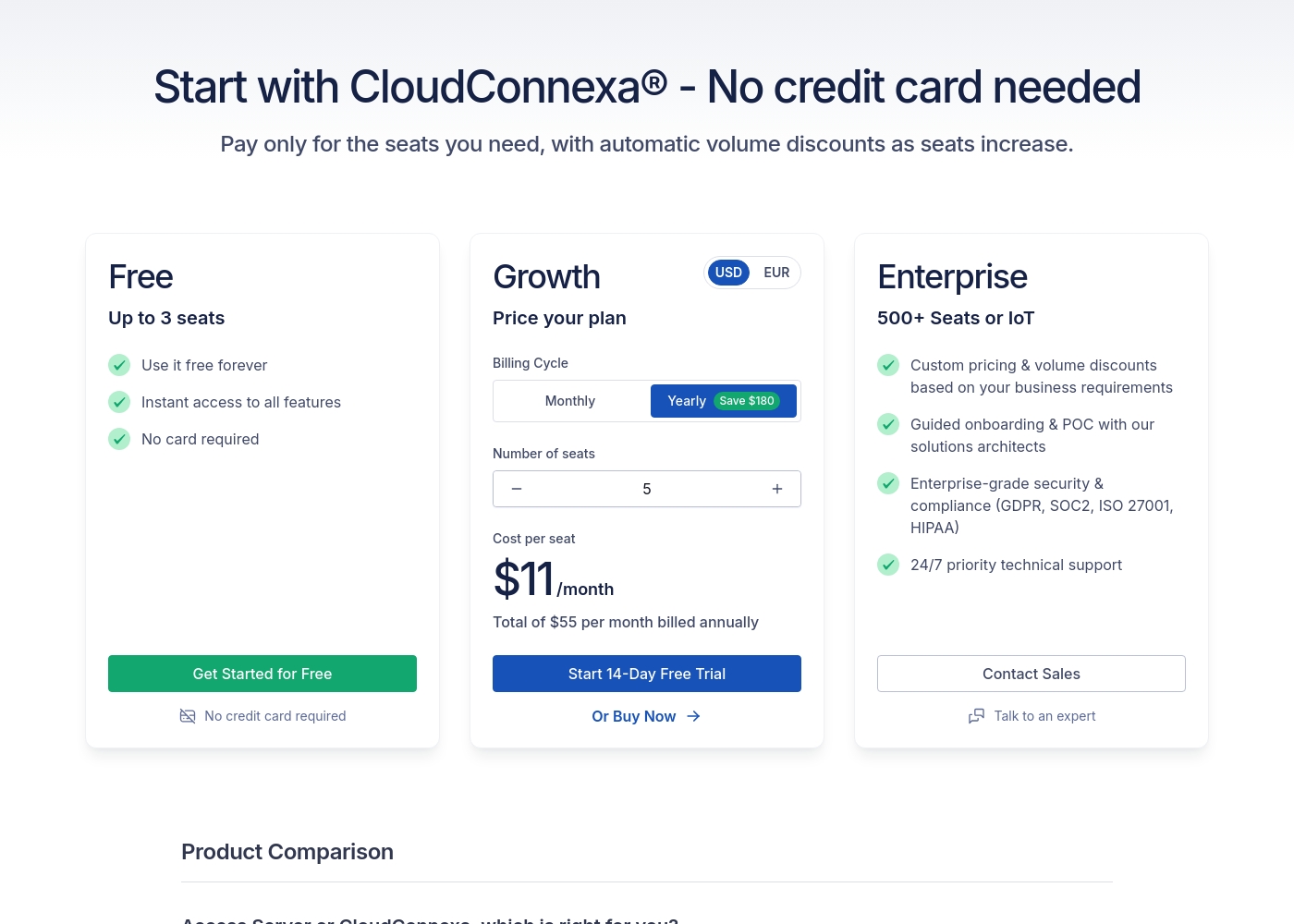
OpenVPN CloudConnexa costs between Free and Custom per year with 3 plans: Free (up to 3 seats), Growth ($11/seat/month billed annually), and Enterprise (Custom Pricing).
OpenVPN also offers two solutions—CloudConnexa and Access Server—but the most straightforward pricing structure is provided for the cloud-delivered CloudConnexa plans detailed below.
Free
Price: Free forever Best For: Small teams or testing Other Features:
- Up to 3 seats
- Use it free forever
- Instant access to all features
- No credit card required
- Up to 3 seats
- Use it free forever
- Instant access to all features
- No card required
- Pay only for the seats you need
- Automatic volume discounts
- Includes 14-Day Free Trial
- Scale seats up or down on demand
- Custom pricing & volume discounts
- Guided onboarding & POC with solution architects
- Enterprise-grade security & compliance (GDPR, SOC2, ISO 27001, HIPAA)
- 24/7 priority technical support
Pricing Notes
- McAfee VPN offers low, flat cost for individual protection at $34.99/year directly.
- McAfee VPN users widely report predatory auto-renewal issues and difficulties obtaining refunds.
- OpenVPN provides a robust, forever Free plan for the CloudConnexa service for up to three seats.
- OpenVPN's Growth plan price of $11/seat/month offers highly flexible scalability for businesses.
- OpenVPN is transparent, noting unused subscription funds are credited back upon timely cancellation.
Pricing Head-to-Head
User Reviews
Users on Trustpilot express widespread dissatisfaction, giving McAfee an extremely poor overall rating (1.3/5). While the VPN is marketed as fast and highly secure, feedback focuses intensely on systemic failures outside of the core protection service.
The most critical complaints revolve around aggressive, difficult pricing practices, including unauthorized automatic renewals and substantial differences between introductory and renewal costs. Furthermore, the bundled security software is aggressively criticized for making computers slow or useless, generating a constant barrage of intrusive pop-up advertisements, and being nearly impossible to uninstall completely.
They auto-renewed my subscription a month early, and I couldn't cancel it using the provided website tools. The site and bot told me to call them, but I was on hold for over an hour and still couldn't resolve the matter.
User feedback on Trustpilot paints a largely negative picture, although this reflects a small sample size of nine reviews. The recurring themes critically focus on reliability and user experience.
Several users describe the platform as "extremely laggy," noting poor UX, especially with the browser authentication process. Functionality is also strongly challenged; one reviewer claimed the platform is fundamentally broken and fails to block expected threats like viruses or DDoS attacks, contradicting its advertising claims.
The user experience for the browser authentication is very poor and complex. It is constantly extremely laggy, which makes daily operations unnecessarily frustrating for mandated users.
Our Verdict
Choosing between McAfee VPN and OpenVPN is straightforward, as they target completely different users. McAfee VPN focuses aggressively on consumer convenience, while OpenVPN is built for corporate network integrity. McAfee VPN’s superpower is its set-it-and-forget-it automated protection on public Wi-Fi. It uses strong bank-grade encryption and costs just $34.99 per year for reliable individual security. However, be strongly warned: user reviews cite terrible customer support and predatory auto-renewal practices. OpenVPN excels at Zero Trust security and complex regulatory requirements like HIPAA and SOC 2. It offers flexible deployment via the managed CloudConnexa or the self-hosted Access Server. OpenVPN scales economically per seat, making it ideal for growing teams. The deciding factor should be your audience and compliance needs, not just price. McAfee VPN offers convenience for shoppers; OpenVPN offers controlled access for employees. While OpenVPN sometimes suffers from lag, its business features are unmatched here. Businesses needing ZTNA and audited compliance must choose OpenVPN for its robust framework. Individuals wanting simple, cheap protection can choose McAfee VPN, but only if they are prepared to fight terrible customer service.
Frequently Asked Questions
Is McAfee VPN suitable for small business or enterprise use?
No, McAfee VPN lacks crucial business features like Zero Trust Network Access and custom access policies. OpenVPN is explicitly designed for enterprise security and remote workforce management. OpenVPN also offers self-hosted deployment options, which McAfee VPN does not.
Does OpenVPN have a better free option than McAfee VPN?
Yes, OpenVPN offers a robust CloudConnexa Free plan for up to three seats forever. McAfee VPN does not offer a free plan for its standalone service. This makes OpenVPN ideal for testing security features with a small team.
Which is better for securing online banking and shopping transactions?
McAfee VPN is designed with automatic activation specifically for public Wi-Fi safety. It uses bank-grade encryption to protect personal payments and transactions. OpenVPN secures all traffic entering the corporate network, but McAfee VPN focuses on consumer risk reduction.
Why are McAfee VPN's user reviews significantly lower than OpenVPN's?
McAfee VPN receives exceptionally low ratings (1.8) due to severe customer service issues. Users frequently report unauthorized automatic renewal charges and non-existent refund processes. OpenVPN’s complaints center primarily on platform lag, not predatory billing.
Can OpenVPN help my business meet mandated compliance standards like HIPAA?
Yes, OpenVPN is specifically built to enable compliance with HIPAA, SOC 2 Type 2, and GDPR requirements. OpenVPN provides the necessary security foundation and auditable controls. McAfee VPN offers no features or certifications to meet mandatory compliance.
Is OpenVPN's self-hosted Access Server customizable?
Yes, OpenVPN Access Server allows IT teams maximum flexibility and architectural control. You can deploy it using Docker, Linux, VMware ESXi, or major IaaS providers like AWS. McAfee VPN provides a zero-customization managed service.
Ready to Choose?
Both tools have their strengths. Choose based on your specific needs.