Mailgun vs SMTP.com
Mailgun and SMTP.com are both dedicated infrastructure providers for email delivery. Mailgun excels with fast support and a flexible developer toolkit built on strong APIs. SMTP.com focuses heavily on high-volume scalability and specific reputation monitoring, despite mixed user reviews. Here is how to decide between the two proven platforms.
Best for: Developers building complex application workflows, Teams prioritizing consistent, fast technical support
Best for: Small businesses needing clear, budget-friendly pricing tiers, Users focused purely on high volume SMTP relay sending
Reliable email delivery with powerful developer tools.
We find Mailgun offers exceptional reliability and powerful features praised by technical users. Support is consistently rated as quick and highly competent, even during non-business hours. Overall, Mailgun is an excellent choice for businesses prioritizing high deliverability and flexible API integration.
Pros
- Provides strong email delivery performance, consistently hitting inboxes.
- Customer support is fast, responsive, and highly knowledgeable.
- API implementation is simple, featuring rich and flexible developer tools.
- Offers detailed analytics on delivery, rejections, opens, and clicks.
Cons
- The dashboard interface is sometimes described as clunky.
- Pricing becomes expensive as sending volume scales up.
- Initial response time for support can occasionally be slow.
Solid email deliverability with mixed reviews.
SMTP.com aims to ensure reliable email delivery with solutions tailored for various business sizes. However, user reviews reveal some inconsistencies. Overall, we think that SMTP.com provides features, but the delivery and support experiences may need improvement.
Pros
- Simple setup
- Good email delivery in some cases
- Detailed reporting
- Dedicated IP options
Cons
- Inconsistent deliverability
- Customer service responsiveness varies
- 30-day cancellation policy
- Intermittent failures reported
AboutMailgun
Mailgun is an email delivery and sending provider designed for adaptability. It acknowledges that your business goals and audience are unique. It’s built to give you the leverage you need with a provider you can trust. Instead of rigid plans, Mailgun provides tailored solutions matching your existing business strategy. ✅
AboutSMTP.com
SMTP.com provides a complete email delivery suite designed to get your emails into subscriber inboxes. ✨ They offer solutions for everyone from small businesses to high-volume senders. With over 20 years of experience, SMTP.com focuses on deliverability and expert support.
Highlights
Feature Comparison
Features Overview
We highlight the main differences and pick a winner for each feature.
Customer Support
Mailgun’s support is consistently praised as fast and knowledgeable by users. SMTP.com’s support responsiveness reportedly varies a lot.
Mailgun users highlight the support team for being fast, knowledgeable, and responsive. Issues are resolved quickly with clear guidance from Mailgun staff. This speed and quality are major pros for Mailgun and its customers. SMTP.com includes "Reliable Expert Support" on all its pricing tiers. However, user experiences with SMTP.com support responsiveness are reported to be inconsistent. High-volume senders do get a dedicated account manager from SMTP.com. The key difference is Mailgun's consistency versus the inconsistency reported for SMTP.com. If timely technical assistance is critical, Mailgun offers a noticeable advantage here.
Developer APIs
Mailgun offers a more flexible and modular toolkit built for complex API integrations. SMTP.com provides a functional Email Relay API.
Mailgun emphasizes its strong API and analytical tools designed for developers. It's built as a modular toolkit that adapts easily to changing goals. Mailgun is suitable for highly customized transactional email workflows. SMTP.com offers a robust Email Relay API for sending transactional and marketing emails. This API is reliable and easily integrated into applications. SMTP.com focuses more on infrastructure reliability than deep API flexibility. Mailgun wins if you need to continually tailor solutions and integrate deeply with various tools. SMTP.com is best for straightforward SMTP relay needs.
Deliverability & Reliability
Mailgun users report reliable delivery, while SMTP.com faces reports of inconsistent performance. Both tools prioritize inbox placement.
Mailgun is frequently praised by users for its reliable email delivery and strong inbox performance. It uses data-backed insights to help maintain deliverability status. Mailgun aims for proof-based outcomes, not just promises. SMTP.com focuses heavily on deliverability due to 20+ years of experience in the field. Despite this focus, SMTP.com users have reported inconsistent deliverability and intermittent failures. SMTP.com's dedicated IP options help personalize reputation control.
Reputation Management Tools
SMTP.com offers specialized add-ons, whereas Mailgun relies on general strong analytics. SMTP.com provides a separate tool for protection.
SMTP.com offers the Reputation Defender as an optional add-on for 20% of the plan cost. Reputation Defender proactively monitors lists and suppresses invalid addresses from your sends. This is a specific tool dedicated to safeguarding sender reputation. Mailgun offers strong analytics and data insights to help users manage their reputation actively. Its flexible nature allows you to tailor solutions based on performance data. While Mailgun provides the data, SMTP.com provides a specific, automated list cleaning tool. If specialized list monitoring is mandatory, choose SMTP.com’s add-on.
Pricing Transparency
SMTP.com has clear, tiered pricing starting low for entry-level senders. Mailgun's pricing is less transparent initially, often needing custom quotes.
SMTP.com provides clear monthly plans starting at $25 for 50,000 emails sent. Their tiers are visible up to 1,000,000 emails for $500/month. This structure makes budgeting simple for low and mid-volume senders. Mailgun's pricing is highly flexible but less clear for newcomers; the starting price listed is 8217. This suggests Mailgun’s structure leans toward tailored, usage-based, or custom enterprise quotes sooner. If you need simple, clear-cut pricing right away, SMTP.com is the better choice. Mailgun's value shines as usage and complexity grow.
Onboarding Experience
SMTP.com focuses on quick, effortless setup to start sending emails immediately. Mailgun's setup experience can sometimes be uneven for beginners.
SMTP.com emphasizes managed onboarding, claiming you can send your first email within minutes of signing up. This quick start process is beneficial for teams needing speedy deployment. It removes friction during the initial configuration steps. Mailgun users suggest that onboarding can sometimes be inconsistent for beginners getting started. Once configured, developers praise Mailgun's versatility and API. SMTP.com is rated higher for initial ease of use and getting immediately operational. Mailgun requires more technical comfort during setup.
Below is a breakdown of the specific plans, detailing what features and benefits each subscription is advertised to offer.
Basic Sending Plan
Other Features:
This plan appears to be tailored for users just starting with email delivery, possibly offering essential tools to begin sending transactional emails or small newsletters. It's likely the best entry point if you're looking for foundational email services without needing advanced scalability right away. 👍

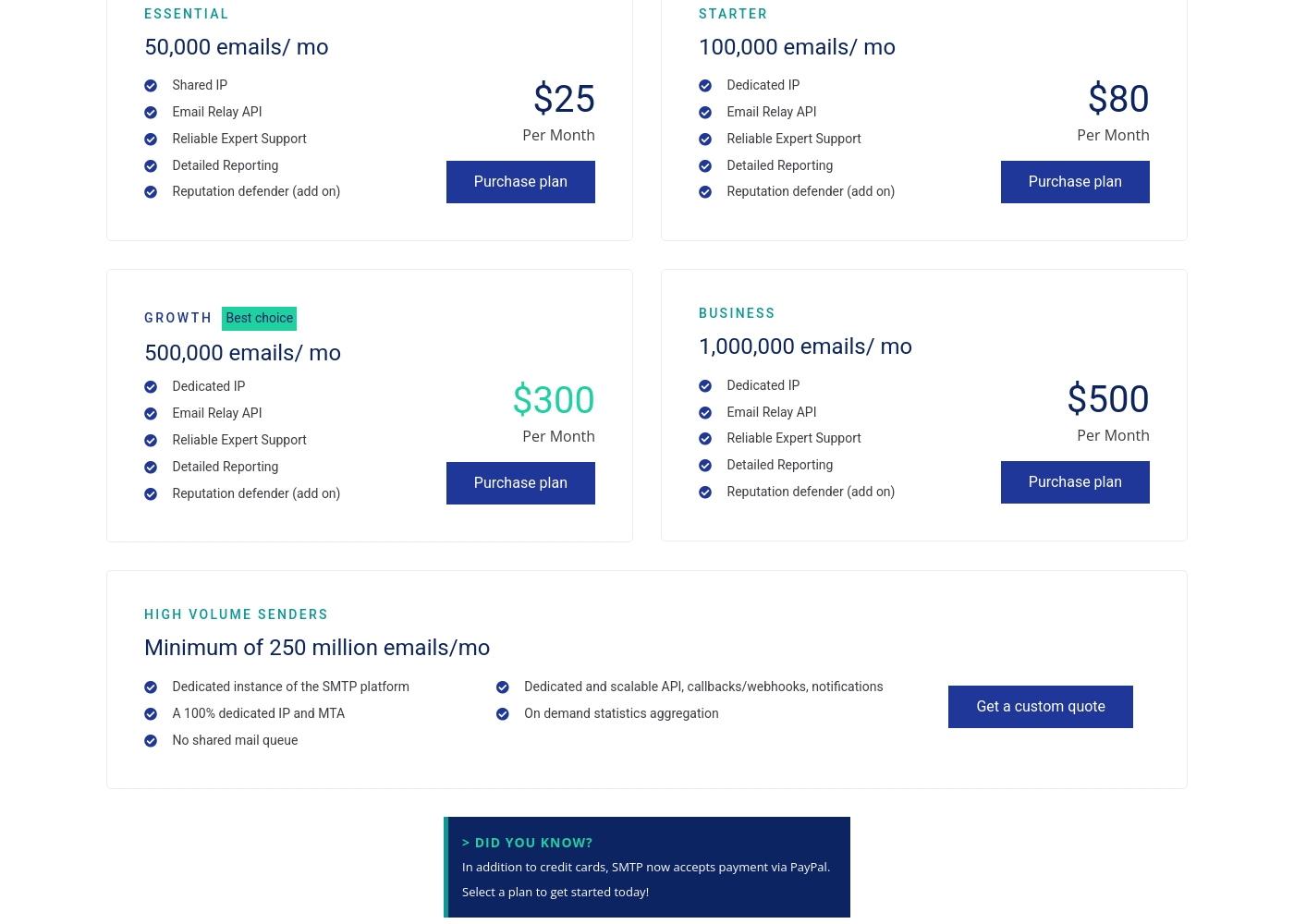
SMTP.com costs between $25 and $500 per month and has four plans: Essential at $25, Starter at $80, Growth at $300, and Business at $500.
Let's explore the details of each plan.
Essential
Price: $25 per month Other Features: Shared IP, Email Relay API, Reliable Expert Support, Detailed Reporting, optional Reputation Defender add-on
- Shared IP
- Email Relay API
- Reliable Expert Support
- Detailed Reporting
- Reputation defender (add on)
- Dedicated IP
- Email Relay API
- Reliable Expert Support
- Detailed Reporting
- Reputation defender (add on)
- Dedicated IP
- Email Relay API
- Reliable Expert Support
- Detailed Reporting
- Reputation defender (add on)
- Dedicated IP
- Email Relay API
- Reliable Expert Support
- Detailed Reporting
- Reputation defender (add on)
Pricing Notes
- SMTP.com offers clear, tiered pricing starting at $25 for 50,000 emails, up to 1 million emails a month.
- Mailgun's initial price is listed vaguely (8217), indicating pricing may quickly move to custom quotes or higher volume tiers.
- Both Mailgun and SMTP.com use a usage-based model tied directly to the volume of emails sent.
- SMTP.com charges a 20% premium for specialized add-ons like Reputation Defender and the Insight Engine.
Pricing Head-to-Head
User Reviews
Users generally rate Mailgun very highly, emphasizing its performance and support. Customers consistently praise the platform for its strong delivery performance, noting that emails reliably reach the inbox.
Many users highlight the extensive analytics, which provide clear insights into delivery, open rates, and clicks. Support is a major theme, often described as fast, responsive, and knowledgeable—even addressing complex issues on weekends or late hours.
Your customer service response was surprisingly fast! I thought this issue would take days to solve. Merit got it fixed in hours; I was incredibly impressed with the efficiency.
SMTP.com's reviews are mixed. 😔 While some users have praised the service for its email delivery returns and simple setup, others express concerns.
Some users report great reporting and a powerful/simple UI, while others mention issues with deliverability, intermittent failures, and account suspension due to spam concerns. Support experiences also vary, with some users citing helpful and responsive support, while others feel the team is lacking.
We used SMTP.com as our external email sending provider for many years without incident. They offer great reporting, a simple but powerful UI, competitive rates, and prompt, knowledgeable support. As an infrastructure engineer with 20 years of experience, I would recommend their service.
Our Verdict
Mailgun and SMTP.com are dedicated delivery services, but they target different users entirely. If reliability and superior developer support are non-negotiable, Mailgun is the clear winner here. SMTP.com serves better for those prioritizing massive infrastructure scale and simple budget planning. Mailgun’s superpower is its highly praised support and flexible, modular toolkit built on strong APIs. Mailgun users report fast, knowledgeable help, ensuring critical issues are resolved quickly. Mailgun provides strong analytics and data-backed insights to continuously fine-tune your sending strategy. SMTP.com excels at providing clear, tier-based pricing for moderate to high volumes, starting at $25. SMTP.com offers specialized add-ons like Reputation Defender, dedicated to proactive list sanitation. High-volume senders also benefit from SMTP.com’s dedicated account managers. The core decision comes down to consistent support quality versus pricing clarity at the entry level. Mailgun provides excellent support and reliability but its pricing is less transparent initially. SMTP.com's setup is simple and pricing is clear, but support consistency is a user concern. Choose Mailgun if you run complex transactional or marketing operations requiring robust APIs and reliable delivery above all else. Go with SMTP.com if you need simple, affordable, high-volume relay sending and prioritize budget clarity.
Frequently Asked Questions
Which tool is more reliable: Mailgun or SMTP.com?
Mailgun is generally more reliable based on collective user reviews and ratings. Mailgun users frequently praise its consistent delivery and reliable sending performance. SMTP.com users sometimes report concerns about intermittent failures and inconsistent delivery.
Is SMTP.com better for small businesses requiring clear pricing?
Yes, SMTP.com is more transparent at lower volumes starting at $25 for 50,000 emails. Mailgun's starting price is listed vaguely, suggesting higher initial costs. SMTP.com offers a simple entry point for budget clarity.
Does Mailgun offer specific reputation protection tools like SMTP.com?
SMTP.com offers the Reputation Defender add-on for automated list monitoring and health. Mailgun relies more on strong general analytics and detailed data-backed insights. Both help, but SMTP.com has a specialized, named feature.
Which service provides faster customer support, Mailgun or SMTP.com?
Mailgun consistently wins in customer support based on user reviews. Mailgun reviewers call help fast and knowledgeable with clear guidance provided. SMTP.com’s support responsiveness is reported as varying widely.
Which platform is primarily built for developers, Mailgun or SMTP.com?
Mailgun is explicitly designed as a flexible, modular developer toolkit built on strong APIs. While SMTP.com is functional for relay, Mailgun excels in customization and developer enablement features.
Does SMTP.com offer scaling benefits that Mailgun does not?
SMTP.com explicitly highlights scaling from thousands to billions of emails monthly. They offer a dedicated platform structure for high-volume senders. Mailgun offers flexibility, but SMTP.com focuses keenly on infrastructure scale.
Ready to Choose?
Both tools have their strengths. Choose based on your specific needs.