Mailgun vs Sender
Mailgun and Sender both promise reliable email, but they're built for different crowds. Mailgun is the developer-friendly powerhouse for transactional emails. Sender is the marketer's friend for simple newsletters and automation. Let's see which one fits your stack.
Best for: Developers building custom applications, Businesses sending high-volume transactional emails
Best for: Small businesses and solopreneurs on a budget, Beginners wanting simple newsletter and campaign tools
Reliable email delivery with powerful developer tools.
We find Mailgun offers exceptional reliability and powerful features praised by technical users. Support is consistently rated as quick and highly competent, even during non-business hours. Overall, Mailgun is an excellent choice for businesses prioritizing high deliverability and flexible API integration.
Pros
- Provides strong email delivery performance, consistently hitting inboxes.
- Customer support is fast, responsive, and highly knowledgeable.
- API implementation is simple, featuring rich and flexible developer tools.
- Offers detailed analytics on delivery, rejections, opens, and clicks.
Cons
- The dashboard interface is sometimes described as clunky.
- Pricing becomes expensive as sending volume scales up.
- Initial response time for support can occasionally be slow.
Simple, free, and effective for basics.
We found Sender to be a solid, no-frills tool for core email marketing tasks. Its free plan is a major draw for startups and small businesses. Overall, it delivers good value with a straightforward interface, though it may lack some advanced features for power users.
Pros
- Extremely generous free plan (2,500 contacts, 15k emails/month).
- Clean, user-friendly interface that's easy to learn.
- Transparent, affordable pricing with no hidden fees.
- Includes essential automation features from the start.
Cons
- Advanced features and segmentation are limited on lower tiers.
- Some users report occasional email deliverability issues.
- Integrations can be inconsistent with certain platforms.
- Free plan lacks SMS marketing capabilities.
AboutMailgun
Mailgun is an email delivery and sending provider designed for adaptability. It acknowledges that your business goals and audience are unique. It’s built to give you the leverage you need with a provider you can trust. Instead of rigid plans, Mailgun provides tailored solutions matching your existing business strategy. ✅
AboutSender
Sender is an email marketing platform designed for businesses of all sizes. It helps you build, automate, and send email campaigns that people actually want to read. Think of it as your straightforward tool for staying in touch with your audience and driving sales. 🚀
Highlights
Feature Comparison
Features Overview
We highlight the main differences and pick a winner for each feature.
Pricing & Value
Mailgun's cost scales with volume and can get expensive. Sender offers a killer free plan and transparent, affordable tiers.
**Mailgun** uses a usage-based model. Pricing is tied to email volume, and costs can jump significantly as you send more. The exact plan details aren't public, so you'll need to check their site. **Sender** leads with a permanent Free Forever plan: 2,500 contacts and 15,000 emails monthly. Paid plans start at just $7/month for up to 1,000 subscribers. The key difference is predictability. Mailgun's value depends on your sending volume, while Sender's pricing is tied to your list size, making budgeting easier for marketers. For a startup, Sender's free tier is unbeatable. For a high-volume app, you'll need to compare Mailgun's volume rates carefully.
Ease of Use
Sender is built for quick setup and simplicity. Mailgun prioritizes power and flexibility, which can mean a steeper learning curve.
**Mailgun**'s interface is sometimes called 'clunky,' though it's improving. The real power is in its API and documentation, which developers love. **Sender** is designed to get you sending in about 5 minutes. Its clean dashboard and visual builder are straightforward for beginners. If you're not technical, Sender's path is much smoother. Mailgun rewards those comfortable with APIs and configuration. Think of it like this: Sender is like a ready-to-drive car. Mailgun is like a kit car you can customize exactly how you want.
Automation & Campaigns
Sender makes email automation simple and accessible from day one. Mailgun's automation is more of a feature than a core focus.
**Mailgun** offers automation tools, but its reputation is built on reliable delivery, not marketing workflows. You can build sequences, but it's not the main selling point. **Sender** includes powerful email automation even on its free plan. You can set up welcome series, abandoned cart emails, and nurture sequences easily. This is a major difference in target audience. Mailgun automates *delivery*. Sender automates *marketing*. For an e-commerce store recovering carts, Sender's built-in automation is a huge win out of the box.
Developer & API Tools
Mailgun is a developer's dream with stellar API and docs. Sender offers basic integrations for non-technical users.
**Mailgun** shines here. Its API is simple, flexible, and praised by developers. Robust documentation lets teams integrate quickly and solve issues independently. **Sender** focuses on plug-and-play integrations with platforms like WordPress and WooCommerce. It has an API, but it's not the central focus. If you're building a custom app, Mailgun's tools are superior. If you're connecting a website, Sender's pre-built connectors are faster. One is for building the engine; the other is for adding a reliable engine to your car.
Deliverability & Reliability
Mailgun is renowned for getting emails into inboxes reliably. Sender users report occasional deliverability hiccups.
**Mailgun**'s core promise is strong delivery performance. Users consistently praise its ability to reach the inbox, backed by detailed analytics on opens and clicks. **Sender** is generally reliable, but some reviews mention occasional deliverability issues. It's solid for marketing emails but not as proven for mission-critical transactional messages. For password resets or receipts, Mailgun's track record is a safer bet. For a newsletter, Sender is perfectly fine. When every email *must* get through, Mailgun has the stronger reputation.
Customer Support
Both offer strong support, but Mailgun's team is highlighted for solving complex technical issues. Sender provides 24/7 access.
**Mailgun**'s support is described as fast, responsive, and highly knowledgeable. Reviewers praise agents for fixing tough problems even on weekends. **Sender** provides 24/7 live support across all plans, including the free tier. This is great for immediate, general help. The difference is depth. Mailgun's support can dive deep into technical delivery issues. Sender's is great for 'how-to' questions. You'll get help from both. Mailgun's help might be more specialized for API integrations.
Reporting & Analytics
Mailgun offers deeper, data-rich analytics on delivery metrics. Sender's reporting is more basic and could be improved.
**Mailgun** provides detailed analytics on delivery, rejections, opens, and clicks. This data is crucial for optimizing technical delivery. **Sender** includes essential metrics, but some users wish for more in-depth reporting. It covers the basics for marketing campaigns. For a developer debugging deliverability, Mailgun's data is far more useful. For a marketer tracking campaign opens, Sender's numbers are sufficient. One gives you engineering-level insights; the other gives you marketing-level dashboards.
Scalability & Limits
Mailgun is built for scaling high-volume transactional sending. Sender scales with your subscriber list and has clearer limits.
**Mailgun** is designed for high-volume email. Its custom plans and volume pricing are meant to grow with your sending needs without hard caps. **Sender** scales based on subscribers. Limits are clear: the free plan caps at 2,500 contacts, paid plans go up to 200,000. For an app that might send millions of messages, Mailgun's architecture is built for that. For a growing mailing list, Sender's tiered model is straightforward. Mailgun scales by *volume*. Sender scales by *audience size*.
Below is a breakdown of the specific plans, detailing what features and benefits each subscription is advertised to offer.
Basic Sending Plan
Other Features:
This plan appears to be tailored for users just starting with email delivery, possibly offering essential tools to begin sending transactional emails or small newsletters. It's likely the best entry point if you're looking for foundational email services without needing advanced scalability right away. 👍

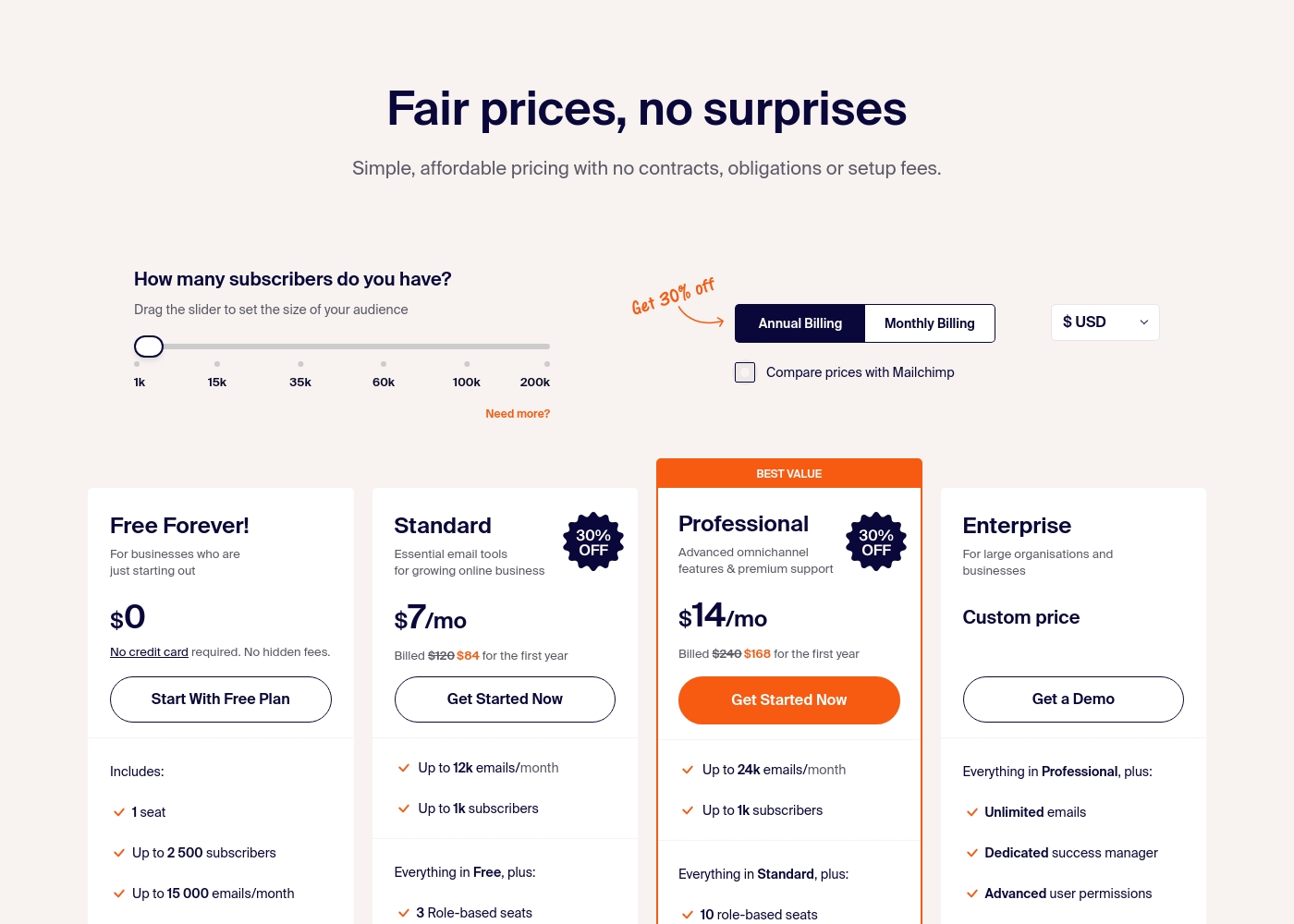
Sender costs between $0 and a custom price per month with 4 plans: Free Forever at $0, Standard at $7, Professional at $14, and Enterprise at Custom price.
Take a look at the specific features and limits included in each plan tier below.
Free Forever!
Price: $0 monthly Best For: Businesses who are just starting out Other Features: 1 seat, up to 2,500 subscribers, 15,000 emails/month, 24/7 live support, email automation.
- 1 seat
- Up to 2,500 subscribers
- Up to 15,000 emails/month
- 24/7 live support
- Email automation
- Up to 12k emails/month
- Up to 1k subscribers
- 3 Role-based seats
- Automated sequences
- Up to 24k emails/month
- Up to 1k subscribers
- 10 role-based seats
- Premium support
- Unlimited emails
- Dedicated success manager
- Advanced user permissions
Pricing Notes
- Mailgun's pricing is usage-based and not publicly listed; costs can increase significantly with sending volume.
- Sender offers a permanent Free Forever plan with no credit card required, which is a major advantage for startups.
- Sender's paid plans start at $7/month, making it very transparent and affordable for small lists.
- Mailgun is better suited for custom, high-volume quotes. Sender is ideal for predictable, list-based budgeting.
Pricing Head-to-Head
User Reviews
Users generally rate Mailgun very highly, emphasizing its performance and support. Customers consistently praise the platform for its strong delivery performance, noting that emails reliably reach the inbox.
Many users highlight the extensive analytics, which provide clear insights into delivery, open rates, and clicks. Support is a major theme, often described as fast, responsive, and knowledgeable—even addressing complex issues on weekends or late hours.
Your customer service response was surprisingly fast! I thought this issue would take days to solve. Merit got it fixed in hours; I was incredibly impressed with the efficiency.
User sentiment on Trustpilot and Capterra highlights Sender's generous free plan and ease of setup as major positives. Many praise the intuitive interface and reliable automation.
😊 However, some note occasional deliverability hiccups and a learning curve for advanced features. Customer support is frequently mentioned as responsive, though a few users report slow responses during peak times.
The free plan is unbeatable for a new business. I set up my first automation in minutes. The platform is simple and gets the job done without fuss.
Our Verdict
There's no single winner here—it's about matching the tool to the job. **Mailgun** is the specialist for developers and high-volume transactional email. Its API is stellar, delivery is rock-solid, and analytics are deep. If you're building an app and need emails to just *work*, Mailgun is your pick. **Sender** is the champion for simplicity and value. Its free plan is genuinely generous, and the platform is a breeze to use. For startups, bloggers, and small businesses focused on marketing campaigns and automation, Sender is the smarter, cheaper starting point. The deciding factor is your technical skill and email type. Choose Mailgun if you need custom, reliable delivery for transactional messages like receipts or alerts. Choose Sender if you want straightforward newsletters and automation without breaking the bank or your brain. For most small businesses and marketers, **Sender** offers more immediate value with its free plan. For developers and technical teams, **Mailgun**'s power and reliability are worth the complexity. Know your use case, and you'll pick the right one.
Frequently Asked Questions
Is Mailgun better for transactional emails than Sender?
Yes. Mailgun is built specifically for high-deliverability transactional and API-driven email. Sender is more focused on marketing campaigns and newsletters, though it does support transactional emails.
Does Sender have a free plan, and how does it compare to Mailgun?
Yes. Sender's Free Forever plan includes 2,500 contacts and 15,000 emails/month with automation. Mailgun does not publicly state a free plan; its pricing is usage-based and not listed.
Which platform is easier for beginners to set up?
Sender is easier. It's designed for quick, 5-minute setup with a clean interface. Mailgun, while powerful, has a steeper learning curve and a more technical focus.
Can I use Mailgun for marketing newsletters?
You can, but it's not its primary strength. Mailgun is optimized for transactional delivery. For marketing campaigns with templates and automation, Sender is a more purpose-built and user-friendly choice.
How does pricing scale with email volume for Mailgun vs. Sender?
Mailgun's pricing scales with your sending volume and can get expensive at high levels. Sender's pricing scales with your subscriber count, starting with a free tier and having clear, affordable paid plans.
Which has better customer support for technical issues?
Mailgun is often praised for highly knowledgeable support that can solve complex API and delivery issues. Sender offers 24/7 support on all plans, which is great for general help.
Ready to Choose?
Both tools have their strengths. Choose based on your specific needs.