Loomly vs Vista Social
Choosing between Loomly and Vista Social is a classic dilemma. One tool is fighting for its reputation while the other is building momentum. Loomly's core collaboration features are solid, but Vista Social's AI-powered, all-in-one approach feels like the future.
Best for: Teams deeply embedded in Loomly's specific approval workflow., Users who prioritize its historical ease of use and onboarding.
Best for: Agencies needing white-labeling and client management tools., Marketing teams seeking AI-assisted content creation and analytics.
Unstable pricing and inaccessible support.
We observed that Loomly offers a feature-rich social management environment, historically praised for ease of use and client onboarding. However, recent, extreme price hikes and inaccessible customer support channels pose severe, well-documented risks. Overall, we rate this tool low due to the collapse of foundational business trust.
Pros
- Historically considered a fantastic and easy-to-use platform.
- Strong historical support for client collaboration and approval workflows.
- Access to post inspiration feeds and a royalty-free content library.
- Effective scheduling features (when technical integrations operate).
Cons
- Recent, extreme price increases (reported up to 900%) are pushing loyal users away.
- Customer support is currently inaccessible, relying primarily on non-helpful chatbots.
- Reliability issues with core platform integrations (e.g., persistent Instagram API limitations).
- Predatory billing practices, including automatic enrollment in expensive new tiers.
Powerful, scalable command center.
Vista Social delivers a robust, all-in-one platform that consolidates scheduling, analytics, and engagement for teams. We find its AI-powered workflow tools and broad channel support particularly strong for agencies and growing brands. Overall, it's a high-value solution for serious social media management.
Pros
- Comprehensive all-in-one platform for publishing, analytics, listening, and engagement.
- AI-powered features to automate tasks and provide insights.
- Designed for team collaboration and agency workflows with white-label options.
- Supports all major social channels, including niche platforms.
Cons
- Full external review data was inaccessible, limiting our independent sentiment analysis.
- Complex feature set may present a learning curve for very small teams or beginners.
- Pricing starts at a mid-range point, which may be a consideration for budget-conscious users.
AboutLoomly
Loomly is an all-in-one social media management tool made for brands and the teams who manage them. It helps marketers increase their reach and build their brand presence online.
This platform lets you craft, optimize, schedule, and analyze content across all your social channels. It is designed to be simple and user-friendly, helping you level up quickly. 💡
AboutVista Social
Vista Social is a comprehensive, AI-powered platform for social media management. 🤖 It's built for teams—like agencies or in-house marketing groups—who need to handle everything from publishing and analytics to engagement and listening across every major social channel. Think of it as your all-in-one hub, designed to replace a stack of separate tools and make your social workflow smoother.
Highlights
Feature Comparison
Features Overview
We highlight the main differences and pick a winner for each feature.
Publishing & Scheduling
Both tools schedule across major platforms. Vista Social adds an AI layer to help create and refine posts.
Loomly provides a straightforward calendar for planning and auto-posting. You can preview posts and customize them for each platform from one draft. The process is efficient for basic content calendars. Vista Social also offers a unified calendar but integrates its AI Assistant directly into the workflow. It can generate captions, suggest hashtags, and refine your copy. This turns scheduling into a more collaborative, creative process. The key difference is the AI support. Loomly relies on your team to create content, while Vista Social aims to assist and accelerate that creation. For pure scheduling mechanics, they're comparable, but Vista Social's AI offers a significant efficiency boost.
Analytics & Reporting
Vista Social provides deeper, customizable analytics. Loomly's reporting is advanced but less flexible.
Loomly offers advanced social analytics tracking follower growth, demographics, and engagement. You can automate report delivery and use content labels to filter campaign-specific performance. It's robust for showcasing results. Vista Social builds on this with detailed analytics and fully custom reporting dashboards. You can visualize data your way and track performance across all channels in one view. It turns numbers into actionable insights more effectively. Vista Social gives you more control and depth in understanding your data. While Loomly's reporting is sufficient, Vista Social's flexibility and insight-driven approach are superior for data-focused teams.
Collaboration & Approvals
Both excel here, with customizable multi-level workflows for team and client sign-offs.
Loomly's core strength is its customizable, multi-level approval workflows. You can loop in clients or managers at various stages and track all feedback in a post history log. This streamlines getting content approved. Vista Social also offers robust collaboration tools with approval workflows, task assignments, and access controls. It adds client management and white-label options, which are particularly valuable for agencies. The process is designed for professional, organized teamwork. Loomly pioneered this focus, making it a known quantity. Vista Social matches the core functionality and adds agency-centric features. For basic team collaboration, it's a tie. For agencies needing white-labeling, Vista Social has the edge.
Community & Engagement
Vista Social offers a more comprehensive engagement suite, including listening and automation.
Loomly includes a unified inbox to manage messages, comments, and replies across platforms. You can assign conversations and use saved replies to speed up response times. It's a solid tool for community management. Vista Social's social inbox is complemented by real-time listening tools for brand mentions and sentiment. It also includes DM automations for lead capture and FAQs. This creates a full-circle engagement ecosystem. Vista Social goes beyond reactive management. It provides proactive listening and automated engagement tools that Loomly lacks. This makes it a more powerful hub for managing and growing your online community.
Pricing & Value
Vista Social has transparent, tiered pricing. Loomly's pricing is opaque and has caused significant user backlash.
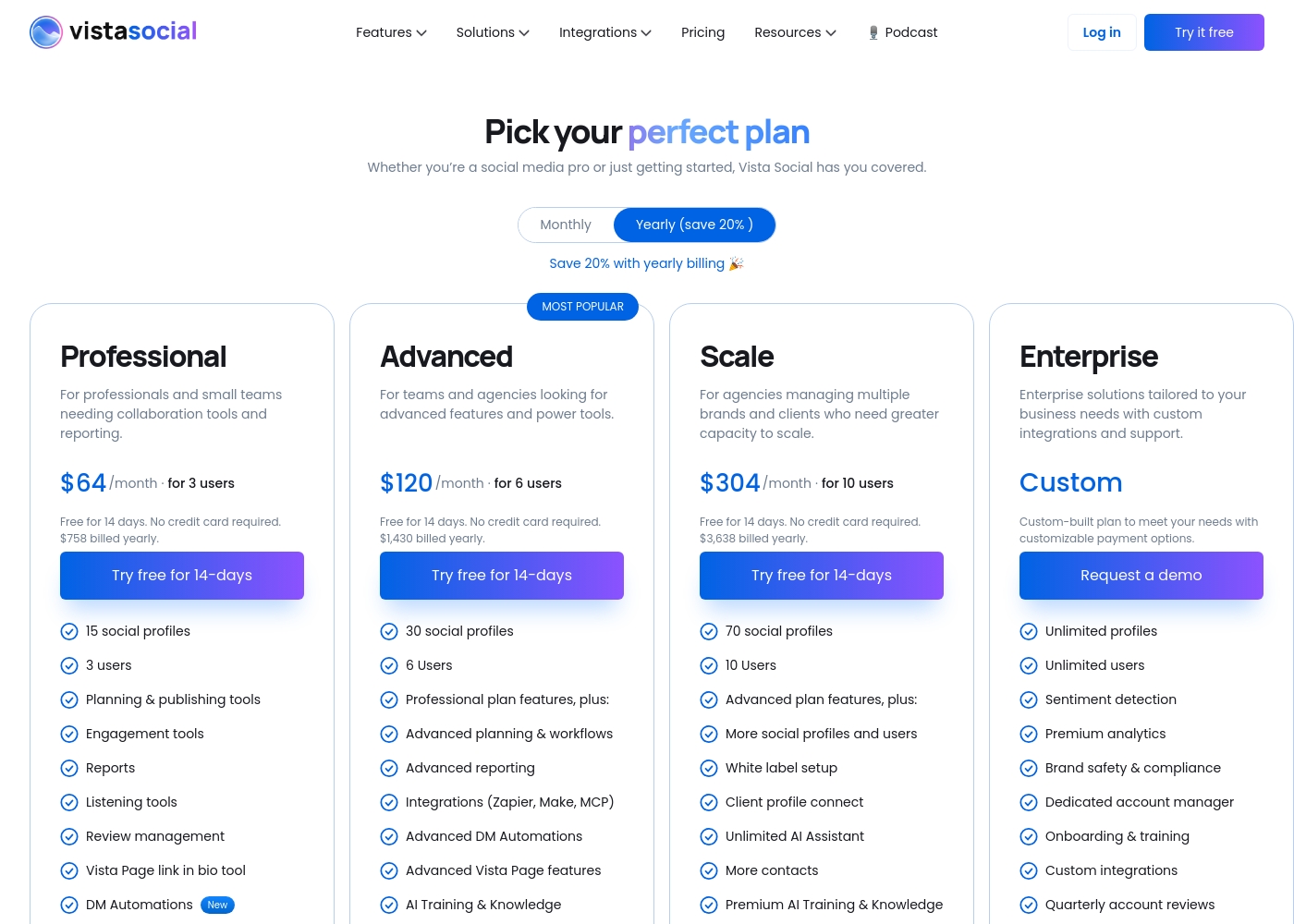
Loomly's pricing is not publicly listed and scales based on team size and features. Recent user reports detail sudden, extreme price increases of 300-900%, leading to mass exodus. This creates major budget uncertainty. Vista Social publishes clear pricing: $64/mo for 15 profiles, $120/mo for 30, and $304/mo for 70. Each tier includes a set number of users and AI credits. You know exactly what you're paying for. Transparency and value are critical. Loomly's hidden pricing and reports of predatory billing are serious red flags. Vista Social offers predictable, scalable costs, providing far better value and trust.
Customer Support
Vista Social offers clear, multi-channel support. Loomly's support is reportedly inaccessible.
Loomly's customer support is currently a major pain point. Users report relying on ineffective chatbots and auto-replies, with virtually no access to human assistance. This makes solving technical issues very difficult. Vista Social provides email and video call support on its Professional and Advanced plans. Scale users get priority support, and Enterprise includes a dedicated account manager. This ensures you can get help when needed. Reliable support is non-negotiable for business tools. Vista Social's clear support structure is a fundamental advantage over Loomly's currently inaccessible system.
AI & Automation
Vista Social has a clear lead with its integrated AI Assistant and DM automations.
Loomly does not currently offer AI-powered features. Its automation is limited to scheduling and post approvals. The platform focuses on streamlining manual workflows rather than augmenting them with AI. Vista Social's AI Assistant helps generate and refine content across all plans. It also offers DM automations for lead generation and customer service. These features save significant time and add new capabilities. This is a categorical difference. Vista Social is actively integrating AI to make teams more productive. Loomly is missing this modern layer entirely, putting it at a strategic disadvantage.
Although we cannot show specific prices right now, Loomly offers flexible tiers designed to fit different team sizes and social media needs. These plans scale efficiently to support content management for organizations ranging from individual marketers up to large agencies managing robust social media campaigns.
Core Features Plan (Implied Base Tier)
Other Features:
- Social media planning and scheduling across platforms
- Access to a royalty-free photo and video library
- Daily post inspiration, so you never run out of ideas
- Built-in tools for designing and editing visuals
This introductory level is likely ideal for individual users or small businesses focused on streamlining their basic content workflow and maintaining a consistent posting cadence. It gives you the fundamental toolkit to preview, schedule, and auto-post your content efficiently toward achieving better social media results.
Vista Social pricing: Vista Social offers flexible social media management plans starting at $64/month when billed annually. Every plan includes a 14-day free trial and features that scale with your team's growth and client needs.
Check out the full breakdown below to find the best fit for your social strategy.
Professional
Price: $64/month billed annually Websites Supported: 15 social profiles Best For: Professionals and small teams needing collaboration tools Other Features: Unlimited scheduling, Canva integration, AI Assistant (2,500 credits), social inbox, and basic reporting.
Pricing Notes
- Loomly's pricing is not published, leading to uncertainty. Users report sudden, massive price hikes of up to 900%.
- Vista Social has transparent, published pricing. Plans start at $64/month billed annually for 15 social profiles.
- Both offer free trials (Loomly: 15 days, Vista Social: 14 days) with no credit card required.
- Loomly's value is undermined by reports of predatory billing practices and lack of pricing clarity.
- Vista Social's pricing scales predictably with features, users, and profiles, offering clear value.
Pricing Head-to-Head
User Reviews
User feedback focuses heavily on recent, dramatic changes that have severely impacted trust and usability. While Loomly was historically seen as a well-functioning platform with smooth onboarding, recent reviews are overwhelmingly negative 📉.
The most frequent and critical complaint revolves around abrupt, massive price increases, frequently cited as 300% to 900% hikes, often coupled with automatic enrollment in the costly new plans or insufficient notice, forcing small businesses and entrepreneurs to leave. Reliability is also a persistent concern, with users reporting technical issues connecting to platforms like Facebook and persistent Instagram API limitations, such as constraints on video length or square image formatting.
After years of loyalty, Loomly sent notice raising my price nearly 300% without explanation or justification. This massive price hike is shocking and unacceptable for a small business that relies on stable budgeting. We had no choice but to terminate service and move our content elsewhere.
We were unable to access the full review content from Trustpilot and Capterra due to access restrictions (403 errors and security verifications). Therefore, we cannot synthesize a specific sentiment summary from those external sources based on the provided snippets. The URLs are listed for reference.
Our Verdict
If you're starting fresh or need reliability, Vista Social is the clear winner. Its AI-powered, all-in-one approach is built for modern social teams. Loomly's superpower was its streamlined approval workflows for client teams. If your entire operation is built around that specific process, it still functions. However, that foundation is crumbling under the weight of its business practices. Vista Social's superpower is being a true command center. It combines publishing, analytics, listening, and engagement with AI assistance. This replaces a stack of other tools for your team. The deciding factor is trust and future-proofing. Loomly's reports of 900% price hikes and zero human support are unacceptable business risks. Vista Social offers transparency and modern features. Choose Loomly only if you're locked in and its specific workflow is irreplaceable for you right now. For everyone else, especially agencies and scaling teams, Vista Social is the safer, more powerful choice for 2024 and beyond.
Frequently Asked Questions
Which is better for agencies, Loomly or Vista Social?
Vista Social is better for agencies. It offers white-label reporting, client management, and scalable plans with clear user limits. Loomly's agency appeal is damaged by pricing uncertainty.
Does Vista Social have approval workflows like Loomly?
Yes, Vista Social includes multi-level approval workflows. It also adds client-specific access and task assignments, matching Loomly's core collaboration feature.
Why is Loomly getting bad reviews lately?
Loomly reviews are poor due to sudden, massive price increases (300-900%) and inaccessible customer support that relies on chatbots. This has caused a major loss of user trust.
Is Vista Social really an all-in-one platform?
Yes, Vista Social is designed to be all-in-one. It covers publishing, analytics, social listening, review management, employee advocacy, and engagement in a single hub.
Which tool has better analytics, Loomly or Vista Social?
Vista Social offers more powerful and customizable analytics. While Loomly has advanced reporting, Vista Social provides deeper insights and fully custom dashboards for data-driven decisions.
Can I test both tools for free?
Yes, both offer free trials without a credit card. Loomly gives you 15 days for full access. Vista Social provides 14 days to test its entire platform risk-free.
Ready to Choose?
Both tools have their strengths. Choose based on your specific needs.