LiProspect vs Lusha
LiProspect and Lusha both tackle B2B lead generation, but their core strategy differs greatly. LiProspect focuses on safe, cloud-based LinkedIn automation for strategic growth. Lusha provides massive external contact data but raises serious privacy flags. Let's see which tool earns a spot in your sales stack.
Best for: Sales teams prioritizing compliant, secure LinkedIn lead generation and outreach., B2B agencies managing multiple client LinkedIn accounts simultaneously.
Best for: Sales Development Reps (SDRs) needing immediate, high-volume access to external contact data., RevOps teams focused on API or MCP data enrichment for HubSpot and Salesforce.
Secure, strategic B2B LinkedIn growth.
We find LiProspect offers a robust, cloud-based solution focused clearly on compliant outreach and strategic B2B scaling. The platform provides strong features like advanced targeting and team network visualization, making it suitable for experienced users or larger agencies. Overall, this is a strong investment for businesses prioritizing safety and detailed analytics in their automation strategy.
Pros
- Entirely cloud-based, so no software installation or browser extension is needed.
- Uses a secure, compliant algorithm to minimize LinkedIn account risk.
- Supports management of multiple LinkedIn accounts seamlessly.
- Includes detailed real-time analytics for strategy optimization.
Cons
- Pricing for the 'Business' plan is not public or transparent.
- Specific feature limits related to contact volume for the Professional plan are unclear.
- No publicly stated refund or money-back guarantee is available.
Serious questions about data privacy.
We observed extreme user concerns regarding Lusha’s data sourcing and privacy adherence, particularly concerning the alleged sharing of scraped personal contact numbers, which overshadows any intended utility. Overall, we cannot recommend a service facing such severe ethical and contractual complaints from its user base.
Pros
- Offers a generous Free plan to test basic functionality.
- Provides broad API and CRM integration options.
- Can be effective for prospecting when the data is accurate.
Cons
- Major concerns regarding the ethical sourcing and sharing of private contact data.
- Users struggle to opt-out or remove their personal information (GDPR violations alleged).
- Substantial complaints about high inaccuracy and obsolete contact details sold.
- Aggressive auto-renewal policies and opaque contract cancellation terms.
AboutLiProspect
LiProspect is a powerful, comprehensive LinkedIn Automation Suite designed to accelerate B2B sales and marketing tactics. This platform operates entirely on a cloud-based basis. You don't need to download a browser extension or install any software to use it. LiProspect is relevant for multiple groups, including entrepreneurs looking to connect with their target audience efficiently. It also helps sales teams boost their efforts and recruitment endeavors reach ideal candidates quickly. 💡
AboutLusha
Lusha powers up your entire Go-To-Market (GTM) engine. It provides access to a massive database of over 280 million verified B2B contacts, helping teams reach precise decision makers. Professionals across Sales, RevOps, Marketing, and Recruiting use Lusha to streamline their work and maximize return. 💡
For sales teams, Lusha helps the pipeline grow with live leads and faster closes. RevOps benefits by keeping data stacks clean, compliant, and connected for better ROI. Marketers power campaigns with enriched audiences, and Recruiters quickly find top talent using highly accurate contact data. This tool truly helps you scale up your business using trusted data.
Highlights
Feature Comparison
Features Overview
We highlight the main differences and pick a winner for each feature.
Account Safety & Structure
LiProspect champions compliant outreach; Lusha risks stem from its data practices.
LiProspect operates cloud-based, which greatly avoids the security risks of browser extensions. The platform uses a secure algorithm to minimize account penalties from LinkedIn. This strategy ensures compliant, safe outreach based on LinkedIn guidelines. Lusha primarily relies on a browser extension to gather and share contact data with 280M+ contacts. User reviews heavily flag major privacy concerns and unsolicited outreach associated with Lusha’s data source. Lusha focuses data gathering, not LinkedIn safety.
B2B Contact Data Volume
Lusha provides massive third-party data; LiProspect focuses on automating existing leads.
Lusha gives you instant access to a vast database of over 280 million verified B2B contacts. It claims strong accuracy: 98% for emails and 85% for phone numbers. This massive volume is essential for bulk enrichment needs. LiProspect's strength is within LinkedIn automation and outreach to network connections. It provides scraping tools and filters to refine current leads. You will not get millions of external contacts found by LiProspect. The trade-off is volume versus security and data source trust. Lusha wins on sheer quantity and explicit accuracy claims.
Team & Collaboration Features
LiProspect offers unique network visualization; Lusha provides standard shared credit pooling.
LiProspect's Business plan features Expanded Network Visualization for large teams. This helps centralize and strategically use the professional connections of all team members. It focuses on collective outreach optimization. Lusha manages collaboration via shared accounts, seats, and credit pools for sales teams. The platform ensures all team members access the same enriched data quickly. Lusha's focus is on integrating data flow, not visualizing networks. Choose LiProspect if leveraging your team's collective LinkedIn influence is critical to your strategy.
Predictable Pricing Model
LiProspect uses flat subscription rates; Lusha relies on variable, usage-based credits.
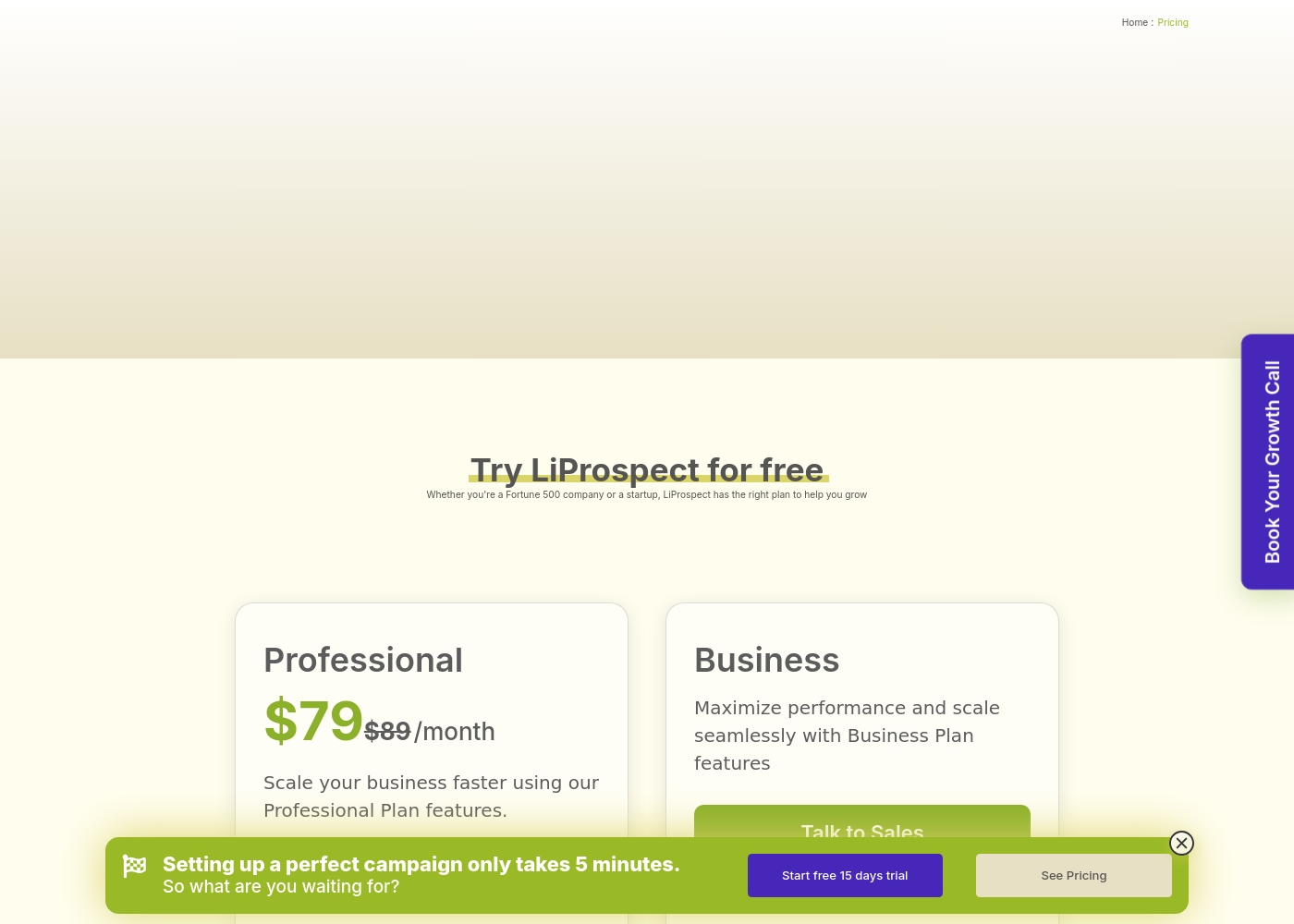
LiProspect offers a predictable flat rate of $79/month for its Professional plan. This makes budgeting easy for small businesses and individuals. However, its enterprise plan pricing is not transparent. Lusha uses a credit-based model, where costs vary based on usage and type of data revealed. Phone numbers cost 10x more (10 credits) than emails (1 credit). This variable pricing can lead to budget surprises. LiProspect is better for those needing a consistent, static monthly budget. Lusha is great for light users enjoying the generous free credit allowance.
CRM Integration Depth
Lusha specializes in deep, widely available integration; LiProspect limits integration to high-tier plans.
Lusha is designed to be a data enrichment engine, integrating seamlessly with many tools like Salesforce, Outreach, and HubSpot. API/MCP enrichment is a core function. LiProspect restricts its essential CRM integration capability to its custom-priced Business plan. This high-tier requirement hurts accessibility for smaller teams needing continuity. For LiProspect, integration is an add-on, not a core function. Lusha provides superior data syncing and enrichment across a wider range of accessible plans.
Lead Signals & Timing
Lusha surfaces real-time buying readiness; LiProspect identifies prospects via filters.
Lusha excels at providing real-time leads and buying signals to its users daily. This helps sales reps prioritize time-sensitive outreach effectively. Teams can act on intent data immediately. LiProspect uses advanced search filters and segmentation tools to build targeted lists proactively. It focuses on automating the journey once the ideal prospect is found. LiProspect is less focused on passive signal monitoring. If speed and acting on intent signals are your priority, Lusha provides a clear structural advantage.
Hyper-Personalization
LiProspect supports engaging rich media; Lusha focuses on contact data accuracy.
LiProspect allows sophisticated hyper-personalization, including the use of GIFs and images in automated campaigns. This is highly effective for maximizing engagement on LinkedIn. This feature makes outreach stand out. Lusha ensures you have the accurate contact information needed for basic personalization in emails or phone calls. It does not provide in-app tools for media-rich, high-impact messaging. Lusha focuses on the 'who,' not the 'how'. For dynamic social engagement and better reply conversion rates, LiProspect offers superior tools.
We offer transparent plans that help businesses of all sizes find the perfect fit. Here’s a detailed look at what each plan offers to help you decide which one you need.
Professional
Price: $79/month or $790/year (saves up to 17%) Best For: Scaling your business faster Other Features:
- Cloud-based platform (no software installation or browser extension needed)
- Allows management of multiple LinkedIn accounts
- Secure algorithm ensuring compliant outreach
- Automated outreach tools (connection requests and messaging)
- Detailed analytics and campaign management
This plan is ideal if you are an individual entrepreneur or a small team ready to ramp up your lead generation efforts. You get secure, comprehensive automation without the hassle of downloading extra software. It’s a strong starting point for maximizing personalized LinkedIn outreach.
- Scale your business faster
- Cloud-based platform (no extension needed)
- Compliant outreach algorithm
- Manage multiple LinkedIn accounts
- Automated connection requests and messaging
- Maximize performance and scale seamlessly
- Integrate with current CRM systems
- Expanded Network Visualization
- Suitable for Fortune 500 or large scaling needs
Lusha offers plans starting at Free, with paid plans requiring contact for pricing details.
Details for specific pricing tiers were unavailable due to a technical error on the Lusha website itself, but we can review the featured plans based on the available text.
Free plan
Price: Free Best For: Getting started with B2B prospecting Refund Policy: Not applicable Other Features:
- Up to 70 credits per month
- Access to basic prospecting features
- Browser extension
- CRM integrations
- Up to 70 credits per month
- Basic prospecting features
- Browser extension
- CRM integrations
- Fully customizable
- Ability to limit credit usage per user
- Includes annual credit rollover option
- Designed for teams larger than 5 users
Pricing Notes
- LiProspect offers a predictable flat rate starting at $79/month, saving 17% on an annual plan.
- Lusha operates on a usage-based, credit system; revealing a phone number costs 10x more than an email address.
- The highest tiers for both LiProspect (Business) and Lusha (Scale) are custom-priced and require contacting sales.
- LiProspect provides a 15-day risk-free trial, whereas Lusha offers a permanent Free plan with 70 monthly credits.
- Budgeting is simpler with LiProspect's flat-rate approach compared to Lusha's variable credit consumption.
Pricing Head-to-Head
User Reviews
We currently do not have specific user feedback or review snippets available from Trustpilot or Capterra to synthesize a balanced summary of external user experiences. This means we cannot report on recurring themes concerning key aspects like onboarding smoothness, the accuracy of its targeting tools, or the effectiveness of customer support responsiveness.
While LiProspect markets itself as a powerful, cloud-based automation suite focused on compliant B2B growth, we lack direct public sentiment regarding the real-world reliability of its connection requests, the value derived from the $79 monthly Professional plan, or the ease of integration with external CRM systems. We strongly recommend that users leverage the generous 15-day free trial to thoroughly test the platform's claimed features, such as the secure outreach algorithm and Expanded Network Visualization for teams, to ensure performance meets specific scaling and automation needs.
User feedback concerning Lusha is overwhelmingly negative, centering on severe data ethics and privacy violations. Many reviewers allege Lusha scrapes and distributes personal contact information—including private mobile numbers—without user consent, leading to a huge volume of unsolicited calls and spam.
Users feel this is a "scammy" or "spam-enabling" practice that violates GDPR. A major complaint is the difficulty in getting personal details removed; many requests for data deletion are reportedly ignored, or the information reappears soon after.
I keep receiving daily unsolicited calls to my personal phone number. When I ask where they got my details, they consistently cite Lusha. This company shows a blatant disregard for privacy.
Our Verdict
Choosing between LiProspect and Lusha boils down to how you source and handle B2B data. This isn't just about features; it’s about trust. For most teams, LiProspect is the safer, more compliant choice for LinkedIn lead generation. LiProspect’s superpower is secure, strategic LinkedIn automation from a safe cloud architecture. It successfully manages multiple user accounts while adhering to compliance guidelines. Teams gain a massive edge using LiProspect’s Expanded Network Visualization tool for centralized outreach strategies. Lusha’s strength is its colossal external database of 280 million verified contacts worldwide. If you need to enrich your CRM with bulk email and phone numbers, Lusha delivers that data immediately. Lusha is also superior for acting fast because it provides real-time buying signals to your dashboard. The deciding factor here is risk tolerance concerning data privacy and compliance. LiProspect promises account safety and transparent, flat-rate pricing for automation. Lusha faces significant user backlash and a low 2.4 rating over privacy concerns and data sourcing methods. Do you prefer compliant outreach or high-volume, potentially risky data? If safety and leveraging your existing network are key, choose LiProspect and its $79/month plan. If your priority is deep CRM enrichment using massive external data volume, Lusha provides the sourcing (use the Free plan first to test data quality).
Frequently Asked Questions
Which tool is better for ensuring LinkedIn account safety: LiProspect or Lusha?
LiProspect is significantly better, operating on a cloud-based platform with a compliant algorithm. Lusha primarily uses a browser extension and faces major user-reported privacy concerns. LiProspect prioritizes risk reduction.
Does Lusha offer a free trial like LiProspect?
LiProspect offers a 15-day risk-free full trial of its platform. Lusha does not offer a traditional trial but provides a permanent Free plan with 70 credits monthly. This lets you test Lusha data quality indefinitely.
Which software provides the best features for managing a sales team?
LiProspect offers unique team features like Expanded Network Visualization for centralizing team connections. Lusha focuses more on shared data enrichment and credit pooling for team access. LiProspect is better for coordinated outreach.
Can LiProspect give me external contact phone numbers like Lusha can?
No, LiProspect is focused on securely automating messages and connection requests within LinkedIn. Lusha is designed to provide external B2B contact data, including phone numbers and personal emails. Lusha offers high volume data access.
Is Lusha's variable credit pricing model worth the risk compared to LiProspect's flat rate?
LiProspect offers predictable budgeting starting at $79/month, regardless of usage volume. Lusha's credit-based pricing is advantageous for low-volume users on the Free plan. Heavy Lusha users may find costs unpredictable with credit consumption.
Which tool integrates better with existing CRM systems?
Lusha integrates deeply with HubSpot and Salesforce across multiple plans, making data enrichment a core function. LiProspect limits CRM integration availability to its custom-priced Business plan tier. Lusha is generally better for CRM flow.
Ready to Choose?
Both tools have their strengths. Choose based on your specific needs.