Lightspeed vs Zettle
Lightspeed and Zettle represent two very different POS philosophies in the market. Lightspeed is built for ambitious, scaling multi-location businesses needing unified control and reporting. Zettle is perfect for simple, portable payments with ultra-low overhead and zero monthly software costs. Your individual business size and growth goals will dictate the clear winner here.
Best for: Ambitious retail businesses focused on rapid scaling, Stores managing complex, multi-location inventory
Best for: Solo entrepreneurs and very small businesses, Mobile vendors doing frequent pop-up events or markets
Robust platform with exceptional onboarding.
We find Lightspeed offers an exceptionally detailed and user-friendly platform, successfully unifying inventory, POS, and loyalty features for ambitious businesses. While the implementation and onboarding support are repeatedly excellent, the platform faces criticism for inconsistent post-setup responsiveness and high long-term costs. Overall, Lightspeed is a robust solution for ambitious retailers who prioritize comprehensive features and can manage the escalating price of specialization.
Pros
- Exceptional onboarding and setup support from dedicated specialists.
- Comprehensive cloud-based platform encompassing POS, inventory, and loyalty.
- User-friendly system with detailed features and frequent updates.
- Effective inventory management functionality is highly praised.
Cons
- Customer service for resolving ongoing issues can be slow or inconsistent.
- Cost increases significantly with add-ons (e.g., rewards program nearly doubles the price).
- Base pricing excludes the cost of extra locations and additional registers.
- Some core features lack basic functionality, such as modifying or duplicating Purchase Orders.
Simple Payment Processing, Needs Hardware Stability.
We find Zettle excels at providing straightforward, pay-as-you-go payment acceptance ideal for small sellers. Overall, while the transparent pricing and accessible customer support are excellent, persistent Bluetooth and proprietary hardware reliability issues must be addressed for consistent daily operation.
Pros
- Simple, pay-as-you-go pricing starting at 1.75% per transaction.
- Free core POS app available for inventory and reporting.
- Customer support is often responsive, knowledgeable, and easy to reach by phone.
- Mobile-ready system including convenient Tap to Pay functionality.
Cons
- Frequent connectivity issues, including slow Bluetooth pairing.
- Hardware reliability concerns (devices locking out or battery failure).
- Limited customer service availability on weekends (peak trading times).
- Higher transaction fees (up to 2.5%) for remote payments and invoices.
AboutLightspeed
Lightspeed is a comprehensive commerce platform built specifically for growing businesses. It provides one seamless touchpoint for all your operational needs. Whether you run a retail store, a fast-paced restaurant, or a specialised golf facility, Lightspeed helps you manage crucial tasks better. It’s an innovative, easy-to-use system that combines multilocation tools, integrations, and reports into a single hub. This reliable platform is trusted by businesses in over 100 countries, supporting roughly 144,000 customer locations globally.
AboutZettle
PayPal Point of Sale, formerly Zettle by PayPal, provides modern tools for business owners. It focuses on making every workday easier by combining payment acceptance and sales tracking in one simple place. These products are made specifically to help you handle transactions smoothly and keep reliable records. ✅
A key component is the new PayPal Reader. This reader features a large touchscreen for a professional and smooth checkout experience. You can connect it via Bluetooth or use a stable connection with the included USB-C cable. New, eligible business users can get this card reader starting from £29 (excluding VAT). Additional readers are priced at £69 (excluding VAT).
Highlights
Feature Comparison
Features Overview
We highlight the main differences and pick a winner for each feature.
Pricing & Overhead
Lightspeed is subscription-based; Zettle offers a free core app with zero monthly fees.
Lightspeed requires a fixed operating cost regardless of sales volume, starting at $89/month. This fee includes comprehensive features and dedicated high-end POS hardware support. The cost significantly increases if you need extra locations or registers added to the account. Zettle's core POS app is provided at absolutely no additional cost or commitment. You only pay usage-based rates when a transaction actually occurs. This pay-as-you-go model makes Lightspeed much more expensive for new or very small sellers. Businesses focused on low overhead should instantly choose Zettle to save monthly subscription costs.
Transaction Rate
Lightspeed offers a lower base rate; Zettle's rate is higher, especially for remote payments.
Lightspeed locks in a highly competitive, fixed card-present rate of only 1.5%. This allows high-volume retailers to budget payment servicing confidently every month. Zettle's standard in-person card transactions cost 1.75% per swipe or tap. This difference of 0.25% will quickly become substantial as your volume increases. Furthermore, Zettle charges up to 2.5% for remote transactions like digital invoices or payment links. Lightspeed provides a greater long-term cost benefit for businesses processing many transactions.
Inventory Management
Lightspeed has advanced, complex inventory tools; Zettle features basic product tracking.
Lightspeed is an inventory powerhouse, designed for detailed retail operations and complex stock. Higher tiers include Landed Costs calculation and useful Forecasting Insights. Zettle allows you to manage product lists and track stock levels within the free POS app. This functionality is essential but remains basic and does not support complex retail mathematics. Lightspeed is necessary if you need detailed, intelligent control over warehousing and multi-location stock movement.
Mobile Payments
Zettle enables instant Tap to Pay on your smartphone; Lightspeed requires integrated hardware.
Zettle excels at pure mobility and flexible payment acceptance right out of the box. You can use Tap to Pay on your existing smartphone after downloading the free app. This turns your device into a payment terminal instantly, minimizing setup friction. Lightspeed's mobile solutions focus more on integrated, specialized retail devices like mobile scanners. The full Lightspeed platform requires dedicated hardware tied to a specific register count. Choose Zettle if you frequently operate at markets or pop-up events.
Scaling & Complexity
Lightspeed is built for extreme scaling; Zettle is optimized for core simplicity.
Lightspeed is explicitly built for ambitious, established retail and hospitality businesses looking to expand. It easily handles complexity, multiple locations, and specialized vertical needs. The system offers high-tier features like API access and custom user roles. Zettle keeps the operations streamlined and simple for the small business owner. It lacks the deep structural capabilities required to effectively manage a multi-store enterprise. For future-proofing your business growth, Lightspeed provides the essential infrastructure.
Customer Support
Lightspeed offers 24/7 dedicated support; Zettle limits help to weekday business hours.
Lightspeed guarantees consistent 24/7 customer support via both phone and chat, regardless of your plan. They also offer whiteglove onboarding services handled by specialized industry experts. Zettle users highly praise their support for being responsive and speaking to a real person quickly. However, phone support is only available Monday through Friday, 8:30 am to 5:30 pm. For a retail business that operates on weekends, Lightspeed's 24/7 coverage is a critical advantage.
Onboarding & Setup
Lightspeed provides expert 'whiteglove' setup; Zettle requires simple DIY app download.
Lightspeed's setup involves personalized 'whiteglove onboarding' with dedicated specialists. This is essential for migrating complex inventory or multi-location configurations smoothly. Zettle simplifies the process completely; you download the free PayPal POS app and start selling. There is no complex migration process required for Zettle's simple system. The level of setup difficulty scales with the tool's complexity; Lightspeed handles the hard work for you.
Reliability & Hardware
Lightspeed is praised for stability; Zettle users report frequent connectivity and hardware failures.
Lightspeed users frequently appreciate the cloud platform's robust reliability and user-friendliness. The system is engineered to handle high transaction volumes without crashing or slowing down. Zettle users consistently report frustration with dropped Bluetooth connections and unreliable battery life. Issues like devices locking out and requiring expensive replacements are common concerns with Zettle’s hardware. For consistent daily operation in a rush, Lightspeed offers greater reported stability.
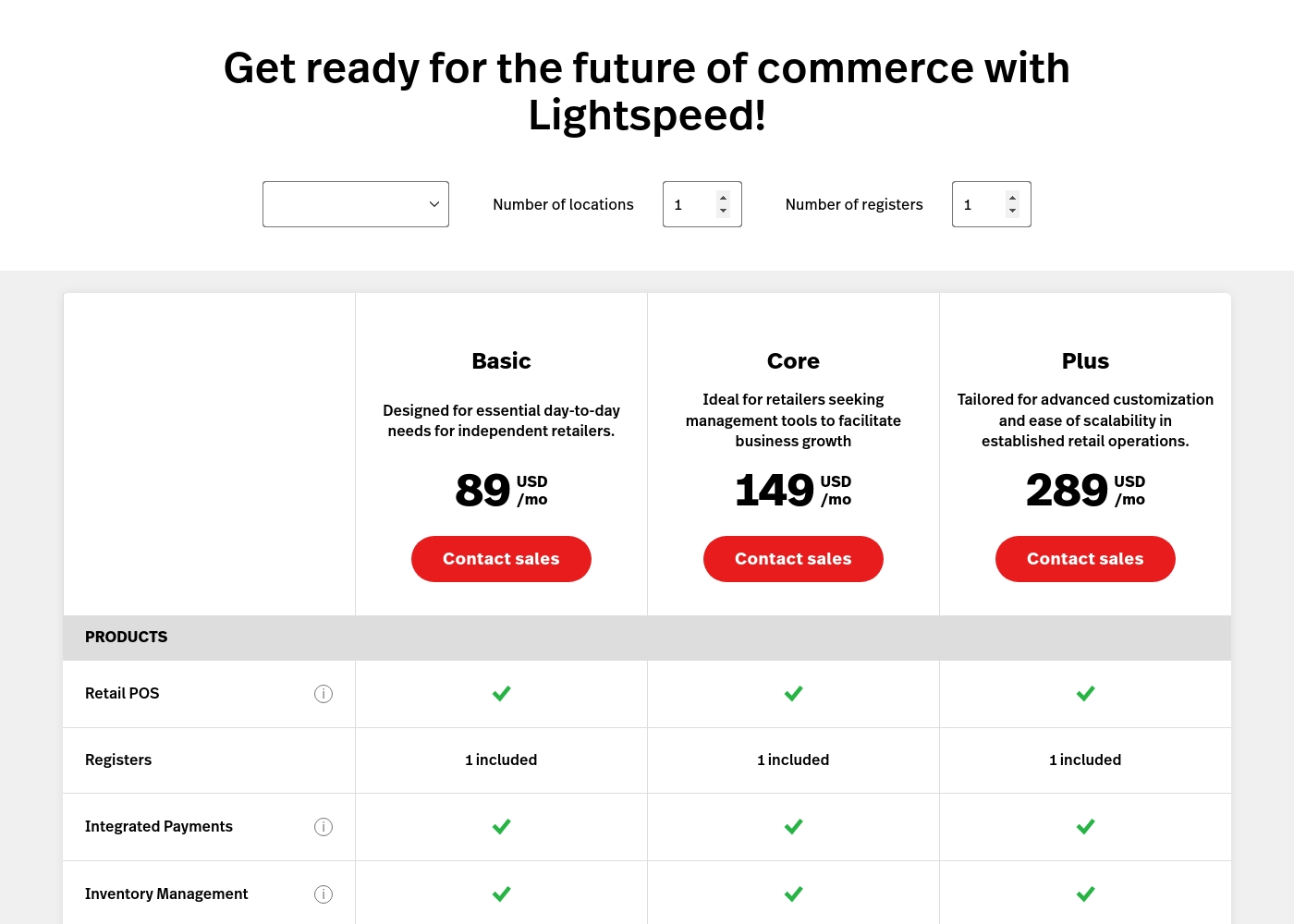
Lightspeed costs between $89 and $289 per month with three plans: Basic at $89/mo, Core at $149/mo, and Plus at $289/mo.
These prices are for the Lightspeed Retail (X-Series) product. They are base costs which cover one location and one register. If you need extra locations or additional registers, you will need to contact the sales team for specific pricing.
Basic
Price: $89 USD /mo Best For: Essential day-to-day needs for independent retailers Other Features: Retail POS, 1 register included, Integrated Payments, Inventory Management, Built-in Lightspeed eCommerce (Basic), In-store and online loyalty, 24/7 support.
- Retail POS
- 1 register included
- Integrated Payments (1.5% card-present rate)
- Inventory Management
- Built-in Lightspeed eCommerce (Basic)
- All Basic features
- Landed Costs
- Insights (Forecasting, order recommendations & custom reporting)
- API access
- Workflows
- All Core features
- Tailored for advanced customization and ease of scalability
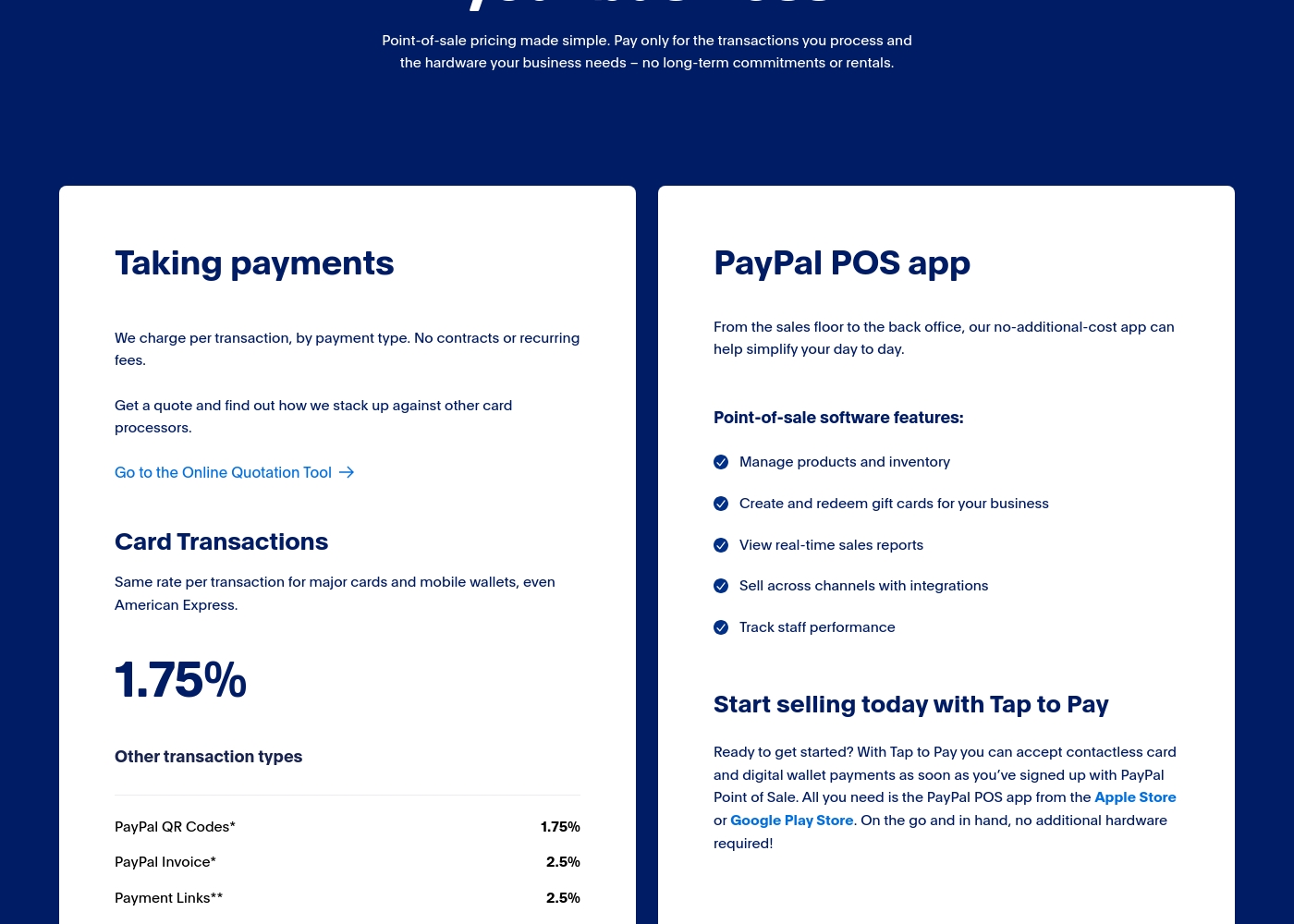
Zettle focuses on simple, transaction-based pricing. You only pay for the payments you process and the hardware your specific business needs. There are no long-term contracts or recurring fees for the software.
PayPal POS App (Software)
Price: No additional cost Best For: Businesses needing core POS functions without monthly subscription costs. Other Features:
- Manage products and inventory
- Create and redeem gift cards
- View real-time sales reports
- Sell across channels with integrations
- Track staff performance
This app acts as your central POS hub. It's included at no additional cost and provides robust tools to handle sales, inventory, and staff management right from your mobile device. Just sign up and download the app to streamline your daily operations. You can even start taking payments right away using Tap to Pay on your existing phone or tablet.
- No additional cost
- Manage products and inventory
- Real-time sales reports
- Tap to Pay enabled
- 1.75% rate for card transactions
- Includes major cards and mobile wallets
- Includes PayPal QR Codes
- No contracts or recurring fees
- Tailored fee structure
- Requires monthly card transactions over £10,000
- Dedicated sales assistance
Pricing Notes
- Lightspeed's listed monthly prices ($89-$289) exclude costs for additional registers or store locations.
- Lightspeed charges a highly competitive fixed 1.5% card-present transaction rate across all plans.
- Zettle offers a free core POS app with absolutely zero monthly recurring software fees.
- Zettle imposes higher transaction fees (up to 2.5%) for remote payments like invoices and payment links.
- High-volume sellers using either Lightspeed or Zettle should contact the sales teams for beneficial custom rate plans.
Pricing Head-to-Head
User Reviews
Lightspeed is widely praised for its comprehensive platform, which effectively consolidates POS, inventory, and loyalty programs into one user-friendly system. Users frequently applaud the excellent onboarding and dedication of specific support representatives, noting their patience and knowledge during complex setups and upgrades.
Customers also appreciate the reliable, cloud-based operation and frequent software updates. However, ongoing service quality is inconsistent outside of initial setup, with some users reporting unresolved issues and long waiting periods for support 😥.
Kanwal was so amazing to work with! She was patient and helpful throughout the entire onboarding process. It is rare to find someone in technical support who seems to be enjoying their job.
Users generally find the Zettle (PayPal POS) system easy to use and convenient, making it ideal for small or mobile businesses. Many users praise the card reader for its reliability and speed during transactions.
A significant point of positive feedback revolves around customer support. Agents are often described as prompt, knowledgeable, and helpful, often resolving issues quickly with a real person on the line, which is rare in this industry.
Great for payments and we received excellent customer service. They are quick to answer the phone, and you speak to a friendly person, not a bot. They took the time to resolve my issue easily.
Our Verdict
Deciding between Lightspeed and Zettle boils down entirely to your current size and ambition. Lightspeed is the enterprise-lite system; Zettle is the mobile powerhouse. If you are serious about expansion, Lightspeed is the clear future-proof investment required. Lightspeed's comprehensive platform unifies inventory, reporting, and multiple locations seamlessly. Its 1.5% fixed transaction rate and 24/7 expert support are essential for scaling retailers. You get powerful growth tools like forecasting and custom user roles even on the mid-tier plans. Zettle, however, is the champion of simplicity and low fixed costs for small operations. The core Zettle POS app is totally free with no contracts or any monthly recurring fees. Zettle is ideal for mobile operations or businesses needing simple card acceptance right now. You can start processing transactions immediately using the Tap to Pay feature on your smartphone. Just download the Zettle app, and you are ready to sell instantly. The deciding factor is complexity: Do you need deep control over complex inventory across multiple stores and channels? Choose Lightspeed. Do you need the lowest overhead and maximum payment portability for markets or pop-ups? Choose Zettle. Go with Lightspeed if you run a growing brick-and-mortar store or specialized venue needing deep data. Choose Zettle if you primarily operate mobile, pop-up shops, or need a cheap, reliable backup payment processor.
Frequently Asked Questions
Which is cheaper: Lightspeed or Zettle?
Zettle is cheaper for low-volume businesses because the core app is free to use. It operates on a pay-as-you-go model with no monthly fees required. Lightspeed starts at $89/month plus transaction costs, making it a higher fixed expense.
Does Zettle offer the same advanced reporting as Lightspeed?
No, Lightspeed offers detailed forecasting, landed costs calculation, and specialized retail insights. Zettle provides robust real-time sales reports but focuses much less on advanced retail analytics. Lightspeed is better for strategic business plotting.
If I am a high-volume seller, should I choose Lightspeed or Zettle?
Lightspeed is better for high volume due to its significantly lower 1.5% card-present transaction rate. Lightspeed is also designed to handle the complexity and scaling of ambitious high-volume multi-location businesses.
Can I use my smartphone as a POS terminal with Lightspeed?
Zettle fully supports using your compatible smartphone as a payment terminal via the Tap to Pay app feature. Lightspeed requires purchasing or integrating standard register hardware based on your subscription tier.
Which service has better customer support availability: Lightspeed or Zettle?
Lightspeed offers superior coverage with guaranteed 24/7 support via both phone and chat on all plans. Zettle's acclaimed support is unfortunately restricted to standard weekday business hours.
Is Lightspeed difficult to set up compared to Zettle?
Lightspeed offers expert whiteglove onboarding to manage complex setups smoothly and quickly. Zettle is much simpler; you download the free app and start accepting payments instantly, minimal effort required.
Ready to Choose?
Both tools have their strengths. Choose based on your specific needs.