Lightspeed vs Shopify POS
Choosing between Lightspeed and Shopify POS defines your retail strategy. Lightspeed provides powerful, specialized tools for complex scaling businesses. Shopify POS is the definitive leader in unifying online and physical sales flawlessly. Your current e-commerce focus should guide your decision today.
Best for: Retailers processing large volumes with complex inventory needs, Established businesses seeking expert, personalized setup and support

Best for: Online businesses making their first step into physical retail locations, Casual sellers requiring basic transaction processing for markets (Starter plan)
Robust platform with exceptional onboarding.
We find Lightspeed offers an exceptionally detailed and user-friendly platform, successfully unifying inventory, POS, and loyalty features for ambitious businesses. While the implementation and onboarding support are repeatedly excellent, the platform faces criticism for inconsistent post-setup responsiveness and high long-term costs. Overall, Lightspeed is a robust solution for ambitious retailers who prioritize comprehensive features and can manage the escalating price of specialization.
Pros
- Exceptional onboarding and setup support from dedicated specialists.
- Comprehensive cloud-based platform encompassing POS, inventory, and loyalty.
- User-friendly system with detailed features and frequent updates.
- Effective inventory management functionality is highly praised.
Cons
- Customer service for resolving ongoing issues can be slow or inconsistent.
- Cost increases significantly with add-ons (e.g., rewards program nearly doubles the price).
- Base pricing excludes the cost of extra locations and additional registers.
- Some core features lack basic functionality, such as modifying or duplicating Purchase Orders.

Powerful omnichannel, constrained by support and cost.
Shopify POS excels at unifying online and physical sales, offering features like automatic inventory sync and centralized management that modern retailers need. Overall, we must apply a significant discount to the rating due to the universally reported failures in customer support and the high recurring cost required to access advanced retail features via POS Pro.
Pros
- Achieves true omnichannel synchronization across all sales channels.
- Inventory levels are updated automatically with every transaction.
- Manage all aspects of the business from a single back office.
- Platform offers a robust app ecosystem for customization.
Cons
- Customer support is consistently reported as non-existent or unhelpful.
- Advanced retail features require POS Pro, adding $89/month per location.
- Users report platform instability and occasional reliability issues.
- Highly complex tiered pricing structure can become costly quickly.
AboutLightspeed
Lightspeed is a comprehensive commerce platform built specifically for growing businesses. It provides one seamless touchpoint for all your operational needs. Whether you run a retail store, a fast-paced restaurant, or a specialised golf facility, Lightspeed helps you manage crucial tasks better. It’s an innovative, easy-to-use system that combines multilocation tools, integrations, and reports into a single hub. This reliable platform is trusted by businesses in over 100 countries, supporting roughly 144,000 customer locations globally.
AboutShopify POS
Shopify POS is a complete system blending powerful hardware and software designed for seamless in-person sales. It provides the tools necessary to processes transactions and accept payments anywhere. This POS system is flexible enough to support retailers of every size, from new stores to those running multiple locations. If you sell products both online and in person, this tool is specifically designed to unify those channels. Your entire business is managed from a single back office, helping you simplify daily tasks and save time. ✅
Highlights
Feature Comparison
Features Overview
We highlight the main differences and pick a winner for each feature.
Customer Support
Lightspeed offers expert, whiteglove onboarding and dedicated help. Shopify POS support is widely criticized as non-existent or bot-based.
Lightspeed prioritizes personalized support from initial setup to daily operation. They offer 'whiteglove onboarding' and 24/7 phone assistance for expert help. This focus means you work with specialists familiar with industry demands. Meanwhile, Shopify POS offers stated 24/7 support across paid plans. However, user reviews universally report poor service quality and unresponsive chatbots. Trying to resolve critical issues with Shopify POS can become difficult and frustrating quickly. Lightspeed treats support as a partnership for growth and scaling success. Shopify POS relies more on self-service documentation and its app developer ecosystem. This service difference is often the deciding factor for complex operations.
Advanced Inventory
Lightspeed includes specific retail tools like Landed Costs. Shopify POS excels primarily at automatic cross-channel syncing.
Lightspeed shines when managing complex retail inventory needs. It includes advanced features like Landed Costs calculation on Core and Plus plans. You also gain Forecasting Insights and custom reporting capabilities here. Shopify POS automatically updates inventory levels with every sale, whether online or in person. This prevents overselling across the unified platform. Yet, it lacks the specialized tools like Landed Costs built into Lightspeed’s base offerings. If deep operational insight is key, Lightspeed has superior integrated features. Shopify POS requires integrating third-party apps for similar specialized inventory functions. Lightspeed is built for the inventory complexity of scaling retailers.
Omnichannel Syncing
Shopify POS is natively built for unified online/offline sales. Lightspeed integrates eCommerce, but focuses more on in-store complexity.
Shopify POS provides a single back office to manage all sales channels seamlessly. Automatically syncing sales across the website and physical store is its core strength. This unified data supports flexibility like buying online and picking up in-store easily. Lightspeed provides built-in or integrated eCommerce solutions across its tiers. It effectively manages inventory across channels. However, its primary design focus is optimizing the physical retail environment and operational workflow. If your business started online and expanded physically, Shopify POS offers the perfect bridge. Lightspeed is better suited if you started physically and want to unify operations there first. For true online/in-person unification, Shopify POS holds the advantage.
Pricing Model
Lightspeed offers simpler fixed pricing plus register costs. Shopify POS requires a base plan PLUS an $89/month POS Pro fee per store.
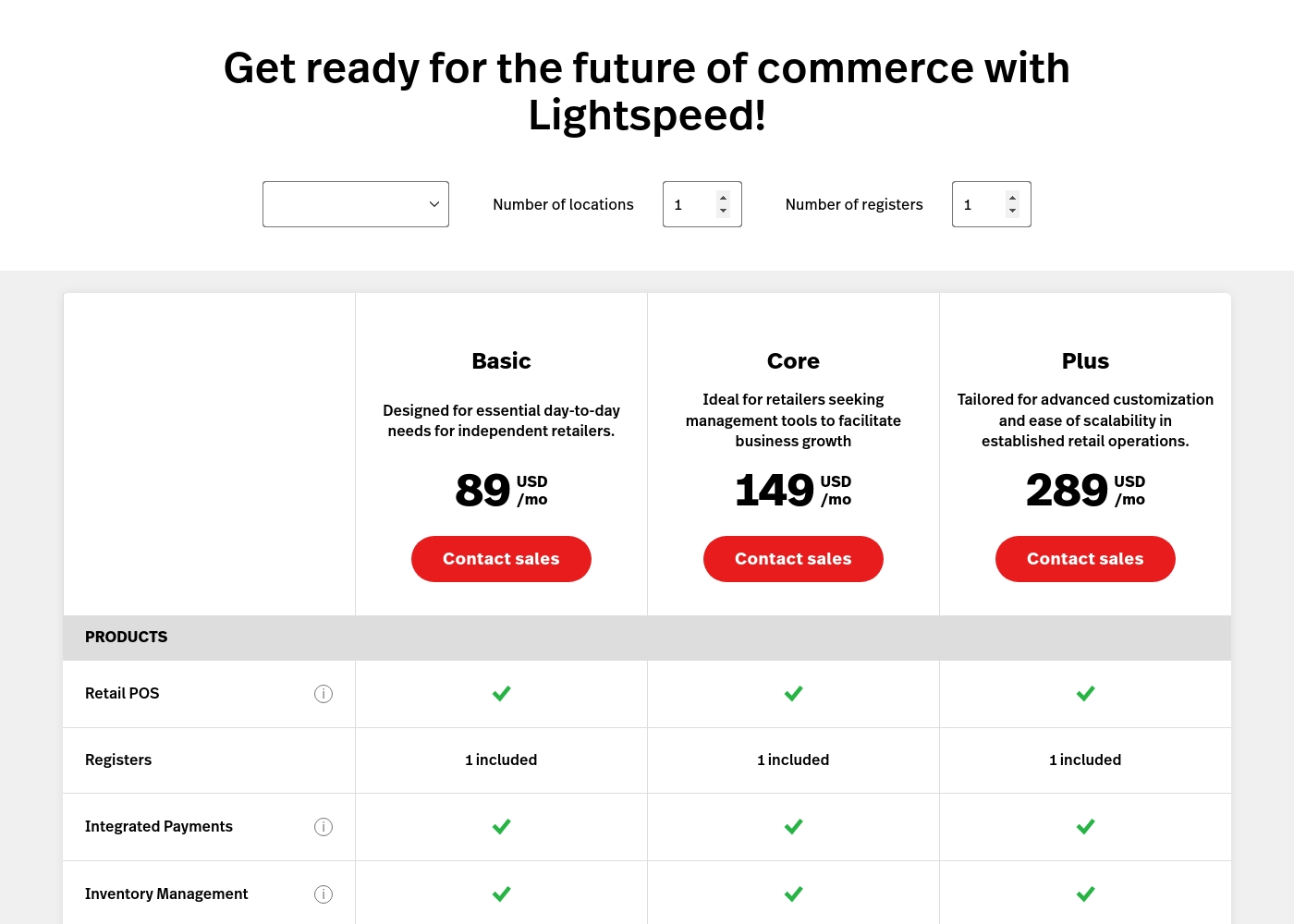
Lightspeed offers base prices from $89-$289 per month, including one register and location. Additional registers and locations require contacting sales for a custom quote. Features like Landed Costs are simply included in the higher tiers. Shopify POS pricing is more complex, linking a base Shopify plan (starting at $5/month) with POS functionality. You must add ‘POS Pro’ at $89/month for each location needing advanced retail tools. This necessary add-on can quickly escalate total costs. Lightspeed’s fixed 1.5% card-present process rate is highly appealing for predictability. Shopify POS rates vary greatly, declining from 5% down to 2.4% + 10¢ on its highest plans. Evaluate both transaction rates and fixed monthly fees carefully.
Lightspeed costs between $89 and $289 per month with three plans: Basic at $89/mo, Core at $149/mo, and Plus at $289/mo.
These prices are for the Lightspeed Retail (X-Series) product. They are base costs which cover one location and one register. If you need extra locations or additional registers, you will need to contact the sales team for specific pricing.
Basic
Price: $89 USD /mo Best For: Essential day-to-day needs for independent retailers Other Features: Retail POS, 1 register included, Integrated Payments, Inventory Management, Built-in Lightspeed eCommerce (Basic), In-store and online loyalty, 24/7 support.
- Retail POS
- 1 register included
- Integrated Payments (1.5% card-present rate)
- Inventory Management
- Built-in Lightspeed eCommerce (Basic)
- All Basic features
- Landed Costs
- Insights (Forecasting, order recommendations & custom reporting)
- API access
- Workflows
- All Core features
- Tailored for advanced customization and ease of scalability
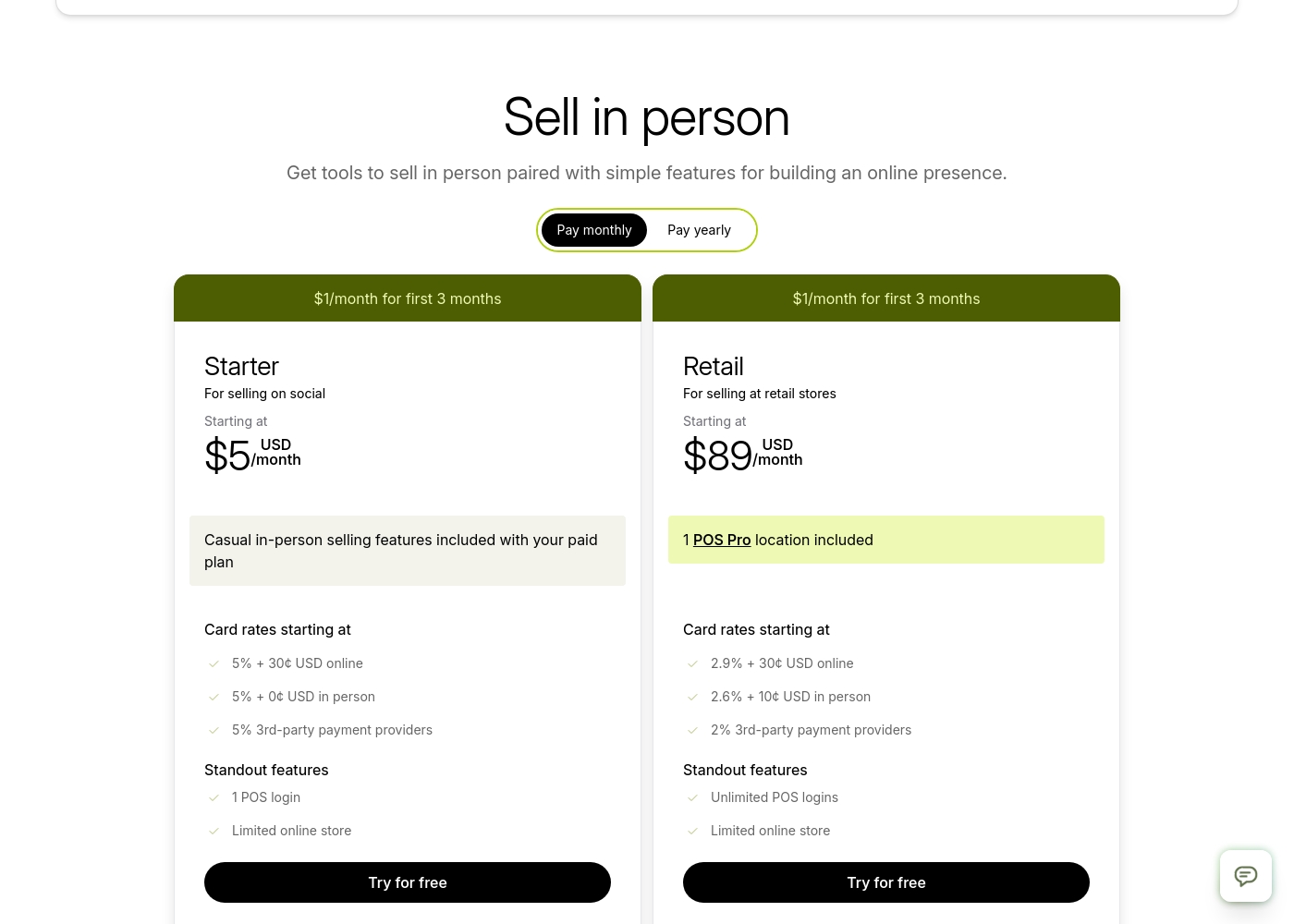
Shopify POS costs between $5 and $399+ per month with 5 main plans (excluding POS Pro add-ons): Starter at $5/month, Retail at $89/month, Basic at $39/month, Grow at $105/month, and Advanced at $399/month.
Below you can review the specific details for these monthly subscription rates, including what they offer for selling both online and in person.
Starter
Price: $5 USD per month Websites Supported: Limited online store Best For: Selling on social/Casual in-person selling Other Features:
- 1 POS login
- Highest card rates (5% + 0¢ USD in person)
- Casual in-person selling features included
- 1 POS login
- Limited online store
- Casual in-person selling features included
- Card rates starting at 5% + 0¢ USD in person
- 1 POS Pro location included
- Unlimited POS logins
- Limited online store
- Card rates starting at 2.6% + 10¢ USD in person
- Unlimited POS logins
- Full-featured online store
- Card rates starting at 2.6% + 10¢ USD in person
- Requires $89 USD/month for each POS Pro location
- 5 staff accounts
- Unlimited POS logins
- Full-featured online store
- Card rates starting at 2.5% + 10¢ USD in person
- Requires $89 USD/month for each POS Pro location
Pricing Notes
- Lightspeed base pricing covers a single location; scaling requires contacting sales for custom quotes.
- Shopify POS requires the additional $89/month POS Pro fee for true retail functionality at each physical location.
- Lightspeed offers a fixed, transparent 1.5% card-present transaction rate.
- Shopify POS transaction fees decrease only on higher-tier, more expensive subscription plans.
Pricing Head-to-Head
User Reviews
Lightspeed is widely praised for its comprehensive platform, which effectively consolidates POS, inventory, and loyalty programs into one user-friendly system. Users frequently applaud the excellent onboarding and dedication of specific support representatives, noting their patience and knowledge during complex setups and upgrades.
Customers also appreciate the reliable, cloud-based operation and frequent software updates. However, ongoing service quality is inconsistent outside of initial setup, with some users reporting unresolved issues and long waiting periods for support 😥.
Kanwal was so amazing to work with! She was patient and helpful throughout the entire onboarding process. It is rare to find someone in technical support who seems to be enjoying their job.
User sentiment regarding the Shopify ecosystem is highly critical, primarily concerning customer service and platform reliability 😥. Many independent business owners and consumers report that support is virtually non-existent, unhelpful, or relies heavily on frustrating chatbots, making it nearly impossible to resolve critical issues like billing errors or account access.
A major recurring concern is the perception that Shopify does not adequately vet its merchants, leading non-selling customers to face frequent scams and fraud when purchasing through the platform. This lack of accountability creates serious trust issues for buyers.
I would give zero stars if I could! Customer support does not exist. I am currently paying for an account I cannot log into because they only use a useless chatbot for recovery. This is unacceptable for business owners.
Our Verdict
The final decision between Lightspeed and Shopify POS depends entirely on your retail foundations. If complex operations and dedicated support are paramount, Lightspeed is your winner. Lightspeed provides expert, personalized 'whiteglove onboarding' and advanced inventory tools. The system includes critical functions like Landed Costs and Forecasting insights in its Core plans. Plus, the fixed 1.5% card-present processing rate is highly predictable and attractive. Lightspeed is built to unify your operations as you aggressively scale. Shopify POS is the superior choice if you started online and need physical retail to conform. It offers the best seamless synchronization of inventory and sales data for true omnichannel success. Its app ecosystem provides endless flexibility for customization. However, budget for the costly $89/month POS Pro fee for every store location you open. Furthermore, be ready to handle most issues yourself; user reviews widely condemn Shopify POS customer support quality. Lightspeed is robust retail management; Shopify POS is e-commerce in a store. For high-volume, established retail needing reliability and deep features, choose Lightspeed. If online selling is 80% of your business and you prioritize simple syncing, Shopify POS is the right platform to start with.
Frequently Asked Questions
Which is better for multi-location businesses: Lightspeed or Shopify POS?
Lightspeed is arguably better for advanced multi-location management and specialized needs. It includes advanced features like Custom User Roles in its base plans. Shopify POS charges an additional $89/month POS Pro fee for every physical store location.
Does Lightspeed offer better transaction rates than Shopify POS?
Yes, for card-present sales. Lightspeed provides a transparent and fixed 1.5% rate across all plans. Shopify POS rates start higher and only drop to 2.4% + 10¢ on its most expensive plan.
Which system is easier to get started with for a new store?
Shopify POS is slightly easier due to its 3-day free trial. However, Lightspeed offers professional 'whiteglove onboarding' specialized for your industry. This expert help can make the initial setup much smoother.
Can I use Lightspeed to manage my online store easily?
Yes, Lightspeed includes a 'Built-in Lightspeed eCommerce' solution across all tiers. This ensures your online and physical product, inventory, and sales data are integrated.
Which platform offers superior customer service?
Lightspeed wins this comparison easily according to user reports. Lightspeed provides personalized expert support and 24/7 accessibility. Shopify POS users frequently report non-existent or inadequate bot-based customer support.
Does Shopify POS include advanced inventory features like Landed Costs?
No, specialized accounting features like Landed Costs are built into Lightspeed's Core plan. Shopify POS focuses on automatic inventory syncing and relies on its app ecosystem for advanced reporting.
Ready to Choose?
Both tools have their strengths. Choose based on your specific needs.
