Leadfeeder vs Zoominfo
Leadfeeder and Zoominfo both accelerate B2B revenue, but they focus on different parts of the pipeline. Leadfeeder excels at converting anonymous website traffic into qualified leads. Zoominfo is a vast, all-in-one GTM platform for massive outbound prospecting. Your choice is between identifying active inbound intent or maximizing outbound data breadth.
Best for: Sales teams needing warm, immediate leads from inbound website traffic, Small to mid-sized B2B companies prioritized on immediate conversions
Best for: Large enterprise GTM teams executing massive outbound strategies, Businesses requiring deep firmographic data enrichment and AI-guided workflows
Advanced B2B Lead Identification, High Risk.
We found Leadfeeder offers powerful B2B visitor identification features, including robust filtering and unique remote employee recognition capabilities. However, we note consistent customer reports detailing unresolved CRM integration failures and problematic auto-renewal billing policies that undermine its fundamental value proposition. Overall, the powerful features are currently overshadowed by serious concerns regarding support responsiveness.
Pros
- Highest company recognition rate available, identifying remote workers.
- Quick setup requiring a simple Google Analytics connection.
- Robust filtering system using over 50 firmographic and behavioral signals.
- Allows identification of companies engaging with ad campaigns.
Cons
- Reportedly flawed and unresolved two-way Dynamics CRM integration features.
- Aggressive annual auto-renewal policy lacking timely notification reminders.
- Customer support is frequently criticized as non-existent or unhelpful.
- High subscription cost scaling based significantly on volume of identified companies.
High Cost, Low Data Accuracy.
We find external user reports indicate a vast mismatch between ZoomInfo's advertised capabilities and actual user experience regarding data accuracy and value. Reports consistently point to aggressive sales practices and inflexible, high-cost contracts that users feel trapped within. Overall, we cannot recommend investing in the platform until these reported issues regarding core data quality, value for money, and customer trust are decisively resolved.
Pros
- AI-powered B2B intelligence platform (based on company description).
- Offers comprehensive solutions for Sales, Marketing, and Talent.
- Provides real-time buyer intent data and signals.
- Explicitly offers a free trial option.
Cons
- Contact data accuracy frequently reported as low (55%–60%).
- Extremely high pricing with poor reported return on investment (ROI).
- Aggressive sales tactics and rigid, complex contracts.
- Widespread concerns regarding unresponsive customer support.
AboutLeadfeeder
Leadfeeder is a powerful tool designed to help salespeople, marketers, and agencies find hidden opportunities in their web traffic. Its unique technology scans incoming traffic and identifies the companies visiting your website based on their IP address. This works even if employees are working from home. Once identified, the tool helps you uncover exactly what those companies are interested in, confirming their true buying intent. This crucial data processing meets all necessary GDPR legislation requirements. ✅
AboutZoominfo
ZoomInfo is a powerful, AI-driven Go-to-Market (GTM) intelligence platform. It provides the clean, accurate, and compliant B2B data you need for every stage of your sales process. Thousands of GTM, product, and growth teams worldwide rely on this platform every day. Instead of acting only as a contact database, ZoomInfo uses generative AI and machine learning across the entire customer journey. This approach helps teams effectively identify and acquire their ideal customers. 💡
Highlights
Feature Comparison
Features Overview
We highlight the main differences and pick a winner for each feature.
Core Data Type
Leadfeeder identifies companies already visiting your site; Zoominfo offers a vast data repository.
Leadfeeder’s core strength is identifying anonymous B2B website visitors using IP tracking. This quickly turns page views into qualified pipeline leads. Leadfeeder focuses on real-time, immediate inbound intent signals. Zoominfo is fundamentally a massive database of verified contacts and B2B company data points. It is designed to fuel comprehensive outbound sales and marketing efforts. If you have high website traffic, Leadfeeder is unmatched for conversion. If you need millions of contacts for cold outreach, Zoominfo is the clear choice. Zoominfo provides the haystack for outreach, while Leadfeeder pinpoints the qualified needle already seeking you out.
Real-time Intent
Leadfeeder focuses on behavioral intent; Zoominfo focuses on topic-based buyer intent.
Leadfeeder tracks behavioral intent by monitoring exactly which pages a prospect visits on your site. This confirms explicit interest, like visiting a pricing page. Zoominfo provides real-time buyer intent signals based on off-site research topics and purchasing activity. This helps identify accounts beginning a research journey. Leadfeeder gives you immediate context on a warm lead’s current interest. Zoominfo enables you to target companies showing market interest, even if they haven't visited you yet. For closing existing leads, Leadfeeder’s direct behavioral data is powerful. For finding new accounts, Zoominfo’s market-based intent is superior.
Pricing Structure
Leadfeeder uses volume pricing; Zoominfo charges per seat plus data usage credits.
Leadfeeder pricing is usage-based tied directly to the volume of companies identified monthly. The cost starts low and scales based on your website traffic volume. Zoominfo pricing is known for being expensive and complex, requiring licenses per seat plus costs for data export credits. This structure makes scaling user headcount costly. Leadfeeder includes unlimited users, which drastically reduces internal licensing costs for large teams. Zoominfo's seat cost adds significant overhead, even before data usage. If budget predictability and low internal user cost are key, Leadfeeder offers better transparency and value.
Technical Setup
Leadfeeder is simple and fast; Zoominfo requires a lengthier onboarding.
Leadfeeder boasts a quick setup, often just requiring a simple Google Analytics connection to start identifying visitors. You can get results in minutes. Zoominfo requires a more comprehensive onboarding process to integrate their GTM platform fully. Reviews indicate this setup can be slow and protracted. Leadfeeder is the ideal tool for fast evaluation or tactical deployment by smaller teams. Zoominfo is a strategic investment requiring full GTM alignment and effort. A faster time-to-value means sales teams can start acting on Leadfeeder data almost immediately.
Data Enrichment
Zoominfo automatically enriches data across your stack; Leadfeeder uses add-on Connectors.
Zoominfo excels in automated data quality and enrichment across your entire tech stack, including your CRM. It actively cleans contact and company records. Leadfeeder relies on add-on Connectors to power other tools with specific firmographic data. This provides enrichment but requires extra configuration. Zoominfo offers advanced, AI-driven automation for data cleansing and routing within their platform. This keeps your records fresh automatically. Choose Zoominfo if maintaining spotless, current CRM data is a critical, ongoing requirement for your enterprise operations.
Contact Accuracy
Zoominfo's contact data receives mixed reviews; Leadfeeder’s main output is verifiable company data.
Leadfeeder immediately provides firmographic data about the company visit, which is verifiably true intent. Contact discovery is a secondary function. Zoominfo's breadth is massive, but user reviews frequently cite issues with outdated contact details and data accuracy. This requires ongoing maintenance. Zoominfo is essential for finding millions of contacts required for cold outreach workflows. Leadfeeder focuses on giving you the right person *within* a company that showed interest. If quality and verifiable intent trump sheer quantity, Leadfeeder minimizes the risk of chasing bad data sets.
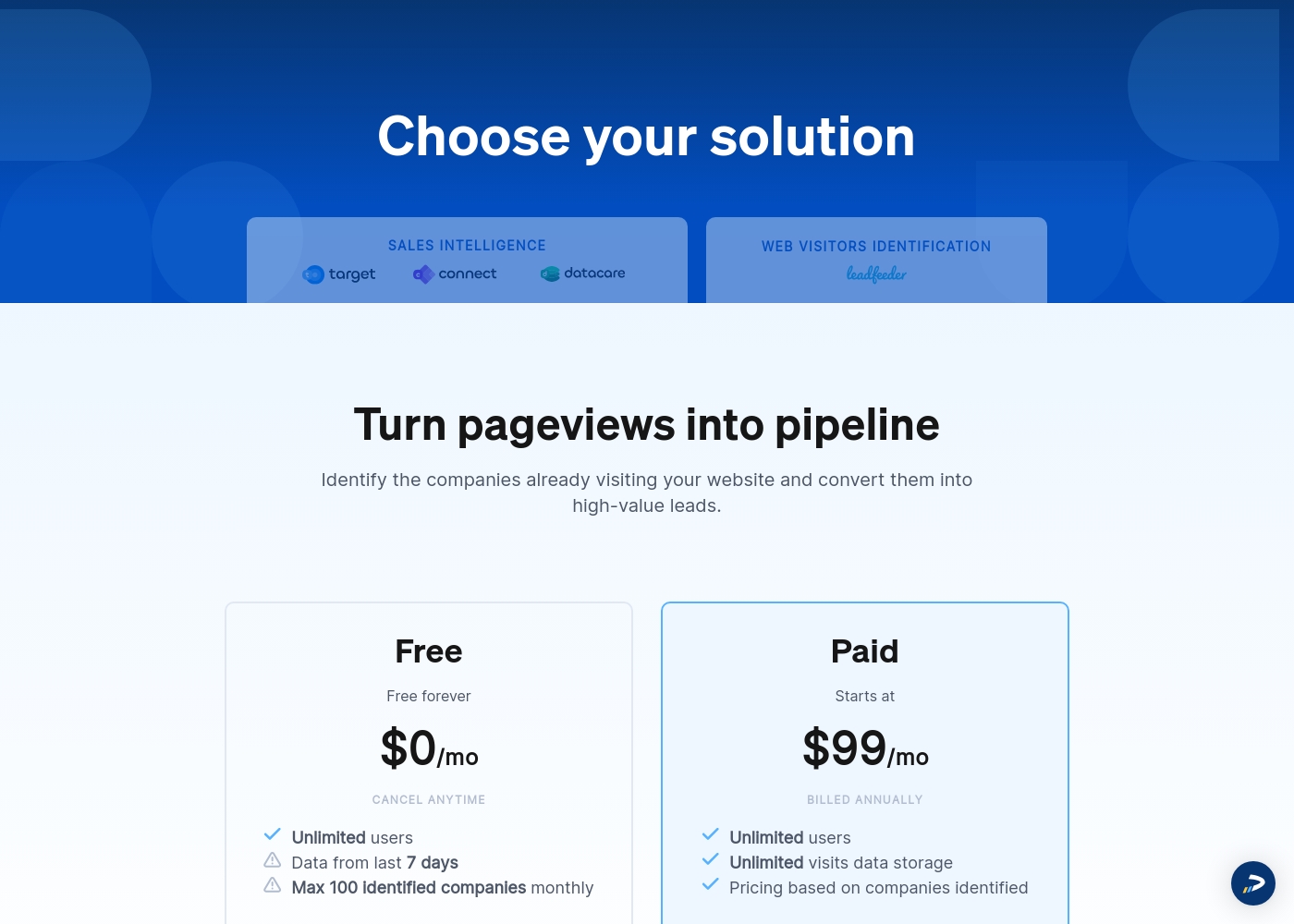
Leadfeeder costs between $0 and $99 per month (billed annually) with two plans: Free at $0 per month and Paid starting at $99 per month.
Here is a breakdown of what you get with each of the available identification solutions.
Free
Price: $0 per month Websites Supported: One per subscription (as subscriptions are priced per website) Best For: Small websites, evaluation, or testing the core feature set Refund Policy: Not applicable (It's free forever) Other Features: Unlimited users, data from the last 7 days, cancel anytime
- Free forever
- Unlimited users
- Verified company details (limited)
- Visitor data storage for the last 7 days
- Unlimited users
- Unlimited visits data storage
- All identified companies access
- Verified company details (firmographics & contact details)
- 25 contact export credits
Since pricing is very flexible and customized, you should contact the sales team for an exact quote. ZoomInfo structures its Go-To-Market (GTM) platform as flexible solution sets for different business functions.
Sales
Best For: Accelerating the entire sales process Other Features:
- Accurate email addresses and direct phone numbers
- Company insights and buying intent signals
- Engagement apps and integrations
This application is perfect for sales teams needing reliable contact data and real-time signals to prioritize accounts and close deals faster. It gives your team a clear, unfair advantage in the market.
- Accurate email addresses and direct dial phone numbers
- Company insights and buying intent signals
- Engagement apps and integrations
- Essential contact data and advanced company insights
- Digital marketing solutions for display advertising, website chat and form management
- Plug-and-play and flexible integrations
- Advanced candidate search with accurate contact data
- Sourcing intelligence with candidate alerts and company scoops
- Engagement apps and integrations
Pricing Notes
- Leadfeeder offers a perpetual Free plan and includes unlimited users in all paid tiers, minimizing licensing costs.
- Leadfeeder pricing scales transparently based only on the volume of unique companies identified visiting your website each month.
- Zoominfo's pricing is primarily based on seat licenses and credit usage, which is often cited by users as highly expensive and opaque.
- Zoominfo users frequently report aggressive sales tactics and burdensome auto-renewal policies in their contracts.
- Leadfeeder's annual billing option saves approximately 30% compared to monthly subscriptions.
Pricing Head-to-Head
User Reviews
The customer feedback available paints a highly polarized picture of Leadfeeder. While users appreciate the core functionality—its ability to identify visiting companies and connect quickly with Google Analytics—recent experiences highlight significant operational and support issues.
Many users found the tool useful for generating leads when paired with high website traffic. However, recurring negative comments focus heavily on the financial practices.
Leadfeeder is a very useful tool and an honest company. It helps us correctly identify website visitors, which allows us to add high-quality prospects to our sales database. The support team has been genuinely helpful throughout our time using the product.
User sentiment across external review platforms, primarily Trustpilot, highlights significant dissatisfaction. Users frequently report that the platform's core offering—contact data accuracy—is inconsistent, with several reviewers citing figures around 55% to 60%.
This low accuracy leads directly to complaints about the very high price point, feeling the service offers extremely poor value (e.g., $30K annual expense yielding zero qualified leads). Many users heavily criticize the aggressive sales tactics and opaque contract structure, often describing being misled or "locked in" to massive, auto-renewing agreements they cannot cancel, even after business dissolution.
The contact information is, at best, about 60% accurate, often dropping to 55%. The product pricing is also extremely high for the quality of data received. I do not recommend making this difficult investment unless you can negotiate a deep discount.
Our Verdict
This comparison is ultimately about deciding between quality inbound intent and sheer outbound data quantity. If your goal is maximizing sales efficiency by converting high-intent, anonymous web traffic, Leadfeeder is the winner. Leadfeeder proves who is already interested in your product. Leadfeeder’s superpower is its sharp focus on website visitor identification; it excels at showing you who is on your pricing page. Leadfeeder makes it easy to qualify leads with 50+ filters and offers unlimited users across all plans. This predictable, usage-based pricing structure is ideal for stabilizing your budget. Zoominfo’s superpower is its vast data ecosystem, enabling comprehensive GTM strategies and automation. Zoominfo provides millions of contacts and deep firmographic data for complex outbound campaigns. You gain AI-guided workflows and robust automated data enrichment capabilities with Zoominfo. Your core workflow is the deciding factor; do you convert website traffic or research new markets? Choose Leadfeeder if you need warm, immediate leads for your sales team right now. Pick Zoominfo if you need deep, market-wide data to fuel large-scale outbound efforts. Don’t forget the cost difference; Leadfeeder offers much higher user scalability at a clearer price point. Zoominfo is a significant investment, best reserved for large enterprises that can fully utilize its GTM feature set.
Frequently Asked Questions
Which tool is better for small B2B sales teams: Leadfeeder or Zoominfo?
Leadfeeder is generally better for small teams due to its lower entry cost and immediate ROI. Its pricing scales by usage, not requiring expensive seat licenses like Zoominfo. Leadfeeder’s focus on warm inbound leads is easier for small teams to manage quickly. Zoominfo is often a massive, expensive undertaking better suited for larger enterprises.
Does Leadfeeder provide the same depth of contact information as Zoominfo?
No, Zoominfo’s core business is providing a massive database of contacts and companies. Leadfeeder’s primary function is company identification from web traffic. Leadfeeder provides contacts as a secondary export feature, but Zoominfo offers vastly greater breadth and detail for cold prospecting.
How does Leadfeeder's intent data compare to Zoominfo's?
Leadfeeder provides behavioral intent data based on the pages a company visits on your website. Zoominfo provides buyer intent signals based on market research topics and off-site activity. Leadfeeder confirms immediate interest; Zoominfo spots early research for cold accounts.
Which tool is easier to integrate with my existing CRM?
Leadfeeder offers quick, native two-way sync integrations with major CRMs. Zoominfo also integrates seamlessly but focuses on automated data enrichment and cleansing. Leadfeeder is simpler for syncing; Zoominfo is more complex but better for maintaining data quality.
Is Zoominfo worth the much higher cost compared to Leadfeeder?
Zoominfo is worth the cost if your strategy heavily relies on comprehensive market data and massive outbound outreach. It is an all-in-one platform. If you mostly need to identify and connect with warm web visitors, Leadfeeder provides much better value for that specific task.
Which tool offers unlimited users in their paid plans?
Leadfeeder includes unlimited users in both its Free and Paid plans. This means you won’t face licensing fees for adding internal team members. Zoominfo requires purchased licensed seats, which significantly increases the overall cost.
Ready to Choose?
Both tools have their strengths. Choose based on your specific needs.