Later vs Loomly
Later and Loomly are both popular social media scheduling tools, but their core audience differs. Later is built for enterprise data, advanced analytics, and influencer marketing. Loomly focuses heavily on streamlined team collaboration and content approval workflows. Choose the tool that best mitigates highly negative user experiences regarding support and billing practices.
Best for: Enterprise organizations focused on measurable ROI, Marketing agencies managing performance-driven influencer campaigns
Best for: Small teams needing fast content creation workflows, Agencies needing systematic client content approval
Unreliable features; severely lacking customer support.
We observe that Later positions itself as a robust, data-driven platform crucial for enterprise social strategy, promising advanced features like competitive benchmarking. However, user experiences consistently highlight significant failures related to operational reliability, punitive billing practices, and severely lacking customer support responsiveness. Overall, we cannot recommend a platform where fundamental functionality proves unreliable and the stated refund policy appears disproportionately harsh.
Pros
- Access to a database of 14 million creators for influencer campaigns.
- Focused on real-time ROI measurement and competitive benchmarking features.
- Offers full-service flexibility for sophisticated marketing operations.
- Provides a comprehensive 14-day free trial across all paid plans.
Cons
- Strict auto-renewal policy leads to unexpected annual charges without refunds.
- Customer support is consistently reported as terrible, slow, and unhelpful.
- Core features, including posting and video quality, are often buggy or fail to work.
- Unilateral removal of key services (e.g., X/Twitter scheduling) post-purchase.
Unstable pricing and inaccessible support.
We observed that Loomly offers a feature-rich social management environment, historically praised for ease of use and client onboarding. However, recent, extreme price hikes and inaccessible customer support channels pose severe, well-documented risks. Overall, we rate this tool low due to the collapse of foundational business trust.
Pros
- Historically considered a fantastic and easy-to-use platform.
- Strong historical support for client collaboration and approval workflows.
- Access to post inspiration feeds and a royalty-free content library.
- Effective scheduling features (when technical integrations operate).
Cons
- Recent, extreme price increases (reported up to 900%) are pushing loyal users away.
- Customer support is currently inaccessible, relying primarily on non-helpful chatbots.
- Reliability issues with core platform integrations (e.g., persistent Instagram API limitations).
- Predatory billing practices, including automatic enrollment in expensive new tiers.
AboutLater
Later is a comprehensive social marketing solution built for enterprise brands. It offers much more than basic scheduling tools by combining advanced technology and full-service execution support.
It brings together three core pillars for market domination. This includes Later Social for content planning, Later Influence for running performance-based campaigns, and Social Listening 💡 for predicting new trends before they hit the mainstream. Think of it as uniting agency expertise with platform technology under one secure roof.
AboutLoomly
Loomly is an all-in-one social media management tool made for brands and the teams who manage them. It helps marketers increase their reach and build their brand presence online.
This platform lets you craft, optimize, schedule, and analyze content across all your social channels. It is designed to be simple and user-friendly, helping you level up quickly. 💡
Highlights
Feature Comparison
Features Overview
We highlight the main differences and pick a winner for each feature.
Analytics & Reporting
Later offers enterprise ROI tracking and competitive data; Loomly provides standard performance metrics.
Later focuses on deep, full-funnel ROI reporting, linking social campaigns to retail outcomes and sales impact. Later provides competitive benchmarking against up to 20 rival brands on its Scale plan. Later utilizes proprietary Social Listening to predict future industry trends. Loomly provides strong social analytics, monitoring audience engagement and follower growth. Loomly includes a URL shortener for click tracking and automated report delivery. Later is built for C-suite reporting, proving sales impact with hard data. Loomly focuses more on optimizing post-level performance. If you need data to justify large budgets and analyze competitors, Later is the tool. Loomly is effective for basic reports but lacks Later's corporate intelligence.
Content Approvals
Loomly is purpose-built for client approvals, offering multi-level customization.
Loomly excels with customizable, multi-level approval workflows for clients or teams. Loomly tracks all feedback clearly using an end-to-end post history log for complete transparency. You get content signed off quickly, preventing workflow bottlenecks. Later offers basic team collaboration and approval features on its Growth and Scale plans. While functional, Later's system lacks Loomly's dedicated multi-level customization. Loomly is engineered to simplify complex agency-style relationships and client sign-offs. Later's focus is on internal brand management. If you manage content for multiple external clients, Loomly offers a significantly smoother workflow.
Influencer Ecosystem
Later is a fully integrated influencer platform; Loomly offers no dedicated tools here.
Later's core strength is its massive 14 million creator database for influencer marketing. Later works with 200,000 vetted creators who produce measurable performance campaigns. Later tracks the full-funnel ROI of creator content right through to retail outcomes. Loomly focuses only on organic scheduling and entirely lacks dedicated influencer or creator sourcing tools. Loomly is primarily a content calendar tool, not a creator marketplace. If running measurable, data-driven influencer campaigns is crucial, Later is the required platform. Loomly cannot compete in this specialized area.
Pricing Reliability
Later’s prices are clear and predictable; Loomly users cite unpredictable, massive price hikes.
Later clearly defines its three tiers, ranging from $18.75 to $82.50 per month when billed annually. Later's pricing is transparent upfront, but users complain heavily about strict auto-renewal policies. Loomly does not publish explicit price tiers, which users suggest is due to extreme fluctuations. Customers report massive, abrupt price increases, sometimes up to 900%, destroying trust and budget certainty. Choosing Later means you know your budget for the year. Opting for Loomly carries a high risk of steep, unannounced financial penalties.
Creative Assets
Loomly includes a massive asset library and editor; Later relies on external tools.
Loomly makes content production faster with access to 5 million royalty-free photos and videos. Loomly also provides a built-in image and video editor for quick post adjustments. Loomly integrates directly with Canva, Unsplash, and Google Drive for asset management. Later, while focused on sophisticated strategy and data, lacks these in-platform creative tools. Later requires users to source and edit assets externally. If your team needs one place for creation, editing, and scheduling, Loomly is the better fit.
Customer Support
Later offers a priority option; Loomly's human support is reportedly inaccessible via chatbot.
Later includes Priority Support on its Scale plan, guaranteeing a 12-hour response time. Lower Later tiers rely on basic email support through a chatbot, which users frequently call slow and unhelpful. Loomly users report support is virtually inaccessible, relying on frustrating, non-helpful chatbots only. Critical technical issues often remain unresolved on Loomly. Later at least provides a path to guaranteed human interaction for high-tier customers. Later is the safer bet if you might need immediate hands-on help.
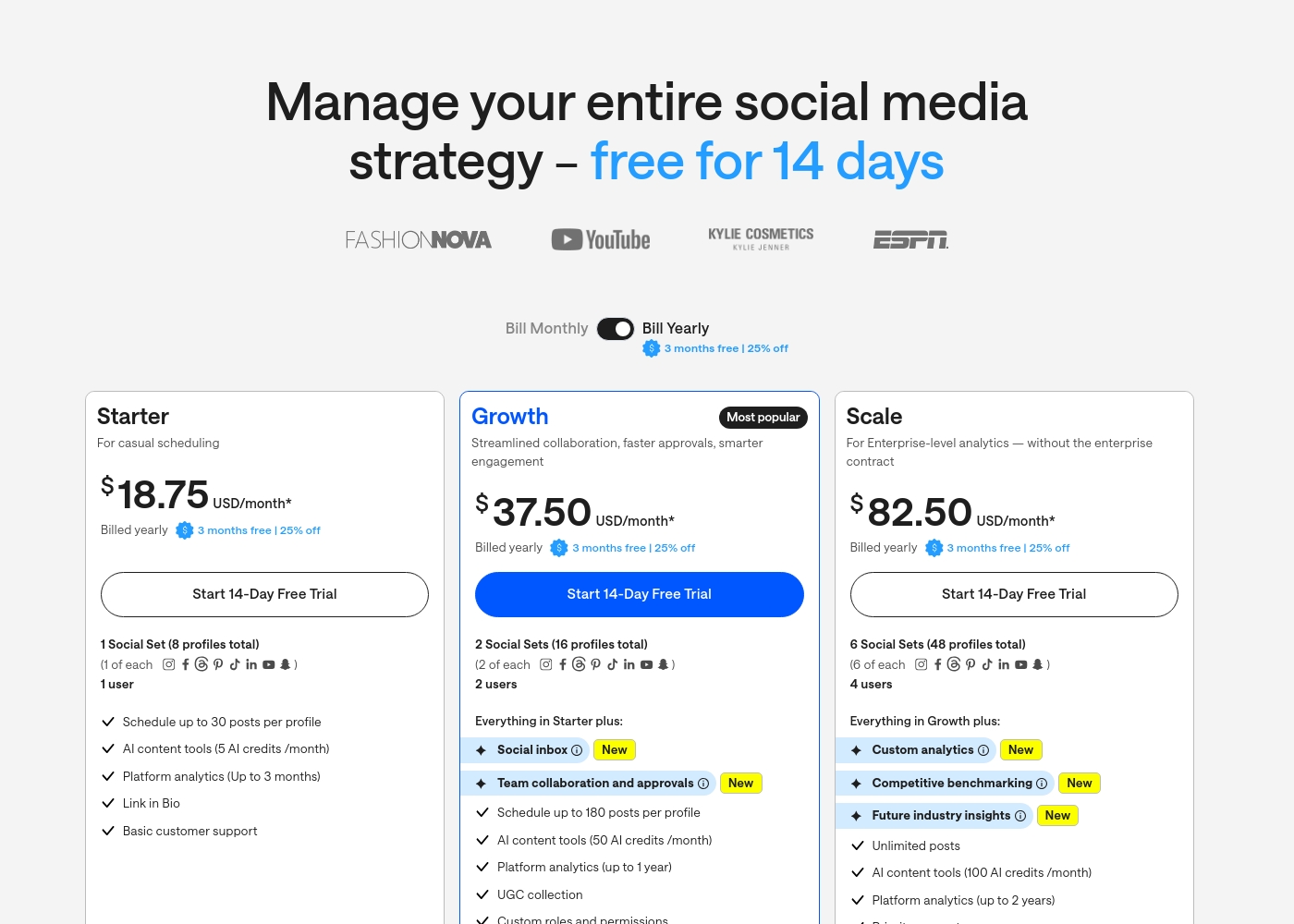
Later costs between $18.75 and $82.50 per month (when billed yearly) with three plans: Starter at $18.75/month, Growth at $37.50/month, and Scale at $82.50/month.
This overview helps you quickly understand the structure of the plans. Below, you can find the detailed features for each level, optimized for different needs, from casual scheduling to enterprise-level analytics.
Starter
Price: $18.75 USD/month (Billed yearly, includes 3 months free | 25% off) Websites Supported: 1 Social Set (8 profiles total) Best For: Casual scheduling Other Features:
- Schedule up to 30 posts per profile, per month
- AI content tools (5 AI credits /month)
- Link in Bio features
- Basic customer support
- Platform analytics (Up to 3 months of data)
- 1 Social Set (8 profiles total)
- 1 user
- AI content tools (5 AI credits/month)
- Link in Bio
- Basic customer support
- 2 Social Sets (16 profiles total)
- 2 users
- Social inbox
- Team collaboration and approvals
- UGC collection
- 6 Social Sets (48 profiles total)
- 4 users
- Custom analytics
- Competitive benchmarking
- Future industry insights
Although we cannot show specific prices right now, Loomly offers flexible tiers designed to fit different team sizes and social media needs. These plans scale efficiently to support content management for organizations ranging from individual marketers up to large agencies managing robust social media campaigns.
Core Features Plan (Implied Base Tier)
Other Features:
- Social media planning and scheduling across platforms
- Access to a royalty-free photo and video library
- Daily post inspiration, so you never run out of ideas
- Built-in tools for designing and editing visuals
This introductory level is likely ideal for individual users or small businesses focused on streamlining their basic content workflow and maintaining a consistent posting cadence. It gives you the fundamental toolkit to preview, schedule, and auto-post your content efficiently toward achieving better social media results.
Pricing Notes
- Later offers clear, published pricing starting at $18.75/month when billed annually.
- Later uses 'Social Sets' (8 profiles each) and post limits to tier its plans.
- Loomly does not publish explicit prices, which users suggest is due to massive, unpredictable price hikes.
- Later charges extra for users ($3.75/month) and extra Social Sets ($11.25/month).
- Loomly provides a slightly longer 15-day free trial that requires no credit card.
Pricing Head-to-Head
User Reviews
Feedback for Later is sharply skewed toward negative experiences, primarily citing significant dissatisfaction with customer support and billing practices. Many users report the company’s strict auto-renewal and no-refund policy results in unauthorized yearly charges, often without notification or consent 🙅♀️.
The customer service is routinely described as terrible, slow, and unhelpful, often relying on automated responses that fail to resolve critical issues like failed posting attempts or inability to cancel. Users also highlight poor software reliability; some features, including the high-value Later Influence platform, were reported as buggy or useless.
This company auto-renewed my subscription pulling an annual fee without consent. They flatly refused to refund the charges, even a partial amount. This shows remarkable greed and poor ethics in their business practices.
User feedback focuses heavily on recent, dramatic changes that have severely impacted trust and usability. While Loomly was historically seen as a well-functioning platform with smooth onboarding, recent reviews are overwhelmingly negative 📉.
The most frequent and critical complaint revolves around abrupt, massive price increases, frequently cited as 300% to 900% hikes, often coupled with automatic enrollment in the costly new plans or insufficient notice, forcing small businesses and entrepreneurs to leave. Reliability is also a persistent concern, with users reporting technical issues connecting to platforms like Facebook and persistent Instagram API limitations, such as constraints on video length or square image formatting.
After years of loyalty, Loomly sent notice raising my price nearly 300% without explanation or justification. This massive price hike is shocking and unacceptable for a small business that relies on stable budgeting. We had no choice but to terminate service and move our content elsewhere.
Our Verdict
Choosing between Later and Loomly means accepting a different set of severe operational risks. If your goal is high-level data and strategic insights, Later is the technical winner. If a smooth creation and approval workflow is essential, Loomly offers a better collaboration experience. Later’s superpower is its deep, data-driven approach built for enterprise brands. Later integrates influencer marketing with full-funnel ROI tracking, linking social to actual sales. Its Scale plan provides unlimited posts and key competitive trend analysis. Choose Later if proving real financial impact is your primary objective. Loomly’s strength lies in making content creation and approval effortless for teams. Loomly offers unique features like daily idea feeds and a 5-million asset library. Its multi-level approval workflows are perfect for getting client content signed off quickly. Loomly is ideal for agency workflow and consistency. The deciding factor is budget certainty versus workflow optimization. Later offers transparent pricing but has poor baseline support. Loomly offers superior collaboration but presents a massive financial risk with user-reported, unpredictable price hikes. Pick Later if you need undeniable, enterprise-grade data and a clear annual budget. You should only choose Loomly if exceptional client approval workflow outweighs the serious concern of radical, sudden cost increases.
Frequently Asked Questions
Which tool has better client approval workflows: Later or Loomly?
Loomly is superior for approvals with its customizable, multi-level workflows. Loomly provides an end-to-end post history for transparent client feedback. Later has solid team approvals but lacks Loomly's deep customization for managing external sign-offs.
How does Later's influencer network compare to Loomly's features?
Later focuses heavily on influencers, offering access to its 14 million creator database and full-service execution support. Later tracks sales performance data from creators for ROI analysis. Loomly does not offer any dedicated influencer or creator tools whatsoever.
Which platform offers more reliable pricing transparency?
Later provides clear, published pricing tiers ranging from $18.75 to $82.50 per month when billed annually. Loomly does not publicize its prices and users report massive, unpredictable price increases, sometimes up to 900%.
Is Later or Loomly better for advanced reporting and competitive insights?
Later is significantly better, offering full-funnel ROI tracking and competitive benchmarking against up to 20 rivals. Later uses proprietary Social Listening to predict future industry trends, a feature Loomly entirely lacks.
Which tool provides better creative assets and editing features?
Loomly is stronger here, giving you access to 5 million royalty-free assets and a built-in image and video editor. Loomly integrates directly with Canva and Google Drive for asset management. Later relies primarily on external tools.
Do Loomly and Later both offer a unified inbox for response management?
Yes, both Loomly and Later feature a unified social inbox to centralize replies and comments. Loomly allows you to assign conversations to teammates and use saved replies to speed up response times.
Ready to Choose?
Both tools have their strengths. Choose based on your specific needs.