KiwiHR vs Tellent
KiwiHR and Tellent are two leading HR platforms for growing teams. KiwiHR focuses on simplicity and core HR tasks. Tellent offers a more integrated, modular suite for the entire employee lifecycle.
Best for: Small to mid-sized businesses needing straightforward core HR, Teams prioritizing simplicity and quick implementation
Best for: Growing companies needing a scalable, modular HR suite., HR teams seeking to automate manual tasks and centralize data.
Intuitive HRIS for growing teams.
We found that this modular platform excels at simplifying core HR tasks like tracking leave and managing personnel files. Users frequently highlight the platform's intuitive interface and highly responsive support team as key strengths. Overall, we recommend it for small to mid-sized companies seeking to centralize their essential HR administration easily and efficiently.
Pros
- Very user-friendly interface for both admins and employees.
- Exceptional customer service that is reactive and solves issues fast.
- Efficiently centralizes employee records and automates leave tracking.
- Flexible, month-to-month subscription options are available.
Cons
- Low 3.0 aggregate TrustScore suggests underlying issues not captured in positive feedback.
- Specific advanced reporting functions, like combined yearly leave reports for tax purposes, were requested by users.
Strong modular suite for growing teams.
We find Tellent offers a powerful, integrated platform for automating HR and recruitment. Its modular design is ideal for mid-sized companies scaling their operations. Overall, it's a solid choice for centralizing people data, though implementation requires planning.
Pros
- Unifies recruiting, HR, and performance management in one platform.
- Offers strong automation and AI features to reduce manual tasks.
- Provides a flexible, modular system that scales with company growth.
- Features a large partner ecosystem (500+ integrations) for connectivity.
Cons
- Pricing is not transparent publicly and requires contacting sales.
- The modular setup may involve a complex initial configuration.
- May not be cost-effective for very small businesses or solopreneurs.
- Advanced customization and deeper technical features can have a learning curve.
AboutKiwiHR
This powerful modular solution covers the entire employee journey in one centralized system. It is a simple Core HR solution built right alongside built-in performance management capabilities. You can start with the modules you truly need and easily add components as your team grows. This helps you unify recruitment, essential HR management, and talent development in one cohesive location. ✅
AboutTellent
It's a People Decision Platform. Think of it as a single, connected suite for recruiting, core HR, and performance management. It's built for mid-sized and growing companies (they mention 7,000+ customers globally) that want to streamline operations. The system is modular, so you can start with what you need, like the ATS, and add an HRIS or performance tools later. 💡
Highlights
Feature Comparison
Features Overview
We highlight the main differences and pick a winner for each feature.
Platform Scope
KiwiHR is a focused core HR tool. Tellent is a full People Decision Platform covering recruiting, HR, and performance.
KiwiHR excels at simplifying essential tasks like leave tracking and employee records. It's designed to be a straightforward system for core administration. Tellent connects an ATS, HRIS, and performance management in one place. This creates a single source of truth from hiring to development. The key difference is breadth. KiwiHR handles the essentials well. Tellent aims to be the central hub for your entire workforce strategy.
Recruiting Power
Both have ATS tools, but Tellent offers deeper automation and a global hiring ecosystem.
KiwiHR provides basic recruitment features to help manage applicants alongside your HR data. Tellent's ATS is a core module with customizable workflows and AI tools. It claims to save teams 64% of time on manual tasks like email drafting. Tellent also offers a global partner network for localized hiring support. This gives it a clear edge for growing companies with complex recruiting needs.
Ease of Use
KiwiHR is often praised for its simple, intuitive design. Tellent's power comes with a slight learning curve.
Users frequently highlight KiwiHR's easy setup and navigation. It's built to minimize admin time without complex configuration. Tellent's modular system is also user-friendly but requires planning during initial setup. Its breadth means more features to learn. For pure simplicity, KiwiHR often wins. Tellent trades some simplicity for powerful, integrated capabilities.
Automation & AI
Tellent leads with practical AI for HR tasks. KiwiHR focuses on automating core processes.
KiwiHR automates leave requests, approvals, and basic employee journeys to reduce manual work. Tellent's AI generates candidate emails, translates job posts, and summarizes feedback. These features tackle specific, time-consuming recruiting tasks. Tellent's automation is more advanced and targeted at strategic HR pain points, especially in recruitment.
Integration Ecosystem
Tellent connects with 500+ partners. KiwiHR offers more limited integration options.
KiwiHR provides integrations for essential tools like payroll systems to streamline core HR functions. Tellent boasts an ecosystem of over 500 tech and service partners. This includes payroll, accounting, and specialized local implementation support. For companies with complex tech stacks, Tellent's vast partner network is a significant advantage.
Global Compliance
Tellent is built for international teams across 100+ countries. KiwiHR is better suited for simpler regional needs.
KiwiHR helps manage compliance for standard HR processes like leave and time tracking within specific regions. Tellent explicitly supports compliance in over 100 countries. It offers multi-language hiring and localized support teams globally. If you have a distributed global workforce, Tellent's built-in international focus is crucial.
Performance Management
Tellent includes a dedicated performance module. This is not a core offering for KiwiHR.
KiwiHR focuses on operational HR and does not include dedicated performance review or goal-tracking tools. Tellent's Performance Management module offers 360° feedback, development plans, and engagement surveys. It's designed to foster growth and retention. For teams wanting to unify performance with HR and recruiting, Tellent provides a complete solution.
Pricing Transparency
KiwiHR displays clear, public pricing. Tellent requires contacting sales for a quote.
KiwiHR's plans and starting prices are listed openly on their website, making budgeting straightforward. Tellent's pricing is modular and scales by company size. You must contact sales to get a detailed quote for your specific needs. KiwiHR wins for transparency, while Tellent's model allows for more customized costing.
Tellent, the People Decision Platform, costs between €83 and €1,374 per month with five main plans: ATS Start at €270/month, ATS Advance at €343/month, ATS Optimize at €1,374/month, Core HRIS Manage at €83/month, and Performance Management Grow at €83/month.
Tellent offers modular solutions; you can choose the Application Tracking System (ATS), the HRIS, or combine both to meet your specific business needs.
ATS Start
Price: €270/month (Save 20% with annual billing.) Best For: Early-stage teams building their fundamental hiring processes. Other Features:
- 5 active job posts
- CareersHub (single-page, no-code careers site)
- Multi-job board posting
- AI-powered email and feedback writing
- Standard reporting and analytics
- 5 active job posts
- CareersHub (single-page, no-code careers site)
- Team collaboration tools
- AI-powered email and feedback writing
- Unlimited data storage
- All Start features included
- Unlimited job posts
- CareersHub (multi-page, branded URL)
- ReferralsHub: employee referrals
- Candidate self-scheduling
- Everything in Advance included
- SSO and API support
- Testing environment
- Dedicated CSM and Onboarding support
- AI fairness tools and BI integrations
- Employee database and time/attendance management
- Absence and expense management
- HR reports & payroll support
- Custom modules for specific business needs
- Whistleblowing functionality
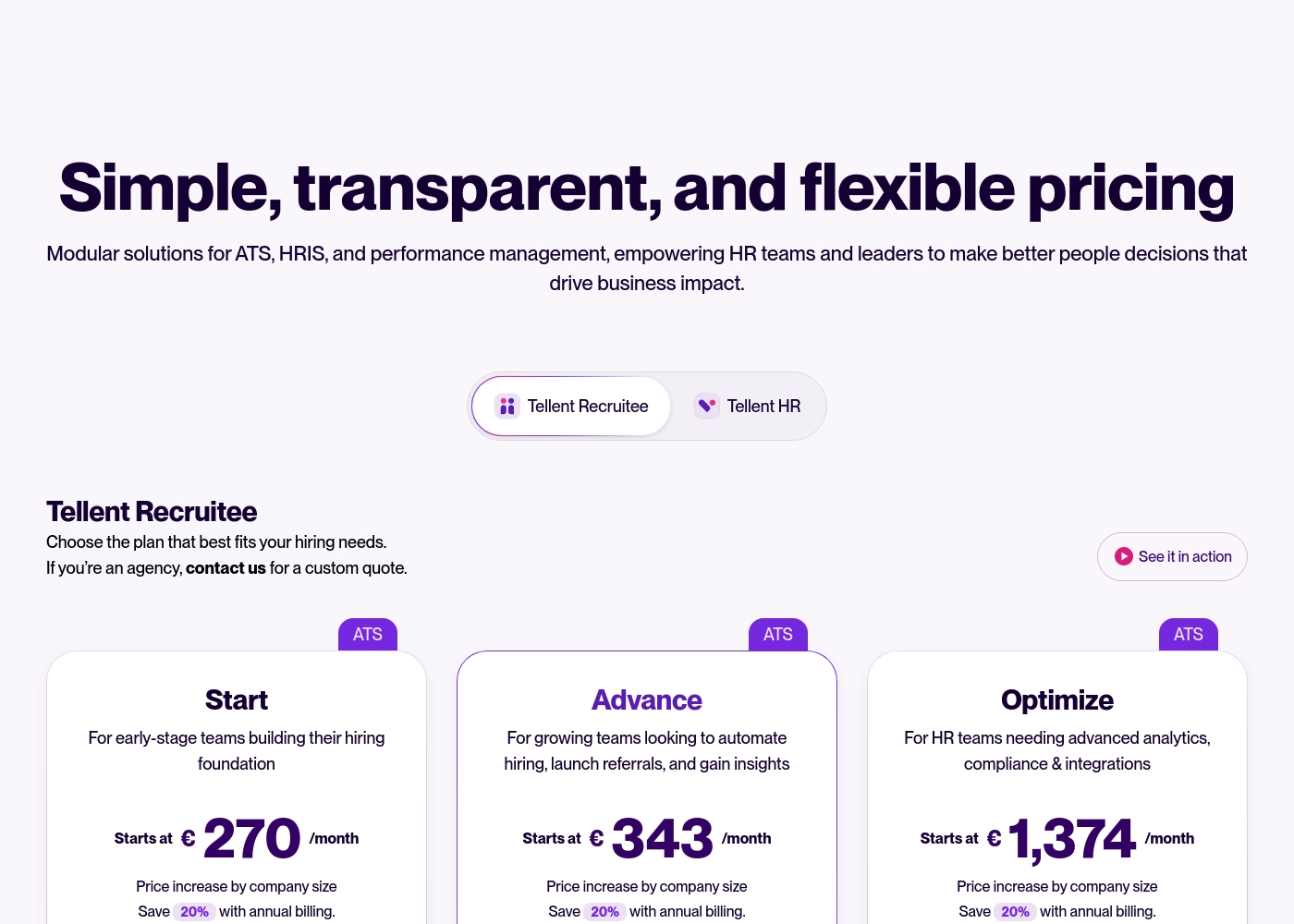
Tellent pricing: Tellent offers modular pricing with specific tiers for recruitment and HR management. Subscription costs increase based on your company's employee count with 20% savings available on annual plans. Plans range: 1–360/month Billing options: Free plan, Free trial, Monthly subscription, Yearly subscription, One-time payment, Usage-based pricing
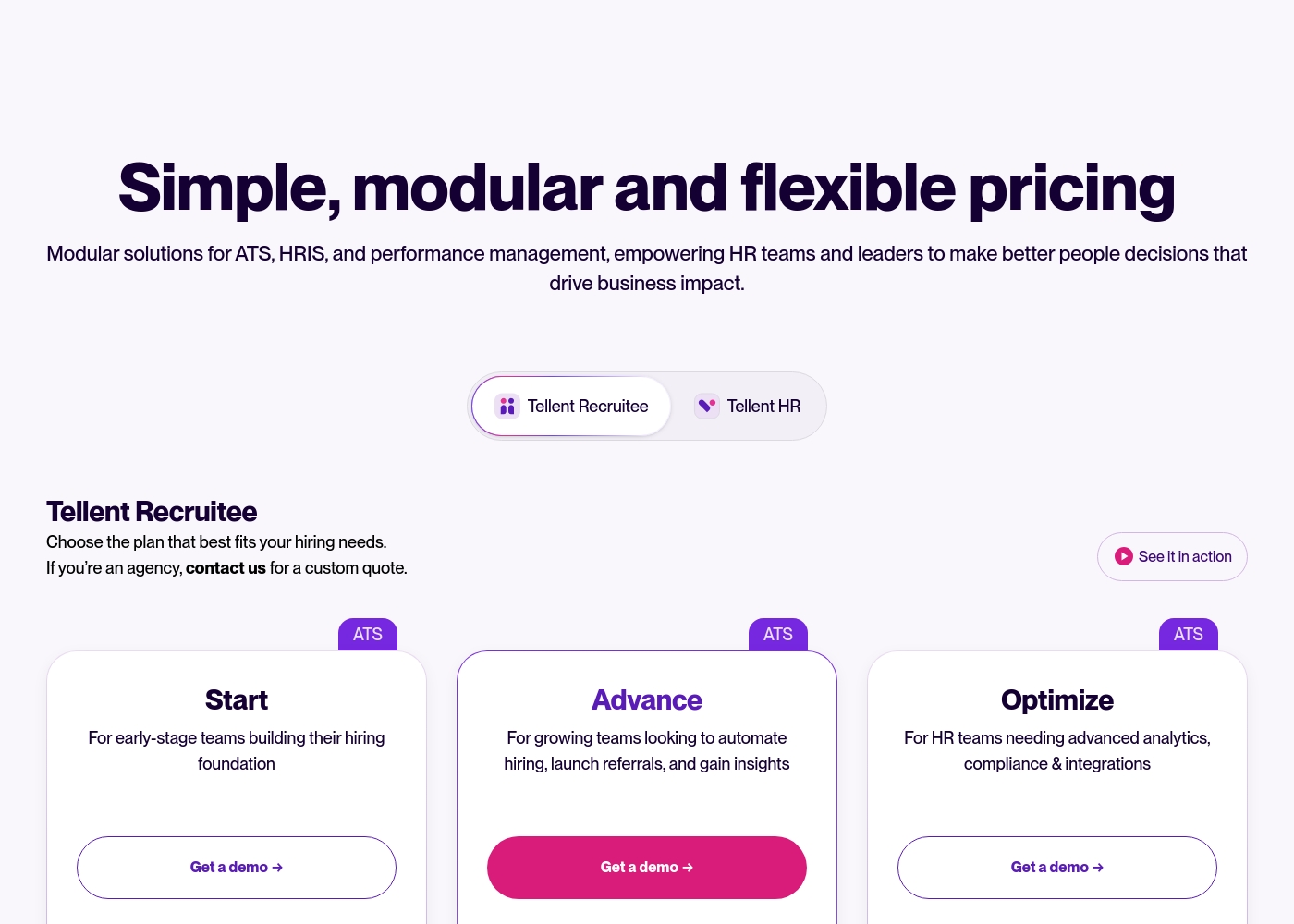
Pricing Notes
- KiwiHR's pricing is straightforward and publicly listed, simplifying budgeting.
- Tellent's pricing is modular; you pay for separate ATS, HRIS, or Performance modules.
- Tellent's cost increases dynamically with your employee headcount.
- Tellent offers an 18-day free trial. KiwiHR also offers a free trial.
- Tellent's high-tier 'Optimize' plan includes premium features like SSO and dedicated support.
Pricing Head-to-Head
User Reviews
The platform, known as KiwiHR and now Tellent HR, holds a 3.0-star rating across 56 Trustpilot reviews. Users consistently praise its exceptional ease of use, specifically noting the system is readily simple and accessible for both administrators and employees.
Reviewers often mention its effectiveness in cutting administrative load, especially for tracking leave and centralizing employee records. They appreciate the ability to step away from manual spreadsheets and value the automatic leave rollover feature, which simplifies recurring year-end processes.
Great overall experience. The platform is easy to use from both an admin and employee point of view. It provides a much needed turnkey HR solution that helps us focus on delivering our product.
From external reviews, Tellent receives praise for its intuitive interface and strong customer support, which helps teams onboard smoothly. Users often highlight the ease of use and the platform's ability to streamline recruitment and HR tasks.
However, some feedback points to occasional bugs and a learning curve with advanced features. Pricing can feel steep for smaller teams, and a few reviewers mention delays in support responsiveness during peak times.
The platform is really intuitive. It streamlined our hiring process and saved our team hours each week. Support has been helpful whenever we had questions.
Our Verdict
It's a close call, but Tellent edges ahead for most growing teams. Its integrated platform is just more powerful for connecting the dots between hiring, HR, and performance. KiwiHR's superpower is its laser focus on core HR. It does leave tracking and employee records with unmatched simplicity. If you need a clean tool for the essentials, KiwiHR delivers. Tellent's superpower is being a complete People Decision Platform. It unifies recruiting with HR data and adds performance management. Its AI tools and global compliance features are built for scale. The deciding factor is your growth stage. KiwiHR is perfect for teams that need solid, easy-to-use HR administration right now. Tellent is for companies planning their HR strategy for the next five years. Choose KiwiHR if you want immediate simplicity for core tasks. Choose Tellent if you're ready to invest in a scalable system that grows with your entire team.
Frequently Asked Questions
Which is easier to set up and use: KiwiHR or Tellent?
KiwiHR is generally considered easier due to its focused design. Tellent's modular system is user-friendly but requires more planning during initial setup for its broader features.
Does KiwiHR offer performance management tools like Tellent?
No, KiwiHR focuses on core HR and administration. Tellent includes a dedicated Performance Management module with 360° feedback and development plans.
Which platform is better for hiring across multiple countries?
Tellent is the better choice for global hiring. It supports compliance in 100+ countries and has a network of local service partners.
Is KiwiHR cheaper than Tellent?
KiwiHR's public pricing starts lower for core HR needs. Tellent's cost scales with company size and module selection, potentially offering more value for integrated needs.
Can I try both KiwiHR and Tellent before buying?
Yes, both offer free trials. Tellent explicitly provides an 18-day trial for its modules. KiwiHR also offers a trial period on its website.
Which integrates better with other software like accounting tools?
Tellent offers a significantly larger integration ecosystem with over 500 partners. KiwiHR provides essential integrations for common HR-related tools.
Ready to Choose?
Both tools have their strengths. Choose based on your specific needs.