Kit (formerly ConvertKit) vs Omnisend
Choosing between Kit (formerly ConvertKit) and Omnisend can feel tricky. Both are great email tools, but they're built for different people. Kit is for creators; Omnisend is for ecommerce stores.
Best for: Authors and writers building a reader community, Newsletter creators focused on subscriber growth
Best for: Small to medium ecommerce businesses, Online stores using Shopify, WooCommerce, or BigCommerce
Creator-friendly, but check support.
We find Kit a capable and intuitive email marketing platform tailored specifically for creators, offering strong automation and a clean interface. Overall, it's a great starting point for growing an audience, though users should weigh the mixed customer support reviews and potential pricing scale against their needs.
Pros
- Intuitive, clean interface designed for creators and non-technical users.
- Powerful visual automations and sequences to nurture audiences.
- Generous free plan for up to 10,000 subscribers.
- Strong focus on deliverability and building owned audiences.
Cons
- Customer support responsiveness and quality receive frequent criticism.
- Pricing can become steep as subscriber counts increase significantly.
- Some users report unexpected account suspensions or deliverability issues.
- Advanced analytics and collaboration features are limited.
Exceptional support meets powerful, intuitive automation.
We found Omnisend to be a high-value marketing platform, excelling due to its comprehensive permanent free tier and customer support praised across all user plans. The intuitive interface makes complex automation workflows accessible for growing e-commerce teams, driving significant sales. Overall, we recommend Omnisend strongly, particularly for businesses seeking robust email and SMS features combined with unmatched reliability.
Pros
- Exceptional 24/7 customer support is provided across all pricing tiers.
- The platform is highly intuitive, featuring easy drag-and-drop email design and workflow setup.
- The permanent free plan includes full feature access, including automation tools, essential for startups.
- Automation features are powerful, flexible, and include functionality like dynamic discount codes.
Cons
- Advanced integrations (like Shopify vs. WooCommerce) may offer different levels of feature depth.
- Some users seek expanded multilingual support options within the platform.
AboutKit (formerly ConvertKit)
Kit is an email marketing platform specifically for creators like authors, podcasters, YouTubers, and entrepreneurs. It's the hub for growing your email list, sending beautiful newsletters, and selling digital products—all while keeping the experience intuitive and straightforward. 💡
AboutOmnisend
Omnisend is an integrated platform for email and SMS marketing designed to engage your shoppers wherever they are. It’s an excellent option for small or medium-sized businesses looking to consolidate their marketing efforts.
The platform provides intuitive tools, making advanced marketing less intimidating. Every template is 100% customizable, ensuring your customer experience is always on-brand and personalized. You can connect Omnisend to your ecommerce platform with a single click. Switching is easy, and you can even be up and running in 30 minutes. 💡
Highlights
Feature Comparison
Features Overview
We highlight the main differences and pick a winner for each feature.
Email Automation
Kit gives creators visual control. Omnisend provides pre-built ecommerce workflows.
Kit (formerly ConvertKit) offers a visual automation builder to create email sequences from scratch. You can build complex nurture series and sales funnels. The Pro plan includes unlimited users for team collaboration. Omnisend provides pre-built automation templates for common ecommerce scenarios. This includes abandoned cart, welcome series, and post-purchase flows. Setup is designed to be fast and reliable. The key difference is flexibility vs. convenience. Kit is for building custom journeys; Omnisend is for plugging in proven sales workflows.
Ecommerce & Sales
Omnisend is built for online stores. Kit helps creators sell digital products.
Kit (formerly ConvertKit) lets you sell digital products, memberships, and subscriptions directly from your emails. It handles checkout, so you own the entire customer relationship. Omnisend integrates deeply with 160+ ecommerce platforms like Shopify and WooCommerce. It's designed to drive sales through integrated email and SMS campaigns. If you sell physical products, Omnisend is the clear choice. For courses or ebooks, Kit's built-in system works well.
SMS Marketing
Omnisend has native SMS. Kit doesn't offer this channel.
Kit (formerly ConvertKit) does not include SMS marketing features. Its focus is purely on email and growing an owned audience list. Omnisend offers integrated SMS campaigns alongside email. Pro plan users get monthly SMS credits. Omnisend data shows combining email and SMS boosts conversions by 47.7%. This is a major difference. If text message marketing is important, Omnisend is the only option here.
Ease of Use
Both are user-friendly, but in different ways. Kit is simple; Omnisend is intuitive for ecommerce.
Kit (formerly ConvertKit) is praised for its clean, intuitive interface designed for non-technical creators. The learning curve is low for basic email sending and list building. Omnisend features a drag-and-drop editor and is often described as having a low learning curve. Users highlight how easy it is to set up complex automations quickly. Both tools are easy to use. Kit feels simpler for solo creators; Omnisend feels more powerful for online store owners.
Customer Support
Omnisend has award-winning 24/7 support. Kit's support gets mixed reviews.
Kit (formerly ConvertKit) offers 24/7 email and chat support on paid plans. However, user reviews frequently mention slow response times and unhelpful agents. Omnisend provides award-winning, 24/7 priority support across all plans. They've won a Stevie Award and receive thousands of five-star reviews for their support. If reliable support is critical, Omnisend has a significant advantage here.
Reporting & Analytics
Omnisend offers more advanced ecommerce reporting. Kit provides basic insights.
Kit (formerly ConvertKit) includes an insights dashboard and deliverability reporting on the Pro plan. This is focused on email performance and list health. Omnisend provides advanced reporting, heat maps, and easy A/B testing deployment. High-volume senders get enhanced reporting tools to optimize campaigns. For data-driven ecommerce decisions, Omnisend's analytics are more robust.
Pricing & Value
Kit's free plan is generous for creators. Omnisend's free plan is limited but scales well.
Kit (formerly ConvertKit) offers a free Newsletter plan for up to 10,000 subscribers. Paid plans start at $39/month for 1,000 subscribers and scale with list size. Omnisend's free plan supports 250 contacts. Standard and Pro plans start at discounted rates. Pricing is based on contact list size. Kit's free tier is better for growing creators. Omnisend's value comes from its integrated features and reliable support.
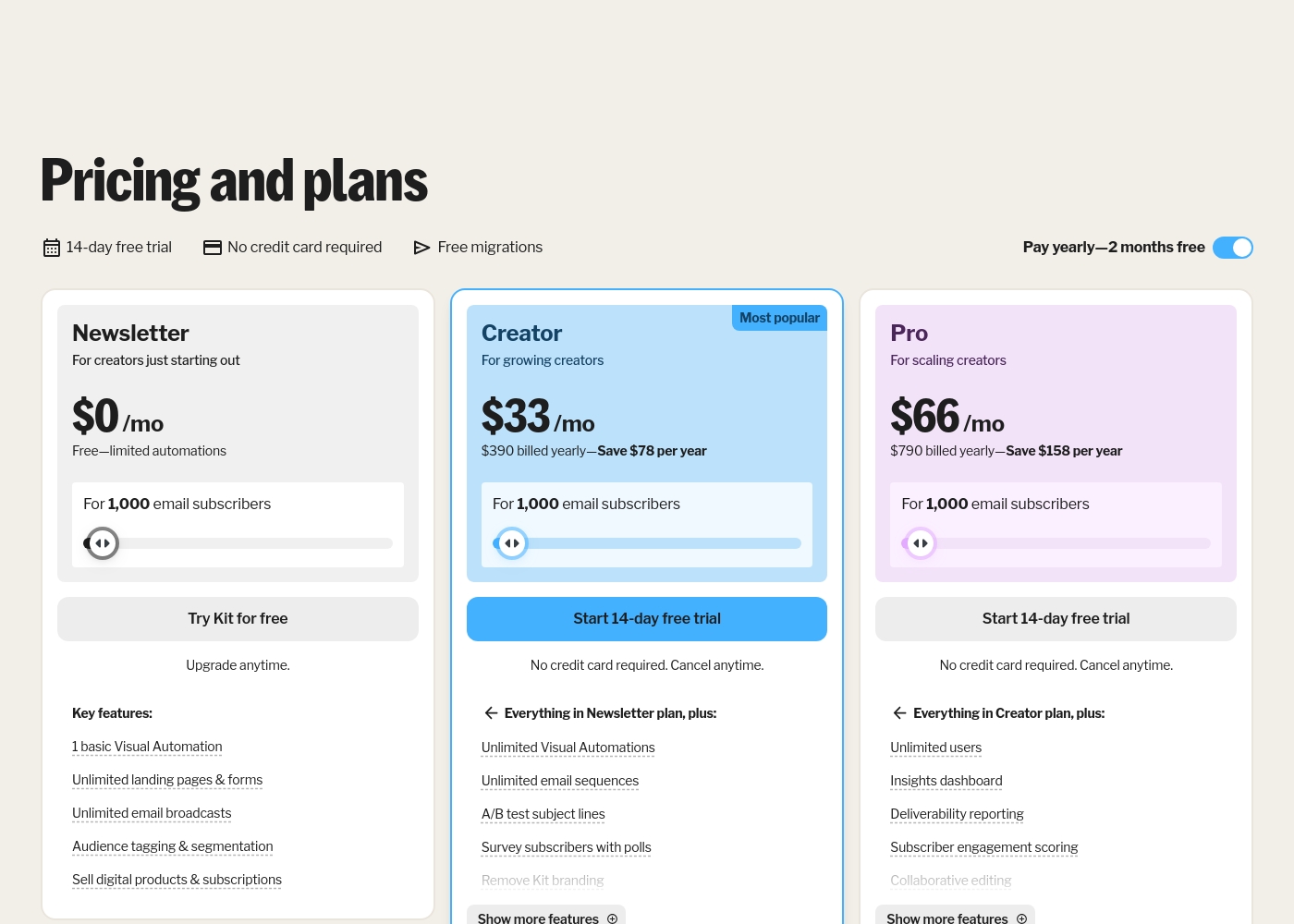
Kit (formerly ConvertKit) costs between $0 and $790 per year for 1,000 subscribers with 3 plans: Newsletter at $0, Creator at $390 billed yearly, and Pro at $790 billed yearly.
Take a look at the breakdown below to see which features fit your current creative goals.
Newsletter
Price: $0 per month Best For: New creators starting out Other Features: Unlimited landing pages, Audience tagging, Digital product sales, 1 basic Visual Automation
- 1 basic Visual Automation
- Unlimited landing pages & forms
- Unlimited email broadcasts
- Audience tagging & segmentation
- Sell digital products & subscriptions
- Everything in Newsletter plan
- Unlimited Visual Automations
- Unlimited email sequences
- A/B test subject lines
- Remove Kit branding
- Everything in Creator plan
- Unlimited users
- Insights dashboard
- Deliverability reporting
- Newsletter referral system
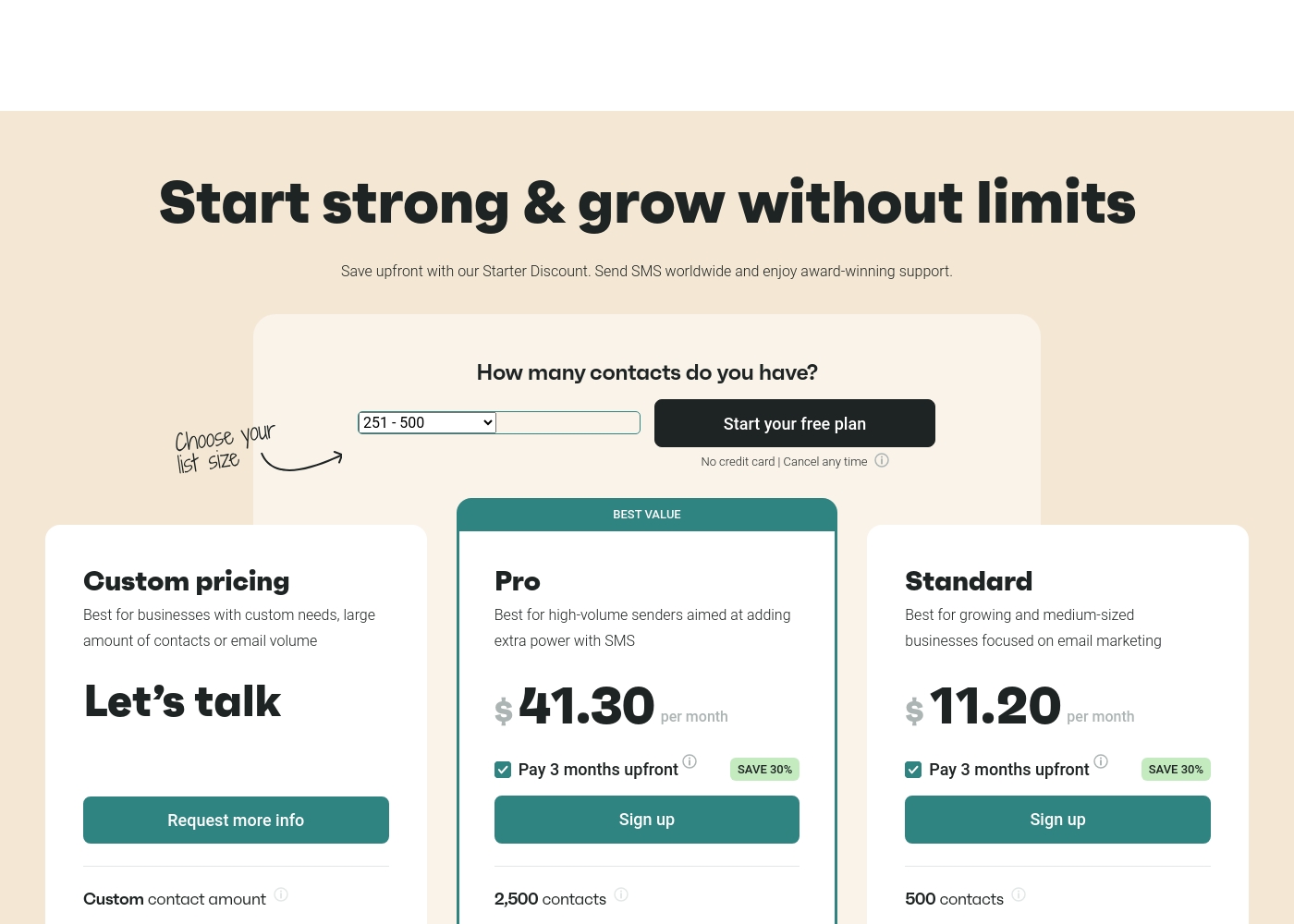
Omnisend costs between $0 and Custom Pricing per month, with three featured monthly plans: Free at $0, Standard starting at $11.20 (discounted rate), and Pro starting at $41.30 (discounted rate).
Omnisend plans are primarily determined by your contact list size, ensuring the plan scales naturally as your business grows. Let’s review the four available options, including the permanent Free tier and the paid growth plans.
Free
Price: $0 per month Best For: Small stores just starting out or merchants wanting to explore Omnisend features. Other Features:
- Reach up to 250 contacts
- Send 500 emails per month
- Includes $1 in free SMS credits to try the channel
- Access to all Omnisend features (including automation, segmentation, and forms)
- 500 emails/month
- 500 web push notifications/month
- $1 in free SMS to try
- Includes all Omnisend features
- 6,000 emails / month
- Unlimited web push notifications
- 24/7 Priority support
- Advanced reporting
- Unlimited emails
- Unlimited web push notifications
- Monthly bonus SMS credits equal to plan price
- Advanced reporting
- Personalized content ADD-ON
- Custom contact amount
- Unlimited emails and web push notifications
- Free migration and dedicated onboarding specialist
- Account Expert support (for spending >$400/month)
Pricing Notes
- Kit (formerly ConvertKit)'s free plan includes up to 10,000 subscribers, which is very generous for creators.
- Omnisend's free plan is limited to 250 contacts but includes all features, including automation.
- Kit's paid plans include a 14-day free trial without requiring a credit card.
- Omnisend offers a 30% starter discount for the first three months on Standard and Pro plans.
- Kit charges a 3.5% + $0.30 transaction fee on digital product sales, which is important to factor in.
- Omnisend Pro users receive monthly SMS credits equal to the price of their plan, adding significant value.
Pricing Head-to-Head
User Reviews
On Trustpilot, Kit (formerly ConvertKit) receives mixed feedback. Users frequently praise its ease of use, highlighting a simple, intuitive interface perfect for creators and beginners.
Many appreciate the automation features and clean design for emails and landing pages. However, a significant number of reviews cite poor customer support, with long response times and unhelpful agents.
ConvertKit is super easy to use. I love how simple it is to set up automations and sequences without any tech headaches. It's perfect for my newsletter.
Omnisend receives overwhelmingly positive feedback, primarily centered around its powerful features, exceptional ease of use, and award-winning support. Users frequently highlight the intuitive interface, praising the drag-and-drop functionality and the simplicity of setting up complex automation workflows.
Many reviewers praise Omnisend for offering better options and pricing compared to competitors like Klaviyo and Mailchimp. The customer service team is consistently commended, described often as “superb” and “exceptional,” providing personalized, responsive, and highly knowledgeable assistance, especially during complicated tasks like DNS setup and complex migrations.
By far the best email/marketing automation software I've used, having tried many alternatives. The platform is super easy and the free tier is essential for small businesses just starting out. I cannot stress enough how much I prefer Omnisend.
Our Verdict
Choosing between Kit (formerly ConvertKit) and Omnisend depends entirely on your business model. There's no single winner here—it's about the right fit. Kit (formerly ConvertKit)'s superpower is its focus on creators. It offers a massive free plan for up to 10,000 subscribers and tools to sell digital products directly. It's built for growing an email list and owning your audience. Omnisend's superpower is its integrated ecommerce engine. It combines email and SMS marketing to boost conversions by 47.7%. Its award-winning support and deep platform integrations are built for online stores. The deciding factor is what you sell. If you're a creator selling digital products or building a newsletter, Kit is your tool. If you run an online store selling physical products, Omnisend is the clear choice. For most creators, Kit (formerly ConvertKit) is the better starting point. For most ecommerce businesses, Omnisend will drive more sales. Pick the one that matches your world.
Frequently Asked Questions
Which is better for small businesses: Kit (formerly ConvertKit) or Omnisend?
It depends on your business type. Kit (formerly ConvertKit) is ideal for solo creators and digital product sellers. Omnisend is better for small ecommerce stores selling physical goods.
Does Omnisend offer a free plan like Kit (formerly ConvertKit)?
Yes, Omnisend has a permanent free plan, but it's limited to 250 contacts. Kit (formerly ConvertKit)'s free Newsletter plan supports up to 10,000 subscribers, which is much more generous for list building.
Can I send SMS marketing messages with Kit (formerly ConvertKit)?
No, Kit (formerly ConvertKit) does not offer SMS marketing features. Omnisend provides integrated email and SMS campaigns, which can boost conversions by 47.7%.
Is Omnisend worth the extra cost over Kit (formerly ConvertKit) for ecommerce?
For ecommerce, yes. Omnisend offers deeper integrations with platforms like Shopify, pre-built automation workflows, and integrated SMS, which directly drives more online sales.
Which platform has better customer support?
Omnisend has award-winning 24/7 support available on all plans. Kit (formerly ConvertKit)'s support receives mixed reviews from users, with some citing slow response times.
Can I sell digital products directly through Omnisend?
No, Omnisend is focused on marketing, not product sales. Kit (formerly ConvertKit) includes built-in tools to sell digital products, courses, and memberships directly from your emails.
Ready to Choose?
Both tools have their strengths. Choose based on your specific needs.