Hubspot vs Salesforce
Hubspot and Salesforce are the biggest names in CRM technology, but they serve very different organizations. Hubspot is built around ease and integration for rapidly scaling teams. Salesforce delivers massive custom power and depth for the global enterprise. Choosing involves balancing flexibility against ultimate specialization.
Best for: Scaling mid-market businesses and growing SMBs (under 200 employees), Teams prioritizing fast deployment and integrated marketing/sales functionality
Best for: Global enterprise organizations with 500+ employees and millions of records, Highly specialized industries (e.g., Healthcare, Manufacturing, Finance)
AI power, significant user friction.
We recognize the expansive feature set and powerful underlying Smart CRM offered by HubSpot, which unifies marketing, sales, and service. However, overwhelming user feedback reports severe issues with customer support responsiveness and problematic, aggressive billing practices, particularly concerning automatic contact tier upgrades. Overall, the platform holds significant potential based on features, but we urge extreme caution regarding contract terms and financial fairness.
Pros
- Comprehensive AI-powered customer platform built on a powerful Smart CRM.
- Deeply integrated ecosystem with 1,900+ available apps.
- Allows businesses to start immediately using robust, free tools.
- Unifies marketing, sales, and service data effectively for growth teams.
Cons
- Support is widely reported as unresponsive, slow, and incapable of solving long-standing issues.
- Users frequently complain about aggressive pricing practices and automatic tier upgrades without clear consent.
- Contracts are restrictive, featuring difficult cancellation processes and automatic annual renewal terms.
- Reported functional reliability issues; features promised by sales sometimes fail to work correctly (e.g., email sequences).
Enterprise Power, Support Needs Fixing
We recognize Salesforce as a globally powerful, feature-rich platform offering expansive, industry-specific tools. However, feedback related to customer support, proprietary billing, and usability is substantially negative and concerning. Overall, the foundational product is essential for large enterprises, but the necessary customer service and contractual practices appear fundamentally broken for many users.
Pros
- Extensive, feature-rich platform capable of handling complex enterprise needs.
- Offers specialized products and industry-specific Cloud solutions.
- Strong ecosystem, community, and AppExchange support.
- Effective for complex data pulling and building detailed reports.
Cons
- Customer service and support are widely reported as nonexistent or abysmal.
- Billing practices are often described as predatory, inflexible, and costly.
- The software is cumbersome, time-consuming, and requires excessive clicks for daily tasks.
- Sales teams pressure long-term contracts (3+ years) and high annual price increases.
AboutHubspot
The HubSpot Customer Platform is a comprehensive system built around the Smart CRM. This Smart CRM acts as your single source of truth for all business data. It helps go-to-market teams—marketing, sales, and customer service—work together seamlessly. Over 268,000 customers across more than 135 countries already use it to scale their operations. The platform offers specialized Hubs that connect to everything you need to create content, find leads, close deals, and grow revenue. 💡
AboutSalesforce
Salesforce is a leading global software company recognized for providing integrated technology solutions. It helps businesses across many sectors, offering specific tools for Financial Services, Retail, Healthcare, and more.
This platform focuses on connecting proactively with customers, automating workflows, and unifying data. Importantly, Salesforce incorporates powerful AI agents like Agentforce to improve support, boost productivity, and drive business outcomes.
The system aims to give you a single, unified value chain approach. You can also leverage a strong ecosystem through the AppExchange for additional tools and partners.
Highlights
Feature Comparison
Features Overview
We highlight the main differences and pick a winner for each feature.
AI & Automation Power
Hubspot’s AI is integrated, while Salesforce uses autonomous AI agents.
Hubspot uses Breeze AI Agents working 24/7 as full teammates. These agents automatically resolve over 65% of customer inquiries easily. Breeze AI accelerates sales prospecting and content creation instantly. Salesforce uses Agentforce AI for 24/7 support and employee augmentation quickly. Agentforce delivers quick, reliable answers within the specialized Salesforce structure. Salesforce focuses on specialized support and data retrieval. Hubspot's AI focuses on unified marketing, sales, and service actions effectively. Salesforce focuses on leveraging trusted AI within its highly complex environment. Hubspot offers a more seamless out-of-the-box experience. If high-volume customer service resolution is vital, Hubspot's 65% resolution rate is valuable. Salesforce excels at augmenting specialized employee tasks and managing complex data flow.
Pricing Transparency
Neither platform offers clear, public pricing for most paid tiers.
Hubspot offers robust free tools to start immediate usage quickly. Exact costs for paid tiers are not explicitly stated publicly. Customers must contact sales for quotes on starter bundles and premium tiers. Salesforce also requires contacting sales for customized quotes and pricing. Most plans require full annual contracts paid yearly in advance. Salesforce Starter is the only level confirmed with a monthly payment option. Both Hubspot and Salesforce utilize complex, opaque pricing models unfortunately. Customers frequently complain about aggressive, costly, non-transparent price practices. This complexity leads to unexpected expense increases for users. Be prepared for long negotiations and carefully review contracts with both companies. Neither Hubspot nor Salesforce makes upfront cost comparison easy.
Ease of Implementation
Hubspot prioritizes rapid deployment; Salesforce requires major effort.
Hubspot is designed for immediate use, allowing teams to start with free tools easily. The Small Business Bundle targets rapid, integrated functionality for growing teams quickly. Setup provides quicker time-to-value for new users. Salesforce build-out is notably cumbersome and requires significant internal effort. Users frequently find the interface difficult and requiring many clicks for daily tasks. Onboarding a complex Salesforce solution is a major, time-consuming investment. Hubspot provides a unified platform built entirely on the Smart CRM seamlessly. Salesforce build-out requires selecting and coordinating various advanced Cloud components. Hubspot wins for quicker functional deployment and integration. For teams needing an integrated solution running within days, Hubspot is the clear choice. Salesforce implementation often extends into months or even years successfully.
Target Customer Size
Hubspot serves scaling mid-market; Salesforce dominates the massive enterprise.
Hubspot targets small businesses up through scaling mid-market companies effectively. It focuses on unified growth and ease of connection for go-to-market teams. Hubspot is ideal for companies with basic to medium complexity needs. Salesforce is designed for large organizations needing massive capacity and specialized tools. It handles complex data structures and compliance requirements readily. Salesforce offers the scalability required by global 500 corporations reliably. Hubspot offers a lower barrier to entry and a much easier user experience initially. Salesforce delivers unmatched enterprise depth but requires heavy investment and upkeep. Salesforce comfortably handles millions of records and users efficiently. If your company has fewer than 200 employees, Hubspot provides powerful features at a better fit. Salesforce is necessary for organizations requiring industry specialization and high custom configuration.
Industry Specialization
Salesforce provides specialized tools; Hubspot provides a broad platform.
Hubspot provides general, unified tools for marketing, sales, and service teams smoothly. It applies its Smart CRM universally across different business types efficiently. Hubspot focuses on core business growth principles globally. Salesforce offers highly dedicated Clouds for sectors like Healthcare and Financial Services. These tools are purpose-built to address industry-specific regulatory needs. This focus drives profitability and specialized process compliance easily. Salesforce provides the functionality needed for highly regulated, niche sectors accurately. Hubspot delivers a broad, unified toolkit suitable for general commercial operations quickly. Salesforce requires deep industry knowledge to configure. Companies needing deep compliance or specialized vertical workflows must select Salesforce. Hubspot is better for general B2B and B2C operational integration needs effectively.
Integration Ecosystem
Hubspot boasts sheer volume, while Salesforce boasts deep customization.
Hubspot supports connection with over 1,900 available app integrations smoothly. The expansive Data Hub cleans and activates this connected information reliably. This wide compatibility ensures remarkable results easily achieved. Salesforce utilizes the robust AppExchange for partners, apps, and specialized agents constantly. Customers gain access to a vibrant community for customized builds readily. Salesforce often requires additional tools like MuleSoft for complex data requirements. Hubspot lists a higher pure volume of potential direct plug-and-play integrations powerfully. Salesforce offers deeper, more industry-specialized application builds via partners frequently. Hubspot is easier for standard business tool connections. If integrating with many external, common marketing or sales tools is key, Hubspot is powerful. Salesforce is necessary for specialized enterprise systems integration requiring complex data mapping.
Customer Support
Users report severely negative support experiences for both platforms.
Hubspot receives frequent complaints of unresponsive and slow support staff members. Users report staff are often unable to solve long-standing, core feature issues quickly. Customer support is commonly described as terrible and overtly robotic. Salesforce support is often dismissed by users as being nonexistent or truly abysmal. Customers report significant difficulty reaching essential account managers or getting timely help. One user reported service being disconnected without adequate warning. Based on thousands of reviews, bother Hubspot and Salesforce deliver a poor post-sale experience. Both platforms prioritize massive feature sets over quality human customer interactions. Neither company provides reliable human accountability when needed. Assume you must manage implementation and complex issues internally for both systems. Do not rely on either Hubspot or Salesforce for fast, personalized help tickets.
Data Foundation
Hubspot's Smart CRM is innate; Salesforce's unity is configured.
Hubspot’s core is the Smart CRM acting as the single source of truth always. The dedicated Data Hub ensures all customer information is clean and actionable immediately. This foundation prevents scattered data from significantly slowing business teams down. Salesforce integrates crucial data points to create a unified value chain across products dynamically. This specialized flow helps serve customers and partners much better efficiently. Salesforce reports excel at pulling complex metrics from deep data sets. Hubspot's unification is foundational, built into the core structure naturally. Salesforce relies on combining specialized Clouds for the unified result successfully. Hubspot offers smoother, immediate foundational data unity. For a truly central, clean customer record across all departments, Hubspot is clearer. Salesforce requires more heavy lifting during setup to achieve that single view precisely.
We understand you need clear pricing information before committing. Here is an overview of the structured purchasing options we know are available, though most exact numerical details are not public.
Free Tools
Price: Free or $0 Refund Policy: Not applicable
This level allows new businesses to start immediately, focusing on core functionality without any initial financial commitment. Since HubSpot explicitly mentions providing these free tools, this is an excellent, zero-risk way to explore the platform's basic features and integrations before considering any paid subscription.
- Starter edition of each product
- Consolidated single price

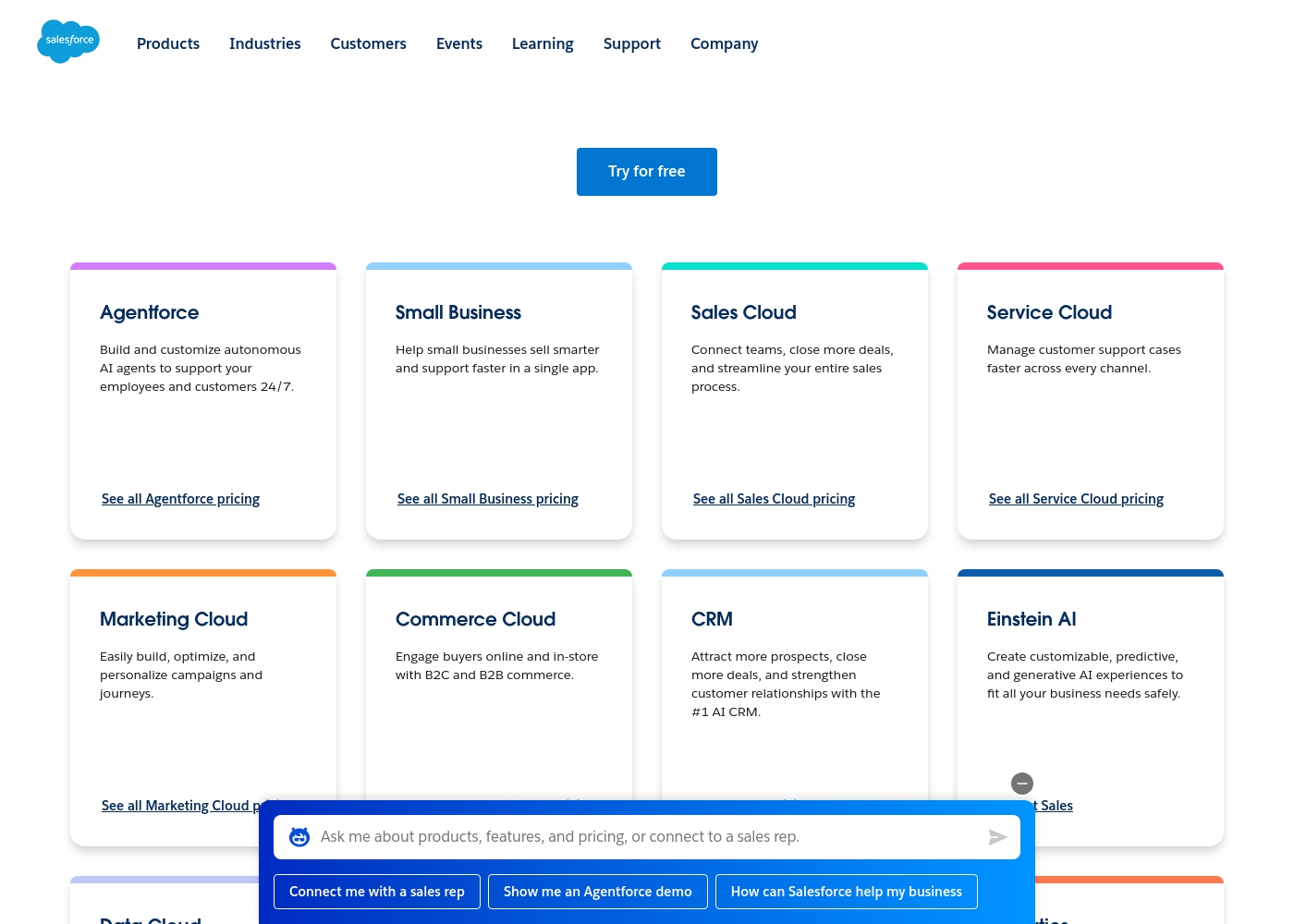
Salesforce pricing is determined on a quote-by-quote basis depending on the specific Cloud products chosen, such as Agentforce, Sales Cloud, and Marketing Cloud.
- Build and customize autonomous AI agents
- Support employees and customers 24/7
- Help small businesses sell smarter
- Faster support in a single app
- Connect sales teams and close more deals
- Streamline the entire sales process
- Manage customer support cases faster
- Manage support across every channel
Pricing Notes
- Hubspot offers robust free tools but requires sales contact for specific paid bundle pricing.
- Salesforce also requires a customized quote for most specialized Cloud products.
- Both Hubspot and Salesforce face severe user complaints regarding predatory and non-transparent billing practices.
- Hubspot users frequently report aggressive, automatic tier upgrades that substantially inflate costs without notice.
- Salesforce contracts are typically required annually in advance, often pressured into long-term commitments.
- Salesforce Starter is the only recognized offering with an optional flexible monthly payment term.
Pricing Head-to-Head
User Reviews
User reviews for HubSpot present a highly critical picture, primarily revolving around customer service and billing complexity. While the platform is acknowledged as a solid or capable system by some long-term users, many consumers report significant dissatisfaction.
Frequent issues include rapacious pricing practices and unauthorized contact tier upgrades that substantially increase costs without clear notice. Support responsiveness is a major pain point; reviewers describe customer service as terrible, often robotic, or incapable of resolving long-standing problems.
Horrible customer service. Their system glitched and locked me out for over a month and I couldn't access my paid subscription. They are completely incapable of solving basic problems.
User feedback on Salesforce is deeply polarized, leading to a very poor overall Trustpilot rating. While some users acknowledge the platform is a powerful tool with extensive features, the overwhelming sentiment focuses on severe issues with customer service and support responsiveness.
Users frequently describe support as "nonexistent" or "abysmal," reporting long waits, unhelpful automated systems, and difficulty reaching essential account managers. A significant pain point is the perceived lack of accountability and predatory billing practices; customers routinely mention inflexible contracts, mandatory annual price increases, and financial stress, especially for smaller businesses.
I strongly regret ever signing up with Salesforce. Their billing practices are predatory and completely inflexible, causing huge frustration and financial stress. I wish I had taken the time to read these reviews first.
Our Verdict
Choosing between Hubspot and Salesforce means picking a specific business philosophy. Both are CRM powerhouses, yet they serve very different masters. Hubspot is the integrated platform built for growth velocity easily accessible. Salesforce delivers specialized custom power for the massive, complex enterprise reliably. Hubspot excels at unifying your data onto one central Smart CRM foundation quickly. Its integrated Breeze AI agents automatically resolve 65% of customer inquiries. Use Hubspot if you need marketing, sales, and service deeply connected instantly. Hubspot offers a quick, manageable path to unified results. Salesforce delivers unmatched industry specialization and feature depth carefully configured. It supports specialized, compliant workflows for regulated sectors like Healthcare and Finance. Salesforce is essential for organizations requiring extreme scale and intricate customization options. Large companies rely on Salesforce for complex data handling and reporting constantly. The key decision hinges on your organization's size and required industry specialization, realistically. If easy implementation and rapid integration of 1,900+ apps matters most, choose Hubspot. If your company is massive and requires purpose-built industry tools, you absolutely need Salesforce capability. Prepare for difficult support experiences with both Hubspot and Salesforce. Small to mid-market teams should pick Hubspot for its foundational unity and ease of use. Global corporations must select Salesforce for essential, enterprise-grade power and custom structure. Hubspot provides faster time-to-value for growing businesses efficiently and effectively.
Frequently Asked Questions
Which is better for small teams: Hubspot or Salesforce?
Hubspot is better for small teams due to its robust free tools and starter bundles. The Hubspot Small Business Bundle offers integrated features at a consolidated price. Salesforce requires a heavier investment and is generally too complex for small-scale use.
Does Hubspot have industry-specific solutions like Salesforce?
No, Hubspot focuses on a general, unified Smart CRM approach for broad growth strategy. Salesforce offers dedicated Cloud solutions for specific sectors like Finance, Retail, and Healthcare. Salesforce wins if highly specific industry specialization is required regularly.
Is Salesforce worth the extra complexity over Hubspot?
Salesforce is only worth the complexity if you need its immense enterprise scale and deep industry customization. Hubspot provides sufficient power for most scaling mid-market needs safely and quickly. Both Hubspot and Salesforce hide their true costs effectively.
Which platform offers better AI for sales automation?
Hubspot’s Breeze AI includes a Prospecting Agent accelerating sales outreach at scale quickly. Salesforce utilizes Agentforce AI to augment employee support and specialized tasks constantly. Hubspot currently offers more explicit, built-in go-to-market automation power.
Why do both Hubspot and Salesforce have such poor customer service reviews?
User reviews report Hubspot support is slow, unresponsive, and robotic for basic issues. Salesforce support is often described as nonexistent or abysmal repeatedly by long-term customers. Large enterprise platforms often struggle significantly to provide timely, personalized human support.
How do Hubspot's integrations compare to Salesforce's AppExchange?
Hubspot lists over 1,900 standard direct app integrations easily connected by the Data Hub efficiently. Salesforce uses the AppExchange for specialized, deep apps and partner solution integrations. Hubspot offers higher volume for seamless standard connections.
Ready to Choose?
Both tools have their strengths. Choose based on your specific needs.