Gumroad vs WooCommerce
Gumroad and WooCommerce represent entirely different e-commerce philosophies. Gumroad prioritizes speed and requires zero upfront cost for creators. WooCommerce offers total control, built on the robust WordPress foundation. This comparison helps you decide if plug-and-play ease or full customization suits you best.
Best for: Solo entrepreneurs testing initial digital product ideas quickly, Creators prioritizing automated worldwide sales tax and VAT compliance
Best for: Developers or agencies building fully customizable client e-commerce stores, Scaling businesses needing total control over platform source code
Sell easily, but proceed with extreme caution.
Gumroad offers an accessible, zero-upfront-cost model ideal for creators starting out in the digital space. However, we found the user reports regarding immediate account bans, withheld payments, and severe customer support failures extremely alarming. Overall, we cannot recommend Gumroad due to critical risks concerning financial security and platform reliability.
Pros
- Purely usage-based model with no required monthly subscription fees.
- Fees are lower (10% + $0.50) for creators who drive their own traffic.
- Handles global sales tax and VAT/GST automatically as Merchant of Record (effective 2025).
- Ability to sell various digital and physical formats, including subscriptions.
Cons
- Frequent reports of withholding or delaying creator payouts without explanation.
- Customer support is often described as non-existent or limited to unhelpful chatbots.
- Accounts are frequently suspended or banned abruptly, trapping earned revenue.
- Lack of transparency regarding transaction fees makes actual costs higher than advertised.
Flexible Ecommerce Built on WordPress Power
We recognize WooCommerce's strength lies in its open-source platform, providing unmatched customization and scalability for ambitious users and developers. This flexibility, however, mandates external maintenance and a high tolerance for technical responsibility, as customer support is repeatedly cited as severely lacking. Overall, we recommend WooCommerce primarily for those with development resources or significant self-help capabilities.
Pros
- Core platform is open source, ensuring high value and low initial cost.
- Offers maximum customization and flexibility for unique stores.
- Trusted for stability and proven ability to handle large sales volumes.
- No platform commissions or subscription fees on the core product.
Cons
- Customer support is slow, non-responsive, or relies heavily on automated responses.
- Requires numerous plugins or custom coding to operate complex features (can feel bloated).
- Steep learning curve, especially concerning shipping, variations, and payment processors.
- Updates sometimes cause functionality issues or price errors.
AboutGumroad
Gumroad is an all-in-one platform built to help creative entrepreneurs sell digital and physical products. It helps you experiment with all kinds of ideas and formats, like video lessons or monthly subscriptions. Whether you need more flexibility or just a different gig, Gumroad makes it easy to chart a new path. You don't need to be a tech expert to upload a file, set a price, and start selling your expertise. ✨
AboutWooCommerce
WooCommerce is known as the most trusted ecommerce platform globally. It provides an open-source solution built on the strength of WordPress, which powers 43% of the internet. This popular combination allows you to build, sell, and scale your way, creating a store as unique as your vision. It empowers businesses and developers alike, offering a foundation for creating powerful, flexible ecommerce experiences. Whether your business is complex, simple, big, or small, WooCommerce helps you take control of your success. 💡
Highlights
Feature Comparison
Features Overview
We highlight the main differences and pick a winner for each feature.
True Cost Structure
Gumroad has zero monthly fees but takes a high commission on sales. WooCommerce core is free, but you must pay for hosting and necessary add-ons.
Gumroad uses a purely usage-based model with no required monthly platform fees. Creators pay 10% + $0.50 per transaction on their self-driven sales. If customers discover you via the Gumroad marketplace, that commission jumps to a steep 30%. WooCommerce operates on an open-source model with zero platform commissions. Users must factor in highly variable costs for hosting, domain names, and required premium extensions. Gumroad's cost is tied to volume; WooCommerce's cost is tied to technical setup and maintenance. The choice is trading highly variable, ongoing commission fees for required fixed costs plus technical maintenance. Both models have different cost benefits for users. Gumroad rewards low-volume sellers; WooCommerce rewards large-scale efficiency. For high-volume sellers, WooCommerce will likely prove far more financially efficient long-term. Gumroad's 30% fee model quickly becomes unsustainable.
Customization Freedom
WooCommerce offers total, unlimited control over every facet of the store design. Gumroad provides a simple, quick setup but with limited customization options.
With Gumroad, setup is instant, allowing you to upload a file and start selling immediately. This 'zero friction' approach is perfect for creators focused on product ideas. Gumroad lets you easily customize your basic storefront or link sales to your existing site. WooCommerce, built on WordPress, allows maximum customization because it is entirely open source. There is literally no ceiling on what developers can build for a unique brand experience. This allows for fine-tuning checkout steps. Gumroad requires seamless connection to external apps for any deep functionality beyond the core features. WooCommerce uses its built-in extension ecosystem for advanced, deeply integrated features. WooCommerce allows technical users to optimize checkout flows, achieving reported conversion rate boosts of 35%. Gumroad prioritizes creator accessibility over deep control.
Global Tax Handling
Gumroad automatically handles global sales tax and VAT/GST as the Merchant of Record. WooCommerce users are fully responsible for managing worldwide tax compliance themselves.
Effective 2025, Gumroad acts as the Merchant of Record for all transactions. This means Gumroad handles all tax obligations, including complex international taxes like VAT or GST. Creators don't need to manage manual settings. Gumroad makes selling globally easy since customers can pay in their local currency. The platform automatically handles all necessary currency conversions smoothly. This is a massive logistics benefit. WooCommerce requires users to manually implement or purchase specialized extensions for tax and currency conversion. The seller assumes all legal and financial responsibility for global compliance. This feature is a huge time-saver for solo creators selling digital products internationally via Gumroad. WooCommerce demands significant compliance effort from the user or developer.
Scalability & Risk
WooCommerce supports enterprise-level scaling and high volume, trusted by millions. Gumroad is great for small ideas but poses significant financial risk when scaling.
WooCommerce has no arbitrary limits on transactions or bandwidth; scaling depends on your hosting choice. It is trusted by over four million online stores globally for stable performance and reliability. Major brands rely on its ability to handle high sales volumes. Gumroad is designed for solo creators testing small products using the 'small bets' philosophy. However, severe user reviews report alarming instances of earned money being trapped and accounts abruptly suspended. If you aim to run a multi-million-dollar operation, WooCommerce provides the proven, secure foundation needed. Gumroad’s reputation for payout instability makes it a critical financial risk for serious business. One key performance benefit of WooCommerce is the ability to reduce cash deposit times from seven days down to one day using WooPayments.
Financial Reliability
WooCommerce offers tools to optimize cash flow and payout speed reliably. Gumroad reports consistent, severe issues with withholding creator payouts and trapping earnings.
Gumroad promises automated payouts every Friday directly to the creator's bank account. This provides consistent, weekly access to earned income for steady sellers. However, reliability is the major issue. Jesse M. noted that Gumroad holds his earnings for months now, skipping payouts because of an arbitrary 'Payment Hold.' Other users report their verified accounts being suspended randomly. WooCommerce helps improve financial efficiency, with users reducing their time to deposit from seven days to just one day. House of Malt also increased its average order value by 22% using Woo features. For operational safety and reliable access to revenue, WooCommerce is the clear winner. Gumroad’s operational and financial instability should be considered a critical failure point.
Ecosystem & Integrations
WooCommerce integrates deeply within the massive WordPress extension ecosystem. Gumroad offers integrations via external connections to thousands of apps.
WooCommerce benefits from having hundreds of trusted extensions and themes available. This allows users to add complex functionality directly into their WordPress site seamlessly. It easily handles advanced features like specialized payment gateways. WooCommerce supports powerful multichannel selling and inventory autosync with major platforms like Amazon and TikTok. This is vital for modern e-commerce scaling needs. Gumroad’s primary integration method is connecting to thousands of external apps in your current tech stack. This often requires reliance on external bridge tools for comprehensive management. For building a cohesive, integrated e-commerce machine, WooCommerce offers superior, more direct integration options. Gumroad's approach is more fragmented.
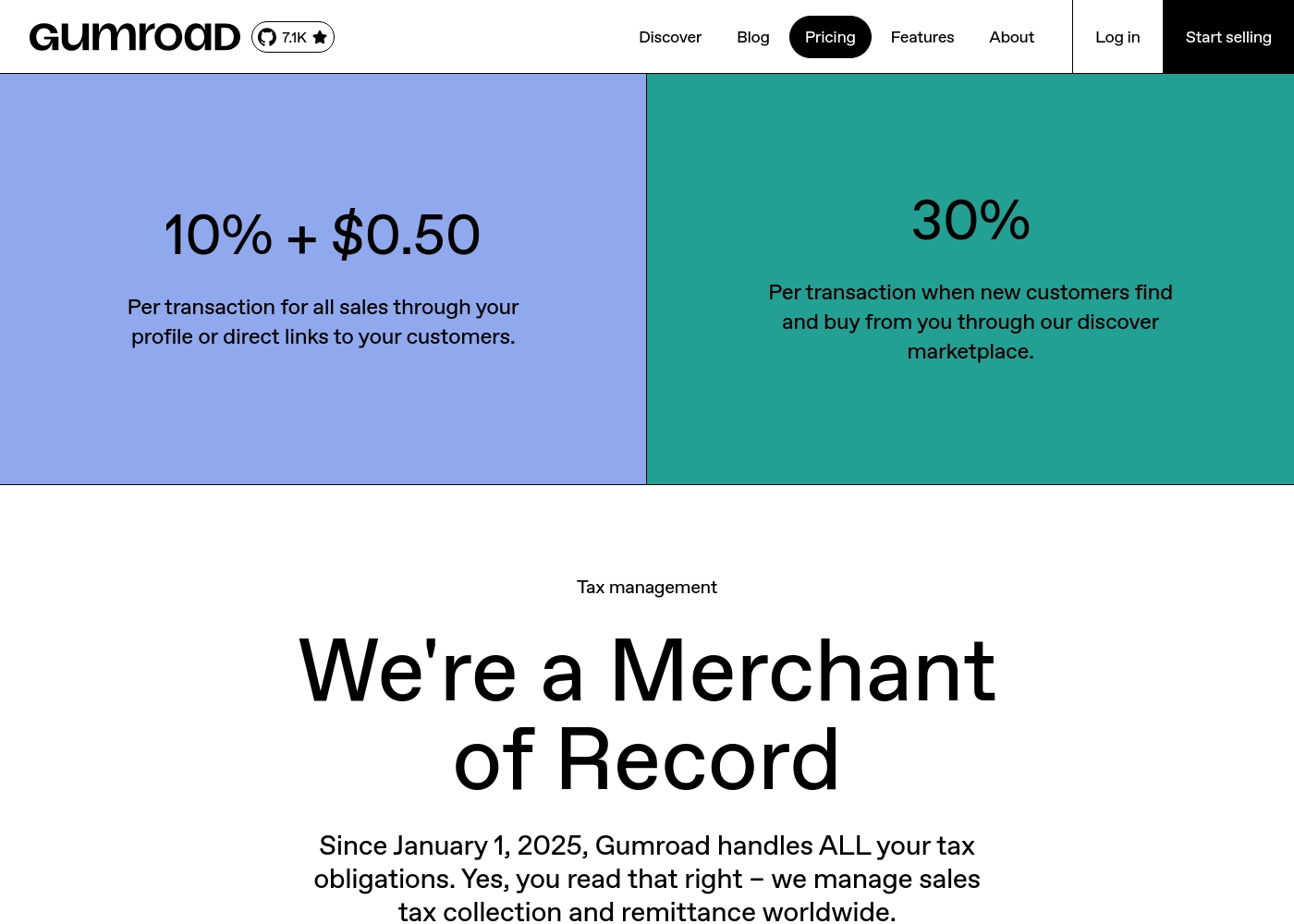
Gumroad pricing is entirely usage-based, costing between 10% + $0.50 and 30% per transaction, with two distinct fee structures.
Gumroad is unique because it doesn't charge any monthly fees. Instead, the cost is tied directly to your sales volume and the source of the customer. You only pay when you make a sale. Here is a breakdown of the two standard transaction-based rates.
Direct Sales and Your Audience
Price: 10% + $0.50 per transaction Best For: Creators who drive their own traffic Other Features:
- 10% + $0.50 per transaction fee
- Applies to sales through your profile
- Applies to sales via direct links to your customers
- Gumroad handles all sales tax collection and remittance (effective Jan 1, 2025)
- Fee Structure: 10% + $0.50 per transaction
- Applicable for sales through your Gumroad profile
- Applicable for sales utilizing direct links to your audience
- Gumroad handles worldwide tax compliance (Merchant of Record)
- Fee Structure: 30% per transaction
- Applicable when new customers find and buy from you via the discover marketplace
- Gumroad handles worldwide tax compliance (Merchant of Record)
Since WooCommerce is open source, its pricing model is highly flexible, focusing on customization rather than fixed tiers.
Core WooCommerce Platform (Open Source)
Best For: Anyone seeking maximum customization freedom and control over their platform. Other Features:
- Powered by WordPress
- Fully customizable ecommerce
- Access to hundreds of trusted extensions and themes
- Support teams across the world
- Safe and secure online payments
This open-source framework lets you build your unique store from the ground up. It's the best option if you want to scale your way without the limitations of fixed proprietary systems. You gain control needed to create an utterly unique brand experience for your customers. ✨
- Fully customizable ecommerce
- Powered by WordPress
- Access to hundreds of trusted extensions and themes
- Open source flexibility
- Support teams across the world

Pricing Notes
- Gumroad charges zero fixed monthly fees; all costs are transactional based on sales volume.
- The Gumroad fee is 10% + $0.50 for sales driven by the creator, but 30% for sales via the marketplace.
- WooCommerce core is free because it is open source, avoiding mandatory subscription fees.
- WooCommerce users must budget separately for robust hosting, custom themes, and premium extensions.
- The total investment for WooCommerce varies significantly based on complexity and required add-ons.
Pricing Head-to-Head
User Reviews
Based on hundreds of Trustpilot reviews, Gumroad faces significant and severe criticism, reflected in its extremely low 1.3-star rating. The most pressing complaints revolve around financial instability and user safety.
Many creators report that Gumroad improperly halts or withholds payouts, often suspending accounts without warning or clear explanation after sales have been made, leading users to feel their hard-earned money was stolen. Customer service is consistently described as nearly non-existent; users report only receiving non-helpful chatbot responses, long silences, or even rude replies, failing to resolve critical issues like verification rejections or account bans.
Gumroad used to be trusty, but it’s fallen off. They hold my earnings for months now, skipping payouts because of a 'Payment Hold,' even though my account is verified. This practice is frustrating for long-time users.
WooCommerce generates highly mixed feedback, primarily due to the severe dichotomy between its powerful, free core product and the perceived lack of service quality. Users praised its unlimited flexibility, open-source nature, and strong customization capabilities, noting it is essential for serious businesses and web developers who want maximum control without recurring platform fees.
Many established users expressed love for the product when paired with the right WordPress themes. However, the overwhelming concern centers on customer support responsiveness ❌.
Their support responsiveness is a major issue; it often takes days for them to even send a reply. This is unacceptable for mission-critical e-commerce operations. We strongly advise that businesses consider this lack of reliable support before committing.
Our Verdict
Deciding between Gumroad and WooCommerce means choosing instant setup versus complex control. For any creator serious about stability, WooCommerce offers the superior long-term foundation. However, Gumroad excels for those needing rapid testing and zero commitment. Gumroad's superpower is making selling incredibly simple right now. You can upload a file, set a price, and start selling within minutes, managing global tax compliance automatically. It operates with zero monthly fees, allowing you to test 'small bets' without upfront financial risk. But be warned: Gumroad constantly faces severe criticism for sudden account bans and withheld user earnings. WooCommerce’s superpower is its unmatched customization, built on the robustness of WordPress. Since the core product is free and open source, you have infinite potential to scale your store successfully. Businesses trust WooCommerce to increase conversions by up to 35% and drastically reduce payment deposit times. The deciding factor is your technical skill and tolerance for operational risk. If you have development resources and demand a professional, secure store, pick WooCommerce. If you are a solo creator who needs instant, hands-off global sales tax compliance and doesn't mind the high fee—and the high risk—Gumroad is the choice. WooCommerce wins for any business serious about sustained growth, scalability, and financial reliability. Gumroad is best left for testing tiny side hustles or digital experiments with low financial dependence.
Frequently Asked Questions
Which is cheaper: Gumroad or WooCommerce?
WooCommerce core software is fundamentally free, avoiding mandatory sales commissions. Gumroad has higher transactional fees, reaching up to 30% for marketplace sales. If you have high sales volume, the variable costs of WooCommerce (hosting/plugins) often become cheaper than Gumroad's high commissions.
Does Gumroad handle better global taxes than WooCommerce?
Yes, Gumroad handles global sales tax and VAT/GST compliance automatically as the Merchant of Record. This is a massive logistical benefit for international sellers. WooCommerce requires users to manage all tax calculations and compliance manually or via expensive extensions.
Which tool offers better customization freedom?
WooCommerce provides total customization freedom because it is built on open-source WordPress. There is no ceiling on what developers can build or optimize. Gumroad offers decent storefront customization but is limited by its proprietary, all-in-one platform structure.
Is WooCommerce better for selling digital products than Gumroad?
Gumroad is designed specifically for instant digital product sales and creative content. WooCommerce can sell digital products but requires more setup and extensions. If you prioritize reliability and long-term scaling, WooCommerce is the stronger choice despite the initial complexity.
How reliable is customer support for Gumroad compared to WooCommerce?
User reviews heavily criticize support responsiveness for both. Gumroad support is often described as non-existent, leaving critical issues unresolved. WooCommerce support is slow or automated but benefits from a vast open-source community that provides alternative help.
Can I scale an enterprise-level business using Gumroad?
No. While Gumroad is excellent for starting small ('small bets'), it is not suitable for serious enterprise scaling. WooCommerce is trusted by millions, supporting major brands for high volume and stable operations, offering superior scalability.
Ready to Choose?
Both tools have their strengths. Choose based on your specific needs.