Gumroad vs Shopify
Gumroad and Shopify both help you sell online, but they target wildly different goals. Gumroad is perfect for quick digital products and testing 'small bets' instantly. Shopify is the robust commerce engine designed for scaling, complex logistics, and large growth. The choice comes down to simplicity versus full control and infrastructure depth.
Best for: Solo entrepreneurs monetizing single digital assets (e.g., ebooks, templates, courses), Creators following the 'Small Bets' philosophy for rapid idea validation

Best for: E-commerce brands managing physical inventory across multiple locations, Businesses requiring integrated online and permanent in-person POS selling
Sell easily, but proceed with extreme caution.
Gumroad offers an accessible, zero-upfront-cost model ideal for creators starting out in the digital space. However, we found the user reports regarding immediate account bans, withheld payments, and severe customer support failures extremely alarming. Overall, we cannot recommend Gumroad due to critical risks concerning financial security and platform reliability.
Pros
- Purely usage-based model with no required monthly subscription fees.
- Fees are lower (10% + $0.50) for creators who drive their own traffic.
- Handles global sales tax and VAT/GST automatically as Merchant of Record (effective 2025).
- Ability to sell various digital and physical formats, including subscriptions.
Cons
- Frequent reports of withholding or delaying creator payouts without explanation.
- Customer support is often described as non-existent or limited to unhelpful chatbots.
- Accounts are frequently suspended or banned abruptly, trapping earned revenue.
- Lack of transparency regarding transaction fees makes actual costs higher than advertised.

Powerful Platform, Critical Service Gaps
We recognize Shopify offers an enterprise-level platform with impressive scaling tools and high-converting technology for merchants of all sizes. However, user reviews indicate systemic failures in support, billing practices, and marketplace fraud protection. Overall, Shopify provides powerful infrastructure but currently struggles to deliver a reliable, secure, or user-focused experience for many customers.
Pros
- Comprehensive commerce platform built for scaling and global growth.
- Unique Shopify Checkout converts 15% higher than competing platforms.
- Lower credit card transaction fees on Grow and Advanced plans.
- Access to Shopify Capital for loans without sacrificing equity.
Cons
- Customer support is frequently reported as unresponsive, slow, or useless (often relying on chatbots).
- Platform often fails to protect buyers and merchants from fraudulent stores.
- Frequent reports of unauthorized billing and confusing cancellation procedures.
- Complexity makes site setup difficult for non-technical beginners.
AboutGumroad
Gumroad is an all-in-one platform built to help creative entrepreneurs sell digital and physical products. It helps you experiment with all kinds of ideas and formats, like video lessons or monthly subscriptions. Whether you need more flexibility or just a different gig, Gumroad makes it easy to chart a new path. You don't need to be a tech expert to upload a file, set a price, and start selling your expertise. ✨
AboutShopify
Shopify is the powerful commerce platform designed to handle every aspect of modern selling. It serves everyone, from solo entrepreneurs launching their first product to large global enterprises. This platform manages your sales whether you are selling direct-to-consumer or handling wholesale B2B transactions. You get an organized, fully centralized Shopify Admin to control everything, from the back office to the front of the store. Millions of merchants trust Shopify; together, they have reached over $1 trillion in collective sales. ✨
Highlights
Feature Comparison
Features Overview
We highlight the main differences and pick a winner for each feature.
Pricing Model
Gumroad uses fees only when you sell; Shopify requires a monthly subscription fee.
Gumroad operates on a purely usage-based model with zero required monthly fees. This rewards creators who only sell products occasionally or are just starting out. You pay 10% + $0.50 for direct sales, and 30% if customers find you via the Gumroad marketplace. Shopify requires a monthly subscription commitment, starting around $29 for the Basic plan. Its transaction fees (using Shopify Payments) are generally lower than Gumroad, starting at 2.9% + 30¢. Gumroad minimizes financial risk by eliminating fixed overhead for new sellers and those testing ideas. Shopify demands consistent revenue to justify the monthly cost, offering lower transaction rates in exchange. The zero-upfront cost of Gumroad makes it immediately accessible for creators placing many 'small bets.' Shopify is better if you have high volume and need the fixed cost overhead.
Tax Compliance
Gumroad handles global sales tax automatically; Shopify leaves tax compliance to the merchant.
Gumroad provides phenomenal value by acting as the Merchant of Record effective January 1, 2025. This means Gumroad handles all complex worldwide sales tax collection and remittance, including VAT and GST. Gumroad ensures creators stay compliant worldwide, simplifying global selling significantly. Shopify requires merchants to manage global tax obligations themselves, often necessitating third-party integrations or expert consultancy. While Shopify provides tools, the ultimate responsibility rests with the seller. This automatic, simplified tax management is a major friction reducer for Gumroad, allowing solo creators to focus solely on their products. Shopify offers greater control over global settings via Shopify Markets but requires more merchant input and management. If you sell digital products internationally, the automatic VAT handling of Gumroad is a massive operational benefit.
Scalability & Tools
Shopify is built for scaling physical, complex businesses; Gumroad is for solo growth.
Shopify is the comprehensive commerce platform designed for rapid, enterprise-level scaling and B2B needs. It offers advanced features like Shopify Markets for localization and Shopify Capital for growth funding up to $2M. Shopify supports up to 200 inventory locations on its Plus plan. Gumroad is designed primarily for individual creators selling knowledge assets and digital files. While Gumroad supports subscriptions and physical goods, its feature set doesn't match the heavy-duty logistics or financial support offered by Shopify. Shopify offers much deeper controls for inventory, fulfillment, and specialized business arrangements like wholesale. Gumroad prioritizes speed and low-friction publishing for creators. Choose Shopify if your long-term plan involves managing complex logistics, multiple employees, and large SKU catalogs. Gumroad suits rapid experimentation and individual income streams.
Multichannel Selling
Shopify handles online and in-person POS sales; Gumroad is purely digital storefront focus.
Shopify excels at unifying online and offline retail experiences through its centralized Admin and Shopify POS system. Merchants can manage inventory and sales across their website, social channels, and physical stores seamlessly. Shopify enables publishing across many channels. Gumroad focuses on delivering digital goods quickly, either through its own profile or embedded on an existing external site. Gumroad lacks dedicated in-person POS capabilities or sophisticated channel management tools. The ability of Shopify to integrate physical retail and e-commerce makes it the superior choice for modern, cross-channel brands. Gumroad is best for sellers whose customer connection is purely digital. If you plan to run pop-up shops or have a permanent physical retail presence, Shopify is the only viable option here.
Ecosystem Depth
Shopify offers vastly more apps and customization via a massive dedicated ecosystem.
Shopify provides access to an enormous ecosystem featuring over 13,000 diverse apps for every business need imaginable. It also supports headless commerce through Hydrogen for maximum development flexibility and control. Gumroad states it can integrate with 'thousands of external apps' in a user's current tech stack to customize workflows. Customization is achieved by linking external tools rather than natively extending core functions. Shopify users essentially own the development roadmap via the app store, granting unprecedented depth for marketing, fulfillment, and specific niche functionalities. Gumroad focuses on ensuring core functions work simply. For businesses that require highly specific, customized workflows or niche integrations, Shopify's depth is unrivaled.
Ease of Use / Launch
Gumroad allows instant sales setup; Shopify requires significantly more effort to configure.
Gumroad boasts a zero-friction setup—upload a file, set a price, and start selling instantly. This enables the 'small bets' philosophy, letting creators quickly validate their ideas without complex implementation. Gumroad is highly intuitive. Shopify has a steep learning curve and significant onboarding complexity dueera to its comprehensive feature set and theme customization requirements. Setting up payments and managing all configurations takes time. Gumroad gets you earning faster; its simplicity is its biggest selling point for beginners and side hustlers. Shopify gives you more power but demands more expertise and time investment upfront. If your goal is monetization speed and lowest complexity, Gumroad is the immediate winner.
Payout Reliability
Both platforms face critical user complaints regarding unexplained payout holds and delays.
Gumroad faces severe and frequent user criticism regarding withholding or delaying weekly creator payouts, sometimes suspending accounts abruptly. These issues cause immense financial stress for creators using Gumroad. Gumroad users rate financial stability very low according to reviews. Shopify also receives recurring complaints about unresolved payout holds, complex refund procedures, and general difficulties contacting support for financial issues. The service reliability of Shopify's financial systems is often questioned. Neither platform provides a comforting sense of financial security based on widespread user reports and extremely low trust ratings. Both should be approached with caution regarding cash flow. If reliable, clean cash flow is your top priority, extensive research into recent trends for both Gumroad and Shopify is necessary, as neither is perfect.
Support Accessibility
Both platforms receive negative support reviews, often relying on slow or non-helpful responses.
Gumroad support is frequently described by users as non-existent, limited to unhelpful chatbots, or providing unresponsive silence. Resolving critical issues like account suspensions is often impossible for Gumroad users, according to Trustpilot reports. Shopify also struggles with customer support, with users reporting long wait times, slow issue resolution, and difficulty escalating complex problems. For a platform of Shopify's size, support inconsistency is a major drawback. For basic queries, Shopify likely has better resources and community documentation than Gumroad. However, for critical, complicated issues that impact revenue, both platforms are frequently criticized. If having responsive, high-quality, human support is essential, neither Gumroad nor Shopify are clear favorites based upon current user sentiment.
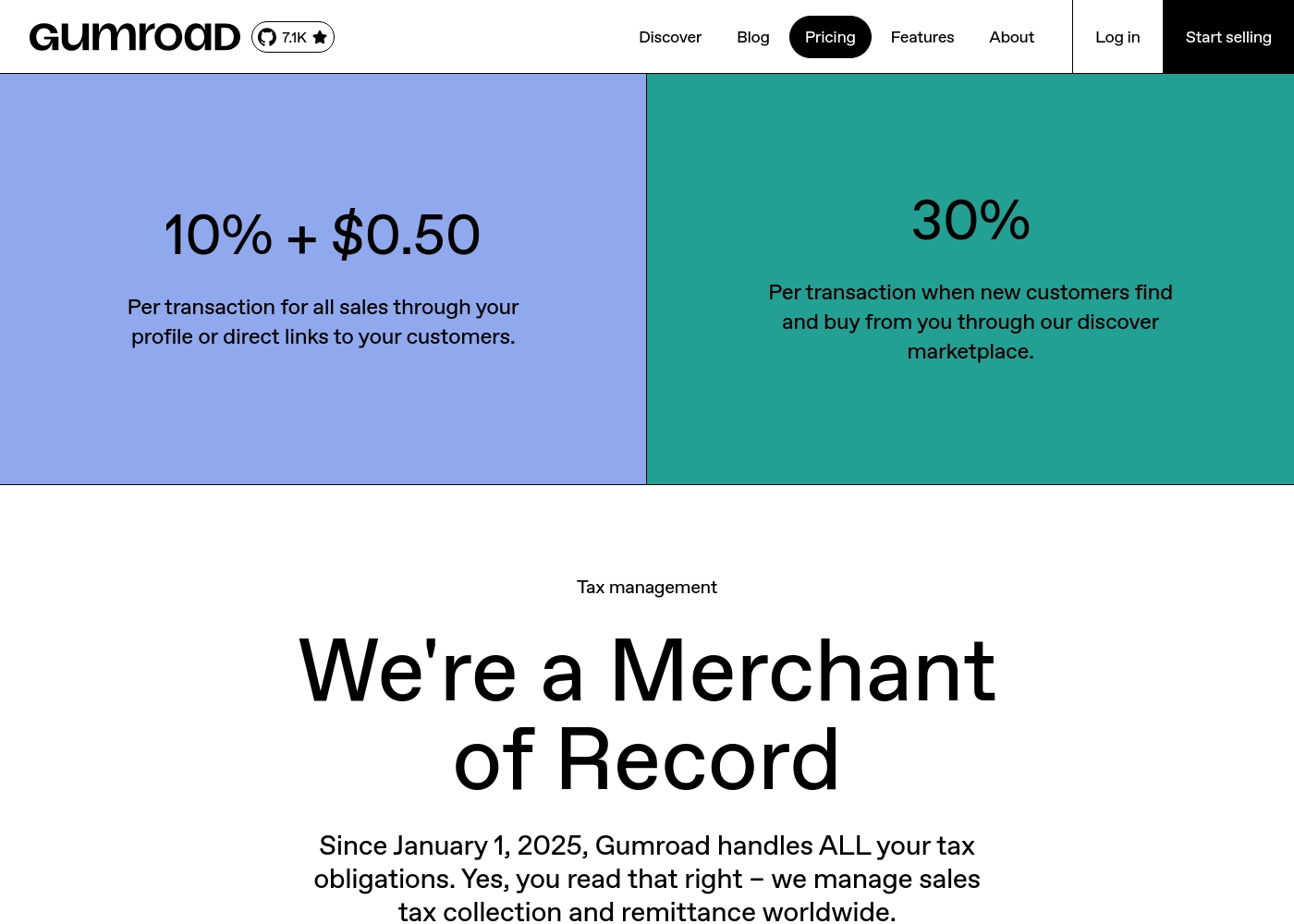
Gumroad pricing is entirely usage-based, costing between 10% + $0.50 and 30% per transaction, with two distinct fee structures.
Gumroad is unique because it doesn't charge any monthly fees. Instead, the cost is tied directly to your sales volume and the source of the customer. You only pay when you make a sale. Here is a breakdown of the two standard transaction-based rates.
Direct Sales and Your Audience
Price: 10% + $0.50 per transaction Best For: Creators who drive their own traffic Other Features:
- 10% + $0.50 per transaction fee
- Applies to sales through your profile
- Applies to sales via direct links to your customers
- Gumroad handles all sales tax collection and remittance (effective Jan 1, 2025)
- Fee Structure: 10% + $0.50 per transaction
- Applicable for sales through your Gumroad profile
- Applicable for sales utilizing direct links to your audience
- Gumroad handles worldwide tax compliance (Merchant of Record)
- Fee Structure: 30% per transaction
- Applicable when new customers find and buy from you via the discover marketplace
- Gumroad handles worldwide tax compliance (Merchant of Record)
Shopify costs between $5 (Starter) and $2,300 (Plus) per month with six key plans: Starter at $5/month, Basic at $29/month (billed yearly), Grow at $79/month (billed yearly), Advanced at $299/month (billed yearly), Retail at $89/month, and Plus at $2,300/month (on a 3-year term).
Here’s a detailed look at the core subscription options designed to help your business evolve and scale.
Starter
Price: $5 USD / month Best For: Selling instantly through social media and messaging apps Other Features: Simple online store, Learn more link
- Sell instantly through social media and messaging apps
- Simple online store access
- For solo entrepreneurs - Most Popular
- 2.9% + 30¢ USD online card rates
- Up to 77% shipping discount
- 10 inventory locations
- 24/7 chat support
- For small teams
- 5 staff accounts
- 2.7% + 30¢ USD online card rates
- Up to 88% shipping discount and insurance
- 1% 3rd-party payment provider fees
- As your business scales
- 15 staff accounts
- 2.5% + 30¢ USD online card rates
- 3rd-party calculated shipping rates
- Enhanced 24/7 chat support

Pricing Notes
- Gumroad operates entirely without fixed monthly fees; you only pay a transaction percentage when you sell.
- Shopify requires a monthly subscription (starting at $29/month) plus lower transaction fees (starting 2.9% + 30¢).
- The 30% fee on Gumroad applies only when the customer finds the product through the Gumroad internal marketplace.
- Shopify charges additional third-party transaction fees (up to 2%) if you choose not to use Shopify Payments.
Pricing Head-to-Head
User Reviews
Based on hundreds of Trustpilot reviews, Gumroad faces significant and severe criticism, reflected in its extremely low 1.3-star rating. The most pressing complaints revolve around financial instability and user safety.
Many creators report that Gumroad improperly halts or withholds payouts, often suspending accounts without warning or clear explanation after sales have been made, leading users to feel their hard-earned money was stolen. Customer service is consistently described as nearly non-existent; users report only receiving non-helpful chatbot responses, long silences, or even rude replies, failing to resolve critical issues like verification rejections or account bans.
Gumroad used to be trusty, but it’s fallen off. They hold my earnings for months now, skipping payouts because of a 'Payment Hold,' even though my account is verified. This practice is frustrating for long-time users.
While Shopify is recognized as an exceptionally powerful commerce platform that enables aggressive scaling, external feedback indicates significant user dissatisfaction. Customers frequently cite severe issues with customer support, emphasizing that interactions are often negative, slow, or handled by unhelpful chatbots.
A major recurring theme, especially on Trustpilot, focuses on platform reliability and integrity, with many users openly classifying Shopify as a 'fraudsters paradise' that fails to protect consumers from scam stores operating on the platform. Furthermore, the pricing structure and billing accuracy generate major complaints.
The platform is expensive and gives minimal customer support. You often learn how things work by making costly mistakes. Given their high fees, they should offer much better service.
Our Verdict
The decision between Gumroad and Shopify boils down to whether you prioritize speed or complex infrastructure. If you are a digital creator focused on quick monetization, Gumroad is your clear winner. Shopify is undeniably the better choice for large, multi-channel brands seeking scale and full control. Gumroad's major draw is its zero-friction approach and freedom from fixed fees. You can instantly upload a PDF or video and start selling, embracing the 'small bets' philosophy. Furthermore, Gumroad handles complex international VAT and sales tax collection automatically starting in 2025, solving a major headache for global sellers. Shopify’s superpower lies in its scalable, unified commerce platform and vast ecosystem. Shopify gives you the tools for complex inventory management, robust B2B features, and seamless integration with 13,000+ apps. If you manage physical goods or need in-person sales (POS), Shopify provides the professional foundation required. The key deciding factor is the cost commitment versus feature set. Gumroad is the superior entry point, providing zero monthly overhead to test ideas rapidly. Shopify demands higher monthly fees upfront, but it unlocks comprehensive logistics and unmatched customization for serious, long-term brand building. Choose Gumroad if you are a solo entrepreneur focused purely on selling digital knowledge with minimal fuss. Opt for Shopify if you are building an ambitious, inventory-heavy brand requiring integrated POS and advanced global scaling tools.
Frequently Asked Questions
Is Gumroad really free to start?
Yes, Gumroad has zero required monthly subscription fees to start. It operates on a usage-based model, meaning you only pay a fee (10% + $0.50 minimum) when you actually make a sale. Shopify, however, requires a monthly subscription, starting at $29.
Which is better for selling physical products: Gumroad or Shopify?
Shopify is significantly better for physical goods due to its core focus on commerce logistics and inventory management. Shopify provides centralized inventory tracking across multiple locations and excellent fulfillment integrations. Gumroad supports physical goods but lacks the advanced features Shopify offers.
Does Shopify handle sales tax like Gumroad?
No, Shopify does not act as the Merchant of Record for global tax remittance. Gumroad handles worldwide sales tax, VAT, and GST collection automatically starting in 2025. Shopify merchants are responsible for managing their own tax compliance.
What are the key pricing differences between Gumroad and Shopify?
Gumroad charges 10% + $0.50 (low rate) with no monthly fee. Shopify charges a monthly fee ($29+) plus a lower card rate (2.9% + 30¢, for Basic). Shopify's fixed monthly cost makes it better for high-volume sellers who benefit from lower individual transaction percentages.
Can I sell subscriptions on both Gumroad and Shopify?
Yes, both Gumroad and Shopify support setting up and managing subscriptions and recurring revenue models. Gumroad is good for fixed-length or monthly content subscriptions. Shopify can manage complex recurring physical or software subscriptions via its app ecosystem.
Which platform is better reviewed for customer support?
Both Gumroad and Shopify receive persistently negative reviews regarding customer support responsiveness and effectiveness. Gumroad is often reported as having non-existent support or chatbots. Shopify support is often slow and inconsistent, especially with critical financial issues.
Ready to Choose?
Both tools have their strengths. Choose based on your specific needs.
