GPTZero vs Sapling
GPTZero and Sapling are top contenders in the crucial fight against AI-generated text. GPTZero focuses on enterprise scale and academic integrity with specialized features. Sapling offers a superior writing assistant packaged with a valuable free trial. Both tools struggle with user reports of detector false positives.
Best for: Educational institutions needing LMS Integration and academic integrity solutions., Publishers verifying the originality of high-stakes, large-volume content quickly.
Best for: Solo writers prioritizing a powerful writing assistant over pure detection accuracy., Users who need to review PDF and DOCX files frequently for convenience.
Promising technology, heavily flagged by users.
We find GPTZero’s claims of 99% accuracy compelling, especially its features for transparency and support for ESL writers. Overall, due to persistent user complaints regarding inaccurate false positives, coupled with aggressive, non-transparent billing practices and absent customer support, we cannot recommend it without reservation.
Pros
- Clearly explains and highlights potential AI sections for user validation.
- Claims high accuracy rates (99%) validated by independent research.
- Model is de-biased to reduce false positives for Non-native English (ESL) writers.
- Useful for educators scanning large volumes of assignments quickly.
Cons
- Frequent and widely reported false positives on authentic human-written content.
- Significant issues with subscription cancellation transparency and unauthorized charges.
- Customer support is largely unresponsive and inadequate, according to users.
- Some users report the detection accuracy deteriorating over time.
Powerful Writing Assistant, Unreliable Detector.
We found Sapling offers powerful tools for improving grammar and making written text more concise, features that users often praise above competitors. Overall, the reported serious issues regarding the AI content detector's high false positive rate significantly undermine confidence in its primary specialized function.
Pros
- Offers significant savings with an annual discounted Pro plan ($12/month).
- Writing suggestions frequently cited as superior to Grammarly for corrections.
- High claimed detection accuracy (97%) for longer AI-generated texts.
- Identifies and highlights sentence segments indicative of simplistic phrasing.
Cons
- AI detector frequently reports significant false positives on human-written content.
- Citations of rigid or inconsistent detection results.
- Reports of high memory usage specifically for the browser extension.
- Interface described by some users as clunky.
AboutGPTZero
GPTZero is a dedicated AI content checker that recognizes machine-generated text in any document. This powerful proprietary model helps you identify exactly which parts of a text originated with a large language model (LLM).
How does it work? It analyzes text for key patterns that distinguish machine writing from human writing. These factors include checking for predictability (perplexity), variation in sentence structure (burstiness), and whether the tone is overly generic or repetitive.
Since its founding in January 2023, GPTZero has quickly become essential. It has served over 10 million users and is used by hundreds of institutions, especially in education. It is truly built for contexts where authentic and quality writing matters most. 💡
AboutSapling
The Sapling AI Content Detector is a powerful tool designed to check the probability that text was written by models such as ChatGPT or Gemini. It uses a specialized machine learning system—a Transformer—to analyze the input. This system specifically estimates the probability that each word or token is machine-generated. 💡
This utility is especially useful for educators concerned about learning integrity, or for practitioners reviewing large volumes of synthetic content. You're guided by visual results, seeing both the overall text score and highlighted portions. The detector also flags individual sentences with low perplexity, helping you catch simplistic or cliché phrasing.
Highlights
Feature Comparison
Features Overview
We highlight the main differences and pick a winner for each feature.
Detection Reliability
GPTZero claims higher accuracy validated by outside research; Sapling has a higher advertised false positive rate.
GPTZero claims an exceptional 99% accuracy rate for identifying AI text. This claim is supported by university research, keeping the false positive rate under 1%. GPTZero specifically analyzes perplexity and burstiness in great detail. Sapling advertises a strong detection rate exceeding 97% for longer AI texts. Its false positive rate for human writing is stated to be under 3%. GPTZero emphasizes superior statistical proof and external validation. Sapling uses a specialized machine learning system, the Transformer model. Winner: A (GPTZero - Based on claimed superior metrics and external validation)
Writing Enhancements
Sapling is widely praised as a superior writing assistant over GPTZero's more basic grammar checks.
GPTZero includes Grammar Check and general Writing Feedback in its paid tiers. These features support the primary AI detection focus. Sapling users frequently cite its suggestions as superior to competitor tools like Grammarly. Sapling helps refine clarity and concise structure. GPTZero's features are supplemental to its detection core. Sapling’s writing features are a powerful standalone selling point. If clear, high-quality human communication is your goal, Sapling offers greater daily utility.
ESL Bias Management
GPTZero uniquely trains its model to protect non-native English (ESL) writers from wrongful AI flagging.
GPTZero is specifically de-biased for ESL learners in its model training. This ensures the false positive rate remains exceptionally low, around 1%. This protection is critical for preserving academic integrity for diverse student populations. GPTZero is built to handle multilingual content reliable. Sapling offers no specific features or model training dedicated to protecting non-native English speakers. Performance may vary. For any global organization or educational setting, GPTZero provides a needed layer of fairness and protection.
Volume & Scaling
GPTZero is designed for truly massive, enterprise-level scale that Sapling cannot match in terms of volume.
GPTZero’s Professional plan handles 500,000 words monthly with a 10 million word overage allowance. It also scans up to 250 files simultaneously. This capacity makes GPTZero ideal for institutions or large publishers. It focuses on high-throughput batch processing. Paid Sapling users can check texts up to 100,000 characters per single query. This limit is high but is structured differently than GPTZero's massive volume allowance. GPTZero is the clear choice for organizations with constant, extremely high content volumes flowing through the system.
Integrations & Access
Sapling’s extension integrates deeper into workflows, whereas GPTZero supports essential academic LMS connections.
GPTZero’s Professional plan includes specialized integration with Learning Management Systems (LMS). This is crucial for education users. GPTZero also offers a robust developer API with ready-to-use code in 17 languages. This aids custom deployments. Sapling provides comprehensive browser extensions for Chrome, Outlook, and Google Docs. Its extension instantly checks text anywhere on the web. Sapling’s highly integrated extension adds a ‘Detect AI’ button next to ChatGPT results for instant verification. Choose GPTZero for academic platform sync, or Sapling for widespread typing and browsing checks.
Pricing & Trial
Sapling is more transparent and offers a valuable free trial, whereas GPTZero risks poor billing experiences.
GPTZero lacks a formal paid plan free trial or money-back guarantee. Users frequently report unauthorized charges and cancellation difficulties. GPTZero's cheapest plan starts at $8.33 per month when billed annually for 150,000 words. Sapling offers a generous 30-day Pro trial without requiring any credit card information. It also features a useful free tier. Sapling’s Pro annual plan costs $12/month, providing excellent value for unlimited use by individuals. Sapling wins on transparency and risk-free evaluation. GPTZero has serious user complaints about its billing model.
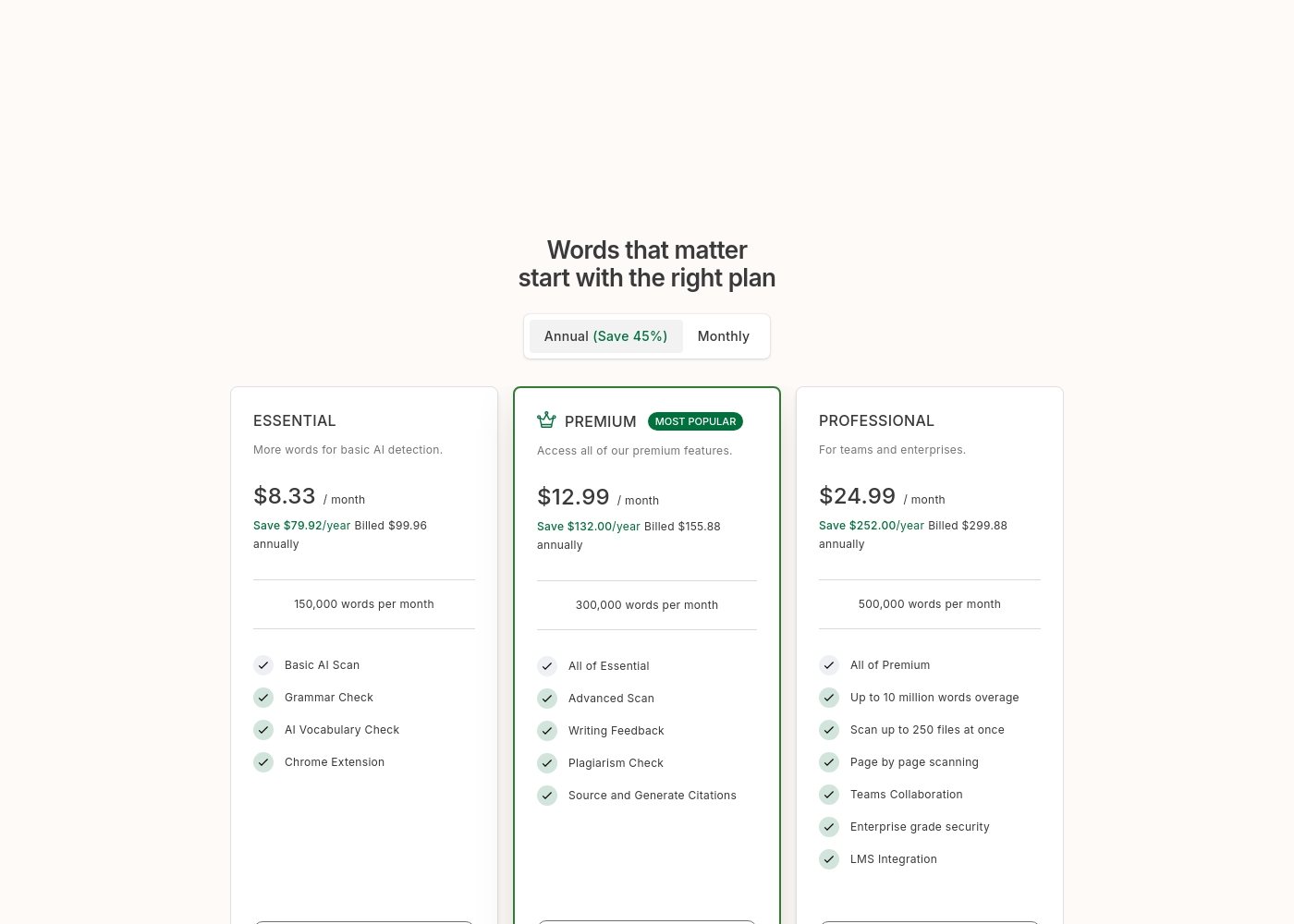
GPTZero costs between $8.33 and $24.99 per month (when billed annually) with three plans: Essential at $8.33, Premium at $12.99, and Professional at $24.99.
These prices reflect a significant discount when you choose annual billing. Let's explore the details of each tier and what you get.
ESSENTIAL
Price: $8.33/month (Billed $99.96 annually) Best For: More words for basic AI detection. Other Features:
- 150,000 words per month
- Basic AI Scan
- Grammar Check
- AI Vocabulary Check
- Chrome Extension
- 150,000 words per month
- Basic AI Scan
- Grammar Check
- AI Vocabulary Check
- Chrome Extension
- 300,000 words per month
- All Essential features included
- Advanced Scan
- Writing Feedback
- Plagiarism Check
- 500,000 words per month
- All Premium features included
- Up to 10 million words overage
- Scan up to 250 files at once
- Page by page scanning
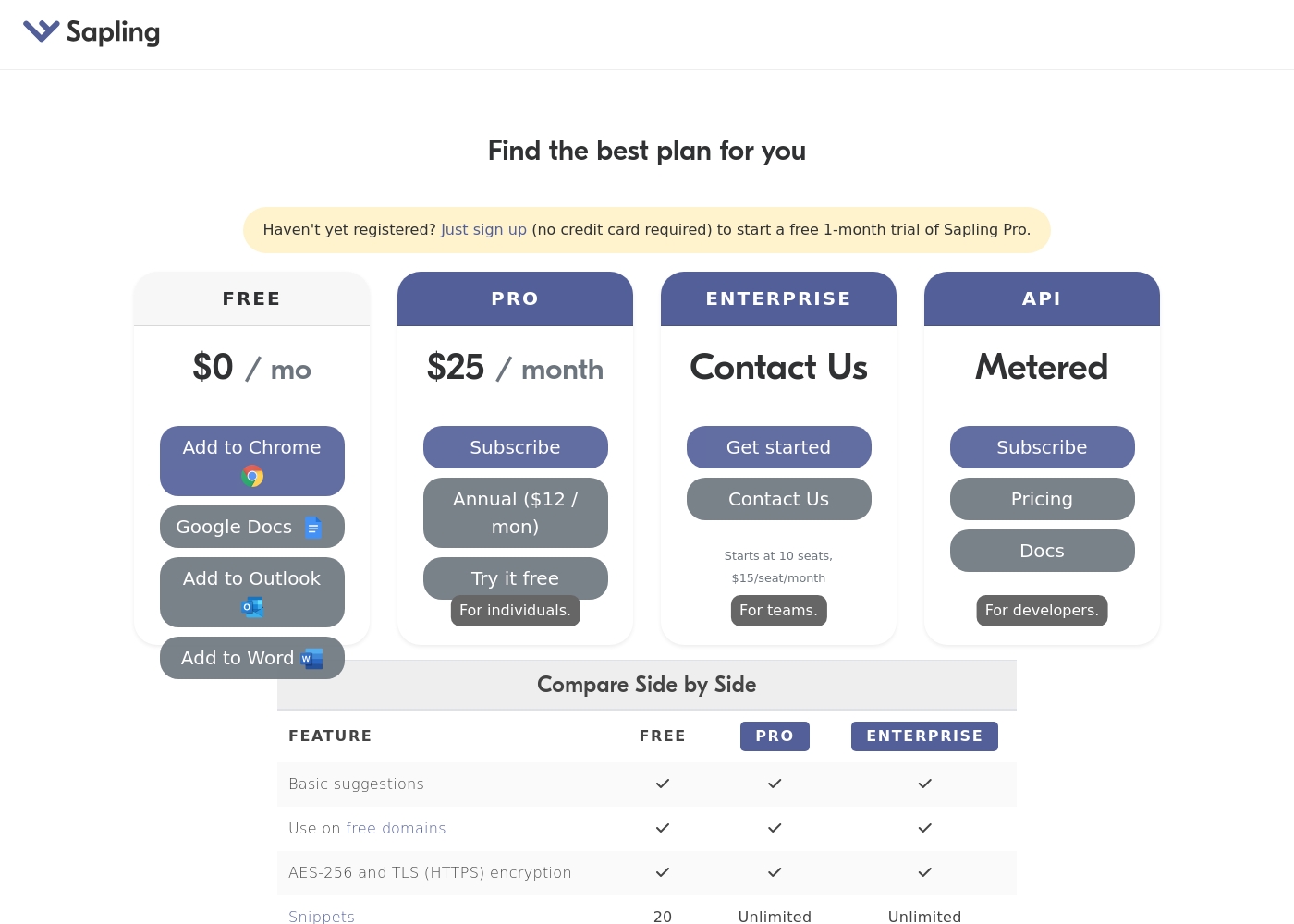
Sapling costs between $0 and $25 per month with four plans: Free at $0/month, Pro at $12/month (annual rate), Enterprise, and API.
You can compare the different options below to find the best fit for your precise writing needs.
Free
Price: $0 / month Best For: Basic individual use Other Features:
- Basic suggestions
- Use on free domains
- AES-256 and TLS (HTTPS) encryption
- 20 Snippets
- Basic suggestions
- Use on free domains
- AES-256 and TLS (HTTPS) encryption
- Basic suggestions
- Use on free domains
- AES-256 and TLS (HTTPS) encryption
- Unlimited Snippets
- Starts at 10 seats
- Priced at $15/seat/month
- Unlimited Snippets
- Basic suggestions and security features included
- Metered pricing structure
- For developers
- Access to full documentation
Pricing Notes
- Sapling offers a robust Free plan and a 30-day Pro trial without requiring a credit card.
- GPTZero's pricing scales purely by a strict volume of words or files scanned.
- Sapling uses a seat-based subscription for its Enterprise plan ($15/seat, 10 seat minimum).
- GPTZero focuses on extreme volume for its Professional plan, offering up to 10 million words overage.
- Users frequently report issues regarding poor billing transparency and cancellation difficulties with GPTZero.
Pricing Head-to-Head
User Reviews
Users reviewing GPTZero present two distinct experiences. Positively, many educators and professionals find the tool quick, efficient, and useful for validation, noting its effectiveness in identifying purely machine-generated text or confirming genuine human submissions.
Some users praise the free plan for providing a valuable summary of potential AI use. However, a significant portion of feedback focuses on fundamental reliability and transparent business practices.
This detector is excellent and accurate. Text written from scratch is very rarely detected as AI, which is what I needed. I have tested it on different writing types and found it very reliable.
Sapling's AI Detector generates starkly contrasting feedback across external platforms, resulting in an overall poor rating on Trustpilot, largely due to major concerns regarding its accuracy. Several users report extreme false positives, where 100% human-written content was flagged as AI-generated 🤯.
This recurring reliability issue is a significant pain point for writers and editors. However, the reviews are not entirely negative.
I was a longtime Grammarly user but grew annoyed by missed basic corrections. I switched to Sapling and was pleasantly surprised by the improvement. It’s just much better at catching mistakes and suggesting concise edits that refine my messaging.
Our Verdict
The decision between GPTZero and Sapling is tricky, as both AI detectors share user disappointment with false positives. Both tools score poorly on customer review sites, often flagging authentic human text as AI. The real choice hinges on whether you need massive scale or excellent writing assistance. GPTZero's superpower is its enterprise-level volume and academic specialization. Only GPTZero offers crucial LMS integration for educational integrity needs. Its Professional plan can handle up to 10 million words and scan 250 files at once. GPTZero is also uniquely trained to protect ESL writers from receiving incorrect AI flags. Sapling’s true strength is its phenomenal utility as a sophisticated writing assistant. Users find Sapling’s suggestions superior for refining tone and clarity compared to many competitors. Sapling also minimizes user risk by offering a robust free plan and a 30-day Pro trial with no credit card required. The core differentiator is the workflow experience. GPTZero is optimized for compliance officers and educators scanning high-stakes, institutional volume. Sapling is better for the individual writer seeking daily help refining their prose. If you prioritize sheer scale, specialized features, and ESL protection, GPTZero is necessary. If you prioritize improved writing quality, a better trial experience, and clearer pricing, Sapling is the smarter choice.
Frequently Asked Questions
Which is better for educational institutions: GPTZero or Sapling?
GPTZero is better for education due to its LMS Integration feature in the Professional plan. It also offers specialized features like ESL model de-biasing. Sapling lacks these specific institutional integrations.
Does Sapling offer a free way to test the full features like GPTZero?
Yes, Sapling provides a generous 30-day free trial for its Pro plan without a credit card. GPTZero offers very limited free scanning but does not provide a formal free trial for its paid Professional features.
Which tool can handle the largest volume of text: GPTZero or Sapling?
GPTZero handles substantially higher volumes. The Professional plan offers a 500,000-word base limit and a 10 million word overage. Sapling limits paid users to 100,000 characters per single query.
Is Sapling a better writing assistant than GPTZero?
Yes, Sapling's core function is a writing assistant, and users frequently rate its suggestions as superior. GPTZero includes grammar checks but they are secondary to its focus on detection.
Which tool has better customer support and billing transparency?
Both GPTZero and Sapling receive widespread complaints regarding unresponsive customer support. GPTZero, however, has more severe user critiques concerning unauthorized charges and cancellation difficulties.
Can I upload formal documents like PDFs to GPTZero or Sapling?
Sapling conveniently supports direct uploads of PDF and DOCX files for easy analysis. GPTZero requires uploading files, but the specific PDF/DOCX convenience is highlighted by Sapling.
Ready to Choose?
Both tools have their strengths. Choose based on your specific needs.