Gmail vs Proton Mail
Gmail and Proton Mail represent two fundamentally opposing philosophies in modern email. Gmail prioritizes speed and seamless integration with Google’s massive ecosystem and AI tools. Proton Mail focuses entirely on user privacy, offering end-to-end encryption and zero-access security. The choice is a clear trade-off between convenience and absolute confidentiality.
Best for: Organizations requiring seamless integration with Google Workspace tools (Meet, Calendar, Chat)., Teams needing AI assistance to draft and summarize emails to process high volume correspondence.
Best for: Journalists, activists, or anyone handling highly sensitive communications requiring maximum security., Users who demand zero-access encryption, ensuring the provider cannot read their emails or attachments.
Secure communication with powerful AI features.
We recognize Gmail as a technology leader, providing unmatched security and advanced AI features that significantly enhance productivity for both personal and business users. Overall, we caution prospective customers that the paid Workspace plans carry considerable risks due to widely reported customer service and billing failures.
Pros
- Enterprise-grade security blocks 99.9% of spam and phishing.
- AI tools (Gemini, Smart Compose) significantly enhance productivity and speed.
- Robust free tier is available for personal use with 15GB storage.
- Seamless integration with Google Meet, Chat, Calendar, and Tasks.
Cons
- Customer support is frequently described as non-existent and unhelpful.
- Widespread issues reported with billing errors and unexpected price increases.
- Difficulty canceling subscriptions results in substantial close-out fees or access issues.
- Users report being locked into annual contracts without clear warning.
Best-in-Class Security, Service Needs Work
We find Proton Mail offers truly exceptional end-to-end encryption and operates under robust Swiss privacy laws. The email product itself is outstanding, but the overall user experience is hindered by severely lagging customer support and occasional confusion in account management. Overall, Proton is the gold standard for email privacy, provided you do not anticipate needing technical assistance.
Pros
- Core email is end-to-end encrypted with zero-access security.
- Operates from Switzerland under strong, protective privacy laws.
- Feature-rich free tier and paid plans offer excellent suite value (VPN, Drive).
- Easy Switch tool simplifies fast migration from other providers.
Cons
- Customer support responsiveness is frequently reported as slow and inadequate.
- Account management and settings can be cumbersome or confusing for users.
- Reliability issues noted occasionally with peripheral services like Proton Drive.
- Users report ongoing challenges with refunds and account suspension resolution.
AboutGmail
Gmail is recognized as the world's number one email platform. It is a secure, easy-to-use, and AI-powered service trusted by billions of people and businesses globally. This platform provides more than just an inbox; it is a central hub for communication. You can access your account anytime, anywhere, whether on your computer, phone, watch, or tablet. 💡 Gmail helps professionals maintain connection and efficiency with Google’s robust, secure global infrastructure supporting them all day and night.
AboutProton Mail
Proton Mail is a secure email service built on uncompromising privacy standards. It is incorporated and headquartered in Switzerland, meaning your data is protected by some of the strictest privacy laws in the world. Proton Mail is the world’s largest end-to-end encrypted email service. It uses strong encryption that works seamlessly in the background, so anyone can use it, regardless of technical ability. 🛡️ Millions of journalists, activists, and everyday citizens trust Proton Mail to protect their communications.
Highlights
Feature Comparison
Features Overview
We highlight the main differences and pick a winner for each feature.
Security & Encryption
Proton Mail leads with zero-access E2E encryption; Gmail uses standard default encryption.
Gmail uses enterprise security to block 99.9% of spam, malware, and phishing attempts. Security focuses on threat detection at Google's infrastructure level. It offers standard encryption, requiring advanced paid plans for client-side encryption. Proton Mail uses mandatory end-to-end and zero-access encryption by default for all users. Not even Proton employees can read the content of your emails or attachments. The key difference is who you trust: Gmail protects you from external threats; Proton Mail protects your privacy from the service provider itself. For journalists, lawyers, or those handling sensitive data, Proton Mail's complete confidentiality is the superior choice, regardless of convenience.
Productivity & AI
Gmail offers unmatched speed with integrated AI tools; Proton Mail provides no built-in AI assistance.
Gmail leverages Gemini AI to draft emails, summarize threads, and provide quick answers instantly. Smart Reply helps speed up responses, reportedly used over 180 billion times annually. Gmail also uses 'Nudges' for automated follow-up reminders. Proton Mail's focus is solely on security and privacy, not augmented productivity features or AI drafting. You must manually compose all communications, relying on the clean interface. Gmail users gain massive speed and ease of use for handling high-volume correspondence. Proton Mail users maintain confidentiality but lose out on AI shortcuts. If you process hundreds of emails daily and need to cut composition time, Gmail's AI features are a proven time saver.
Ecosystem Integration
Gmail deeply integrates with corporate tools; Proton Mail integrates with its own privacy suite.
Gmail serves as the central hub for Google Workspace, offering seamless access to Meet, Calendar, Chat, and Tasks. You never have to leave the Gmail interface to start a meeting or schedule an appointment. Proton Mail integrates tightly with its own ecosystem of privacy tools: Proton VPN, Drive, and Password Manager. Unlimited plans give access to the full, secure suite under one subscription. Choose Gmail if your workflow relies on Google's productivity tools for collaboration. Choose Proton Mail if you need a comprehensive, fully encrypted privacy solution. Proton Mail is excellent if your need is privacy beyond just email; Gmail is mandatory if your team uses Google apps heavily.
Privacy Jurisdiction
Proton Mail is under strict Swiss law; Gmail operates under US federal jurisdiction.
Gmail operates on Google’s massive global infrastructure, which means it is subject to US jurisdiction. Your data may be legally accessed by government requests or courts under certain conditions. Proton Mail is purposefully headquartered in Switzerland, protected by some of the world's most stringent privacy laws. This offers a robust legal shield for user data. For high-security users, the Swiss jurisdiction of Proton Mail provides a layer of legal protection Gmail cannot match. This is a crucial distinction for data sovereignty. Users concerned about government surveillance or requests often migrate to Proton Mail specifically for its Swiss location.
Email Migration
Proton Mail's Easy Switch tool is highly user-friendly; Gmail supports import from legacy systems.
Gmail supports importing emails from specific legacy environments, including Microsoft and IBM Notes. Organizations can undertake migration using resources provided by the Help Center. Proton Mail’s Easy Switch tool allows one-click transfer of all emails, labels, contacts, and calendars from any provider. New data is instantly encrypted upon arrival. Proton Mail makes migrating from any provider simpler and quicker for the user. Its tool ensures immediate protection for all imported, historical data. If you are overwhelmed by the idea of switching thousands of emails, Proton Mail offers the path of least resistance.
Free Plan Storage
Gmail gives 15x more storage for free; Proton Mail provides absolute privacy for free.
Gmail provides an extremely generous 15 GB of pooled storage for free to all personal users. This capacity makes it a powerful, robust free offering for everyday use. Proton Mail starts with 500 MB of free storage, which can be extended to 1 GB by completing a few steps. The storage is severely limited but is entirely encrypted. Gmail wins significantly on practical usability and storage capacity for free users. Proton Mail wins on guaranteed privacy for its free users. For most users who just want a high-capacity email without paying, Gmail is the clear winner in value and function.
Digital Tracking
Proton Mail blocks activity monitoring; Gmail focuses primarily on blocking malware.
Gmail focuses heavily on enterprise security, blocking 99.9% of incoming malware and phishing threats. Its security model assumes default trust in the provider. Proton Mail proactively blocks known email trackers and digital spies that monitor user activity. PhishGuard also blocks known phishing attempts. Proton Mail directly combats surveillance used by advertisers and marketing tools. Gmail focuses on systemic hardware security and complex threat detection. If you are tired of companies knowing when and where you opened an email, Proton Mail fixes that specific privacy invasion.
Customer Support
Both services suffer from widespread user reports of slow, frustrating support experiences.
Gmail Business Standard includes personalized 24/7 technical support. However, reviewers frequently report unhelpful support, especially concerning billing and account cancellation issues. Proton Mail offers priority or dedicated customer support on its paid plans. Users complain that support response times are frequently sluggish and inadequate. Neither provider demonstrates consistently high customer support satisfaction based on user reviews. Both organizations have significant room for improvement with user pain points. If reliable, quick support is absolutely mandatory, neither Gmail nor Proton Mail excels according to user feedback.
There are two primary options shown: the free "No cost" plan, and the paid "Business Standard" plan.
It's important to choose the right plan based on how much storage you need and whether you require professional business features like a custom domain name. Here is a breakdown of the available options.
No cost
Price: Free Best For: Personal use, individuals, and students Refund Policy: Not applicable (it's free) Other Features:
- 15GB pooled storage per user to store emails and files.
- Default security encryption helps protect your data.
- Access your inbox anytime, anywhere via your computer, phone, watch, or tablet.
- Access to AI features (Gemini) through separately purchased Google AI Pro or Ultra plans for personal use.
- 15GB pooled storage per user
- Default security encryption
- Gemini integration available with Google AI Pro or Ultra personal plans
- 2TB pooled storage per user
- Custom domain
- Meeting recording
- Appointment scheduling
- Default security encryption, plus client-side encryption on select plans
This pricing structure provides tailored options based on your storage needs and desired suite of privacy tools.
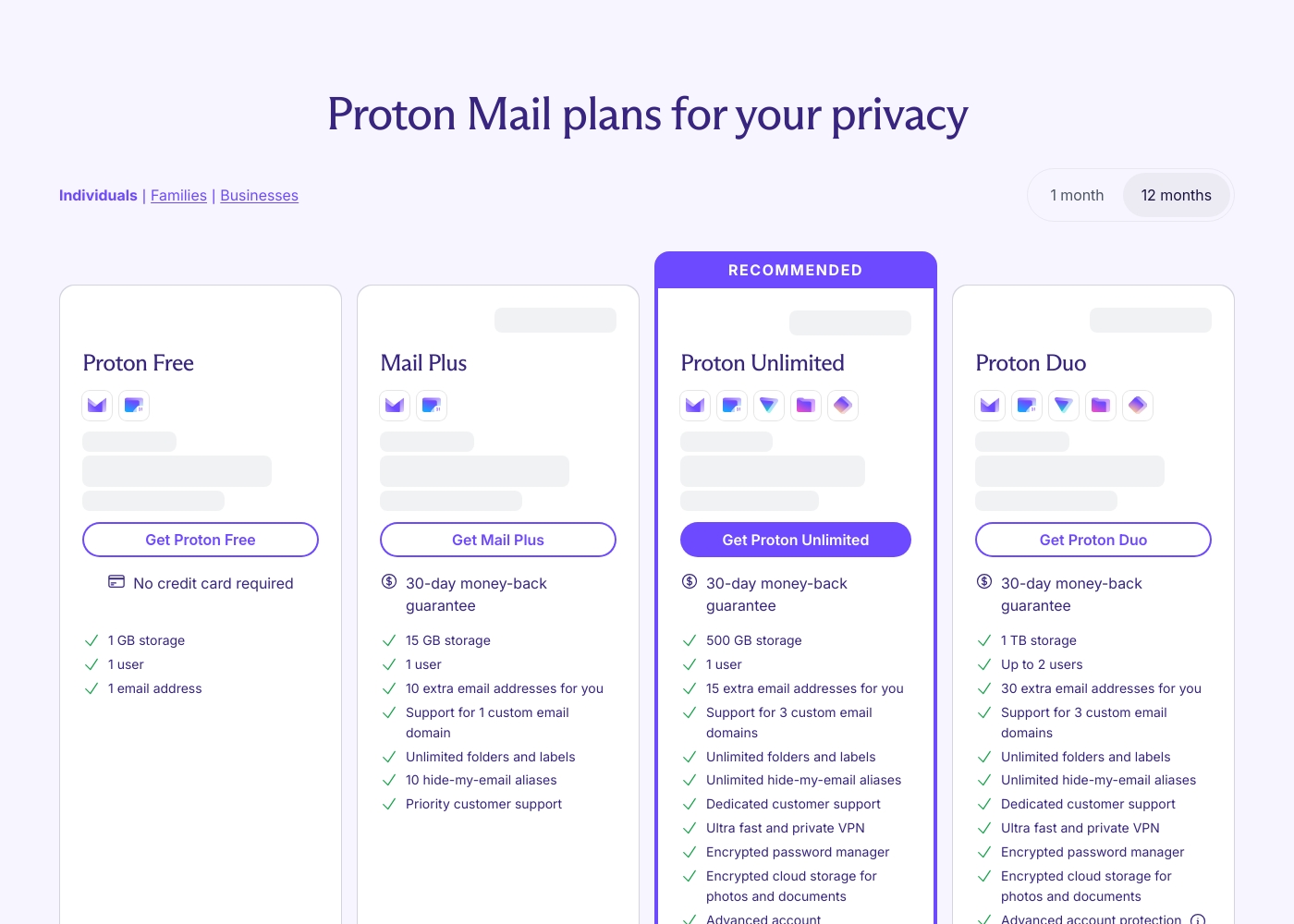
Proton Free
Price: Free Websites Supported: No custom domains supported Best For: Basic individual use Refund Policy: Not applicable Other Features: 1 GB storage, 1 user, 1 email address, No credit card required
This is the perfect way to embrace online privacy without any commitment. You get 1 GB of secure storage, which is great for new users or those who only need basic email functionality. It always remains free, honoring Proton's commitment to secure communication.
- 1 GB storage
- 1 user
- 1 email address
- No credit card required
- 15 GB storage
- 1 user
- 10 extra email addresses
- Support for 1 custom email domain
- Unlimited folders and labels
- 500 GB storage
- 1 user
- 15 extra email addresses
- Support for 3 custom email domains
- Unlimited folders and labels and hide-my-email aliases
- 1 TB storage
- Up to 2 users
- 30 extra email addresses
- Support for 3 custom email domains
- Unlimited folders and labels and hide-my-email aliases
Pricing Notes
- Gmail offers a highly robust, perpetually free 'No cost' plan with 15GB of pooled storage.
- The explicit cost for the required paid business plan (Business Standard) for Gmail is not stated in the provided data.
- All Proton Mail paid subscriptions come with a risk-free 30-day money-back guarantee.
- Proton Mail pricing scales based on the amount of encrypted storage and included suite tools (VPN, Drive).
- Both Gmail and Proton Mail require contacting sales or signing up to determine specific per-user monthly costs for their paid business tiers.
Pricing Head-to-Head
User Reviews
Users are deeply divided when reviewing the Google Workspace experience. While the core Gmail service itself is universally acknowledged as reliable and secure (handling billions of users), external reviews, particularly for the paid Workspace platform, highlight pervasive customer service and billing failures.
Users frequently express widespread dissatisfaction with support responsiveness, often describing it as “non-existent,” slow, and frustratingly unprofessional. Recurring pain points include being locked into annual contracts without clear warning, experiencing shocking billing errors, dealing with double charging, and finding it nearly impossible to cancel without incurring significant fees.
I rely on Gmail daily for my small business needs. The seamless integration with Meet and Calendar keeps my workflow perfectly organized. The strong security features are truly reliable, too; I rarely see any spam.
External feedback paints a dramatically mixed picture, heavily influenced by extreme opinions about customer service versus product quality. Users consistently praise Proton Mail itself (often rated 5/5), along with the idea of uncompromising privacy and the company's strong data protection location in Switzerland.
The suite provides solid value, especially as Proton frequently introduces new features to its unlimited plans. However, customer support is a major pain point, described as "useless," "disgraceful," and having "sluggish response times." Users often complain about a noticeable lack of authority or tools for support representatives to resolve complex issues like account suspensions, configuration access problems, or delayed refunds.
I’ve experimented with several of Proton's products and found them highly reliable. Proton Mail, specifically, deserves a 5/5 rating. I use it successfully for my custom domain email plan and the security is unmatched.
Our Verdict
Choosing between Gmail and Proton Mail boils down to a core philosophical conflict: productivity versus privacy. If maximum convenience and deep integration are your priorities, Gmail is the superior choice. If uncompromising security and data confidentiality are critical, you must choose Proton Mail. Gmail’s superpower is making busy lives easier through sheer efficiency and scale. Its AI tools, like Gemini, help you draft replies and summarize long threads instantly. The seamless integration with Meet, Chat, and Calendar optimizes professional workflow dramatically. Proton Mail’s superpower is its commitment to absolute user privacy and data sovereignty. End-to-end, zero-access encryption ensures not even Proton can read your messages. Being based in Switzerland offers crucial protection under the world's strictest privacy laws. The decisive factor is the trade-off inherent in each tool’s design. Gmail offers 15 GB free storage and world-class speed, but you accept US jurisdiction and data scanning. Proton Mail limits storage but guarantees no tracking, making it ideal for sensitive communications. Choose Gmail if you run a fast-paced business and rely heavily on the Google ecosystem. Choose Proton Mail if you handle confidential data or if privacy and being free from digital surveillance are your non-negotiable requirements.
Frequently Asked Questions
Which is better for core business operations: Gmail or Proton Mail?
Gmail is better for teams requiring tight workflow integrations for collaboration. Gmail provides seamless access to Google Meet, Calendar, and Tasks without leaving the inbox. Proton Mail is better for businesses requiring high compliance and unparalleled data privacy protections.
Does Gmail offer end-to-end encryption like Proton Mail?
No, Gmail uses default security encryption, and the provider can technically access your data. Proton Mail uses mandatory zero-access, end-to-end encryption. This powerful encryption ensures only you can ever read your emails.
Is the free plan from Gmail or Proton Mail more valuable?
The Gmail free plan is more valuable for general use, offering a massive 15 GB of pooled storage. The Proton Mail free plan is highly storage-restricted (up to 1 GB). However, Proton Mail guarantees zero-access security even on the free tier.
How do AI productivity features compare between Gmail and Proton Mail?
Gmail excels in AI, using Gemini to draft, summarize, and assist composition instantly. Proton Mail has no native AI productivity tools. If speed is essential, Gmail's AI functionality is superior.
Which service handles migration easier: Proton Mail or Gmail?
Proton Mail offers the 'Easy Switch' tool for simple, one-click migration of all data from any provider. Gmail supports importing from legacy systems like IBM Notes and Microsoft. Proton Mail is more user-friendly for migration.
Does Proton Mail protect against trackers like Gmail protects against malware?
Yes, Proton Mail's security focuses on blocking email trackers and digital surveillance. Gmail focuses heavily on blocking malware, spam (99.9%), and external attack vectors. Both services fulfill different security needs effectively.
Ready to Choose?
Both tools have their strengths. Choose based on your specific needs.