Gist vs Tidio
Gist and Tidio both tackle customer engagement but from very different angles. Gist offers a stable, all-in-one suite with unique flat-rate pricing. Tidio focuses heavily on maximizing efficiency using its powerful Lyro AI Agent. Choosing depends on your need for broad feature depth versus specialized AI support for resolution.
Best for: Businesses prioritizing cost certainty with mandatory stable budget controls, Growth-focused teams needing native email marketing and meeting scheduling tools
Best for: SMBs needing potent AI deflection and automation right away, Service teams prioritizing rapid resolution rates and high ticket deflection via AI
Powerful features, undermined by integrity issues.
We found Gist offers a strong, feature-rich product designed for customer service and lead capture, including an attractive flat-rate pricing option. Overall, consistent reports of severe ethical concerns regarding billing practices and affiliate payments prevent us from recommending Gist broadly at this time.
Pros
- Feature-rich "all-in-one" solution for seamless customer service and lead capture.
- The product is noted for continuously improving and adding new features.
- Effective visual workflow feature helps manage customer journeys efficiently.
- A unique flat rate plan ($99/month) offers stable, predictable pricing.
Cons
- Recurring reports of unethical billing, changing plans, and fraudulent affiliate payout avoidance.
- Customer support responsiveness is highly inconsistent, often taking hours to days to reply.
- Severe functional issues reported with the iOS mobile application (buggy or inoperable).
- System has been reported to block email sending capability without issuing any warning.
Great AI automation, difficult billing practices.
We found Tidio excels in delivering powerful AI chat automation supported by remarkably fast and expert human assistance. Overall, we must caution that frequent reports of unexpected price hikes and aggressive billing strategies significantly cloud this positive technical experience.
Pros
- Superior and professional customer support with fast response times.
- Easy setup process and smooth website integration.
- Lyro AI effectively automates responses to common customer questions.
- Reliable chat platform with a user-friendly interface.
Cons
- Reports of unexpected rate increases and unnotified plan changes.
- Concerns raised about misleading pricing and billing practices.
- Some users experienced difficulty canceling subscriptions or receiving refunds.
- Limited customization options reported for chatbot design.
AboutGist
Gist is an ecosystem designed specifically to improve your customer service and prospect engagement efforts. Users recognize it as a comprehensive tool that streamlines communication efficiently. You won't need to be a programmer to get started, either. One user noted that installing the key features, like live chat, was very easy to set up without technical help. It’s built to be accessible, helping any serious business owner manage conversations better. ✅
AboutTidio
Tidio is a complete customer service stack built to optimize your support offering. It provides the most intuitive real-time Live Chat combined with a robust Help Desk.
This structure helps you turn departmental chaos into streamlined efficiency. The platform uses Lyro AI, which handles about 90% of repetitive tasks across chat, email, and social media.
Tidio is built for brands that refuse to compromise on their customer experience. 💡 They aim to make your human agents more effective, not redundant.
Highlights
Feature Comparison
Features Overview
We highlight the main differences and pick a winner for each feature.
AI Chat & Automation
Tidio’s Lyro AI is far superior; Gist uses traditional routing and communication rules.
Gist uses rapid communication rules and visual workflows for basic efficiency improvements. It captures rich contact context like location during initial visitor engagement. Tidio’s Lyro AI handles up to 67% of repetitive queries automatically. Lyro boasts an impressive 89% resolution rate, freeing your human agents completely. Tidio focuses on AI augmentation to achieve higher resolution rates and measurable uplift. Gist focuses on internal process automation. If AI-driven deflection and scale are paramount, Tidio is the clear choice for your service team.
Pricing Model
Gist has a unique $99 flat rate for predictability; Tidio offers a free plan and usage tiers.
Gist uniquely offers a $99/month flat rate plan for total budget predictability. You can seemingly grow your usage significantly for the same fixed fee. Tidio offers a completely Free plan to start and scales up with tiered, usage-based subscriptions. Tidio pricing can potentially reach $5000/month or more based on requirements. If fixed, stable budgeting is critical for your scaling business, Gist’s flat rate is uniquely appealing. Tidio’s cost changes with your billable conversation volume. Tidio's free tier makes it easier for small startups to get started immediately, unlike Gist.
Feature Scope
Gist is a true all-in-one suite; Tidio focuses tightly on specialized CX and chat Flows.
Gist is a feature-rich solution including email marketing, knowledge base, and meeting tools. It aims to manage the entire customer lifecycle successfully. Tidio is centered on Help Desk, Live Chat, and powerful AI-powered conversation Flows. Tidio focuses on optimization rather than breadth. Tidio relies on 120+ integrations for functions Gist builds natively into its platform. Gist offers more components under one roof. If consolidating different tools into one ecosystem is your goal, Gist provides that depth internally.
Integrations
Tidio explicitly integrates with 120+ tools; Gist focuses on its built-in platform features.
Tidio explicitly advertises 120+ tool integrations to connect seamlessly with existing tech stacks. This extensive external ecosystem ensures smooth operations. Gist's documentation does not specify the number of external CRM or third-party tool connections. Gist believes its native tools cover most needs. Tidio is designed to be a best-in-class connector for existing business infrastructure. Gist feels more like a closed ecosystem. If connecting specialty third-party tools like CRMs is essential, Tidio offers far greater flexibility.
System Reliability
Tidio is noted for reliable performance; Gist reports issues with mobile apps and lagging UI.
Gist users have reported severe functional issues with the iOS mobile application experience. The UI can also lag significantly when managing contact lists in bulk. Tidio reviews praise the platform for its easy use and solid, reliable performance generally. No major technical instability issues are widely reported. Technical stability is a clear differentiator favoring Tidio over Gist, especially for mobile users. Gist's functionality can impede agent workflow. Teams needing reliable mobile access for customer engagement should heavily favor Tidio's performance stability.
Customer Support
Tidio's support is reliable and fast; Gist's support is known to be highly inconsistent.
Gist users report highly inconsistent support responses, sometimes waiting days for a ticket update. This inconsistency severely impacts trust. Tidio is generally reviewed for easy access, quick replies, and knowledgeable, friendly support staff. They are known for resolving issues fast. Tidio offers dependable support access when you need it most, enhancing user trust immediately. Gist support is a recurring customer pain point. For mission-critical support needs, choose Tidio for its proven speed and consistency in resolving issues.
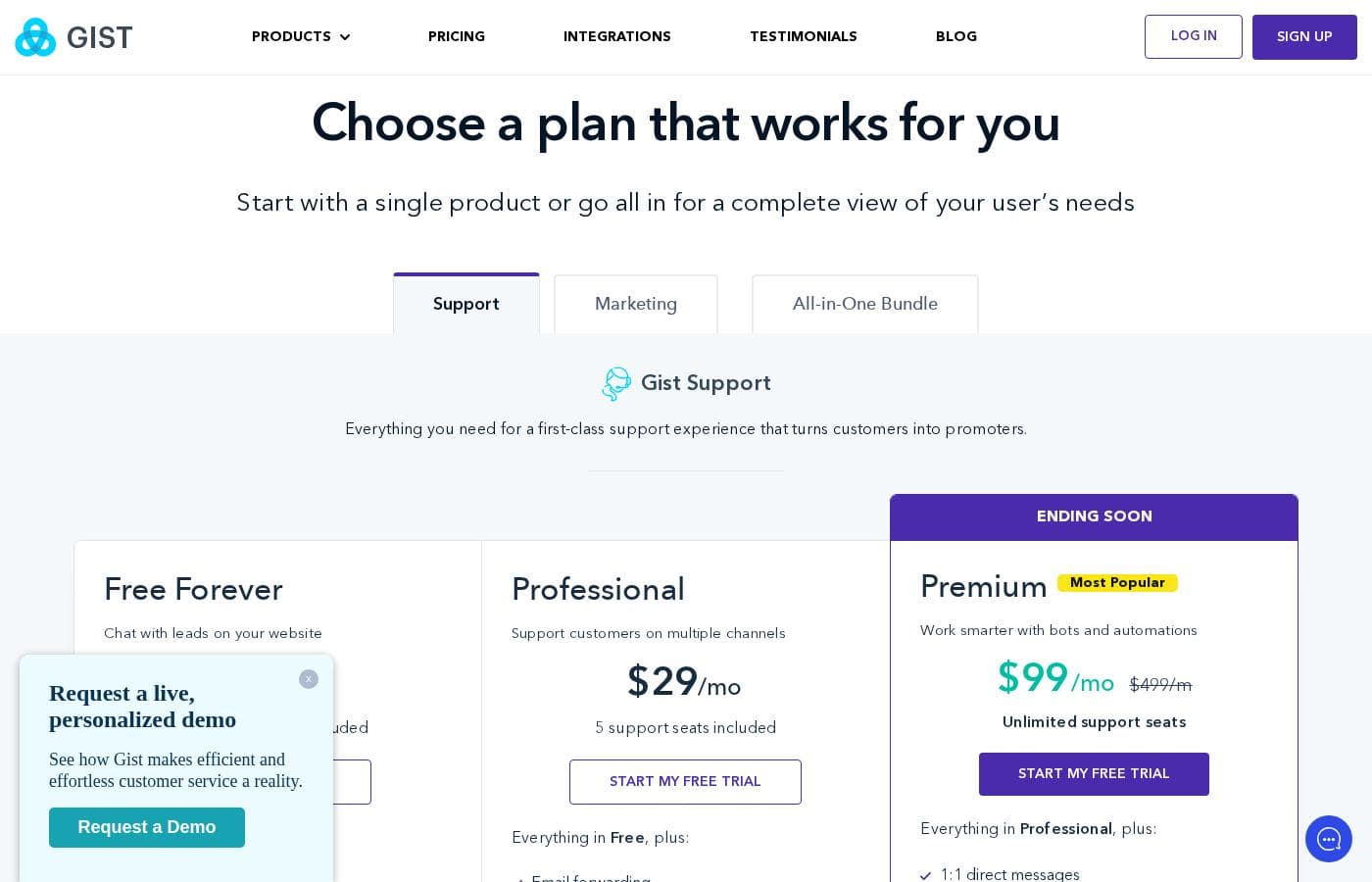
Gist pricing appears to start at $99 per month for a flat rate plan, or scale based on the number of people accessing the platform, reaching $1830 per month for 30 seats.
Here’s a closer look at the specific options Gist provides:
Flat Rate Plan
Price: $99/month Other Features: Flat pricing structure; "Grow all you want, still $99/month total."
- Flat price structure
- Grow all you want, $99/month total
- Access for 5 people
- Access for 10 people
- Access for 30 people
Tidio costs between $0 and $749+ per month with 5 main plans: Free at $0/mo, Starter at $24.17/mo, Growth starting at $49.17/mo, Plus starting at $749/mo, and Premium requiring contact for pricing.
Here’s a breakdown of what each subscription offers so you can choose the best fit for your business needs.
Free
Price: $0/mo. Other Features:
- 10 seats
- 50 Billable conversations per month
- Live chat & Ticketing
- Your first 50 Lyro AI Agent conversations (lifetime limit)
- 10 seats
- Live chat & Ticketing
- Copilot New
- Website scraper
- 10 seats
- Basic analytics
- Social media integrations
- Email management system
- Everything in Starter
- Advanced analytics
- Permissions
- Live typing
- Automatic response
- Everything in Growth
- Dedicated Success Manager
- Custom branding
- Multiproject
- Multilanguage

Pricing Notes
- Gist offers a unique $99/month flat rate plan guaranteeing rate stability despite usage volume.
- Tidio starts with a free plan and offers a 7-day free trial; Gist offers neither option.
- Tidio pricing is usage-based, scaling up primarily with billable conversations per month.
- Gist scales rapidly based on seats, reaching $1830/month for 30 users.
- Concerns exist with both: Gist faces ethical billing complaints, and Tidio faces pricing confusion.
Pricing Head-to-Head
User Reviews
Gist receives extremely mixed feedback, balancing praise for its functionality against serious issues regarding business reliability. Users occasionally describe Gist as a feature-rich and excellent product that is constantly improving and reasonably priced.
Specific support agents are sometimes identified by name for being friendly and responsive. However, the overall sentiment, reflected in a low 2.1/5.0 score, raises significant red flags.
Gist is an absolutely fantastic tool that keeps improving. My experience with the team has always been exceptional; they are friendly, helpful, and go the extra mile. They even add suggestions to the product roadmap quickly.
Users predominantly praise Tidio for its exceptional customer support. Reviewers consistently describe the staff as knowledgeable, friendly, and fast-responding, often resolving complex issues quickly via live chat—many naming agents personally for providing ‘flawless’ and ‘top-notch’ service.
The platform itself is widely regarded as user-friendly and reliable, noted for its quick setup and smooth website integration. Customers highly value the Lyro AI features, particularly the ability to train the chatbot based on existing help center content.
I had an exceptional experience with Tidio’s customer service team! They provided clear guidance and helped me choose the perfect plan that aligns with my team's needs. Their response time was incredibly fast and helpful.
Our Verdict
Choosing between Gist and Tidio involves picking your primary focus: all-in-one depth or AI-driven specialized efficiency. Both Gist and Tidio excel at customer engagement, but Tidio is the safer, generally better-reviewed choice for most teams today. Gist's superpower is its commitment to being a feature-packed all-in-one revenue suite. If you want native email marketing, meetings, and a knowledge base, Gist delivers those features instantly. The unique $99 flat-rate pricing plan offered by Gist provides incredible budget predictability during scaling. However, Tidio dominates the AI and operational efficiency battlefield. Tidio’s Lyro AI Agent can resolve almost 90% of repetitive questions instantly. Lyro handles 67% of queries, allowing human agents to focus quickly on complex cases. Tidio also offers 120+ seamless integration options. The biggest difference lies in overall reliability and user trust, where Tidio clearly wins out. Gist faces recurring negative reviews about inconsistent support and serious ethical billing complaints. Tidio is consistently praised for fast, knowledgeable support and higher platform stability. If you are a growing SMB needing robust AI automation and a high integration ceiling, choose Tidio. If you absolutely require a fixed, stable IT budget and want all your essential sales tools bundled natively, Gist warrants consideration, but proceed with caution.
Frequently Asked Questions
Which is better for AI automation: Gist or Tidio?
Tidio is superior for AI automation using its dedicated Lyro AI Agent. Lyro handles roughly two-thirds of repetitive queries successfully. Gist relies on traditional automation rules and visual workflows for efficiency.
Which platform offers better pricing predictability?
Gist offers a unique $99/month flat rate plan, guaranteeing a stable cost regardless of heavy usage. Tidio uses usage-based tiered plans that scale according to billable conversations. If budget stability is key, Gist is the winner.
Does Gist offer a free trial like Tidio?
No, Gist does not offer a free trial or a free plan based on the documented pricing. Tidio provides a 7-day free trial with full feature access. Tidio also offers a permanent starter Free plan.
Which one is a true 'all-in-one' tool: Gist or Tidio?
Gist is marketed as the all-in-one tool, including native email marketing, knowledge base, and meeting features. Tidio is more specialized, focusing on Live Chat and Help Desk functions, relying on 120+ integrations for ecosystem breadth.
Why are Gist's customer reviews significantly lower than Tidio’s?
Gist users report issues with functional stability, including buggy iOS apps and UI lag. More seriously, Gist faces recurring complaints of unethical billing and inconsistent support responsiveness. Tidio scores higher on support and reliability.
Can I use Gist or Tidio on multiple websites easily?
Tidio explicitly confirms you can add the platform to multiple sites, with shared behavior and widget appearance. Gist's documentation does not specify domain limits or multi-site usage capabilities.
Ready to Choose?
Both tools have their strengths. Choose based on your specific needs.