GEOfinder vs Phonsee
People often compare GEOfinder and Phonsee for their phone tracking needs today. GEOfinder focuses on anonymous location lookups with zero installation required for simplicity. Phonsee offers a deep, real-time monitoring suite spanning social media and call logs. Your final choice depends entirely on depth versus installation complexity.
Best for: Quick, one-off location lookups via phone number only with max simplicity, Users needing to trace an older, basic feature phone that cannot run proprietary tracking apps
Best for: Monitoring family safety with reliable real-time GPS and location history alerts, Managers needing oversight over team devices (Android, iOS) for compliance and productivity
Major concerns about billing and features.
GEOfinder promises simple, anonymous, worldwide location tracing with no software installation required. We note that the wide compatibility with all global networks is a strong theoretical benefit. However, extreme negative user feedback concerning billing policies and unreliable results entirely overshadows these promised features. Overall, we advise extreme caution due to widespread reports of unexpected costs and highly questionable tracking functionality.
Pros
- No software installation or downloads are required.
- Compatible with all phone models and networks globally (stated feature).
- Geolocation requests can be performed anonymously.
- Reported success with reverse lookup features (finding name, address in some cases).
Cons
- Widespread complaints about unexpected, hidden recurring subscription fees.
- Location tracking is frequently described by users as inaccurate or unreliable.
- Extreme difficulty reported in canceling automatic charges or obtaining refunds.
- Customer support is largely unresponsive, often using only auto-replies.
High-feature promises, low reliability execution.
We found Phonsee promises comprehensive and secure tracking using an intuitive dashboard interface. However, overwhelming user reports of major bugs, features failing to load, and issues with refunds seriously undermine its reliability claims. Overall, buyers must exercise extreme caution.
Pros
- Offers a comprehensive suite of monitoring tools.
- Utilizes GPS and Wi-Fi for claimed high accuracy location tracking.
- Setup is described as straightforward with a seemingly user-friendly interface.
- Secure, cloud-based data delivery to a personal dashboard.
Cons
- External users report significant software bugs and syncing failures.
- Core features reportedly do not load, even after paying for full access.
- Users report difficulty in obtaining the promised refunds/money-back guarantee.
- Reports of website redirection (to eyezy.com) raise transparency concerns.
AboutGEOfinder
GEOfinder is a straightforward service designed for finding a mobile location using only the associated phone number. It eliminates the need for complicated software downloads both for you and the target person. This service works across all major cell phone brands and models. It’s ideal for anyone who needs to trace a location quickly and efficiently, no matter which mobile network they use globally. 💡
AboutPhonsee
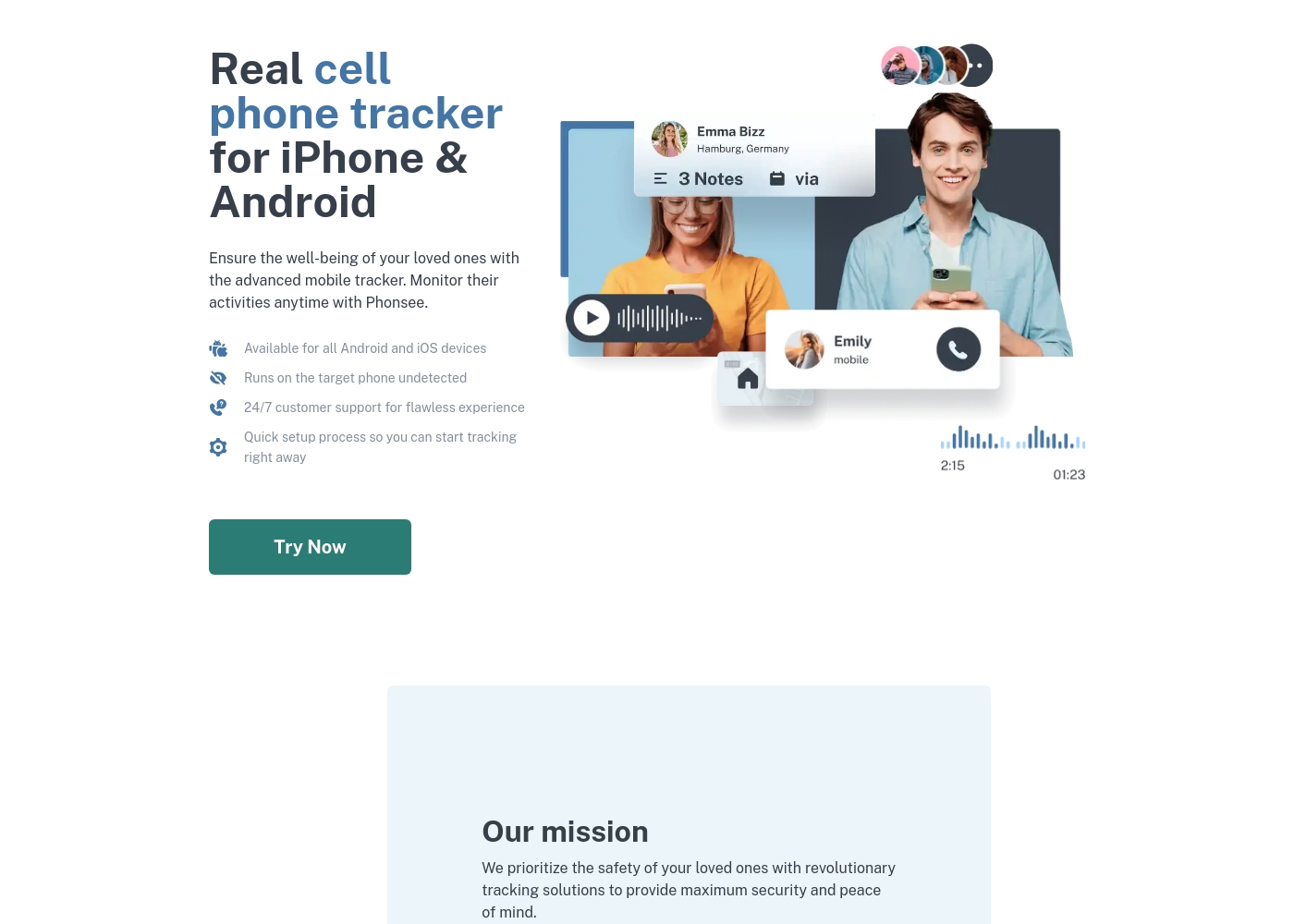
Phonsee is an advanced mobile tracker designed to stand out in the monitoring market. The app provides comprehensive features within an easy-to-use platform, suitable for both beginners and experienced professionals. The technology relies on GPS satellite and Wi-Fi to provide the most accurate location tracking available, ensuring you get correct, up-to-date information 💡. Your monitoring remains flexible, with cross-platform compatibility allowing you to track devices running on Android or iOS.
Highlights
Feature Comparison
Features Overview
We highlight the main differences and pick a winner for each feature.
Setup Complexity
GEOfinder requires zero installation onto any device; Phonsee needs an app installed on the target phone.
GEOfinder uses a simple external phone number lookup process through its web interface. You skip all configuration steps, which is incredibly fast for quick checks. No downloads are required on your side or the target's side to start tracking the device. Phonsee is a monitoring tool requiring a proprietary app installation on the target device. Setup is straightforward, but physical access to the phone is necessary for Phonsee to function fully. The zero-install method of GEOfinder wins on speed, but Phonsee offers greater long-term depth.
Monitoring Depth
Phonsee offers robust social media and calls tracking; GEOfinder only performs basic geographic location tracing.
GEOfinder’s only feature is finding basic location based solely on the provided phone number. It focuses narrowly on where the device is right now. Phonsee offers broad surveillance encompassing call logs, social media activity, and app usage details. If you need robust details beyond simple coordinates, Phonsee is the only viable option. This extended scope allows Phonsee to provide comprehensive visibility for full device monitoring needs. GEOfinder cannot compete with Phonsee on the depth of user data collected and displayed.
Real-time Location
Phonsee provides real-time GPS updates; GEOfinder’s location service is frequently reported as inaccurate or unreliable.
Phonsee explicitly delivers real-time location updates using both GPS and Wi-Fi data sources. Users receive exact coordinates and detailed location history with timestamps in their cloud dashboard. GEOfinder initiates a simple request for location, which user testimonials describe as often unreliable or delivering ‘fake results.’ For constant, dependable awareness and precision, Phonsee's architecture offers superior real-time performance. Phonsee’s reliability lets users respond quickly to changes in location or security matters.
Geofencing & Alerts
Phonsee defines safe zones and offers instant boundary alerts; GEOfinder completely lacks this active alert capability.
Phonsee includes advanced geofencing features, letting you define customized boundaries. The system instantly notifies you when the monitored device enters or leaves these defined safe zones. GEOfinder does not offer geofencing, custom boundary alerts, or any form of continuous, active monitoring. The proactive alert ability makes Phonsee far superior for continuous oversight or family safety monitoring. Phonsee gives you control over the perimeters, which is a massive feature benefit.
Universal Compatibility
GEOfinder supports all phones and global carriers; Phonsee is restricted to modern iOS, Android, and tablets.
GEOfinder is designed for universal compatibility, supporting all phone models, brands, and basic feature phones. It also advertises seamless operation across all mobile network operators globally. Phonsee requires a dedicated monitoring application, limiting its use to modern, smart operating systems like Android and iOS. If you need to trace an older basic device, or frequently track globally across obscure networks, GEOfinder handles that niche easily. GEOfinder theoretically has broader reach, though feature success is questioned.
Pricing Clarity
Phonsee is transparent with a $7–$27 range; GEOfinder provides no up-front costs and is associated with hidden fees.
Phonsee states its plans range from $7 to $27 and mentions flexible subscription structures openly. GEOfinder provides zero public pricing details, forcing users to contact sales to understand subscription rates. User reviews overwhelmingly cite GEOfinder for charging unauthorized, high recurring fees after a cheap trial. Phonsee's upfront clarity, even with usage-based notes, is vastly superior to GEOfinder's reported predatory billing. Phonsee lets you assess the costs before committing to a plan.
User Trust & Reviews
Phonsee has a moderate 3.4/5 rating; GEOfinder scores an abysmal 1.8/5 due to widespread fraud complaints.
GEOfinder holds an extremely low 1.8/5 rating due to user outrage over sudden, unauthorized recurring charges and non-functional tracking. Users describe GEOfinder as a scam service that is impossible to cancel after the cheap initial payment. Phonsee's 3.4/5 rating reflects functional features, despite reports of occasional bugs and varied support quality. When choosing a tracking tool, Phonsee is the only service that holds a sustainable level of user trust. Avoid GEOfinder entirely due to the extreme trust issues.
Since the pricing details are not available, we can review the core features that define the GEOfinder location tracing tool. The provided information does not list distinct pricing tiers or specific names for subscription plans.
Other Features: Supports all phone models (and brands), works with all mobile network operators globally, totally anonymous geolocation requesting, no software installation required.
Since no specific plan details are available, we can only note that this service is ideal for anyone needing quick, anonymous location tracing without having to install complicated software on their own device.
Since Phonsee offers flexible subscription options, we can generalize the benefits available across their models. You can select the best fitting plan for the type of device you need to track.
Standard Subscription Plan
Best For: Users requiring secure and reliable cross-platform mobile tracking Refund Policy: Money-back guarantee Other Features:
- Flexible plans are available
- Prices drop for long-term commitments
- Secure and reliable service
- Regular updates are included
This subscription model is designed for flexibility, allowing users to find an option that works well for their specific requirements. Remember that if you know you need monitoring for an extended period, choosing a longer commitment will help you realize cost savings.
- Flexible renewal options
- Includes money-back guarantee
- Lower rates for long-term commitments
- Secure and reliable monitoring service with regular updates
Pricing Notes
- GEOfinder does not list explicit pricing, forcing users to inquire directly for subscription costs and facing alleged hidden fees.
- Phonsee offers much better transparency with a stated pricing range of $7–$27 and different plan types.
- GEOfinder users widely report being charged $47.99 to $49.99 for unauthorized, recurring auto-renewal fees after a low-cost trial.
- Phonsee mentions a money-back guarantee, but GEOfinder makes no statement regarding refunds or easy cancellation procedures.
Pricing Head-to-Head
User Reviews
GEOfinder currently holds a low Trustpilot rating (2.3/5 based on over 350 reviews). The overwhelming majority of users express extreme dissatisfaction, primarily focusing on unethical billing practices.
Customers frequently report being lured by low initial offers (e.g., £0.97), only to face sudden, unauthorized recurring charges for costly monthly subscriptions ($49.99). Many people claim the service fails to function as advertised, describing the location tracking as unreliable or yielding 'fake results' rather than accurate data.
I paid £0.97 for a location search because I suspected a scam. They never provided the information I paid for, and the next day, they took £47.99 from my bank account. Support is useless, only sending automated replies.
Phonsee’s external feedback is currently overwhelmingly negative, based solely on a small number of Trustpilot reviews which yield a low 2.9-star average. Users report significant operational failures, stating that the software “never synced properly” and was “full of bugs.” One user who purchased full access noted that “half the features wouldn’t load,” ultimately forcing them to switch to a competitor that worked immediately.
This highlights Phonsee’s severe reliability issues. Critically, recurring reports describe major problems with customer service responsiveness and resolution, specifically concerning the money-back guarantee.
I used this software for a small business project. It never synced properly, and half the features wouldn’t load, even after paying for full access. Their support simply blamed my device for the issues. I was highly disappointed that this paid app couldn't manage basic reliability.
Our Verdict
The choice between GEOfinder and Phonsee is surprisingly easy: trust matters most in tracking software. GEOfinder promises simple, no-install tracking, but its user reviews are disastrous. Phonsee offers a full monitoring suite and, despite some occasional bugs, is far more reliable and honest. GEOfinder's true selling point is its universal zero-installation appeal and anonymous tracing. You literally only need the phone number to start a trace. This is technically perfect for tracking old feature phones or using any global mobile network. However, most users report paying money only to receive inaccurate results and face hidden monthly charges. Phonsee is the vastly better choice for serious, ongoing surveillance needs. It delivers comprehensive monitoring, covering social media, call logs, and app activity. Its cloud dashboard and real-time GPS ensure location tracking is accurate and highly responsive. Phonsee also offers critical geofencing alerts, which GEOfinder simply lacks entirely. The key factor here is transparency and ethical business practices. Phonsee has clear pricing ($7–$27) and even mentions a money-back guarantee. GEOfinder hides its subscription costs and then hits users with unauthorized $49.99 fees. Considering the widespread fraud complaints against GEOfinder, Phonsee is the only safe option. If you need a reliable monitoring tool with real-time alerts and trustworthy billing, definitely choose Phonsee. Avoid GEOfinder entirely unless you are willing to risk severe hidden recurring charges and unreliable location tracing.
Frequently Asked Questions
Is GEOfinder or Phonsee better for real-time location tracking?
Phonsee is clearly superior for real-time tracking, using GPS and Wi-Fi for accurate coordinates. GEOfinder's location service is widely reported by users as inaccurate and often failing to deliver data. Phonsee also provides detailed location history with timestamps, which GEOfinder does not.
Which tool is more compatible with different types of phones?
GEOfinder boasts universal compatibility, claiming to work with any phone model, brand, or global mobile network. Phonsee requires application installation, limiting it to Android, iOS, tablets, and PCs. If you must trace a very old or basic feature phone, GEOfinder is technically the only listed option.
Does GEOfinder or Phonsee offer social media monitoring?
Phonsee is a comprehensive monitoring suite that includes social media tracking and browser activity. GEOfinder is strictly a location trace via phone number only, offering no features for social media or call log surveillance. Choose Phonsee if you need broad digital activity insights.
Why are GEOfinder's user reviews so much worse than Phonsee's?
GEOfinder's poor 1.8/5 rating stems from major financial complaints by users. Customers allege fraudulent billing, unauthorized high recurring charges, and extreme difficulty canceling the service. Phonsee has milder complaints about bugs, but its featured tracking generally works as intended.
How does the pricing model differ between GEOfinder and Phonsee?
Phonsee is transparent, providing a clear pricing range of $7–$27 for flexible subscription plans. GEOfinder does not disclose its pricing publicly, leading to widespread reports of unexpected and mandatory $49.99 monthly fees after a cheap initial trial. Phonsee is much safer financially.
Can I use GEOfinder to set up geofencing alerts?
No, GEOfinder does not support geofencing or advanced alerts of any kind. This feature is exclusive to Phonsee, which allows you to define safe zones. Phonsee will send you instant notifications when the tracked device enters or leaves the boundary.
Ready to Choose?
Both tools have their strengths. Choose based on your specific needs.