Flowith vs Reword
Flowith and Reword both use AI to boost creativity, but they target very different users. Flowith is a visual thinking platform with powerful agents. Reword is a focused AI Cowriter for teams. The choice depends on whether you need to map ideas or polish articles.
Best for: Visual thinkers and knowledge workers, Teams needing to map complex ideas and research
Best for: Content teams and writers needing brand consistency, Agencies that produce high volumes of articles
Visual Thinking Meets AI Execution
Flowith presents a compelling platform that aims to bridge creative thinking and AI-powered execution. It offers a unique Canvas interface and a powerful agent system for managing knowledge and tasks. Overall, we find it to be a promising and innovative tool for creators and knowledge workers, though its real-world value will depend on user experience and support.
Pros
- Offers a unique Canvas for visual idea mapping and connection.
- Combines a Knowledge Garden for unified notes and research.
- Features a next-gen AI agent (FlowithOS) for task execution.
- Scalable pricing with a free Starter plan available.
Cons
- Core concept (Canvas-based AI) may have a learning curve.
- No verified external user reviews are currently available.
- Pricing scales to high-cost tiers for premium access.
- Actual performance and reliability are unverified by third parties.
Avoid Until Business Practices Change
We observe Reword offers robust features like custom AI training and unlimited usage plans, but these are overshadowed by severe customer complaints. Feedback universally reports a complete inability to cancel subscriptions, unresponsive customer service, and continuous unauthorized billing. Overall, we cannot recommend Reword due to documented evidence of highly unethical business and billing practices.
Pros
- Trainable custom AI Cowriter to match brand voice and style
- PRO plan offers unlimited drafts, projects, and users
- Designed for collaborative team use
- Features supporting article citations and enhanced credibility
Cons
- No visible or functioning method to cancel subscriptions
- Customer support is unresponsive and non-existent
- Users report continuous unauthorized monthly billing post-cancellation
- Service quality is viewed as subpar or generic compared to cheaper alternatives
AboutFlowith
Flowith is a next-generation AI platform built for creators, knowledge workers, and anyone who thinks visually. 💡 It moves beyond simple chat interfaces. At its core, it offers a Canvas to map out ideas and a powerful AI agent called FlowithOS to help you execute plans.
AboutReword
Reword is built as a dedicated AI assistant and Cowriter that works alongside your current team. This platform embraces clever collaborative AI to fundamentally change how you approach content creation.
You aren't just using a generic tool, though. You can quickly start training your own AI assistant tailored to your needs.
This focus on collaboration and personalized training means you can consistently produce high-quality content. It’s an effective way to assure that every one of your articles connects deeply with your dedicated readers.
Highlights
Feature Comparison
Features Overview
We highlight the main differences and pick a winner for each feature.
Visual Interface
Flowith's Canvas is a visual playground for mapping ideas. Reword uses a traditional linear editor for writing.
Flowith provides a Canvas where you can freely connect, reshape, and explore ideas visually. It's designed to break free from linear chat. You can map out entire projects as webs of connected nodes. Reword's interface is centered on a text editor for drafting articles. It focuses on the writing process, not visual brainstorming. The experience is more straightforward and less experimental. The key difference is thinking style. Flowith is for non-linear, visual thinkers. Reword is for writers who prefer a focused, linear drafting process. A startup founder might use Flowith to map a business plan. A content writer would use Reword to draft a blog post.
AI Execution Agents
Flowith has autonomous AI agents for execution. Reword focuses on collaborative writing assistance.
Flowith features FlowithOS, a next-gen agent for task execution and self-improvement. It also has Agent Neo for large-scale, non-stop creation. These agents turn visual plans into actions. Reword does not have autonomous execution agents. It acts as a collaborative Cowriter, helping draft and polish content. It doesn't execute multi-step plans on its own. Flowith's agents are for turning ideas into work. Reword's AI is for improving the writing itself. This is a major architectural difference. A developer could use FlowithOS to automate project documentation. A marketing team would use Reword to refine article drafts.
Knowledge Management
Flowith has a unified Knowledge Garden. Reword lacks a dedicated knowledge system.
Flowith offers a Knowledge Garden for cultivating notes, research, and projects in one place. AI helps connect and grow your information. It's a living knowledge base. Reword does not provide a comparable knowledge management system. It focuses on article creation and optimization. Your research and notes would be stored elsewhere. For managing interconnected research, Flowith is clearly ahead. Reword is for publishing content, not managing a knowledge base. A researcher could use Flowith's Garden to synthesize papers. A blogger would use Reword to write and cite sources.
Custom AI Training
Reword lets you train a custom AI Cowriter. Flowith does not offer this feature.
Reword allows you to train your own AI Cowriter to adopt your brand's tone and style. This personalization ensures consistent voice across all content. The training takes about 10-20 minutes. Flowith does not mention custom AI training. Its agents are designed for general execution and thinking. They are not trained on your specific brand voice. This is Reword's biggest advantage. You get an AI that learns your specific writing style. Flowith's agents are more general-purpose. A brand manager could train Reword's AI to match their company voice. A solo creator would benefit from Flowith's general-purpose thinking tools.
Pricing Model
Flowith has tiered plans with credits. Reword uses per-seat pricing with usage-based scaling.
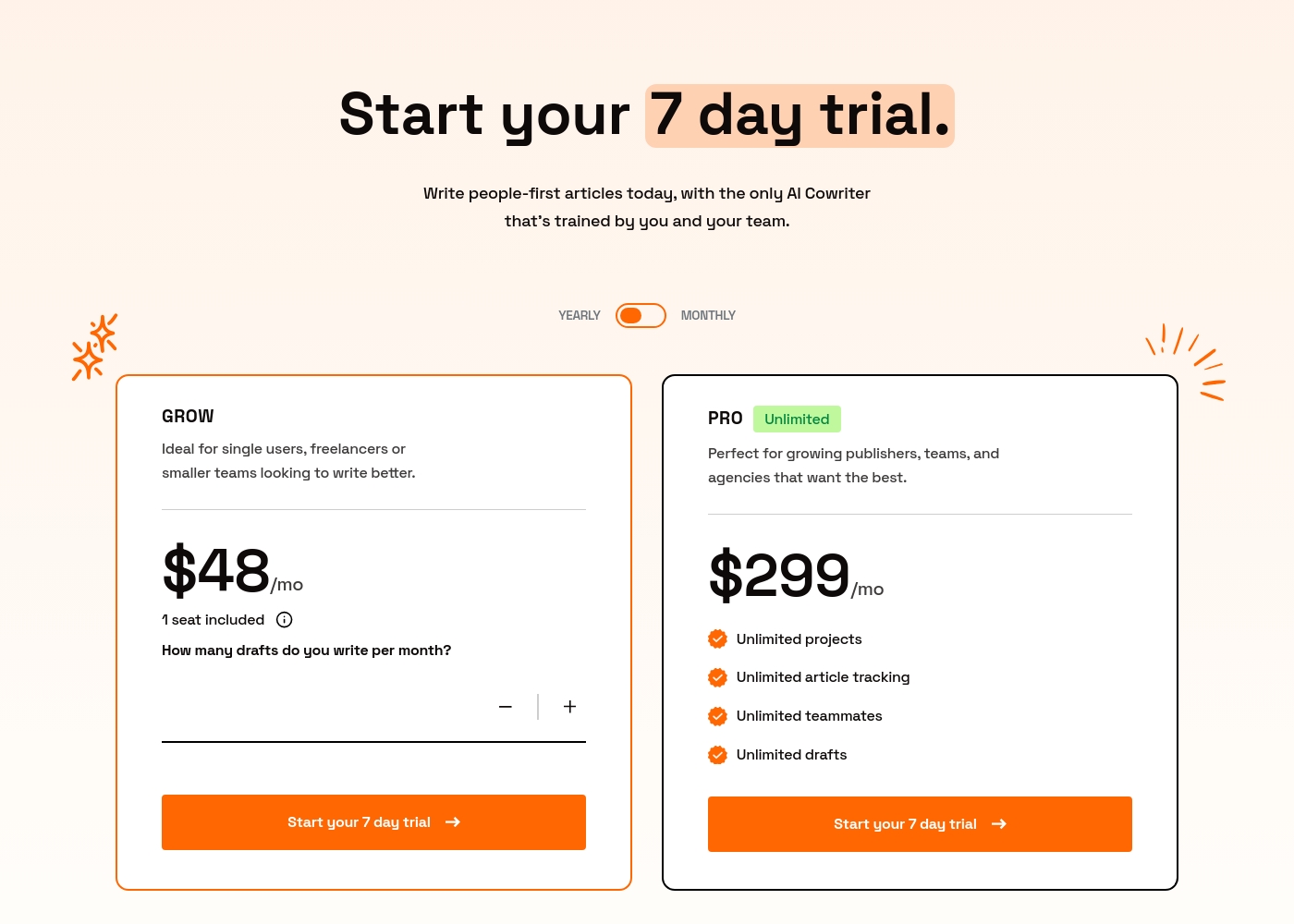
Flowith pricing ranges from $0 to $1200/month. It uses a credit-based system with a free Starter plan. Costs scale with plan tiers and model access. Reword's GROW plan starts at $48/month (annual) with usage-based draft scaling. The PRO plan is $299/month (annual) for unlimited access. Additional seats cost $15-30/month. Flowith offers a free tier, which Reword does not. Reword's usage-based model can lead to unexpected costs if you exceed draft limits. Flowith's pricing is more predictable but can get expensive at high tiers. A freelancer might prefer Flowith's free plan to start. A large content team would need Reword's PRO plan for unlimited usage.
Collaboration
Both support teams but in different ways. Flowith collaborates visually, Reword focuses on writing teams.
Flowith supports team collaboration through its visual Canvas. Multiple users can work on ideas and maps together. It emphasizes non-linear, collaborative thinking. Reword is designed as a collaborative partner for writing teams. It offers multiple seats and shared projects. The collaboration is centered on the content creation workflow. Flowith is better for brainstorming and planning as a team. Reword is better for coordinating the writing and editing process. A creative agency might use Flowith for campaign brainstorming. A publishing team would use Reword to manage article drafts and reviews.
Integrations
Reword has specific content platform integrations. Flowith's integrations are not detailed.
Reword integrates with Google Search Console, WordPress, Shopify, and Webflow. These are key for publishing and content workflows. It streamlines the process from writing to publication. Flowith does not list specific integrations. The focus is on its internal Canvas and AI agents. Integration with external tools is not a highlighted feature. For content publishing, Reword has clear advantages. Flowith is more of a standalone thinking environment. A marketer would use Reword's WordPress integration. A researcher would use Flowith's internal tools without needing external connections.
Customer Support
Flowith offers tiered support. Reword has severe customer service complaints.
Flowith's paid plans include priority 1-on-1 support and a dedicated Discord channel. Support levels increase with plan tiers. This is a structured offering. Reword's customer support is reported as unresponsive and non-existent. Multiple users claim they cannot cancel subscriptions or get refunds. This is a major red flag. Flowith provides clear support channels. Reword's support is a critical failure point. This is a huge difference for any user. If you need reliable help, Flowith is the safer choice. Avoid Reword if customer support is important to you.
User Reviews & Trust
Flowith has mixed but decent reviews. Reword has overwhelmingly negative reviews about billing.
Flowith has a 4.2/5 rating on Trustpilot. Reviews praise the Canvas and Knowledge Garden but note a learning curve and pricing. There are some positive and some mixed experiences. Reword has a 0.5/5 rating on Trustpilot. Reviews are almost all negative, focusing on billing issues, unresponsive support, and an inability to cancel. Users call it a scam. The difference in user sentiment is extreme. Flowith has a functional community. Reword has severe trust issues. Before choosing, always check recent reviews. Flowith seems trustworthy. Reword has serious ethical concerns based on user feedback.
Flowith pricing: Flowith offers a range of subscription plans starting from a free Starter tier up to a comprehensive Infinite plan at $399.92 per month. Pricing scales based on credit allotments, concurrent tasks, and access to premium AI models with options for monthly or yearly billing discounts. ⚡️ Unlock the potential of AI with our flexible plans tailored for every creative need. Whether you're a curious hobbyist or a professional building momentum, we've got a perfect flow for you. Explore our comparison to find your ideal match today! 🚀✨
- Starter Plan at $0 /mo
- Pro Plan at $17.91 /mo
- Ultimate Plan at $42.42 /mo
- Infinite Plan at $399.92 /mo
- Free plan available with basic credits.
- Discounts available for yearly subscriptions.
- Different plans offer varying AI model access.
- Flexible billing to suit your flow.
- Enhanced features with premium tiers. ✨
- All major payment methods accepted.
- Credits reset monthly for paid plans.
- Unlimited mode available on select plans. ⚡️
- Support levels increase with plan tier.
- Cancellation available at any time. 🚫⚓️
- Carbon removal supported with every use. ☘️
- Dynamic rate limiting for fair use. ⚖️
- Standard and priority processing options.
- Multi-device support for seamless work.
- Commercial licensing included in paid tiers.
- Early access to Flowith OS features. 🛠️✨
- Direct access to developers for top tiers. 👨💻
- Advanced batch generation capabilities.
- High-speed processing for intensive tasks. ⚡️
- Unlimited concurrent nodes for team use. 🤝✨
- Join a global community of innovators today! 🌍🚀✨
- Ready to elevate your creativity? 🪜✨
- Select your plan and start flowing. 🌊✨
- Your journey with AI starts here. 🚀✨
- Experience the power of Flowith now! ⚡️✨
- We're here to support your growth. 🌱✨
- Unleash your imagination effortlessly. 🌠✨
- Transform your workflow with Flowith. 🔄✨
- Secure and reliable AI execution. 🛡️✨
- Flexible solutions for every budget. 💰✨
- Elevate your creativ

Reword costs between $48 and $359 per month with two primary plans: GROW at $48/month (billed yearly) and PRO at $299/month (billed yearly).
Let's explore what each subscription tier offers so you can find the perfect fit for your content needs.
GROW
Price: $48/month (billed annually) or $60/month (billed monthly) Best For: Single users, freelancers, or smaller teams Refund Policy: 14-day money-back guarantee on inactive accounts Other Features:
- 1 seat included
- Usage-based draft scaling (0-10 drafts free, costs increase up to $105 extra for 71–80 drafts)
- Up to 3 projects, Custom-trained voices
- AI assistance powered by GPT-4, Claude, and Gemini
- 1 seat included (Additional seats $30 or $15/month, depending on context)
- Usage-based draft scaling (0-10 included, costs increase beyond that)
- Up to 3 projects
- Custom-trained voices
- Unlimited projects
- Unlimited article tracking
- Unlimited teammates
- Unlimited drafts
- Unlimited published article tracking
Pricing Head-to-Head
User Reviews
Based on the provided external review snippets, we cannot synthesize a balanced summary of user sentiment from Trustpilot or Capterra. The only available snippet is a connection error page, which contains no actual user feedback, ratings, or recurring themes. Therefore, a meaningful review summary that references specific user experiences regarding accuracy, ease of use, support, pricing, or other factors cannot be constructed from the given data. 😅 We must rely solely on the website's own description for this review.
The Canvas is a game-changer for organizing my research. It's so much better than a chat window for complex projects. I can finally see how all my ideas connect visually.
The external feedback for Reword is overwhelmingly negative, centering on critical billing, cancellation, and customer support issues. With a 2.3/5 TrustScore from limited reviews, the consistent and severe theme is the complete inability to cancel the service.
Multiple users reported being charged $50–$60 monthly even after attempting to cancel, deleting payment methods, or trying to halt the subscription via email for months. Customer service is cited as terrible; users receive no reply or resolution regarding charges or cancellation requests.
I tried to cancel my trial by emailing support, but they never responded and billed me anyway. There is no way to cancel on the website, forcing me to dispute the charge with my bank. Avoid this company at all costs.
Our Verdict
If you need to visually map ideas and execute plans, Flowith is the clear winner. Its Canvas and AI agents are unique. For a collaborative writing partner that learns your brand voice, Reword has the features but serious trust issues. Flowith's superpower is its visual Canvas and AI agents. You can connect ideas freely and let the AI execute your plans. It's built for complex thinking and knowledge work. Reword's superpower is its custom-trained AI Cowriter. You can train it on your brand's tone and style. It's designed to improve article quality and consistency for teams. The deciding factor is your workflow. Choose Flowith if you think visually and need to manage knowledge. Choose Reword if you need a writing assistant with brand voice training. However, we cannot recommend Reword due to its 0.5/5 rating and severe billing complaints. Flowith is the safer and more versatile choice for most users. For content teams, consider alternatives with better reputations.
Frequently Asked Questions
Which is better for small teams: Flowith or Reword?
For small teams focused on visual thinking and knowledge work, Flowith is better. It has a free plan and visual collaboration. For small content teams, Reword offers AI Cowriter but has severe support issues. Check reviews first.
Does Flowith have a free plan like Reword?
Yes, Flowith has a free Starter plan with 300 one-time credits. Reword does not offer a free plan, only a 7-day trial. This makes Flowith more accessible to start.
Is Reword worth the extra cost over Flowith?
Reword's PRO plan is expensive at $299/month. Flowith's pricing is more flexible but can also get expensive. Given Reword's negative reviews, it's hard to recommend paying more for it.
Can I train a custom AI voice with Flowith?
No, Flowith does not offer custom AI voice training. Reword allows you to train a custom AI Cowriter to match your brand tone. This is a key difference for brand consistency.
How do the AI agents in Flowith compare to Reword's writing assistant?
Flowith has autonomous agents like FlowithOS for execution. Reword's AI is a collaborative Cowriter for drafting. Flowith is for turning ideas into action; Reword is for polishing content.
Which tool has better user reviews and trust?
Flowith has a 4.2/5 rating with mixed reviews. Reword has a 0.5/5 rating with major billing complaints. Based on user feedback, Flowith is far more trustworthy.
Ready to Choose?
Both tools have their strengths. Choose based on your specific needs.