Etsy vs WooCommerce
Etsy and WooCommerce represent two fundamentally different ways to sell online successfully. Etsy offers massive marketplace traffic but you pay high transaction fees for the convenience. WooCommerce gives you vast customization built on WordPress, demanding full technical control. Here’s how to pick the right business foundation.
Best for: Solo entrepreneurs selling unique, handmade, or vintage goods., Sellers prioritizing immediate sales access and built-in audience over custom branding.
Best for: Developers or agencies building bespoke e-commerce solutions for clients., Businesses prioritizing maximum brand control, SEO, and full ownership.
Unique finds, operational headaches.
We recognize Etsy’s powerful concept of offering unique, handmade goods and strong personalization options. However, external reviews reveal chronic operational issues, particularly concerning system stability and customer care responsiveness. Overall, the platform’s valuable market niche is severely undermined by widespread failures impacting key reliability factors for both buyers and sellers.
Pros
- Access to a vast selection of unique, handmade, and vintage items.
- Enables strong product personalization (engraving, embroidery).
- Pricing model uses low listing fees rather than mandatory monthly subscriptions.
- Effective platform for supporting independent and small businesses.
Cons
- Customer support is widely reported as unhelpful, inadequate, or entirely nonexistent.
- Both buyer and seller accounts are frequently suspended without clear reason or explanation.
- High incidence of misleading product listings and scam sellers (poor accuracy).
- Widespread reliability issues concerning delivery, shipping delays, and faulty tracking.
Flexible Ecommerce Built on WordPress Power
We recognize WooCommerce's strength lies in its open-source platform, providing unmatched customization and scalability for ambitious users and developers. This flexibility, however, mandates external maintenance and a high tolerance for technical responsibility, as customer support is repeatedly cited as severely lacking. Overall, we recommend WooCommerce primarily for those with development resources or significant self-help capabilities.
Pros
- Core platform is open source, ensuring high value and low initial cost.
- Offers maximum customization and flexibility for unique stores.
- Trusted for stability and proven ability to handle large sales volumes.
- No platform commissions or subscription fees on the core product.
Cons
- Customer support is slow, non-responsive, or relies heavily on automated responses.
- Requires numerous plugins or custom coding to operate complex features (can feel bloated).
- Steep learning curve, especially concerning shipping, variations, and payment processors.
- Updates sometimes cause functionality issues or price errors.
AboutEtsy
Etsy is a vibrant online marketplace dedicated to all things distinctive and handmade or vintage. It is where you find items beyond the typical store purchase, ensuring your shopping feels personal. This destination is perfect for shoppers looking for original items, spanning from mugs and home goods to jewellery and apparel. Etsy focuses on delivering gifts as special as the recipient, prioritizing unique craftsmanship. It's a great place to discover essential items tailored to specific hobbies too. 💡
AboutWooCommerce
WooCommerce is known as the most trusted ecommerce platform globally. It provides an open-source solution built on the strength of WordPress, which powers 43% of the internet. This popular combination allows you to build, sell, and scale your way, creating a store as unique as your vision. It empowers businesses and developers alike, offering a foundation for creating powerful, flexible ecommerce experiences. Whether your business is complex, simple, big, or small, WooCommerce helps you take control of your success. 💡
Highlights
Feature Comparison
Features Overview
We highlight the main differences and pick a winner for each feature.
Cost Structure
Etsy is low upfront but charges steep transaction fees; WooCommerce has zero software fees but requires external resources.
Etsy charges a minimal $0.20 listing fee to get started right away. However, sellers pay a high 6.5% transaction cost plus processing fees on every sale. WooCommerce is open source and fundamentally free software. You never pay a platform commission or subscription fee for the core product. WooCommerce's real costs come from expensive hosting, required domain registration, and necessary premium extensions. The key difference is control: Etsy costs are performance-based, while WooCommerce costs are fixed budget items. If your sales volume is high, Etsy's percentage cuts will always be far more expensive than fixed WooCommerce hosting fees.
Ease & Setup
Etsy is instant setup for non-technical users; WooCommerce requires technical skills and managing your own server.
Etsy walks you through the shop setup immediately; you can be selling handmade goods in minutes. It handles the server, security, and payment gateways for you entirely. WooCommerce requires you to manage hosting, install WordPress, and configure complex selling features yourself. This steep technical involvement makes WooCommerce unsuitable for users who lack coding or developer knowledge. For speed and zero technical headache, Etsy is unbeatable for beginners.
Audience & Traffic
Etsy provides instant access to millions of shoppers; WooCommerce offers zero built-in traffic, requiring external SEO and ads.
Etsy is a massive marketplace where buyers actively search for unique, handmade, and vintage items. Your items show up in search results immediately. This inherent traffic means Etsy acts as an initial marketing engine for new shops. WooCommerce is a standalone site; you must drive every single visitor yourself. You need robust SEO and consistent external advertising to generate traffic. If getting eyes on your product rapidly is vital, Etsy provides an obvious advantage.
Customization & Control
WooCommerce provides unlimited customization via open-source code; Etsy locks sellers into rigid platform templates and rules.
WooCommerce is built for flexibility and control, allowing developers to modify every screen and feature. You can optimize checkout flows to boost conversion rates by 35% or more. Etsy limits you to platform-approved sections for your shop and branding. You have minimal control over the design, checkout experience, or underlying code. If your business requires bespoke functionality or highly unique branding, WooCommerce is the required choice.
Scalability & Fees
WooCommerce scales infinitely with hosting resources; Etsy fees are structured to punish high-volume growth heavily.
WooCommerce's scalability is dependent only on your chosen hosting provider, supporting massive enterprise-level growth. You escape platform caps or transaction-based penalties that limit growth. Etsy’s 6.5% transaction fee plus processing fees becomes exorbitant as sales increase significantly. High-volume sellers may also be mandated to pay a 15% Offsite Ads fee, severely cutting into already thin margins. WooCommerce gives you predictable overhead crucial for scaling profitably.
Multichannel Selling
WooCommerce natively autosyncs across marketing channels; Etsy requires manual input or relies solely on third-party tools.
WooCommerce is designed to manage sales across many platforms seamlessly. You can autosync inventory and sales data between your store, Amazon, TikTok, or other marketplaces. This robust feature is critical for modern e-commerce scaling. Etsy is focused on its internal ecosystem, making external inventory management difficult. It is challenging to keep tracking correct when you use Etsy as one channel among many. WooCommerce excels when you are selling everywhere.
Operational Risk
Etsy risks arbitrary account suspension and fund freezing; WooCommerce risk is primarily technical maintenance and bug fixing.
Etsy reviews frequently describe unexplained account suspensions that freeze seller funds for long periods. Buyers also report high unreliability with delivery and tracking. WooCommerce's issues revolve around updates causing functionality errors or requiring constant bug fixes. However, the user maintains ultimate control over their own instance, avoiding arbitrary platform discipline. For stable, predictable operation, user-controlled WooCommerce minimizes external risks.
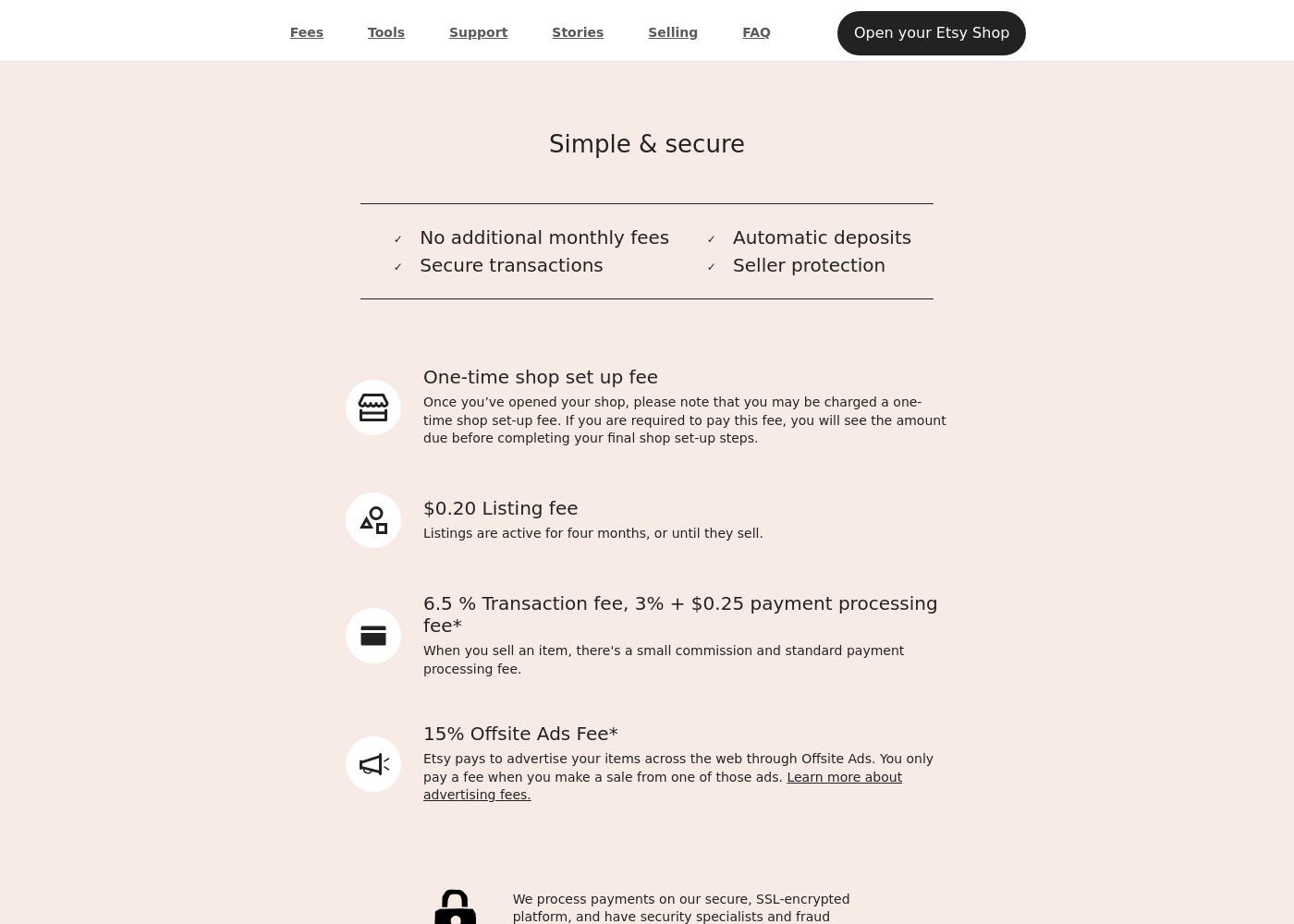
Etsy costs primarily involve fees when you list items or make a sale, with no mandatory additional monthly fees. The minimum fixed fee is $0.20 per listing, and transaction fees start at 6.5% plus a payment processing fee.
To understand how selling on Etsy works, we break down the necessary fees you should expect when setting up your shop and selling products.
Listing Fee
Price: $0.20 per listing Best For: All sellers who want to publish items on the platform Other Features:
- Listings are active for four months
- Fee applies until the item sells
- $0.20 USD per listing
- Active for four months or until sold
- Required to publish item
- 6.5% Transaction fee on sale price
- 3% + $0.25 Payment processing fee
- Only paid upon successful sale
- 15% fee when a sale is generated by an ad
- Etsy handles advertising on major external sites
- Optional for most sellers
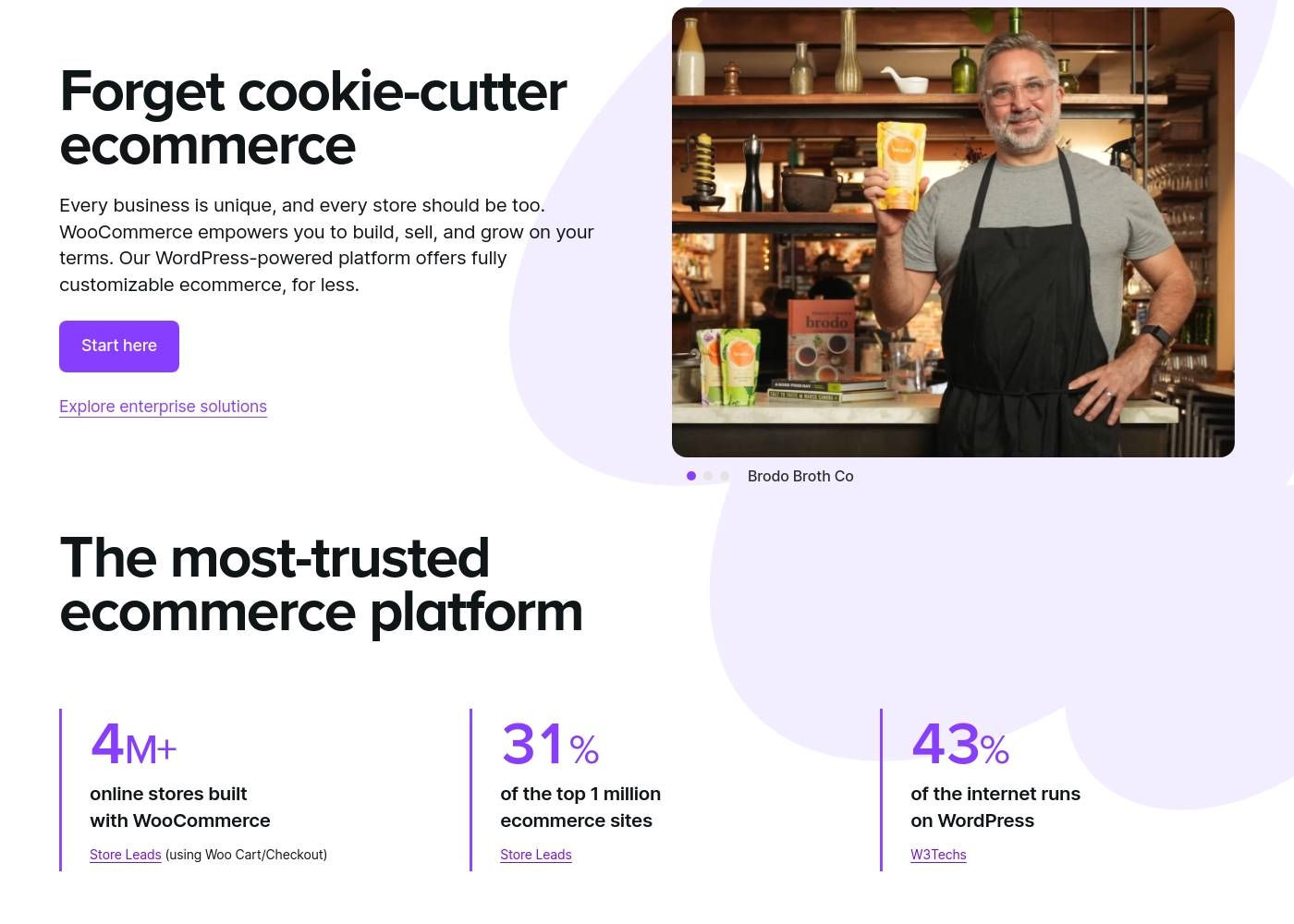
Since WooCommerce is open source, its pricing model is highly flexible, focusing on customization rather than fixed tiers.
Core WooCommerce Platform (Open Source)
Best For: Anyone seeking maximum customization freedom and control over their platform. Other Features:
- Powered by WordPress
- Fully customizable ecommerce
- Access to hundreds of trusted extensions and themes
- Support teams across the world
- Safe and secure online payments
This open-source framework lets you build your unique store from the ground up. It's the best option if you want to scale your way without the limitations of fixed proprietary systems. You gain control needed to create an utterly unique brand experience for your customers. ✨
- Fully customizable ecommerce
- Powered by WordPress
- Access to hundreds of trusted extensions and themes
- Open source flexibility
- Support teams across the world
Pricing Notes
- Etsy only charges a minimal $0.20 listing fee upfront, focusing on performance-based transaction costs.
- Etsy charges a mandatory 6.5% transaction fee plus a payment processing fee (3% + $0.25) on every single sale.
- WooCommerce's core software is free, completely eliminating mandatory subscription fees, but requires costly external hosting.
- Sellers on Etsy can be forced into paying a 15% Offsite Ads fee if their sales volume exceeds a specified threshold.
- WooCommerce offers a 30-day money-back guarantee on purchased extensions, providing confidence for expansion.
Pricing Head-to-Head
User Reviews
The public sentiment regarding Etsy is highly critical, ranking extremely low with a multitude of negative experiences reported by both buyers and sellers. While the core idea of supporting independent creators is valued, the platform’s execution is consistently criticized.
A major theme is the failure of support responsiveness: users find customer service unhelpful, inaccessible, and often described as providing only generic responses. Reliability is another significant issue; many buyers report items arriving late, tracking numbers failing, or not receiving their purchases at all.
My account was permanently banned for absolutely no reason, and they will not specify why. I tried contacting support repeatedly about the suspension, but I only received generic, unhelpful messages in return. It’s frustrating.
WooCommerce generates highly mixed feedback, primarily due to the severe dichotomy between its powerful, free core product and the perceived lack of service quality. Users praised its unlimited flexibility, open-source nature, and strong customization capabilities, noting it is essential for serious businesses and web developers who want maximum control without recurring platform fees.
Many established users expressed love for the product when paired with the right WordPress themes. However, the overwhelming concern centers on customer support responsiveness ❌.
Their support responsiveness is a major issue; it often takes days for them to even send a reply. This is unacceptable for mission-critical e-commerce operations. We strongly advise that businesses consider this lack of reliable support before committing.
Our Verdict
The decision between Etsy and WooCommerce is about choosing a business philosophy. Etsy is the massive, bustling market, ready for you today. WooCommerce is the powerful, custom foundation that you build for long-term control. If you hate touching code, Etsy wins instantly for its ease of use. Etsy’s superpower is its built-in traffic of millions of active customers. You pay $0.20 and your product is instantly searchable by active buyers. Etsy manages hosting, payments, and marketing, making it ideal for the solo maker focused purely on creation. However, Etsy’s high transaction fees eventually limit your long-term profit. WooCommerce’s superpower is offering essential freedom and unlimited scalability built on the power of WordPress. High-volume sellers leverage WooCommerce to avoid Etsy’s costly 6.5% transaction fees and mandated 15% ad charges. You gain total control over the brand experience, including custom checkout flows. Ultimately, the choice hinges on control versus convenience. Can you tolerate high fees and arbitrary platform rules for instant marketing access? Choose Etsy. Do you need custom features and low transaction costs at the expense of difficult setup? You must choose WooCommerce. For beginner artisans prioritizing speed and visibility, Etsy is the clear place to start. For serious businesses needing complex multi-channel scaling or custom optimization, WooCommerce provides the essential tools for professional growth.
Frequently Asked Questions
How does the pricing differ between Etsy's fees and WooCommerce's costs?
Etsy uses a performance-based model, charging a 6.5% transaction fee plus other costs upon sale. WooCommerce’s core software is free, eliminating all those platform commissions. However, WooCommerce requires expensive external hosting and maintenance costs that Etsy includes automatically.
Which platform is better for selling a high volume of products: Etsy or WooCommerce?
WooCommerce is far better for high volume because it avoids Etsy’s crippling percentage-based fees. Etsy’s 6.5% transaction fee and potential 15% ad fee will severely limit profit. WooCommerce’s fixed hosting costs make revenue predictable and scalable.
Is it easier to start a shop on Etsy or WooCommerce?
It is exponentially easier to start on Etsy. Etsy is designed for instant setup and requires zero technical skill or configuration. WooCommerce requires installing WordPress, arranging specialized hosting, and configuring extensions.
Can I sync my inventory between my website and external channels using Etsy or WooCommerce?
WooCommerce offers seamless, native autosyncing for multi-channel selling, like Amazon and TikTok. Etsy does not offer this inherently, forcing sellers to rely on manual updates or less reliable third-party tools.
Which platform carries a higher risk of account suspension: Etsy or WooCommerce?
Etsy carries a significantly higher risk. Reviewers often report arbitrary account suspensions, sometimes accompanied by frozen funds. With WooCommerce, you own the platform, meaning operational risk is entirely controlled by you.
Should a developer choose Etsy or WooCommerce for client projects?
A developer should overwhelmingly choose WooCommerce. It offers open-source code and unlimited customization capacity highly sought by clients. Etsy offers minimal control and is limited to platform-specific templates.
Ready to Choose?
Both tools have their strengths. Choose based on your specific needs.