Etsy vs Thinkific
Etsy and Thinkific aren't direct competitors, but they both empower entrepreneurs. Etsy is a global marketplace for selling physical, handmade goods. Thinkific is a platform for creating and selling digital courses and knowledge.
Best for: Artisans selling handmade jewelry, pottery, or textiles., Vintage collectors sourcing and selling unique items.
Best for: Entrepreneurs and subject-matter experts packaging their knowledge into courses., Businesses launching customer education or employee training academies.
Unique finds, operational headaches.
We recognize Etsy’s powerful concept of offering unique, handmade goods and strong personalization options. However, external reviews reveal chronic operational issues, particularly concerning system stability and customer care responsiveness. Overall, the platform’s valuable market niche is severely undermined by widespread failures impacting key reliability factors for both buyers and sellers.
Pros
- Access to a vast selection of unique, handmade, and vintage items.
- Enables strong product personalization (engraving, embroidery).
- Pricing model uses low listing fees rather than mandatory monthly subscriptions.
- Effective platform for supporting independent and small businesses.
Cons
- Customer support is widely reported as unhelpful, inadequate, or entirely nonexistent.
- Both buyer and seller accounts are frequently suspended without clear reason or explanation.
- High incidence of misleading product listings and scam sellers (poor accuracy).
- Widespread reliability issues concerning delivery, shipping delays, and faulty tracking.
Solid all-in-one for knowledge businesses.
We find Thinkific is a robust platform for creators and businesses focused on selling courses and communities. Its core strength is combining creation, marketing, and sales tools in one reliable package. Overall, it's a strong choice for those ready to scale their expertise, though it may not suit the simplest or most custom tech needs.
Pros
- Intuitive drag-and-drop course builder for easy setup.
- All-in-one platform includes marketing, sales, and community tools.
- Reliable hosting with unlimited students and courses.
- Strong customer support and onboarding resources.
Cons
- Interface design can feel slightly dated in places.
- Deep customization of layouts may require more steps.
- Pricing details for higher tiers aren't always fully transparent upfront.
- No native, built-in CRM for direct sales workflow automation.
AboutEtsy
Etsy is a vibrant online marketplace dedicated to all things distinctive and handmade or vintage. It is where you find items beyond the typical store purchase, ensuring your shopping feels personal. This destination is perfect for shoppers looking for original items, spanning from mugs and home goods to jewellery and apparel. Etsy focuses on delivering gifts as special as the recipient, prioritizing unique craftsmanship. It's a great place to discover essential items tailored to specific hobbies too. 💡
AboutThinkific
Thinkific is an online course platform for creators, coaches, and businesses. 🚀 It lets you build and sell digital learning experiences. You can create courses with a simple drag-and-drop editor, add communities and memberships, and handle payments all in one place. It’s built for anyone wanting to share their knowledge and earn revenue from it.
Highlights
Feature Comparison
Features Overview
We highlight the main differences and pick a winner for each feature.
Core Platform & Purpose
Etsy is a marketplace. Thinkific is a course creation platform.
Etsy is where people come to buy physical goods. You set up a shop within their massive marketplace to sell items like jewelry, clothing, or home decor. It's built-in foot traffic. Thinkific is where you build your own online school. You create the website, upload your course content, and manage students. You are responsible for driving your own traffic. The key difference is control vs. convenience. Etsy gives you an audience. Thinkific gives you the tools to build an audience from scratch.
Product Creation & Delivery
Etsy handles physical products. Thinkific handles digital learning.
On Etsy, you list physical items you've made, found, or designed. You handle inventory, packaging, and shipping. Thinkific provides a drag-and-drop builder to create video lessons, quizzes, and downloadable files. Thinkific includes tools like AI for outlines and SCORM compliance for structured learning. Etsy's tools are for managing listings and orders, not content creation. Selling a handmade necklace on Etsy is totally different from teaching a 10-module photography course on Thinkific.
Sales & Commerce
Etsy charges per sale. Thinkific charges a subscription for sales tools.
Etsy's model is pay-as-you-go. You pay a $0.20 listing fee, then a 6.5% transaction fee plus payment processing when you sell. No upfront costs. Thinkific uses monthly subscriptions starting at $74/month. Higher tiers add features like upsells, coupons, and abandoned cart recovery to boost your sales. Thinkific users reportedly sell 31% more with its commerce tools. Etsy's fees can add up significantly at high volume.
Audience & Discovery
Etsy brings buyers to you. Thinkific requires you to bring students.
Etsy is a search engine for unique goods. Millions of buyers browse it daily looking for specific items. You can pay for Etsy Ads or join Offsite Ads for more reach. Thinkific provides the platform but not the audience. You must use your own marketing, SEO, or ads to attract students to your courses. For Etsy, discovery is baked in. For Thinkific, you are the chief marketing officer.
User Experience & Interface
Etsy is a shopping interface. Thinkific is a creation dashboard.
Etsy's interface is designed for buyers to discover and purchase. Sellers manage a relatively simple dashboard for listings and orders. Some report support issues. Thinkific's course builder is praised as intuitive and simple. The admin dashboard can feel slightly dated. It's focused on content organization, not product merchandising. One is for browsing products, the other for building educational content.
Support & Community
Thinkific offers award-winning support. Etsy's support is frequently criticized.
Etsy's support is widely reported as unhelpful and hard to reach. Users describe getting generic messages, with account suspensions a common fear. Thinkific's support team won a G2 award for customer service. They offer onboarding help, with phone support on higher plans and dedicated teams for enterprise. Good support is crucial when your business depends on the platform. Thinkific has a clear edge here.
Pricing & Value
Etsy has no subscription, just fees. Thinkific has monthly plans.
Etsy costs $0 to start. You pay small fees only when you list or sell something. It's low-risk for testing product demand. Thinkific starts at $74/month. You pay even if you make zero sales. However, you get unlimited courses, students, and a full suite of business tools. Etsy's value comes from access to a marketplace. Thinkific's value is from providing an all-in-one business platform.
Scalability & Growth
Etsy scales within its marketplace. Thinkific scales your entire business.
Etsy can limit you with its rules and fees. High-volume sellers can face mandatory ad participation and significant total fees. Thinkific has no limits on courses, students, or bandwidth. You can scale from one student to hundreds of thousands without hitting platform walls. Thinkific is built for businesses that want to grow an asset they own. Etsy is for businesses that want to sell within a system.
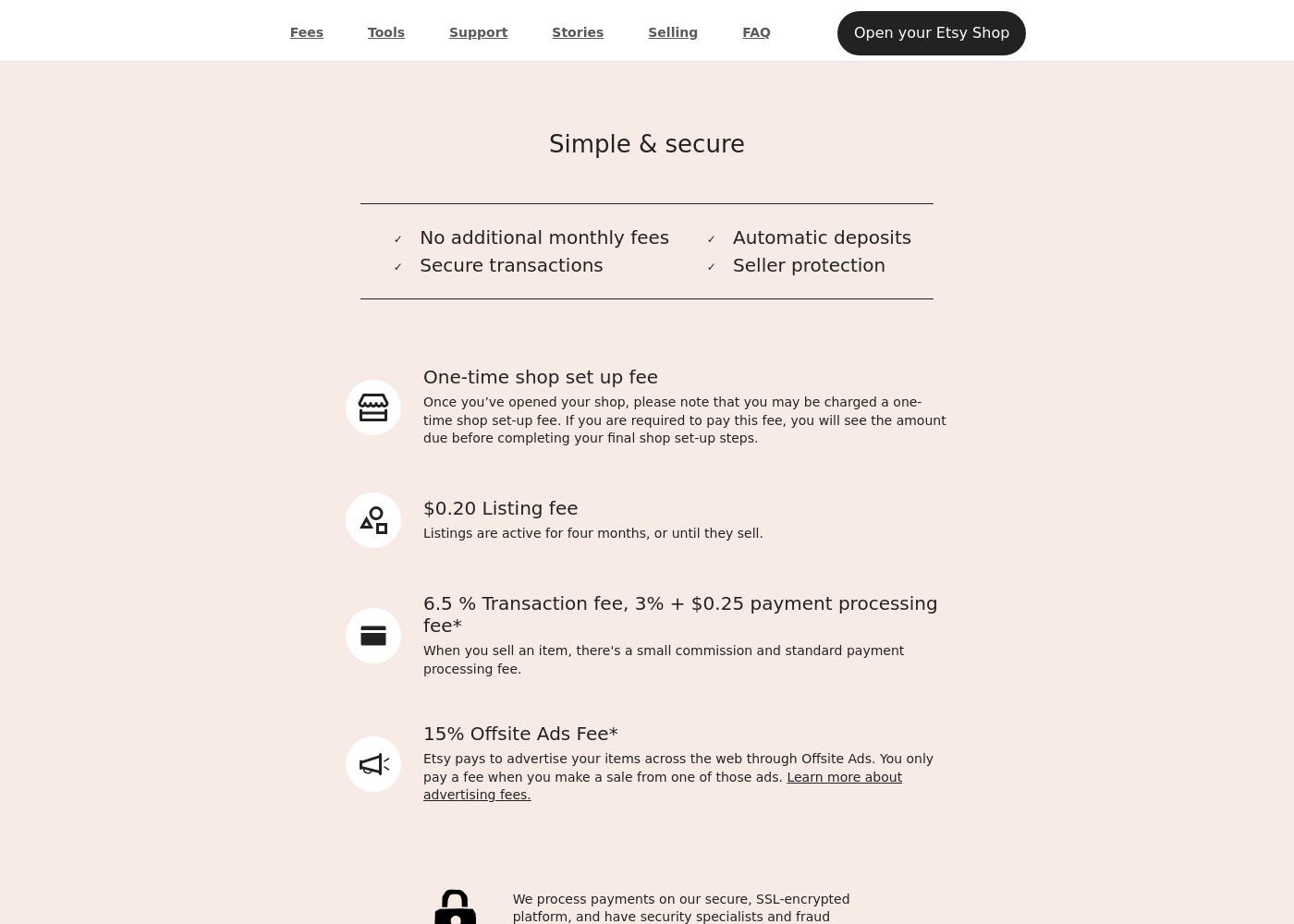
Etsy costs primarily involve fees when you list items or make a sale, with no mandatory additional monthly fees. The minimum fixed fee is $0.20 per listing, and transaction fees start at 6.5% plus a payment processing fee.
To understand how selling on Etsy works, we break down the necessary fees you should expect when setting up your shop and selling products.
Listing Fee
Price: $0.20 per listing Best For: All sellers who want to publish items on the platform Other Features:
- Listings are active for four months
- Fee applies until the item sells
- $0.20 USD per listing
- Active for four months or until sold
- Required to publish item
- 6.5% Transaction fee on sale price
- 3% + $0.25 Payment processing fee
- Only paid upon successful sale
- 15% fee when a sale is generated by an ad
- Etsy handles advertising on major external sites
- Optional for most sellers
Thinkific pricing: Thinkific offers tiered subscription plans starting at $74/month when billed annually. Pricing scales based on the number of active students, admin accounts, and advanced selling or integration features needed for your learning business.
Each plan includes a 30-day free trial to explore all AI-enabled tools and course-building features risk-free. Annual billing provides a significant discount over monthly payments, with professional-grade tiers tailored for scaling academies and large organizations through Thinkific Plus.
Thinkific also provides native payment processing via TCommerce to help you sell more effectively with no hidden transaction fees on its own processor. All plans include a 30-day free trial to get started.
Pricing Notes
- Etsy has no monthly subscription. Fees are pay-as-you-go: $0.20 listing + 6.5% transaction + payment processing.
- Thinkific's free plan exists but is very limited. Paid plans start at $74/month billed annually.
- Etsy's Offsite Ads fee (15%) is optional for most but mandatory for high-volume sellers.
- Thinkific charges no transaction fees if using its native TCommerce payment processor.
- For a high-volume seller, Etsy's cumulative fees can exceed Thinkific's flat subscription cost.
Pricing Head-to-Head
User Reviews
The public sentiment regarding Etsy is highly critical, ranking extremely low with a multitude of negative experiences reported by both buyers and sellers. While the core idea of supporting independent creators is valued, the platform’s execution is consistently criticized.
A major theme is the failure of support responsiveness: users find customer service unhelpful, inaccessible, and often described as providing only generic responses. Reliability is another significant issue; many buyers report items arriving late, tracking numbers failing, or not receiving their purchases at all.
My account was permanently banned for absolutely no reason, and they will not specify why. I tried contacting support repeatedly about the suspension, but I only received generic, unhelpful messages in return. It’s frustrating.
Users consistently praise Thinkific's ease of use, particularly its straightforward course setup and content upload process 👍. However, some note that certain interface elements feel outdated and that customizing layouts can require extra steps.
Customer support responsiveness and the platform's reliability for hosting are frequently highlighted as positive. Recurring feedback points to the value of the all-in-one features for creators and coaches, though some mention that transparent, upfront pricing for all plan details would be helpful.
Setting up my course was incredibly simple. The drag-and-drop editor made everything visual. I had my first module live in under an hour.
Our Verdict
Choosing between Etsy and Thinkific isn't really a choice at all. They serve completely different goals. Your decision comes down to what you want to sell. Etsy's superpower is its massive, built-in audience. Millions of people visit Etsy daily to find unique, handmade, and vintage items. If you make physical products, Etsy puts you in front of ready-to-buy shoppers. Thinkific's superpower is giving you the tools to build a knowledge business. You can create professional courses, communities, and memberships under your own brand. It's an all-in-one platform for turning expertise into revenue. The deciding factor is your product. Do you craft physical goods or teach digital skills? Etsy is for makers. Thinkific is for teachers. Pick Etsy if you want to sell handmade goods without building a website from scratch. Pick Thinkific if you want to package your expertise into courses and build a scalable online school. They're in different worlds, so pick the one that matches your work.
Frequently Asked Questions
Can I sell online courses on Etsy?
No. Etsy is designed for physical, handmade, and vintage products. For selling digital courses, memberships, or educational content, you need a platform like Thinkific.
Is Thinkific cheaper than Etsy?
It depends on volume. Etsy has no monthly fee but charges per listing and sale. Thinkific has monthly subscriptions starting at $74. For high-volume sellers, Thinkific's flat fee can become more cost-effective.
Which platform has better customer support?
Thinkific has better support. It offers award-winning customer service, with email, chat, and phone support on higher plans. Etsy's support is widely criticized as unhelpful and hard to reach.
Can I sell physical products on Thinkific?
Not primarily. Thinkific is built for digital products like courses, downloads, and memberships. For selling physical goods, a marketplace like Etsy is the appropriate platform.
Do I need to build my own website with Thinkific?
Yes. Thinkific provides the tools to build a fully branded website with a custom domain. On Etsy, you set up a shop within their existing marketplace structure.
Which platform is better for beginners?
Both are beginner-friendly for their purposes. Etsy is simpler to start if you already have physical products to list. Thinkific is straightforward for building a first course if you have expertise to share.
Ready to Choose?
Both tools have their strengths. Choose based on your specific needs.