Etsy vs Square Online
Etsy and Square Online both help you sell products, but their business models are fundamentally different. Etsy is a massive global marketplace for handmade and unique finds. Square Online is a flexible e-commerce builder for a fully branded, standalone site. You must decide whether you want to rent space or own your very own retail shop.
Best for: Solo entrepreneurs selling small batches of unique goods, People testing a fun side-hustle with low financial investment
Best for: Established retail stores needing seamless POS/e-commerce sync, Businesses prioritizing full brand control and customer data ownership
Unique finds, operational headaches.
We recognize Etsy’s powerful concept of offering unique, handmade goods and strong personalization options. However, external reviews reveal chronic operational issues, particularly concerning system stability and customer care responsiveness. Overall, the platform’s valuable market niche is severely undermined by widespread failures impacting key reliability factors for both buyers and sellers.
Pros
- Access to a vast selection of unique, handmade, and vintage items.
- Enables strong product personalization (engraving, embroidery).
- Pricing model uses low listing fees rather than mandatory monthly subscriptions.
- Effective platform for supporting independent and small businesses.
Cons
- Customer support is widely reported as unhelpful, inadequate, or entirely nonexistent.
- Both buyer and seller accounts are frequently suspended without clear reason or explanation.
- High incidence of misleading product listings and scam sellers (poor accuracy).
- Widespread reliability issues concerning delivery, shipping delays, and faulty tracking.
Seamless integration for retail and e-commerce.
We found Square Online excels at connecting physical retail operations with a user-friendly e-commerce platform, minimizing inventory sync issues. The pricing model, which features a robust free tier and subsequent plans offering lower processing fees, presents clear value for scaling businesses. Overall, Square Online is an excellent, reliable choice, particularly for businesses already leveraging the Square ecosystem.
Pros
- Exceptional ease of setup, navigation, and intuitive user interface.
- Seamless integration between the online store and Square POS (Point of Sale).
- System is highly reliable, stable, and allows sellers to take payments anywhere.
- Strong free plan available ($0/month) perfect for new businesses.
Cons
- Customer service responsiveness and quality are reported as mixed.
- Initial setup can sometimes be challenging for new users requiring detailed guidance.
- Paid plans are charged per location, increasing costs for multi-site operations.
- A 2.5% load fee applies to gift cards on the Free and Plus tiers.
AboutEtsy
Etsy is a vibrant online marketplace dedicated to all things distinctive and handmade or vintage. It is where you find items beyond the typical store purchase, ensuring your shopping feels personal. This destination is perfect for shoppers looking for original items, spanning from mugs and home goods to jewellery and apparel. Etsy focuses on delivering gifts as special as the recipient, prioritizing unique craftsmanship. It's a great place to discover essential items tailored to specific hobbies too. 💡
AboutSquare Online
Square Online is a robust yet easy-to-use platform for building an e-commerce website. You don’t need any coding or web design experience to create a professional site. It caters perfectly to businesses that need their physical store and online sales to sync without hassle. You can start designing a professional site immediately with a free Square account. Square handles the free web hosting, providing exceptional speed, performance, and security for your store. 💡
Highlights
Feature Comparison
Features Overview
We highlight the main differences and pick a winner for each feature.
Platform Model
Etsy is a marketplace sending traffic; Square Online is your own branded site.
Etsy operates as a massive global marketplace for vintage and handmade goods. Millions of shoppers are already on Etsy looking for unique products immediately. You rent space in this bustling virtual mall. Square Online is a dedicated e-commerce site builder for independent businesses. You create your own fully branded, standalone website. This gives you absolute control over the customer experience. If instant audience access is most important, Etsy is better. If full branding and long-term customer relationship control matter more, pick Square Online. Square Online simplifies your domain ownership and removes platform dependency.
Pricing Structure
Etsy uses high transaction fees; Square Online uses low-fee subscriptions.
Etsy has no mandatory monthly fees but charges $0.20 per listing. The core cost is a high stack of fees upon sale, starting at 9.5% plus $0.25 (minimum). This makes small sales expensive quickly. Square Online has a robust $0/month Free plan for new sellers. Paid plans start at $49/month per location, unlocking advanced features easily. You can try the Plus/Premium plans free for 30 days. Higher-tier Square Online plans offer significantly lower payment processing fees. Growing businesses save money with Square Online since they avoid Etsy’s high commissions. Etsy is perfect for low-volume sellers testing the waters due to low entry barrier.
Inventory Sync
Square Online syncs perfectly with POS; Etsy requires manual input or specific third-party tools.
If you have a physical store, integrating your inventory with Etsy is difficult. Sellers usually rely on external apps or manually updating stock levels. This increases the risk of overselling. Square Online is built for unified commerce using Square POS. Inventory, orders, and customer data sync instantly across all sales channels. This integration prevents stock level issues. Square Online drastically simplifies management if you sell both online and in-person. Etsy forces you to treat your online presence as a separate business unit. Perfect inventory sync via Square Online means less administrative work and happier customers.
Customer Support
Square Online support is dependable; Etsy seller support is widely reported as unhelpful.
Etsy's seller reviews consistently criticize support for being inadequate, generic, and inaccessible. Serious issues like arbitrary suspension have no clear resolution path. This creates a high risk for sellers. Square Online users generally report reliable and helpful support experiences. The Premium plan includes dedicated 24/7 phone support for established merchants. Dependable support from Square Online dramatically reduces operational risks in case of issues. Etsy's lack of support is a critical barrier for scaling sellers. Trusting your livelihood to Etsy’s reportedly poor support can be a serious business mistake.
Traffic Generation
Etsy provides the shoppers; Square Online provides the specialized marketing tools.
Millions of targeted buyers visit Etsy daily looking for unique, specific items. Sellers automatically benefit from this huge built-in, ready-to-shop audience. Initial sales traction is much easier here. Square Online gives you strong integrated SEO tools to build your organic traffic. You must use tools like Meta and Google integrations to drive your own customer base. Etsy makes the first sale easier by providing the audience, but you have less control. Square Online forces you to build traffic but rewards you with a direct customer relationship. High-volume Etsy sellers can be penalized with mandatory Offsite Ads fees (15%).
E-commerce Tools
Square Online has advanced features; Etsy keeps the functionality transactional and basic.
Etsy’s feature set focuses primarily on basic creation and listing of items. Selling is fundamentally simple and relies on the platform’s organic search traffic. Advanced growth tools are mostly absent. Square Online paid tiers unlock powerful e-commerce features essential for modern selling. This includes integrated loyalty programs, subscriptions, and abandoned cart recovery emails. If you are serious about building a contemporary e-commerce brand, Square Online offers the necessary tools. Etsy operates well for simple transactions but limits your growth capabilities. Advanced features on Square Online help you save sales and increase customer lifetime value efficiently.
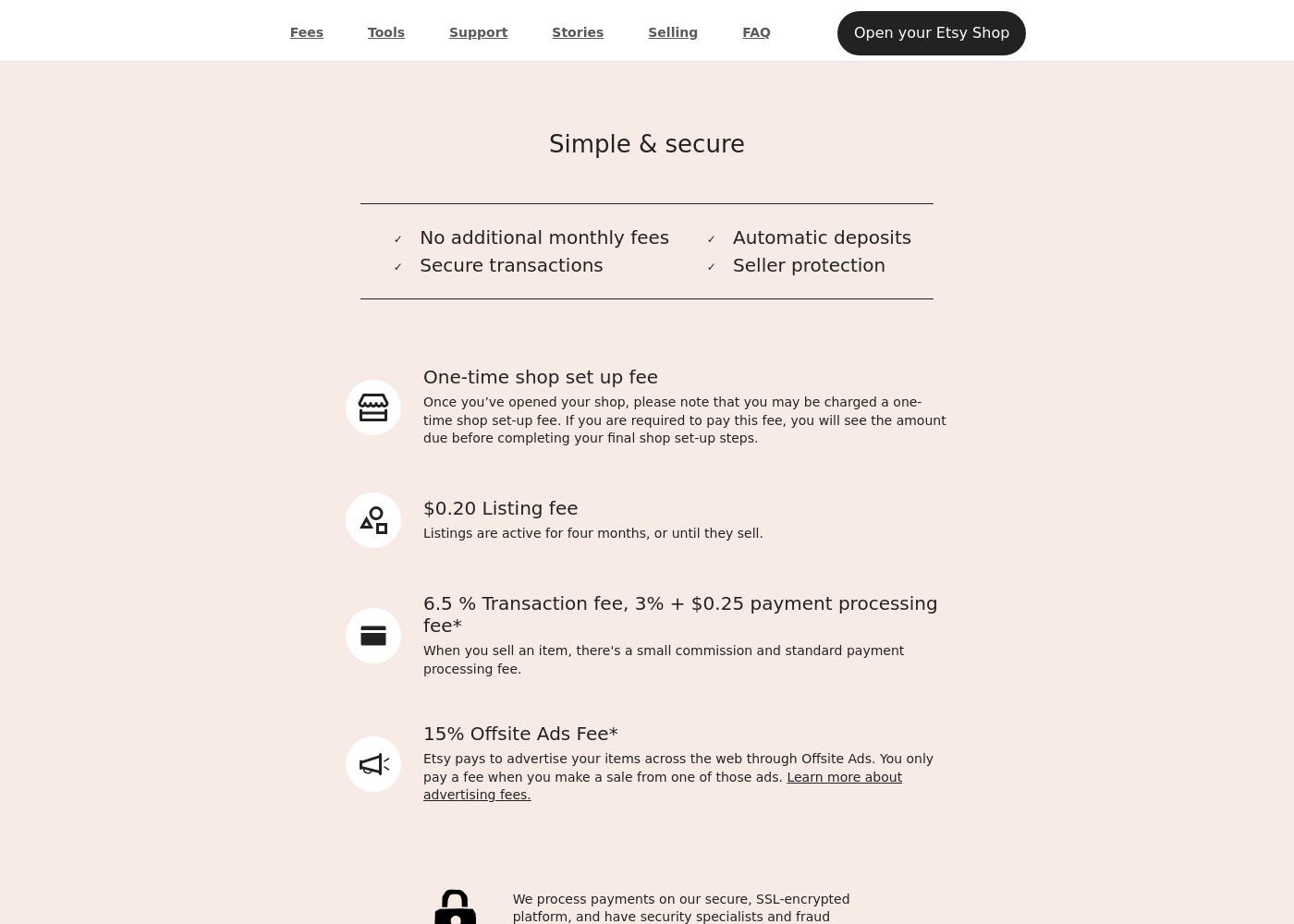
Etsy costs primarily involve fees when you list items or make a sale, with no mandatory additional monthly fees. The minimum fixed fee is $0.20 per listing, and transaction fees start at 6.5% plus a payment processing fee.
To understand how selling on Etsy works, we break down the necessary fees you should expect when setting up your shop and selling products.
Listing Fee
Price: $0.20 per listing Best For: All sellers who want to publish items on the platform Other Features:
- Listings are active for four months
- Fee applies until the item sells
- $0.20 USD per listing
- Active for four months or until sold
- Required to publish item
- 6.5% Transaction fee on sale price
- 3% + $0.25 Payment processing fee
- Only paid upon successful sale
- 15% fee when a sale is generated by an ad
- Etsy handles advertising on major external sites
- Optional for most sellers
Square Online costs between $0 and $149 per month with three fixed plans: Square Free at $0, Square Plus at $49/month per location, and Square Premium at $149/month per location, plus a custom Square Pro tier.
Here is a breakdown of what each Square Online tier includes.
Square Free
Price: $0 per month Best For: New businesses or businesses just starting to sell online Other Features:
- Processing fees (3.3% + 30¢ online; 2.6% + 15¢ in-person)
- Website builder with SEO tools
- Pickup, local delivery, and shipping fulfillment
- Sell on search and social media
- Website builder with SEO tools
- Pickup, local delivery, and shipping
- Sell on search and social
- In-person processing: 2.6% + 15¢
- Online processing: 3.3% + 30¢
- Expanded site customization
- Advanced item settings
- QR code ordering and subscriptions
- Abandoned cart emails
- Free shipping progress bar
- Real-time shipping rates
- Advanced reporting
- 24/7 phone support
- 0% gift card load fee
- In-person processing: 2.4% + 15¢
- Custom pricing and processing fees
- Hardware discounts
- Onboarding and implementation support
- Access if processing over $250,000 per year
Pricing Notes
- Etsy uses a high, multi-layered transaction fee (minimum 9.5%) stacked on every single sale.
- Square Online offers a robust $0/month Free tier, perfect for getting started immediately.
- Paid Square Online plans are charged per business location, increasing costs for multi-site operations.
- Scaling sellers benefit greatly from Square Online’s Premium plan due to significantly lower processing fees (2.4% + 15¢).
Pricing Head-to-Head
User Reviews
The public sentiment regarding Etsy is highly critical, ranking extremely low with a multitude of negative experiences reported by both buyers and sellers. While the core idea of supporting independent creators is valued, the platform’s execution is consistently criticized.
A major theme is the failure of support responsiveness: users find customer service unhelpful, inaccessible, and often described as providing only generic responses. Reliability is another significant issue; many buyers report items arriving late, tracking numbers failing, or not receiving their purchases at all.
My account was permanently banned for absolutely no reason, and they will not specify why. I tried contacting support repeatedly about the suspension, but I only received generic, unhelpful messages in return. It’s frustrating.
Square users consistently report a highly positive experience due to the platform's user-friendliness and simple, intuitive interface. A major recurring theme is the excellent ease of setup and use, making it ideal for small businesses and mobile operations.
Reliability is frequently praised; users find the system stable and note that payments are processed quickly and securely. The seamless integration between the online store and in-person sales allows inventory and tracking to sync perfectly, which simplifies business management significantly.
Switching to Square was the best decision for my small café. The setup was quick and the reporting tools make managing sales so much easier. Everything syncs perfectly between my physical register and the online shop.
Our Verdict
The decision between Etsy and Square Online is a classic 'Marketplace vs. Own Store' debate. If you need immediate exposure and built-in organic traffic, Etsy wins easily. Millions of shoppers are already there looking for handmade goods. Etsy is great for testing product viability with minimum upfront cost. Etsy's superpower is its massive, eager audience of niche buyers. If you sell a highly unique, customized product, Etsy is your best marketing tool. Remember that operating on Etsy comes with significant risks regarding poor support and high commissions. Square Online’s superpower is unification and control over your brand and data. If you have a physical store, Square Online syncs inventory seamlessly with Square POS. You get robust tools like abandoned cart recovery and subscriptions, which Etsy lacks entirely. The deciding factor should be your volume and tolerance for operational risk. If you project high sales volume, Square Online’s lower transaction fees will save you thousands annually. Furthermore, Square Online offers vastly more reliable support and a stable financial environment. Choose Square Online if you are serious about building a scalable, professional brand. Stick with Etsy if you are a solo entrepreneur focused primarily on leveraging the marketplace's massive existing traffic.
Frequently Asked Questions
Which is cheaper for high-volume sellers: Etsy or Square Online?
Square Online becomes significantly cheaper as you scale your business volume. Etsy’s high stacked transaction fees (9.5% minimum) take a large chunk of profits. Square Online Premium subscription reduces processing fees to an industry-low 2.9% online.
Can I integrate my physical store sales with Etsy?
Etsy does not natively synchronize inventory with physical sales platforms like Square POS. You will likely need to use expensive third-party tools or manually manage all stock. Square Online, however, syncs inventory instantly and seamlessly.
Which platform offers better customer support for sellers?
Square Online is the clear winner for seller support accessibility and quality. Etsy sellers frequently report receiving unhelpful, generic, or nonexistent assistance. Square Online Premium offers 24/7 phone support.
Does Square Online allow me to sell unique, personalized products like Etsy?
Yes, Square Online provides the tools to sell any product, including handmade and unique items. You retain full control over your branding and product presentation. However, you must generate all the customer traffic yourself.
Is it mandatory to pay a monthly fee on Square Online?
No, Square Online offers a powerful Free plan that requires zero monthly subscription fees. You only pay transaction fees when you make a physical or online sale. Paid plans start at $49 per month.
Which platform is safer regarding fund transfers and stability?
Square Online is considered highly reliable for financial stability and rapid fund transfers. Etsy sellers report severe risks, like funds being withheld following unexplained account suspensions. Always choose stability for finances.
Ready to Choose?
Both tools have their strengths. Choose based on your specific needs.