Etsy vs Shopify
Etsy and Shopify follow totally different e-commerce strategies for sellers. Etsy is a curated marketplace built for unique goods and instant traffic. Shopify is a full-featured platform that gives you total control over your own store. Choosing depends entirely on your product type and specific growth goals.
Best for: Solo entrepreneurs selling personalized or handmade goods, Hobbyists testing the market with minimal overhead costs

Best for: Brands needing full control over store design and customer data, E-commerce businesses planning global expansion using localization tools
Unique finds, operational headaches.
We recognize Etsy’s powerful concept of offering unique, handmade goods and strong personalization options. However, external reviews reveal chronic operational issues, particularly concerning system stability and customer care responsiveness. Overall, the platform’s valuable market niche is severely undermined by widespread failures impacting key reliability factors for both buyers and sellers.
Pros
- Access to a vast selection of unique, handmade, and vintage items.
- Enables strong product personalization (engraving, embroidery).
- Pricing model uses low listing fees rather than mandatory monthly subscriptions.
- Effective platform for supporting independent and small businesses.
Cons
- Customer support is widely reported as unhelpful, inadequate, or entirely nonexistent.
- Both buyer and seller accounts are frequently suspended without clear reason or explanation.
- High incidence of misleading product listings and scam sellers (poor accuracy).
- Widespread reliability issues concerning delivery, shipping delays, and faulty tracking.

Powerful Platform, Critical Service Gaps
We recognize Shopify offers an enterprise-level platform with impressive scaling tools and high-converting technology for merchants of all sizes. However, user reviews indicate systemic failures in support, billing practices, and marketplace fraud protection. Overall, Shopify provides powerful infrastructure but currently struggles to deliver a reliable, secure, or user-focused experience for many customers.
Pros
- Comprehensive commerce platform built for scaling and global growth.
- Unique Shopify Checkout converts 15% higher than competing platforms.
- Lower credit card transaction fees on Grow and Advanced plans.
- Access to Shopify Capital for loans without sacrificing equity.
Cons
- Customer support is frequently reported as unresponsive, slow, or useless (often relying on chatbots).
- Platform often fails to protect buyers and merchants from fraudulent stores.
- Frequent reports of unauthorized billing and confusing cancellation procedures.
- Complexity makes site setup difficult for non-technical beginners.
AboutEtsy
Etsy is a vibrant online marketplace dedicated to all things distinctive and handmade or vintage. It is where you find items beyond the typical store purchase, ensuring your shopping feels personal. This destination is perfect for shoppers looking for original items, spanning from mugs and home goods to jewellery and apparel. Etsy focuses on delivering gifts as special as the recipient, prioritizing unique craftsmanship. It's a great place to discover essential items tailored to specific hobbies too. 💡
AboutShopify
Shopify is the powerful commerce platform designed to handle every aspect of modern selling. It serves everyone, from solo entrepreneurs launching their first product to large global enterprises. This platform manages your sales whether you are selling direct-to-consumer or handling wholesale B2B transactions. You get an organized, fully centralized Shopify Admin to control everything, from the back office to the front of the store. Millions of merchants trust Shopify; together, they have reached over $1 trillion in collective sales. ✨
Highlights
Feature Comparison
Features Overview
We highlight the main differences and pick a winner for each feature.
Traffic Model
Etsy provides immediate traffic; Shopify requires you to generate your own buyers.
Etsy is a giant existing marketplace with millions of daily shoppers. You benefit instantly from Etsy’s massive built-in buyer base. You pay a listing fee to place your product in front of this specific user base. Shopify is your own private storefront and you are fully responsible for attracting every customer. You must utilize marketing, SEO, and paid ads to generate all traffic. The trade-off is efficiency versus control; Etsy brings the buyers, but Shopify allows comprehensive growth management. For new sellers, Etsy offers quicker initial sales due to the nature of the existing market demand.
Pricing Structure
Etsy uses low listing fees; Shopify relies on recurring monthly subscriptions.
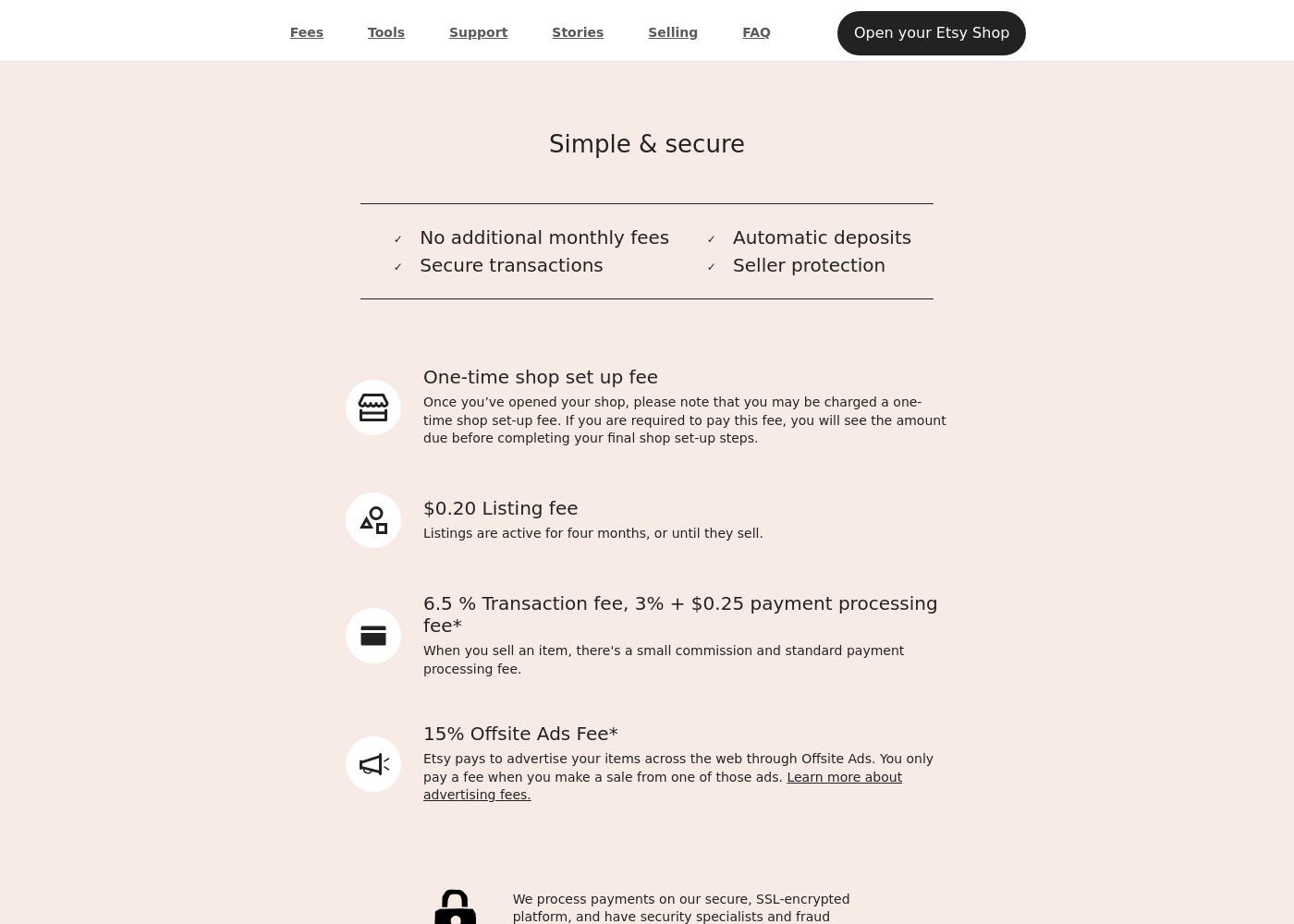
Etsy has no mandatory monthly fees to maintain a shop, keeping overhead very low initially. You pay $0.20 per listing and a 6.5% transaction fee only when items successfully sell. Shopify requires a recurring subscription starting at $29/month for Basic plans to operate. This fixed monthly cost is charged regardless of whether sales are made. Shopify’s transaction fees are competitive, starting at 2.9% + 30¢ with Shopify Payments. Etsy’s fees (6.5% + processing) can accumulate quickly with higher volume sales. Etsy is the cheaper solution for hobbyists, but Shopify becomes more profitable once volume increases significantly.
Branding Control
Shopify offers total branding control; Etsy forces sellers to operate under its marketplace framework.
Shopify provides total customization over your storefront's design, experience, and features. You control the customer journey end-to-end and build your unique brand identity. Etsy sellers exist strictly within the standard marketplace layout and fixed shop pages. You have limited control over the site design and buyer relationship. Shopify easily handles custom domains and advanced coding using options like Hydrogen. Etsy offers basic custom website integration, but the shop remains attached to the marketplace. Long-term brand building and ownership demand the autonomy that Shopify provides.
Scalability & B2B
Shopify is built for massive global scale and wholesale; Etsy focuses entirely on retail niche sales.
Shopify is designed for scaling, supporting multiple inventory locations and global selling via Markets. It also offers integrated B2B features like flexible pricing and payment terms for wholesale buyers. Etsy focuses heavily on the niche retail consumer market requiring unique or handmade goods. It does not provide explicit B2B features or advanced tools for complex logistics. Shopify provides tools to localize experiences globally, essential for international growth. High-growth businesses needing complex stock management or wholesale must choose Shopify.
App Ecosystem
Shopify offers 13,000+ apps for deep customization; Etsy's internal tools are more focused.
Shopify boasts a vast commerce ecosystem with over 13,000 unique apps for integration and customization. Users can tailor their store with specific logistics, marketing, and reporting tools. Etsy has tools like the Seller App for basic order management and messaging. It lacks the extensive, flexible third-party integration library offered by Shopify. Shopify leverages advanced proprietary technologies like Hydrogen and AI (Shopify Magic) for customization. Shopify is the required choice for businesses needing maximal technical flexibility and advanced external integrations.
Customer Support
Both platforms struggle with support, but Etsy's reported failures are more severe and impactful.
Etsy reviews consistently flag customer support as unresponsive, inadequate, or sometimes entirely absent. Sellers face frequent, arbitrary account suspensions without clear communication. Shopify reviews also report struggles with slow issue resolution and difficulties resolving charge and refund issues. Its support problems center on responsiveness and delays. Etsy sellers risk their funds being withheld for up to 180 days following suspension. This poses a significant, existential threat to small businesses on Etsy.
Product Policy
Etsy strictly mandates unique or handmade goods; Shopify allows selling almost any legal product.
Etsy requires everything listed to be handmade, vintage, or uniquely sourced/designed according to its standards. This limits potential product lines to maintain the marketplace's creative integrity. Shopify imposes virtually no specific product restrictions beyond legality. Merchants can sell mass-produced items, services, or diverse product mixes. The Etsy mission is to support independent creators, filtering out standard retail business models. If your general inventory consists of retail or non-creative niche items, Shopify is the only suitable option.
Sales Channels
Shopify enables centralized multichannel selling with POS; Etsy focuses purely on online marketplace retail.
Shopify features include Shopify POS, centralizing all online, social, and in-person sales management. It allows publishing and inventory synchronization across multiple digital channels. Etsy focuses purely on listing and completing transactions within the online marketplace. Integrated POS functionality is not a core offering for Etsy sellers. Shopify merchants manage all inventory, sales points, and customer data from one unified Admin portal. If you plan to sell at pop-up shops or physical markets, Shopify’s integrated POS feature is critical.
Etsy costs primarily involve fees when you list items or make a sale, with no mandatory additional monthly fees. The minimum fixed fee is $0.20 per listing, and transaction fees start at 6.5% plus a payment processing fee.
To understand how selling on Etsy works, we break down the necessary fees you should expect when setting up your shop and selling products.
Listing Fee
Price: $0.20 per listing Best For: All sellers who want to publish items on the platform Other Features:
- Listings are active for four months
- Fee applies until the item sells
- $0.20 USD per listing
- Active for four months or until sold
- Required to publish item
- 6.5% Transaction fee on sale price
- 3% + $0.25 Payment processing fee
- Only paid upon successful sale
- 15% fee when a sale is generated by an ad
- Etsy handles advertising on major external sites
- Optional for most sellers
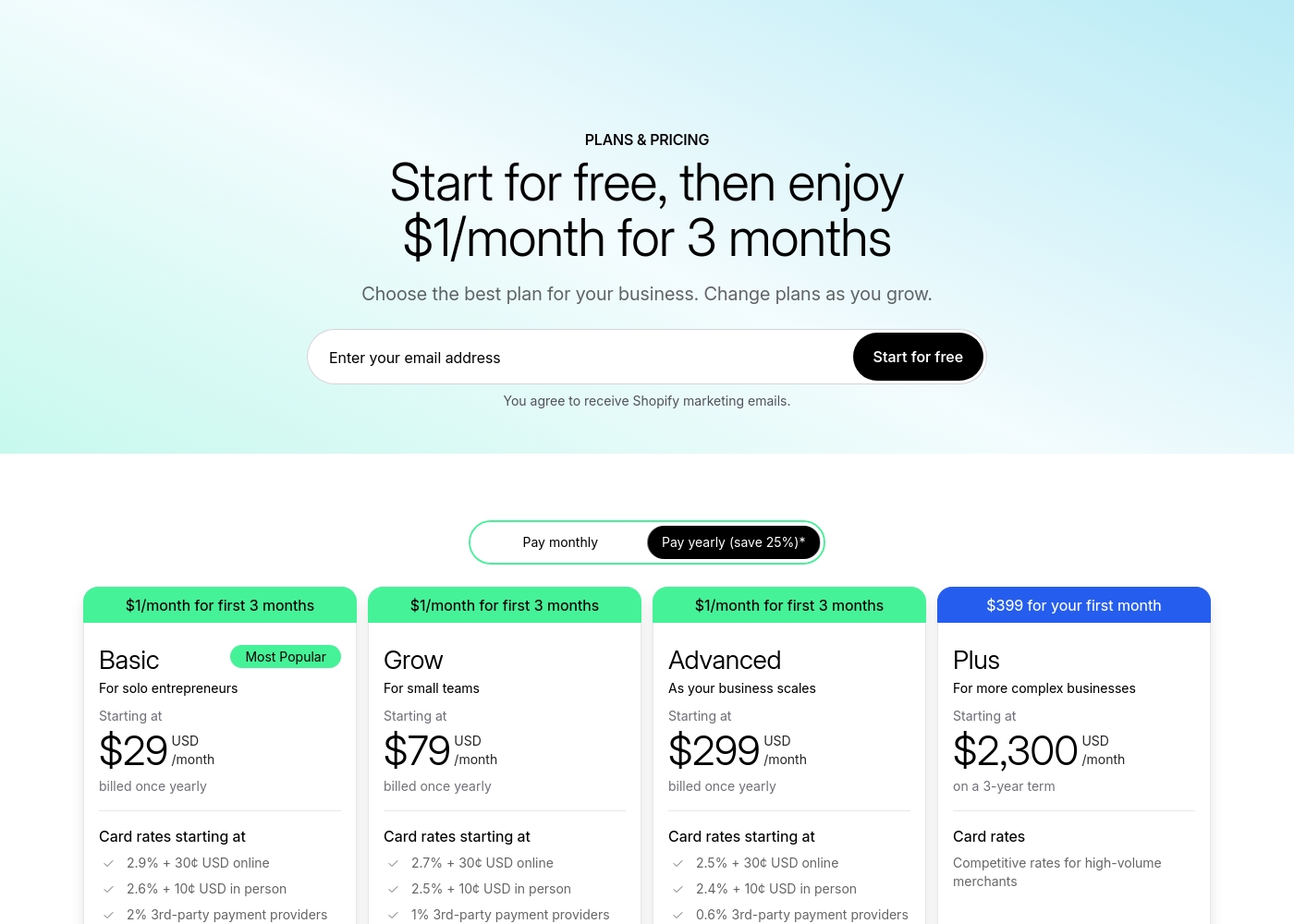
Shopify costs between $5 (Starter) and $2,300 (Plus) per month with six key plans: Starter at $5/month, Basic at $29/month (billed yearly), Grow at $79/month (billed yearly), Advanced at $299/month (billed yearly), Retail at $89/month, and Plus at $2,300/month (on a 3-year term).
Here’s a detailed look at the core subscription options designed to help your business evolve and scale.
Starter
Price: $5 USD / month Best For: Selling instantly through social media and messaging apps Other Features: Simple online store, Learn more link
- Sell instantly through social media and messaging apps
- Simple online store access
- For solo entrepreneurs - Most Popular
- 2.9% + 30¢ USD online card rates
- Up to 77% shipping discount
- 10 inventory locations
- 24/7 chat support
- For small teams
- 5 staff accounts
- 2.7% + 30¢ USD online card rates
- Up to 88% shipping discount and insurance
- 1% 3rd-party payment provider fees
- As your business scales
- 15 staff accounts
- 2.5% + 30¢ USD online card rates
- 3rd-party calculated shipping rates
- Enhanced 24/7 chat support
Pricing Notes
- Etsy’s model favors low starting costs; you only pay transaction fees (6.5% + processing) upon making a sale.
- Shopify offers a free plan and a 3-day trial, but active selling usually requires a paid monthly subscription ($29/month minimum).
- Etsy utilizes a $0.20 USD listing fee that must be paid upfront to publish an item for four months.
- Shopify’s transaction fees decrease as you upgrade plans, making higher volume sales eventually more cost-effective than Etsy's fees.
- Shopify users incur third-party transaction fees up to 2% if they do not use Shopify Payments.
Pricing Head-to-Head
User Reviews
The public sentiment regarding Etsy is highly critical, ranking extremely low with a multitude of negative experiences reported by both buyers and sellers. While the core idea of supporting independent creators is valued, the platform’s execution is consistently criticized.
A major theme is the failure of support responsiveness: users find customer service unhelpful, inaccessible, and often described as providing only generic responses. Reliability is another significant issue; many buyers report items arriving late, tracking numbers failing, or not receiving their purchases at all.
My account was permanently banned for absolutely no reason, and they will not specify why. I tried contacting support repeatedly about the suspension, but I only received generic, unhelpful messages in return. It’s frustrating.
While Shopify is recognized as an exceptionally powerful commerce platform that enables aggressive scaling, external feedback indicates significant user dissatisfaction. Customers frequently cite severe issues with customer support, emphasizing that interactions are often negative, slow, or handled by unhelpful chatbots.
A major recurring theme, especially on Trustpilot, focuses on platform reliability and integrity, with many users openly classifying Shopify as a 'fraudsters paradise' that fails to protect consumers from scam stores operating on the platform. Furthermore, the pricing structure and billing accuracy generate major complaints.
The platform is expensive and gives minimal customer support. You often learn how things work by making costly mistakes. Given their high fees, they should offer much better service.
Our Verdict
Choosing between Etsy and Shopify hinges on your business definition, not the software. While extremely different, both Etsy and Shopify enable online selling. You need to decide if you are joining a market or building your own brand empire. Etsy's greatest strength is instant access to a massive captive audience base. You pay a small $0.20 listing fee and your unique product is immediately visible to millions of shoppers. Etsy is perfect for specialty sellers, hobbyists, or those prioritizing immediate traffic and low upfront costs. Shopify provides the total infrastructure to build, scale, and own your entire brand identity. You get powerful multichannel tools, including Shopify POS, for selling anywhere globally. Shopify supports complex growth and B2B operations that Etsy simply cannot handle. The real decision comes down to branding potential versus audience maturity. If selling unique, personalized, or handmade items is your core identity, Etsy is the fast track. If you sell retail products and require deep brand control and technical scalability, choose Shopify. Pick Etsy if you sell truly unique items and want sales faster with minimal subscription risk. Commit to Shopify if you need long-term brand control, plan to sell globally, or require advanced features like B2B wholesale and integrated POS.
Frequently Asked Questions
Which platform is better for building my own professional brand, Etsy or Shopify?
Shopify is significantly better for brand building and ownership. It allows total control over your storefront design and domain name. Etsy forces sellers to operate within their highly standardized marketplace template.
Is Etsy better for unique handmade items than Shopify?
Yes, Etsy is specifically designed for unique, vintage, or handmade goods and mandates this via policy. Shopify allows you to sell anything but lacks the dedicated handmade audience of Etsy.
Which platform has a lower cost barrier to start selling, Etsy or Shopify?
Etsy has a lower cost barrier because it charges no mandatory monthly subscription fees. You only pay a small $0.20 listing fee and transaction fees when you make a sale. Shopify requires a monthly plan for serious selling.
Can I use a POS system for physical sales with Etsy like I can with Shopify?
Shopify excels at retail with its integrated Shopify POS system that syncs inventory easily. Etsy focuses on its online marketplace and does not offer a core, integrated POS feature.
Which platform has lower transaction fees for high-volume sales, Etsy or Shopify?
For high-volume sellers, Shopify generally offers lower combined transaction fees. Etsy charges a flat 6.5% transaction fee plus payment processing. Shopify’s rates decrease as your subscription plan rises.
Does Etsy offer global selling and advanced localization like Shopify Markets?
No, Shopify is designed for global growth with integrated tools like Shopify Markets and Shipping localization. Etsy handles international sales but lacks specialized global optimization features.
Ready to Choose?
Both tools have their strengths. Choose based on your specific needs.
