Employment Hero vs Tellent
Choosing between Employment Hero and Tellent is a classic all-in-one vs. modular dilemma. Both platforms aim to unify your HR, recruitment, and employee management. The key difference is their core philosophy and approach to global scaling.
Best for: Growing SMEs wanting a single system for HR, payroll, and recruitment., Companies needing to hire or manage employees globally without setting up entities.
Best for: Growing companies needing a scalable, modular HR suite., HR teams seeking to automate manual tasks and centralize data.
Powerful all-in-one platform with mixed support.
Employment Hero is a comprehensive, AI-driven system for managing global HR, payroll, and compliance. We found it offers significant time-saving potential and a unified employee experience. Overall, it's a robust solution for growing businesses, but its value depends heavily on your ability to navigate its modular pricing and variable customer support.
Pros
- All-in-one platform for HR, payroll, recruitment, and benefits.
- AI-powered features automate hiring, shortlisting, and administrative tasks.
- Strong global capability via HeroForce managed service for 180+ countries.
- Employee superapp improves engagement and provides easy access to info.
Cons
- Customer support responsiveness can be inconsistent or slow.
- Onboarding and initial setup process can be complex.
- Pricing model with modules and tiers can feel less transparent.
- Some users report occasional software bugs or feature delays.
Strong modular suite for growing teams.
We find Tellent offers a powerful, integrated platform for automating HR and recruitment. Its modular design is ideal for mid-sized companies scaling their operations. Overall, it's a solid choice for centralizing people data, though implementation requires planning.
Pros
- Unifies recruiting, HR, and performance management in one platform.
- Offers strong automation and AI features to reduce manual tasks.
- Provides a flexible, modular system that scales with company growth.
- Features a large partner ecosystem (500+ integrations) for connectivity.
Cons
- Pricing is not transparent publicly and requires contacting sales.
- The modular setup may involve a complex initial configuration.
- May not be cost-effective for very small businesses or solopreneurs.
- Advanced customization and deeper technical features can have a learning curve.
AboutEmployment Hero
✨ Employment Hero is an AI-powered Employment Operating System (EmploymentOS). It provides software for businesses to manage their own teams, and a managed service called HeroForce that acts as the legal employer in 180+ countries, handling contracts, payroll, and compliance. It’s designed for SMEs and growing organizations across almost any industry.
AboutTellent
It's a People Decision Platform. Think of it as a single, connected suite for recruiting, core HR, and performance management. It's built for mid-sized and growing companies (they mention 7,000+ customers globally) that want to streamline operations. The system is modular, so you can start with what you need, like the ATS, and add an HRIS or performance tools later. 💡
Highlights
Feature Comparison
Features Overview
We highlight the main differences and pick a winner for each feature.
Global Compliance
Employment Hero offers a managed EOR service for 180+ countries. Tellent supports compliance in 100+ countries with a partner ecosystem.
Employment Hero's HeroForce acts as the legal Employer of Record. It handles contracts, payroll, and compliance for employees you hire globally. This is a core, managed service for scaling anywhere. Tellent provides tools for global HR and compliance. It supports operations in over 100 countries with localized teams. The focus is on software with partner support. The key difference is managed service vs. software support. HeroForce takes on legal liability, while Tellent provides the tools and partner network. Your choice depends on risk appetite.
Platform Structure
Employment Hero is a unified, all-in-one system. Tellent is a flexible, modular suite you build over time.
Employment Hero is designed as an Employment Operating System. It aims to be your single source for HR, payroll, recruitment, and benefits. Everything is tightly integrated from the start. Tellent is built as a modular platform. You can start with their ATS (Recruitee) and add HR or performance modules later. This offers more flexibility in your initial setup. Employment Hero offers simplicity through unity. Tellent offers flexibility through modularity. One is a complete package, the other is a customizable toolkit.
AI & Automation
Both use AI to automate tasks. Employment Hero focuses on hiring workflows. Tellent emphasizes everyday HR communication.
Employment Hero's AI helps shortlist candidates and automate hiring steps. It's part of a workflow designed to reduce admin time in recruitment. The goal is to move candidates faster. Tellent's AI generates personalized emails, translates job posts, and summarizes feedback. It targets repetitive, daily HR tasks. The aim is to free up time on communication. Employment Hero's AI is more workflow-integrated for hiring. Tellent's AI is more task-focused for general HR. Both save time, but in different areas.
Employee Experience
Employment Hero has a dedicated superapp for employees. Tellent provides a unified platform but no specific superapp.
Employment Hero Work is an employee superapp. It gives staff one place for payslips, leave, benefits, and career tools. This centralizes the entire employee experience. Tellent offers a unified platform for HR data. Employees can access relevant information, but it's not packaged as a single, branded superapp. The focus is on managerial workflows. Employment Hero provides a more branded, consumer-like app for employees. Tellent offers a more traditional software interface. This affects daily engagement.
Pricing Model
Employment Hero uses per-employee pricing with a minimum. Tellent uses modular pricing based on employee count.
Employment Hero pricing starts at $10 per employee/month for core HR. There's a minimum of 10 users for subscriptions. Costs scale with team size and modules. Tellent pricing is modular and based on employee count. You pay for the modules you choose (ATS, HR, etc.). There's no stated minimum user requirement. Employment Hero's model favors mid-sized teams from the start. Tellent's model can be more flexible for very small teams or specific module needs.
Integration Ecosystem
Tellent has a larger, public marketplace of 500+ partners. Employment Hero lists specific integrations.
Tellent highlights a marketplace with over 500 technology and service partners. This includes payroll, accounting, and other HR tools. It suggests broader out-of-the-box connectivity. Employment Hero mentions integrations with platforms like Xero and MYOB. The full list is on their site. The ecosystem feels more curated than vast. Tellent clearly wins on the scale and transparency of its partner ecosystem. Employment Hero's integrations are present but less emphasized.
Customer Support
Employment Hero offers unlimited phone support on higher tiers. Tellent provides a dedicated CSM on higher tiers.
Employment Hero includes unlimited phone support for plans like Employment Unlimited. Other tiers have help center and chat support. Reviews note variable responsiveness. Tellent offers live chat and localized support on all plans. Higher tiers add onboarding support and a dedicated Customer Success Manager. Reviews praise the support quality. Both offer scalable support. Tellent's CSM model may provide more dedicated partnership. Employment Hero's unlimited phone access is a strong perk for complex issues.
Best for Small Teams
Tellent's free plan and no minimum users may suit very small teams. Employment Hero's minimum could be a barrier.
Tellent offers a free plan and has no stated minimum user requirement. This makes it accessible for very small businesses or startups just beginning. You can start with a single module. Employment Hero requires a minimum of 10 users for core subscriptions. This may exclude solopreneurs or very small teams. The value is in the full platform. For a team under 10 people, Tellent is likely the more accessible and cost-effective starting point.
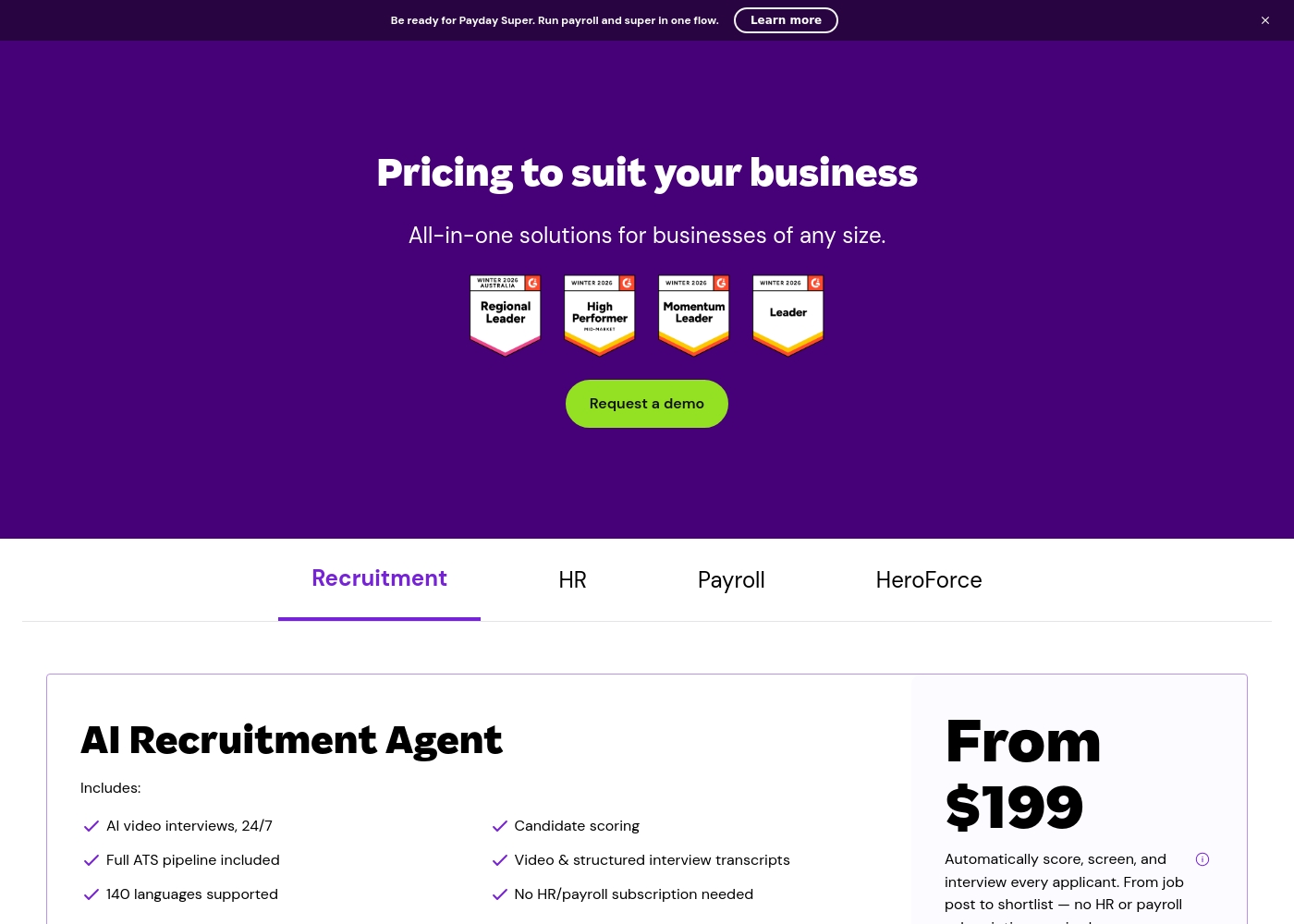
Employment Hero pricing: Employment Hero offers tiered subscription plans starting at $10 per employee/month for HR essentials, alongside specialized AI recruitment and payroll solutions. Costs scale based on team size and selected modules, with both monthly and annual billing options available for specific services like the AI Recruitment Agent at $199/month (billed annually).
Professional managed services under the HeroForce brand are also offered with custom pricing, allowing businesses to tailor their plan to their specific needs and workforce size. Note that a minimum of 10 users is required for core subscriptions and pricing is quoted in AUD excluding GST for the Australian market.
Some plans also offer flexibility for single entity or global expansion setups, simplifying the complexity of multi-national compliance and local payroll management through their unified platform infrastructure. Businesses can scale their usage of AI-powered tools such as video interviewing and candidate scoring as their hiring needs grow over time, ensuring they only pay for the capacity they actually use each month through transparent tiered pricing.
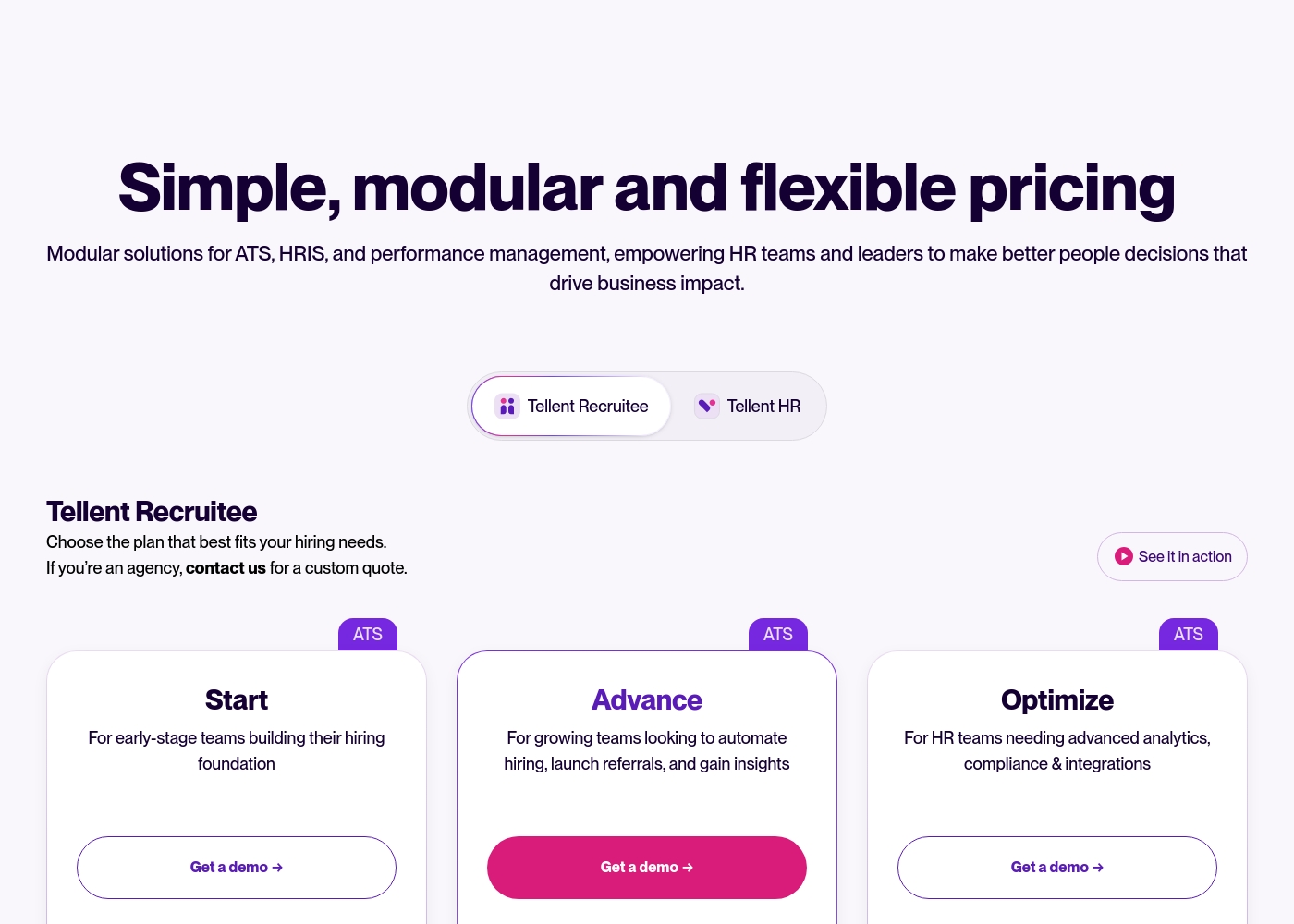
Tellent pricing: Tellent offers modular pricing with specific tiers for recruitment and HR management. Subscription costs increase based on your company's employee count with 20% savings available on annual plans. Plans range: 1–360/month Billing options: Free plan, Free trial, Monthly subscription, Yearly subscription, One-time payment, Usage-based pricing
Pricing Notes
- Employment Hero pricing starts at $10 per employee/month for HR Essentials, with a 10-user minimum.
- Tellent offers modular pricing based on employee count, with 20% savings on annual plans.
- Tellent has a public free plan and an 18-day free trial for core modules.
- Employment Hero's free trial details are not explicitly stated on their website.
- Both platforms have custom pricing for enterprise or advanced needs—contact sales is required.
- Employment Hero pricing is quoted in AUD (excl. GST) for Australia. Global pricing may vary.
- Tellent's cost can increase as you add more modules (e.g., ATS, HRIS, Performance).
Pricing Head-to-Head
User Reviews
We found mixed sentiment from users on Trustpilot and Capterra, though we could only access a limited set of reviews. Users frequently praise the platform's ease of use and the time-saving benefits of having payroll, HR, and employee management integrated.
👍 Recurring positives include the intuitive mobile app for employees and the helpfulness of customer support in resolving issues. However, a common point of friction is customer service responsiveness, with some reporting slow or inconsistent support.
The platform has streamlined our payroll and HR processes significantly. The employee app is a great touch for the team. Support was helpful when we needed it.
From external reviews, Tellent receives praise for its intuitive interface and strong customer support, which helps teams onboard smoothly. Users often highlight the ease of use and the platform's ability to streamline recruitment and HR tasks.
However, some feedback points to occasional bugs and a learning curve with advanced features. Pricing can feel steep for smaller teams, and a few reviewers mention delays in support responsiveness during peak times.
The platform is really intuitive. It streamlined our hiring process and saved our team hours each week. Support has been helpful whenever we had questions.
Our Verdict
It's not a clear-cut winner—your choice depends on your company's stage and strategy. If you want a powerful, all-in-one system to run your entire business, Employment Hero is the frontrunner. Its true superpower is simplifying global growth. With HeroForce, you can legally employ people in 180+ countries without the admin nightmare. Tellent's superpower is its flexible, modular approach. It's perfect if you want to start with a best-in-class ATS and add HR or performance tools when you're ready. Its 500+ partner integrations make it a hub for your existing tech stack. The deciding factor is your need for a managed service. Choose Employment Hero if you want a single provider to handle global compliance risk. Choose Tellent if you prefer to own the process with a customizable software suite. For most growing companies needing a unified platform, Employment Hero offers more out of the box. For teams prioritizing a best-of-breed recruiting tool now with room to grow, Tellent is the smarter, more agile pick.
Frequently Asked Questions
Which is better for small teams: Employment Hero or Tellent?
Tellent is likely better for very small teams. It offers a free plan and has no stated minimum user requirement. Employment Hero requires a minimum of 10 users for its core subscriptions.
Does Employment Hero handle global hiring like Tellent?
Yes, Employment Hero offers a managed service called HeroForce. It acts as the legal employer in 180+ countries, handling contracts, payroll, and compliance. This is a more comprehensive EOR solution.
Is Tellent worth the extra cost over Employment Hero?
Value depends on your needs. Tellent may seem more affordable initially if you only need an ATS. However, Employment Hero's per-employee pricing includes a wider feature set (HR, payroll, benefits) from the start.
Can I migrate from Employment Hero to Tellent easily?
Migration complexity depends on your data and workflows. Both platforms offer onboarding support. Tellent has a network of 500+ partners to assist with implementation. You should contact both vendors for a migration assessment.
Which platform has better customer support?
User reviews are mixed for both. Tellent reviews often praise support quality and offer a dedicated CSM on higher tiers. Employment Hero reviews note variable responsiveness but offers unlimited phone support on premium plans.
Do both platforms offer payroll?
Yes, both Employment Hero and Tellent include payroll features. Employment Hero's payroll is fully integrated and part of its core platform. Tellent's payroll is part of its HRIS module and may involve integration partners.
Ready to Choose?
Both tools have their strengths. Choose based on your specific needs.