Duda vs Framer
Duda and Framer take radically different approaches to web deployment. Duda is built for agencies needing speed, scale, and rock-solid reliability. Framer gives designers powerful visual control and handoff-free publishing. Choosing between stability for clients and cutting-edge design is the major difference.
Best for: Web design agencies managing 50+ client sites, Hosting providers offering branded (White Label) services
Best for: Freelance product designers transitioning from Figma, Startups prioritizing cutting-edge, highly animated marketing sites
The indispensable platform for scaling web agencies.
We assess Duda as a top-tier website platform built purely for professional scaling. It provides agencies with crucial tools like white-label controls, robust AWS infrastructure, and advanced AI features designed to slash time-to-publish. Overall, Duda delivers exceptional speed, reliability, and support, making it an excellent investment for modern client services.
Pros
- Designed specifically for agencies, supporting large site volumes and collaboration.
- Sites deliver exceptional speed and consistent Core Web Vitals for superior SEO performance.
- The platform is reliable, offering 99.99% uptime and zero technical maintenance or plugin issues.
- Intuitive drag-and-drop editor allows deep control via advanced HTML/CSS customization.
Cons
- Pricing scales quickly if you need many additional site licenses outside the included tiers.
- 24x7 phone support is reserved exclusively for the non-public Custom enterprise tier.
- Some advanced users note it may lack a few niche or specialized cutting-edge features.
Powerful Design, Challenging User Experience.
Framer is pitched as a high-performance visual tool offering designers full creative control and rapid deployment capabilities. However, we note that the steep learning curve, combined with systemic issues like unhelpful support and reports of misleading pricing structures, creates a challenging user environment. Overall, we find that the foundational technology is impressive, but major user experience and customer service failures drastically undermine its claimed efficiency.
Pros
- Powerful visual tool favored by designers, especially those familiar with Figma.
- Enables handoff-free publishing and rapid site deployment.
- Built-in modern features like advanced CMS, SEO tools, and AI generation.
Cons
- Highly complicated and unintuitive user interface (UI/UX).
- Frequent reports of constant bugs and reliability issues.
- Pricing is often misleading, with unexpected, high costs for basic features like localization.
- Customer support is reportedly slow, difficult to access, and often relies on unhelpful AI bots.
AboutDuda
Duda is the AI-Ready Website Platform built exclusively for professionals. This includes digital marketing agencies, SaaS companies, and freelance builders. Its workflow is designed to help you build and offer better sites much faster.
You'll work within an intuitive no-code editor that uses drag-and-drop simplicity. It leverages built-in AI tools for superior productivity. The infrastructure is rock-solid, too. Sites run on ultra-reliable AWS hosting with enterprise-grade security and automatic backups. You never worry about ongoing technical maintenance again. 💡
AboutFramer
Framer is a powerful visual design tool made for crafting and publishing modern websites. It empowers you to build exactly what you imagine using smooth effects, animations, and interactions. You can craft responsive layouts visually, eliminating the need to write code.
The platform helps you skip the blank canvas entirely. Integrated AI can generate sophisticated page layouts and advanced components right away. Collaboration is built in, meaning updates are seamless, and the entire process is completely handoff-free. 💡
Highlights
Feature Comparison
Features Overview
We highlight the main differences and pick a winner for each feature.
Reliability & Uptime
Duda offers a 99.99% uptime SLA and superior stability. Framer reports constant bugs and concerns about long-term reliability.
Duda is built on AWS infrastructure, providing enterprise-grade security and automatic backups. They guarantee a 99.99% uptime SLA across all subscription tiers. This means Duda sites are stable and require zero technical maintenance from you. Framer users report frequent site bugs and overall instability in the platform. While Framer hosting is fast, there is no public uptime SLA guarantee offered. Users often feel the platform is still refining key features. For professional client services, the guaranteed reliability of Duda is a game-changer. Framer's focus is on speed and design, sometimes at the expense of consistent stability. Agencies using Duda can promise clients exceptional stability and performance. Framer might require more attention post-launch due to potential unaddressed issues.
Scaling for Agencies
Duda is purpose-built for volume using white-label tools and APIs. Framer scales per site, lacking true agency controls.
Duda handles scaling for agencies exceptionally well via advanced features. The Agency and White Label plans include multiple site licenses and collaboration tools. Duda delivers a powerful REST API to automate site creation and content updates programmatically. Framer’s paid plans are priced per site, making scaling dozens of projects expensive quickly. Scaling efforts depend on plugins and custom code snippets. Framer is built more for individual high-fidelity sites than high-volume portfolio management. The White Label plan in Duda is crucial for client ownership and branded delivery. Framer makes users rely on external tools or custom processes to manage multiple client projects efficiently. If you run a web design firm, Duda provides the necessary tools like customizable permissions and centralized client management.
Creative Design Control
Framer offers total creative mastery with code-free immersive visuals. Duda focuses on an intuitive editor built for deployment speed.
Framer empowers designers with powerful controls over interactions, animations, and responsive layouts. Designers accustomed to Figma find Framer's visual canvas highly capable. You can achieve complex, immersive designs entirely visually without writing code. Duda utilizes an intuitive, drag-and-drop no-code editor prioritizing fast production times. While flexible, Duda's visual editing provides deep control via advanced HTML/CSS customization options. The focus is speed over bleeding-edge, visual complexity. If your client needs complex visual flair and unique interactions, Framer delivers full creative freedom. Duda prioritizes fast, high-performing sites that convert and rank well. Use Framer if the design itself is the main, complex selling point. Choose Duda if rapid deployment and Core Web Vitals are the priority.
Customer Support
Duda provides praised, responsive priority support options. Framer reports slow, unresponsive support often relying on AI bots.
Duda receives consistently high marks for knowledgeable and rapid customer service. Higher tiers like Agency and White Label include Priority support for faster resolutions. Many users praise Duda's friendly and accessible team, including live chat availability. Framer users frequently report that customer support is difficult to access and often relies on unhelpful AI bots. Many testimonial complaints cite long wait times and serious delays in response to critical bugs. Good support is non-negotiable when managing client sites. Duda clearly wins here, minimizing downtime and friction for professionals. Framer's rumored support issues add a significant risk factor, especially if you plan to rely on the platform heavily for business operations.
Pricing Clarity
Duda pricing is straightforward and includes a money-back guarantee. Framer users report highly misleading and unexpected costs.
Duda offers clear monthly or annual pricing with four published plans from $19–$149/month. All subscriptions are backed by a strong 30-day money-back guarantee. Pricing is based mainly on included site licenses and user count. Framer utilizes per-site pricing starting at $75/month, but users encounter surprising high costs. Localization, for example, can incur an extremely high additional monthly fee per language. Framer's refund policy is limited to 14 days and only for EU/Turkey residents. If you need budget predictability, Duda offers a much clearer cost structure. Framer’s reported hidden costs can crush smaller companies or new agencies quickly. Framer's usage-based pricing for advanced features like analytics adds further variable expense risks not present in Duda’s models.
Integration & Data
Duda excels at programmatic data connectivity and automation via API. Framer focuses on third-party plugin syncs like Notion.
Duda's Dynamic Pages powerfully connect sites to external datasets like Google Sheets or Airtable. The full REST API allows full programmatic control, essential for large-scale enterprise automation. Duda emphasizes integration for scaling content. Framer supports specific plugins like Notion Sync and JSON Sync for content management synchronization. This approach is designer-friendly for pulling data from primary sources. Framer offers integrated Analytics and A/B testing. For large-scale data synchronization and workflow automation, Duda’s API and dynamic data connectors are superior. Framer's focus is narrowly on design data integration. If integrating your site with Hubspot or your own SQL database is key, Duda is the stronger choice for backend connectivity.
AI Workflow Tools
Duda uses AI for content collection and SEO optimization. Framer's AI is focused on instantly generating full design layouts.
Duda leverages its AI Assistant to significantly accelerate content generation and modification. A killer feature is the AI Content Collection form, which painlessly gathers client materials. Duda also uses AI for SEO tasks like generating metadata and alt-text. Framer uses its AI Wireframer feature to bypass the blank canvas entirely. This instantly generates sophisticated page layouts and advanced components. Framer uses AI to kickstart the design process immediately. Both platforms integrate powerful AI, but serve different workflow needs effectively. Duda streamlines content and client onboarding using AI. Framer streamlines initial layout creation. If your bottleneck is content collection from clients, Duda provides the specific solution you need.
Advanced Optimization
Framer offers integrated A/B testing and growth funnels. Duda requires third-party tools for advanced optimization features.
Framer includes Advanced Analytics (as an add-on) featuring robust A/B testing and click tracking. Designers and marketers can integrate conversion tracking and funnels directly into the platform. This makes performance analysis seamless. Duda provides excellent built-in SEO tools, delivering high Core Web Vitals scores out-of-the-box. However, advanced conversion optimization and native A/B testing features are not included. Users must rely on external tools for this functionality. If optimizing conversion rates through continuous A/B testing is a core requirement, Framer has the integrated solution. You pay extra for the add-on, but the functionality is powerful. Duda allows developers to build custom analytics, but it lacks the out-of-the-box native marketing tools that Framer provides.
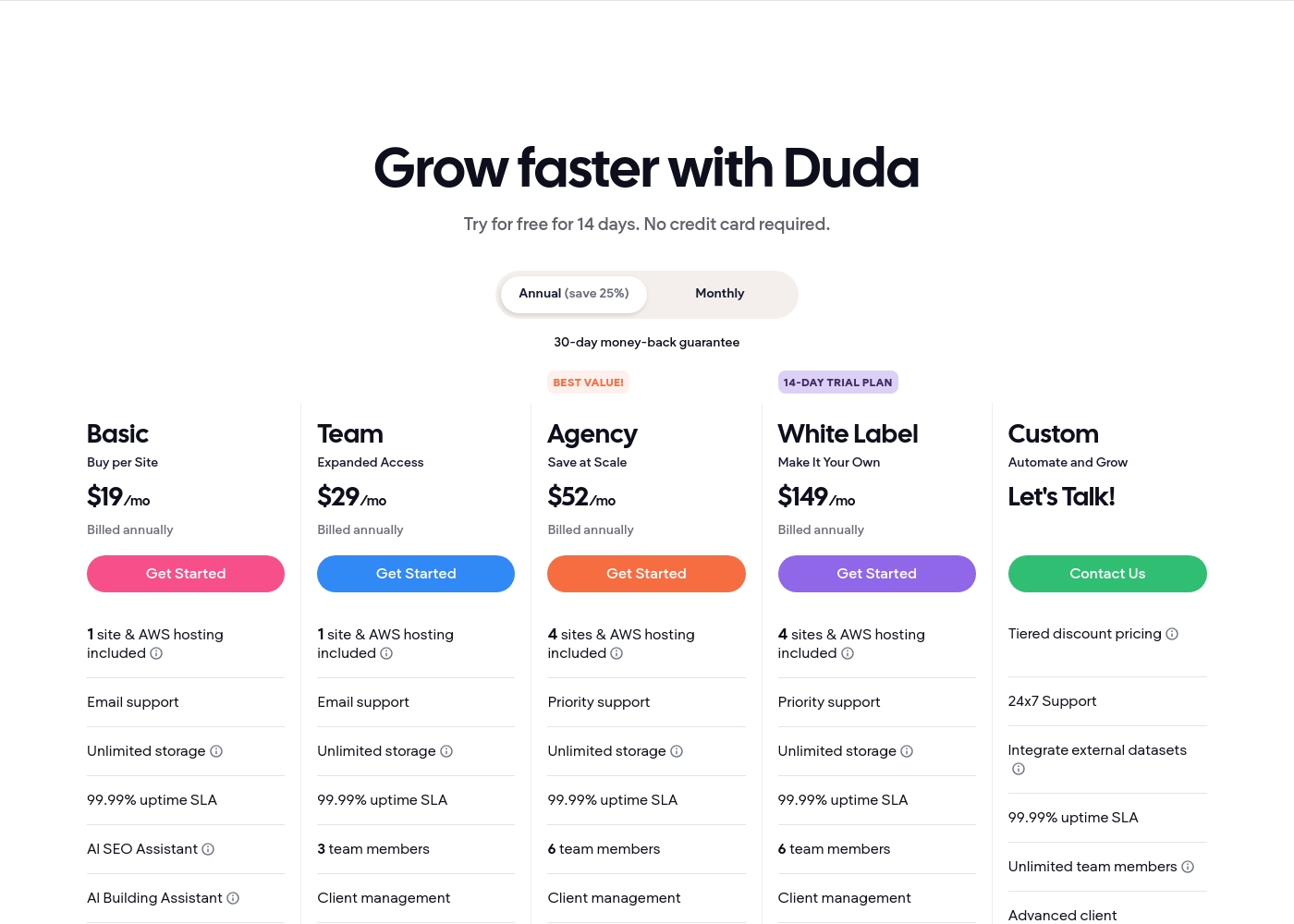
Duda costs between $19 and $149 per month with four published plans: Basic at $19/mo, Team at $29/mo, Agency at $52/mo, and White Label at $149/mo (all billed annually).
Review the plans below to find the best fit for your team's size and required features.
Basic
Price: $19/month when billed annually ($25/month when billed monthly) Websites Supported: 1 site & AWS hosting included Best For: Buy per Site Refund Policy: 30-day money-back guarantee Other Features:
- Email support
- Unlimited storage
- AI SEO Assistant
- AI Building Assistant
- 1 site & AWS hosting included
- Email support
- Unlimited storage
- 99.99% uptime SLA
- AI SEO Assistant
- 1 site & AWS hosting included
- Email support
- Unlimited storage
- 99.99% uptime SLA
- 3 team members
- 4 sites & AWS hosting included
- Priority support
- Unlimited storage
- 99.99% uptime SLA
- 6 team members
- 4 sites & AWS hosting included
- Priority support
- Unlimited storage
- 99.99% uptime SLA
- 6 team members
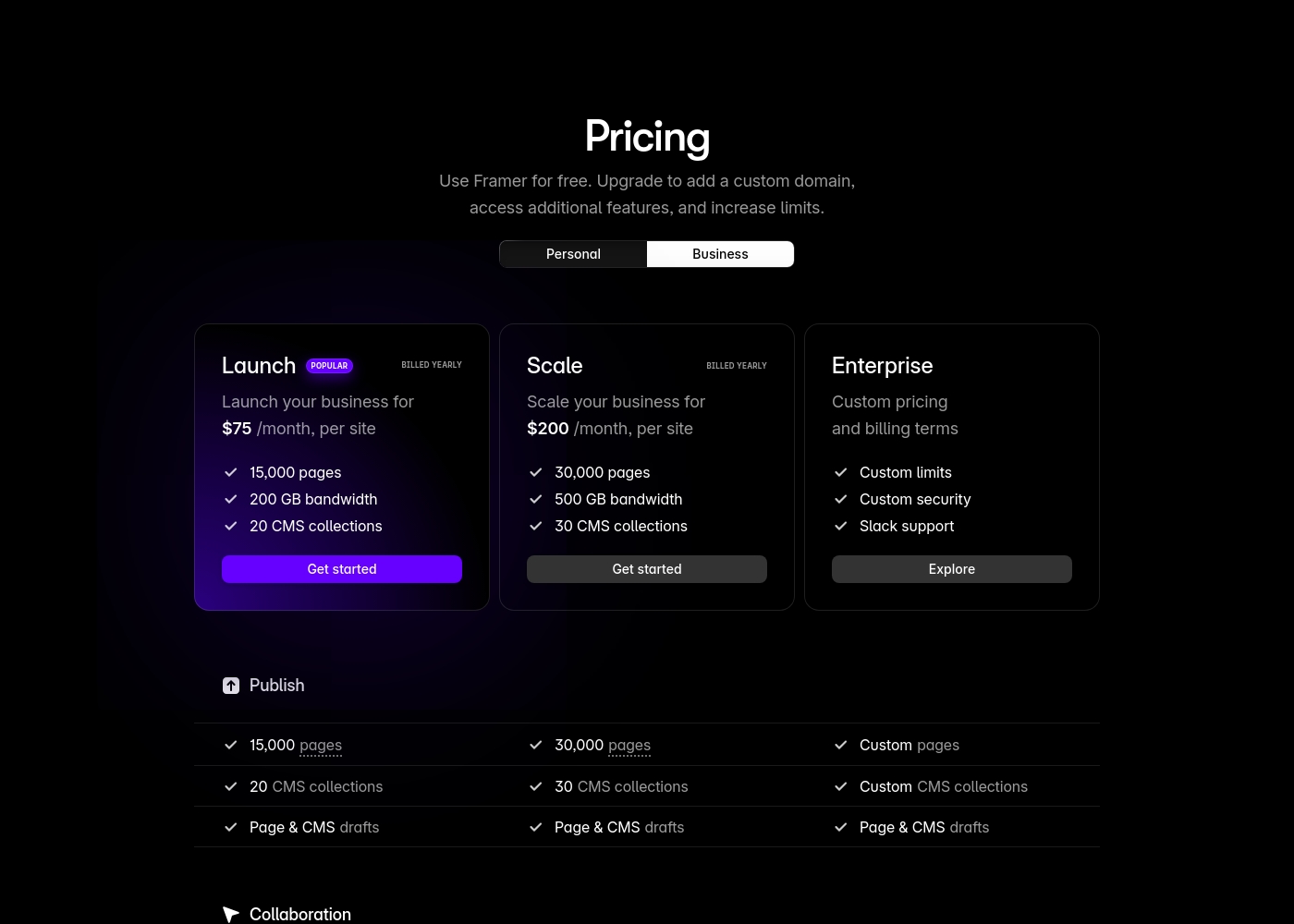
Framer costs between $75 and $200 per month (billed yearly) with two fixed-price plans: Launch at $75/month and Scale at $200/month, plus a custom Enterprise option.
Framer offers a Free plan to let you start designing right away. When you are ready to add a custom domain and access advanced features, you can choose from these paid business offerings.
Launch (Popular Business Plan)
Price: $75/month, per site (billed yearly) Websites Supported: Per site Best For: Launching a business site or marketing stack Refund Policy: 14-day refund eligible for EU and Turkey residents Other Features:
- 15,000 pages, 20 CMS collections
- 200 GB bandwidth, 50GB file storage
- Password protect, Custom code, Cookie banner
- Up to 10 editors (additional editors $40/month)
- 10 CMS collections
- 1,000 pages
- 5MB file uploads
- Free locale to try
- 15,000 pages
- 20 CMS collections
- 200 GB bandwidth
- 50GB storage
- 90 day version history
- 30,000 pages
- 30 CMS collections
- 500 GB bandwidth
- 100GB storage
- 120 day version history
- Custom limits and security
- Premium CDN and hosting
- Unlimited analytics and redirects
- Dedicated Slack support and team training
- SSO for editors and sites
Pricing Notes
- Duda saves you 25% if you choose annual billing across its four published pricing tiers.
- Framer's published pricing is per site, while Duda includes multiple site licenses (up to 4) in higher-tier plans.
- Framer's Advanced Analytics/A/B testing is a usage-based add-on after a 30-day trial period, costing extra.
- Users report that Framer's localization feature incurs high, unexpected costs ($40/additional locale), which is a serious budget risk.
- Duda offers a clear 30-day money-back guarantee, while Framer’s refund is limited to 14 days and only for EU/Turkey residents.
Pricing Head-to-Head
User Reviews
Users overwhelmingly rate Duda as excellent, specifically highlighting its value for professionals and agencies. Reviewers frequently mention the platform’s intuitive drag-and-drop editor and how it dramatically accelerates production, often reporting a 70% reduction in build times.
Consistency in performance is a major theme; sites built on Duda deliver superior SEO results, quick page-load speeds, and reliable Core Web Vitals, avoiding the constant “plugin headaches” associated with other popular builders. Agents running white-label solutions call the platform outstanding, noting its stability, security, and exceptional scalability for managing hundreds of client sites.
We converted hundreds of sites from WordPress to Duda and couldn't be happier! There's zero downtime and no ridiculous plugin worries. We can now build sites much faster, which has been a game-changer for our agency operations.
Framer generates highly polarized feedback, reflected in its low Trustpilot standing. Users generally praise the platform’s powerful features and the impressive technical capabilities for designers, noting its potential as a beautiful site builder.
However, the external criticism mainly centers on poor User Experience (UX), which many describe as clunky, complicated, and unintuitive, making even simple tasks frustrating 😡. A significant number of reports highlight constant bugs and half-baked features impacting overall reliability.
The UI/UX is truly terrible, clunky, and overly complicated. I’ve been in web design for eight years, and this is the least intuitive platform I have ever used. Seriously, they need to hire a new designer quickly.
Our Verdict
If your income depends on site deployments, Duda is unequivocally the safer, smarter choice. It’s the platform designed to help professionals scale profitably. Duda eliminates costly maintenance headaches and provides guaranteed 99.99% uptime for client peace of mind. Framer offers incredible design flexibility, but its reported reliability issues make it a risky professional investment. Duda’s superpower is making scalability effortless, specifically for agencies. You skip endless maintenance and plugin conflicts entirely, focusing on client acquisition instead. Dynamic Pages and the robust REST API allow Duda to automate content deployment like no other builder. Duda even provides full platform white labeling so clients only see your brand. Framer’s strength lies in giving designers total, visual control over complex design elements. If you prioritize smooth animations, custom effects, and a handoff-free publishing workflow, Framer delivers. Its AI Wireframer feature can generate full layouts instantly, speeding up the initial creative process significantly. The deciding factor is the cost of failure and user comfort. Duda’s intuitive UI, strong support, and clear pricing offer stability. Framer requires a much steeper learning curve, and users frequently report costly hidden fees and constant bugs. Choose Duda if you need reliable, profitable scale and superior stability, like for hosting client portfolios. Opt for Framer if you prioritize cutting-edge design finesse and are comfortable troubleshooting a less reliable, more complicated tool.
Frequently Asked Questions
Which is better for scaling a web design agency: Duda or Framer?
Duda is specifically built for agency scaling and high volume. Duda includes multi-site licenses, white-label features, and a full REST API for automation. Framer prices are per-site, which can quickly become cost-prohibitive for large client bases.
Is Framer's visual design control worth the higher price than Duda?
Framer offers superior overall creative control for advanced animations and visual effects. However, Framer has reported misleading pricing and mandatory upcharges for basic features like localization. Duda offers better value and reliability for professionals.
Does Duda have integrated A/B testing like Framer?
Duda does not offer native A/B testing features out-of-the-box. Framer provides A/B testing, click tracking, and conversion funnels as part of its Advanced Analytics add-on. Duda users typically rely on specific third-party integrations for testing.
Which platform is easier to learn for a beginner: Duda or Framer?
Duda has an intuitive, drag-and-drop no-code editor that users praise for ease of use. Framer is widely reported as clunky and overly complicated, making the learning curve very steep. Duda is easier for fast adoption.
Can I connect client sites to external databases like Google Sheets in Framer or Duda?
Yes, Duda excels at this using Dynamic Pages connected to Google Sheets, Airtable, or HubSpot. Framer supports similar data connection via third-party plugins like Notion Sync and JSON Sync. Duda’s feature is more centralized for bulk content creation.
How reliable is the customer support for Duda compared to Framer?
Duda’s customer support is highly praised, offering email and priority support options on higher plans. Framer users frequently report slow customer service, difficulty accessing help, and reliance on unhelpful AI bots. Duda consistently delivers better support.
Ready to Choose?
Both tools have their strengths. Choose based on your specific needs.