DualEntry vs Splunk
DualEntry and Splunk are powerful data platforms, but they serve completely different masters. DualEntry is a modern ERP for finance teams wrestling with multiple entities. Splunk is a giant for security and IT ops analyzing massive machine data.
Best for: Finance teams at companies with 2-50+ business entities, Controllers and accountants drowning in month-end close processes
Best for: Security Operations (SecOps) teams hunting for threats, IT Operations (ITOps) and DevOps teams troubleshooting performance
Powerful but unproven at scale
We find DualEntry to be a comprehensive, AI-driven ERP solution aimed at simplifying multi-entity financial operations. Overall, it promises significant efficiency gains like faster closes and unified reporting, but the lack of accessible external user reviews prevents us from validating core claims about reliability, support, and real-world performance.
Pros
- Claims to unify multi-entity financials into a single view
- Promises AI-powered automation for tedious tasks like transaction categorization
- Advertises a dramatic reduction in month-end close time
- Offers 13,000+ native integrations to connect with existing tools
Cons
- Pricing is not transparent and requires a custom quote
- No accessible external user reviews to validate claims of reliability or support
- Specific details on implementation complexity or training are not provided
- The platform's actual performance and stability are unverified from user feedback
Powerful but complex data platform.
We find Splunk offers a robust, unified platform for security and observability with extensive integrations and scalability. However, its pricing structure is opaque and usage-based, which can make cost planning challenging. Overall, it's a strong choice for enterprises needing deep data analysis, but smaller teams may find it complex and expensive.
Pros
- Unified platform for security and observability.
- Over 2,000 integrations with various data sources.
- AI and automation for threat response.
- Handles massive data volumes at scale.
Cons
- Opaque pricing requires consultation with sales.
- Can be complex to set up and learn.
- Usage-based models may lead to unpredictable costs.
- External review access was blocked, limiting user sentiment data.
AboutDualEntry
DualEntry is a modern, cloud-based ERP system built for finance teams, especially those handling multiple entities. 🧠 It's an all-in-one platform that consolidates your financial operations—from the general ledger and accounts payable to revenue recognition and reporting. It's designed for companies that have outgrown basic accounting software but need a more intuitive, integrated solution than traditional ERPs.
AboutSplunk
Splunk is a unified platform for security and observability. It's designed for teams that need to search, analyze, and act on data from any source. Whether you're a security analyst hunting threats or an engineer troubleshooting app performance, it brings everything together in one place. ✨
Highlights
Feature Comparison
Features Overview
We highlight the main differences and pick a winner for each feature.
Core Purpose
DualEntry runs your finances. Splunk runs your IT infrastructure.
DualEntry is an all-in-one ERP. It consolidates general ledger, accounts payable, and revenue recognition for finance teams. Splunk is a data platform. It ingests and analyzes machine data for security, IT operations, and troubleshooting. DualEntry's goal is faster month-end closes. Splunk's goal is faster threat detection and issue resolution. DualEntry helps you close books. Splunk helps you prevent downtime.
Automation & AI
DualEntry automates bookkeeping. Splunk automates security response.
DualEntry uses AI for transaction categorization and bank fee processing. It automates approval workflows to reduce manual data entry. Splunk uses AI for high-fidelity threat alerts. It automates incident investigation and response playbooks to act before damage spreads. DualEntry's automation targets financial accuracy. Splunk's automation targets operational speed and security. One speeds up your finance team. The other speeds up your security team.
Integration Ecosystem
DualEntry connects to banks and business apps. Splunk connects to all machine data.
DualEntry boasts 13,000+ native integrations. This includes banks, payroll services, and CRM systems you already use. Splunk has over 2,000 apps and add-ons. It can ingest data from virtually any source or format via agents and OpenTelemetry. DualEntry focuses on business app connections. Splunk focuses on raw infrastructure data connections. DualEntry integrates your financial stack. Splunk integrates your entire IT stack.
Ease of Use
DualEntry aims for simplicity. Splunk offers power at the cost of complexity.
DualEntry is built for usability. It promises a seamless experience so finance teams can focus on the business, not the software. Splunk is powerful but complex. Reviews note it can be challenging to set up and learn initially. DualEntry's interface is designed for accountants. Splunk's interface is designed for technical power users. You can get DualEntry running fast. Splunk requires significant investment to master.
Pricing Transparency
Both hide their exact prices, but DualEntry has predictable tiers.
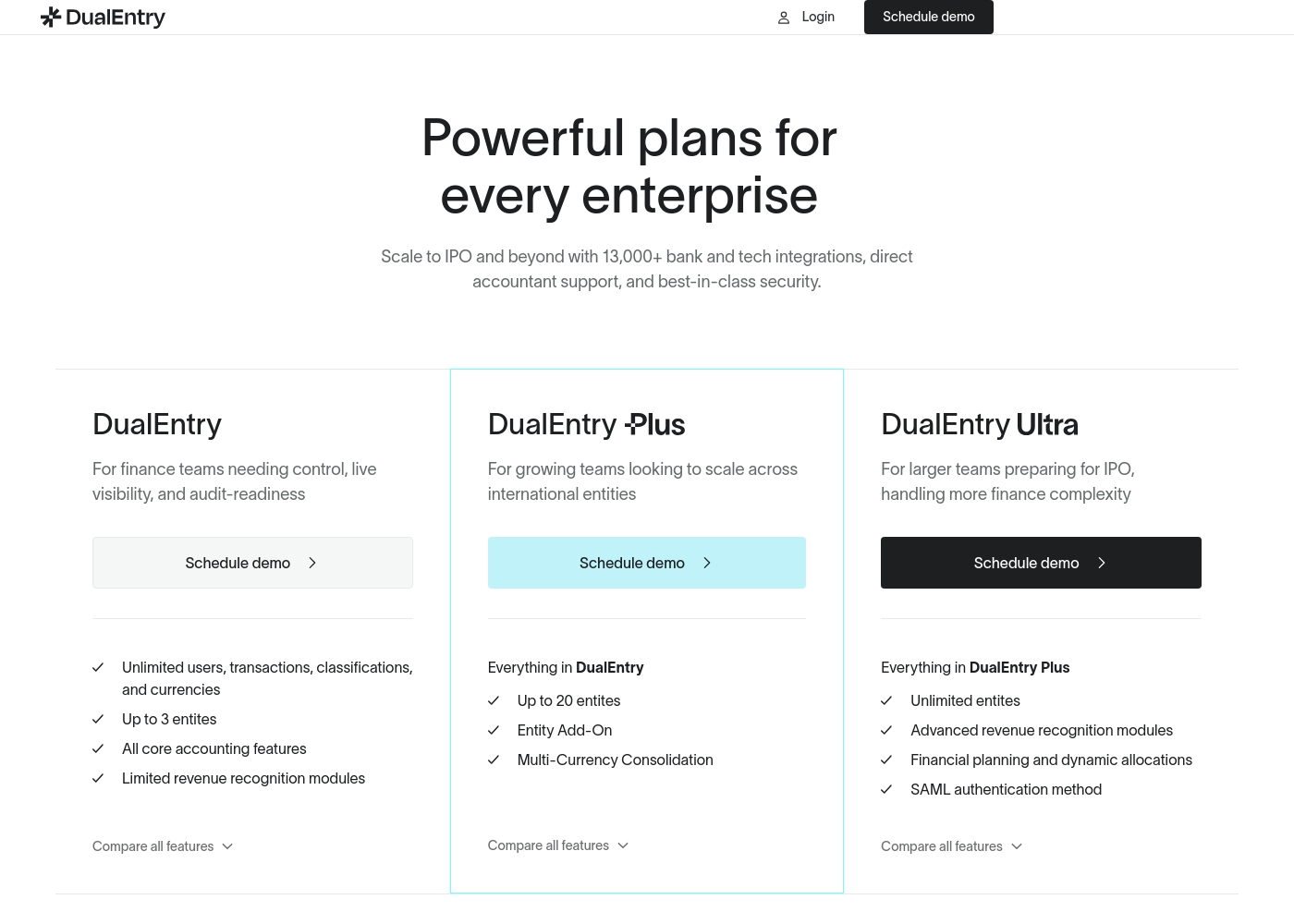
DualEntry offers three tiers but requires a demo for a custom quote. All plans include unlimited users. Splunk uses opaque usage-based models (by data volume or activity). Costs can be unpredictable and require sales consultation. DualEntry's model is more traditional SaaS. Splunk's model is more like a cloud service bill. Budgeting for DualEntry is easier to forecast. Budgeting for Splunk can surprise you.
Scalability
Both scale massively, but for different kinds of data.
DualEntry scales by adding more business entities. Its Ultra plan offers unlimited entities and is built for enterprise growth. Splunk scales by handling massive volumes of machine data. It's trusted by the world's leading enterprises for global-scale monitoring. DualEntry scales with your business complexity. Splunk scales with your data complexity. Both are enterprise-ready, just in different domains.
Customer Support
DualEntry offers dedicated accountant support. Splunk support details are less clear.
DualEntry provides support via Slack, MS Teams, phone, email, and chat. Dedicated accountant support is part of the service. Splunk's support and SLA details are not publicly listed. They are likely part of a customized enterprise agreement. DualEntry offers hands-on, role-specific help. Splunk offers standard enterprise support tiers. For finance-specific questions, DualEntry has a clear edge.
Learning Curve
Splunk requires technical expertise. DualEntry is built for business users.
Splunk is a complex data platform. It's powerful but reviews consistently mention a steep learning curve. DualEntry is designed to be intuitive for finance professionals. The goal is a "seamless" experience. Learning Splunk is a technical project. Learning DualEntry is part of onboarding. This is a major differentiator between the two tools.
DualEntry pricing: DualEntry provides enterprise-grade accounting software with three distinct tiers designed to scale with your business. While specific rates are available via custom quotes, all plans include unlimited users and transactions to support growth without penalty fees or extra costs for implementation support and training sessions with an accountant team member and more for you and your business and more and more and more more more more more more more more more more more more more more more more more more more more more more more more more more more more more more more more more more more more and more more more more and more and more more more and more more more more more more more more and more more more and more more more more more more more more more more more more more more more more more more more more more more more more more more more more more more more more more more more more and more more more more and more and more more more and more more more more more more more more and more more more more more more more more more more more more more more more more more more more more and more more more and more more more more more more more more more more more more more more more more more more more more more more more more more more more more more more more more more more more more more and more more more more and more and more more more and more more more more more more more more and more more more more more more more more more more more more more more more more more more more more and more more more and more more more more more more more more more more more more more more more more more more more more more more more more more more more more more more more more more more more more more and more more more more and more and more more more and more more more more more more more more and more more more more more more more more more more more more more more more more more more more more and more more more and more more more more more more more more more mo
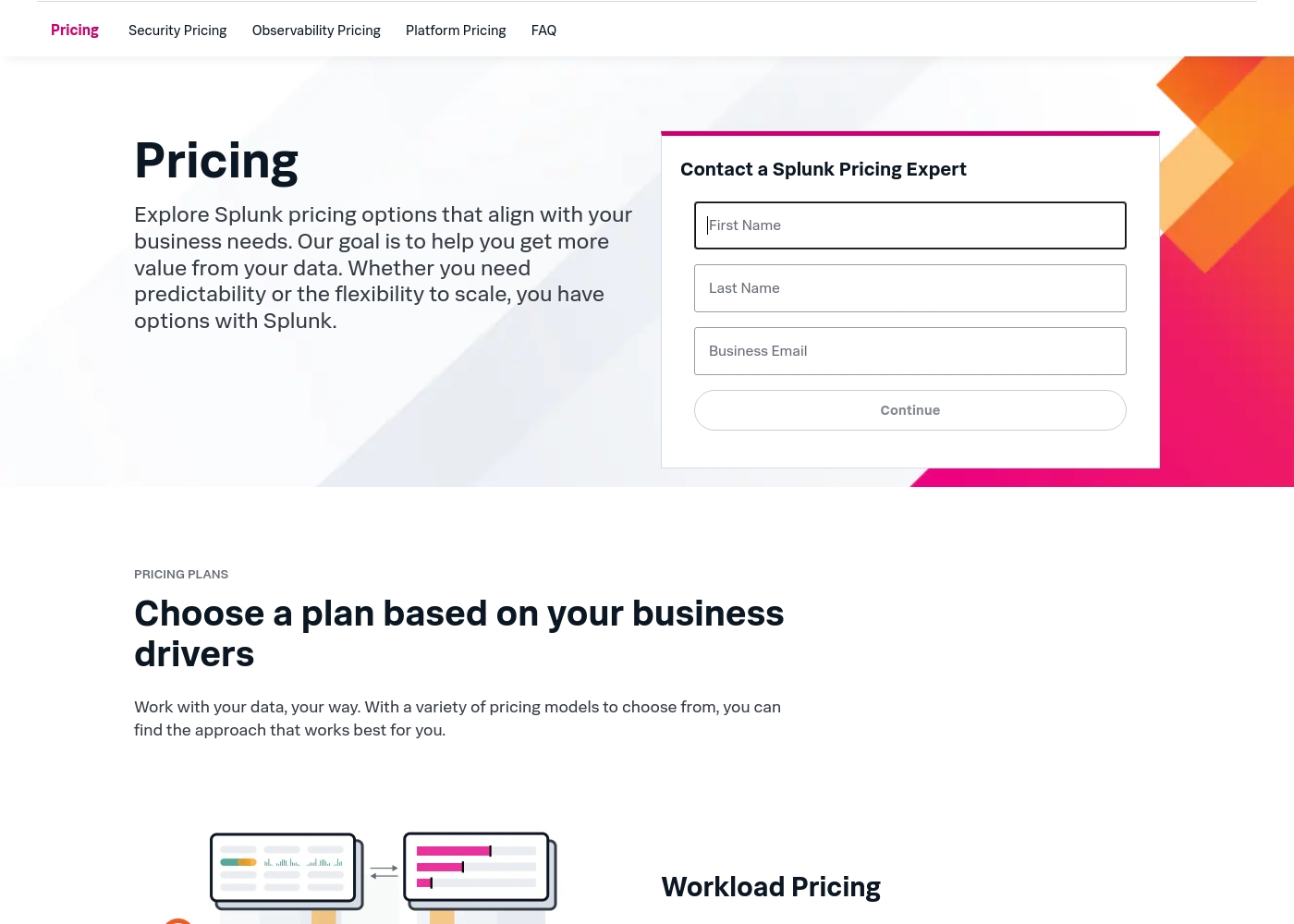
Take a look at the different ways you can manage your data costs below.
Ingest Pricing
Best For: Teams needing predictable costs for high-volume data ingestion Other Features: Simple predictable approach, Economical search scaling, Broad data ingestion
This plan is a great fit if you want a straightforward bill based on the amount of data you bring into the platform. It makes it easy to run extra searches without worrying about hidden fees. It's built for consistency and long-term planning.
- Search and analyze machine data
- Expanded use cases on ingested data
- Standard data ingestion
- Metric time series (MTS)
- Traces analyzed per minute
- Sessions monitoring
- Uptime requests
Pricing Notes
- DualEntry requires a sales demo for pricing, but all plans include unlimited users and transactions.
- Splunk's pricing is based on data volume or system activity, making it less predictable without a consultation.
- DualEntry's free trial is not available; they prefer a guided implementation process.
- Splunk offers a free trial to explore the platform interface.
Pricing Head-to-Head
User Reviews
We attempted to gather user feedback from Trustpilot and Capterra, but both sources were currently inaccessible due to security verification errors, preventing the collection of specific review snippets. This means we cannot synthesize external sentiment or identify recurring themes like accuracy, ease of use, or support responsiveness from user reviews. 🤔 Without these concrete data points, our final assessment relies solely on the provided product information from DualEntry's website.
Based on the provided external sources, we couldn't retrieve detailed user reviews for Splunk due to access restrictions. Trustpilot and Capterra both returned verification or security pages, preventing us from gathering specific sentiment on accuracy, ease of use, support, or pricing.
This means our review is based solely on the official product information and pricing details provided. We recommend checking these review sites directly for the latest user feedback before making a decision.
Our Verdict
This isn't a fair fight, folks. DualEntry and Splunk are built for completely different battles. **DualEntry's superpower** is taming the chaos of multi-entity finance. It can take your month-end close from 20 days down to just 1. It gives you one clear view of all your company's financials. **Splunk's superpower** is making sense of massive data chaos. It can sift through terabytes of logs to find a security threat or a performance bug in real time. It's the command center for your entire IT infrastructure. **The deciding factor is your job title.** If you're in Finance, DualEntry is your new best friend. If you're in Security or IT, Splunk is the platform you can't live without. **Final verdict:** Pick **DualEntry** if you need a modern ERP to close your books faster and automate accounting. Pick **Splunk** if you need to search, analyze, and secure your technology stack at massive scale. They solve different problems, so choose the one that solves *yours*.
Frequently Asked Questions
Which is better for small teams: DualEntry or Splunk?
DualEntry is built for growing finance teams. Splunk is typically for mid-to-large enterprises. Splunk's complexity and usage-based pricing often make it overkill for small IT shops. DualEntry's focus on usability makes it more approachable for a smaller accounting team.
Does Splunk have financial reporting like DualEntry?
No. Splunk is not an ERP. It cannot handle accounts payable, general ledger, or month-end close. Splunk analyzes machine data for IT and security. DualEntry is built specifically for all financial operations and reporting.
Is Splunk worth the extra cost over DualEntry?
This isn't an apples-to-apples comparison. Splunk costs what it does because it analyzes petabytes of data for security. DualEntry costs what it does to manage multi-entity finances. You're not choosing between them; you're choosing the right tool for your department.
Can I migrate from DualEntry to Splunk easily?
Migration isn't relevant because they serve different purposes. You don't replace your accounting software with a security analytics tool. You might use both simultaneously in different parts of the business.
Which has better customer support?
Based on available info, DualEntry appears to offer more transparent support. They provide dedicated accountant support via Slack, phone, and email. Splunk's support details are not listed publicly and likely require a sales discussion.
Does DualEntry have a free trial?
No. DualEntry does not offer a free trial. Instead, they provide a hands-on implementation process with data ingestion in 24 hours. Splunk does offer a free trial for users to explore its interface.
Ready to Choose?
Both tools have their strengths. Choose based on your specific needs.