DualEntry vs Odoo
DualEntry and Odoo are both powerful ERP platforms, but they target different teams. DualEntry focuses on fast, multi-entity finance automation, while Odoo offers a vast, all-in-one business suite. Your choice depends on whether you need specialized accounting or a full business ecosystem.
Best for: Finance teams managing 5+ entities with complex accounting needs, Businesses wanting to cut month-end close time from 20 days to 1
Best for: Small to mid-sized businesses needing an all-in-one platform (CRM, ERP, eCommerce), Startups or micro-businesses wanting a free plan to start with one app
Powerful but unproven at scale
We find DualEntry to be a comprehensive, AI-driven ERP solution aimed at simplifying multi-entity financial operations. Overall, it promises significant efficiency gains like faster closes and unified reporting, but the lack of accessible external user reviews prevents us from validating core claims about reliability, support, and real-world performance.
Pros
- Claims to unify multi-entity financials into a single view
- Promises AI-powered automation for tedious tasks like transaction categorization
- Advertises a dramatic reduction in month-end close time
- Offers 13,000+ native integrations to connect with existing tools
Cons
- Pricing is not transparent and requires a custom quote
- No accessible external user reviews to validate claims of reliability or support
- Specific details on implementation complexity or training are not provided
- The platform's actual performance and stability are unverified from user feedback
Powerful Integration, Complex Setup.
We find Odoo to be an exceptionally flexible and powerful all-in-one business platform, celebrated by users for its comprehensive application suite and superb customer support responsiveness. Overall, based on its high feature value and dedication to integration, we rate Odoo very highly, despite user friction surrounding setup complexity and occasional clarity issues regarding total implementation costs.
Pros
- Access to a comprehensive suite of fully integrated business applications.
- High level of flexibility and customization supported by Odoo Studio and 40,000+ community apps.
- Support team is highly responsive, knowledgeable, and willing to assist even free users.
- Affordable and clear per-user pricing structure with a permanent free plan option.
Cons
- Initial setup and implementation process is often slow, complex, and requires significant client time.
- Some users report unexpected costs related to custom code or specific hosting solutions.
- Website functionality can sometimes break after major platform updates or upgrades.
- Advanced users report issues with external API reliability.
AboutDualEntry
DualEntry is a modern, cloud-based ERP system built for finance teams, especially those handling multiple entities. 🧠 It's an all-in-one platform that consolidates your financial operations—from the general ledger and accounts payable to revenue recognition and reporting. It's designed for companies that have outgrown basic accounting software but need a more intuitive, integrated solution than traditional ERPs.
AboutOdoo
Odoo is a comprehensive platform designed to handle nearly all aspects of your business operations. It combines a vast collection of apps that are perfectly integrated and ready to install with a single click. If you identify an issue or process you want to improve, there is likely an app for that purpose.
Odoo offers ultimate flexibility, catering to companies from micro businesses to large enterprises. It comes in two versions: the Community edition, which is 100% free and open source, and Enterprise, which includes extra apps, infrastructure, and professional services. This robust system is supported by a global developer community of over 100,000 people. ✅
Highlights
Feature Comparison
Features Overview
We highlight the main differences and pick a winner for each feature.
Core Focus & Use Case
DualEntry is built for multi-entity finance teams, while Odoo covers all business processes.
DualEntry targets finance teams managing multiple entities. It consolidates general ledger, accounts payable, and revenue recognition into one view. The focus is on cutting month-end close time from 20 days to 1. Odoo is an all-in-one business suite with 100+ integrated apps. It handles CRM, inventory, accounting, manufacturing, and more. It's designed for micro to enterprise businesses needing a unified platform. The key difference is scope. DualEntry specializes in financial automation, while Odoo aims to replace your entire tech stack. If you need deep accounting, choose DualEntry; if you need broad business tools, choose Odoo.
Pricing & Value
DualEntry uses custom quotes, while Odoo offers transparent per-user pricing with a free plan.
DualEntry pricing is not publicly listed and requires a custom quote. All plans include unlimited users and transactions. Costs vary by entity tier (base, Plus, Ultra). Implementation is included at no extra cost. Odoo starts with a free plan (One App Free) for unlimited users. Standard costs $24.90/user/month (annual). Custom costs $37.40/user/month (annual). Discounts apply for the first 12 months. Odoo is more transparent and affordable for small teams. DualEntry is better if you need enterprise-grade features without per-user fees. Watch out for Odoo's initial discount expiration and potential implementation costs.
Ease of Use & Setup
DualEntry promises fast implementation, while Odoo's setup can be complex and time-consuming.
DualEntry advertises 24-hour data ingestion and a 4-6 week go-live time. Implementation is included, with accountant-led support. The goal is minimal disruption. Odoo users report complex setup requiring significant effort. The system's logic can be hard to learn. Implementation may require Success Packs or external partners, adding cost and time. If you want a smoother onboarding, DualEntry seems faster. If you're willing to invest time for customization, Odoo offers more flexibility later.
Automation & AI
DualEntry focuses on AI-powered accounting automation, while Odoo emphasizes speed and low data entry.
DualEntry automates bank-fee processing, transaction categorization, and expense management. It uses AI for anomaly detection and continuous close. Customers report cutting close time dramatically. Odoo leverages smart AI for a fast UI and reduced data entry. Operations complete in under 90 milliseconds. The automation is more about general efficiency than specific accounting tasks. DualEntry's automation is deeper for finance teams. Odoo's speed helps across all modules. Choose based on whether you need targeted accounting automation or general business speed.
Integration Ecosystem
Both offer massive integrations, but DualEntry has 13,000+ native ones, while Odoo has 40,000+ community apps.
DualEntry provides 13,000+ native bank connections and tech integrations. An open API is available for custom links. This is focused on finance and ERP tools. Odoo's community contributes over 40,000 apps covering every business need. You can install specialized modules for POS, manufacturing, or HR. This ecosystem is broader but may vary in quality. DualEntry's integrations are deep and finance-focused. Odoo's are vast but may require more curation. For accounting integrations, DualEntry wins; for broader business apps, Odoo wins.
Customer Support
DualEntry offers dedicated accountant support, while Odoo provides responsive multilingual email support.
DualEntry support includes Slack, MS Teams, phone, video, email, and live chat. Dedicated accountant support is part of the service. This is tailored for finance teams. Odoo offers 24/5 email support in English, French, Spanish, and Dutch. Users praise the support team's responsiveness and knowledge, even for free plans. Support is comprehensive but may lack real-time channels. DualEntry's support is more personalized and finance-specific. Odoo's support is reliable and multilingual. For hands-on accounting help, DualEntry; for general platform support, Odoo.
Scalability & Flexibility
DualEntry scales by entity tier, while Odoo scales by user count with unlimited features.
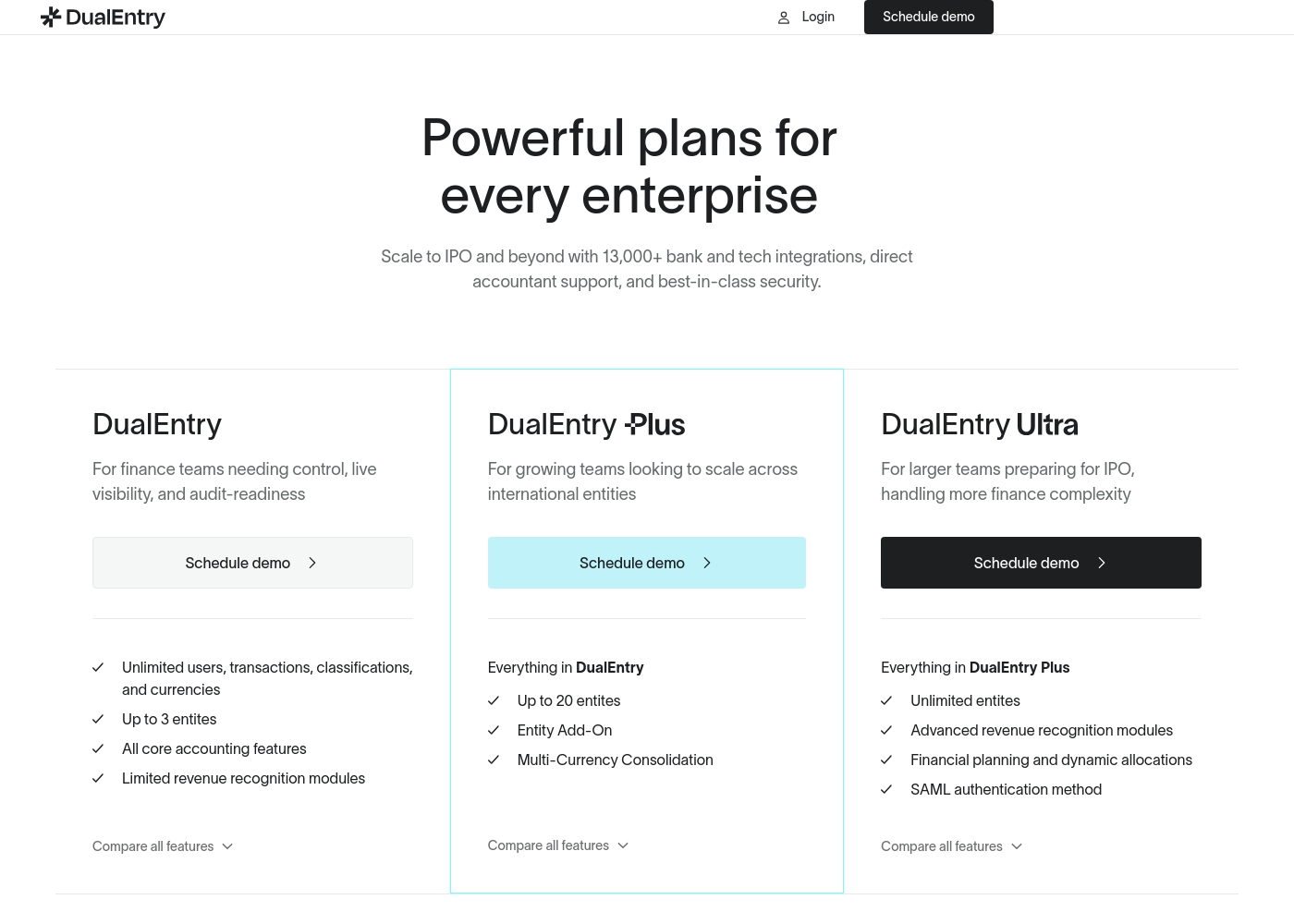
DualEntry scales through tiered plans: up to 3 entities on base, 20 on Plus, unlimited on Ultra. All plans include unlimited users and transactions. This is designed for growing multi-entity businesses. Odoo scales by adding users per month. Plans include all apps without feature limits. You can start with one app and expand to the full suite. This suits businesses of any size. DualEntry's scaling is entity-focused, ideal for financial complexity. Odoo's scaling is user-focused, ideal for adding more departments or locations.
Security & Compliance
DualEntry is certified SOC 2, PCI, CCPA, SSL, and IFRS/GAAP. Odoo's security is not detailed but is open source.
DualEntry emphasizes security with SOC 2, PCI, CCPA, and SSL certifications. It uses AES-256 encryption and supports IFRS/GAAP compliance. This is critical for regulated industries. Odoo's security is not explicitly detailed in the data. As an open-source platform, it relies on community and enterprise support. Data is stored in PostgreSQL format, but certifications aren't mentioned. For strict compliance needs, DualEntry is the safer bet. If you need open-source flexibility, Odoo may suffice but lacks clear security claims.
User Reviews & Sentiment
Odoo has strong user reviews (4.4/5), while DualEntry lacks accessible external reviews.
DualEntry's external reviews could not be accessed due to security errors. No user feedback is available to validate claims about reliability or support. The rating is 4.2/5. Odoo has a 4.4/5 rating with positive Trustpilot reviews. Users praise flexibility, speed, and support. Some note complex setup and unexpected costs. The sentiment is generally favorable. Odoo's reviews are more transparent and positive. DualEntry's unverified reviews are a risk. For user trust, Odoo wins.
DualEntry pricing: DualEntry provides enterprise-grade accounting software with three distinct tiers designed to scale with your business. While specific rates are available via custom quotes, all plans include unlimited users and transactions to support growth without penalty fees or extra costs for implementation support and training sessions with an accountant team member and more for you and your business and more and more and more more more more more more more more more more more more more more more more more more more more more more more more more more more more more more more more more more more more and more more more more and more and more more more and more more more more more more more more and more more more and more more more more more more more more more more more more more more more more more more more more more more more more more more more more more more more more more more more more and more more more more and more and more more more and more more more more more more more more and more more more more more more more more more more more more more more more more more more more more and more more more and more more more more more more more more more more more more more more more more more more more more more more more more more more more more more more more more more more more more more and more more more more and more and more more more and more more more more more more more more and more more more more more more more more more more more more more more more more more more more more and more more more and more more more more more more more more more more more more more more more more more more more more more more more more more more more more more more more more more more more more more and more more more more and more and more more more and more more more more more more more more and more more more more more more more more more more more more more more more more more more more more and more more more and more more more more more more more more more mo
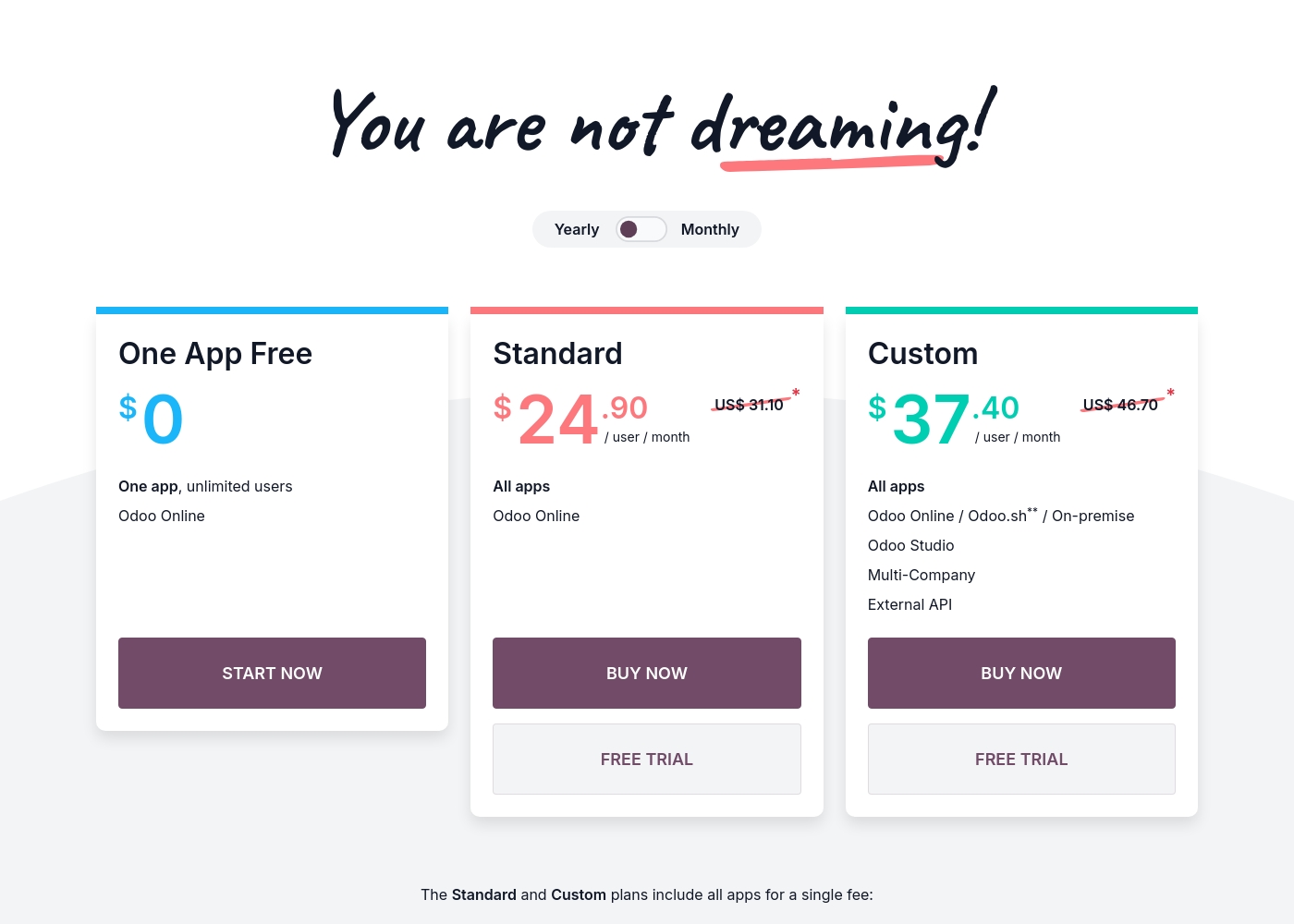
Odoo costs between $0 and $37.40 per user/month annually with three plans: One App Free at $0, Standard at $24.90, and Custom at $37.40.
These plans are designed to accommodate businesses of all sizes, offering scalable solutions based on your need for integrated apps and deployment flexibility.
One App Free
Price: $0 Best For: Small teams or individuals focusing on a single core operation. Other Features:
- One application included
- Unlimited users
- Hosted on Odoo Online
- One application included
- Unlimited users
- Hosted on Odoo Online
- Access to all apps
- Hosted on Odoo Online
- Unlimited support, hosting, and maintenance
- Access to all apps
- Odoo Studio
- Multi-Company support
- External API access
- Flexible hosting: Odoo Online, Odoo.sh, or On-premise
Pricing Head-to-Head
User Reviews
We attempted to gather user feedback from Trustpilot and Capterra, but both sources were currently inaccessible due to security verification errors, preventing the collection of specific review snippets. This means we cannot synthesize external sentiment or identify recurring themes like accuracy, ease of use, or support responsiveness from user reviews. 🤔 Without these concrete data points, our final assessment relies solely on the provided product information from DualEntry's website.
Odoo users generally praise the platform's flexibility and power, noting its ability to manage diverse business processes like invoicing, stock control, and subscriptions all in one integrated system. Many customers highlight the exceptional quality and responsiveness of the Odoo support team 🌟.
Reviewers often mention individual support members by name for providing timely, knowledgeable, and multilingual assistance, even to those on free plans. The system is frequently described as robust regarding cybersecurity, maintenance, and upgrades.
Thanks to Odoo, I can now manage all my processes through one single software. Having everything integrated helps save money by stopping the usage of other tools and also saves significant time. The system is very complete and flexible for our specific needs.
Our Verdict
For most businesses, Odoo wins as the more versatile, affordable, and well-reviewed option. It's the Swiss Army knife of business software. DualEntry shines if you're a finance team drowning in multi-entity spreadsheets. It automates accounting and cuts close time dramatically. Think 20 days down to 1. Odoo's superpower is its all-in-one ecosystem. It covers sales, inventory, accounting, and more with 40,000+ apps. It's like having your entire tech stack in one place. The deciding factor is your team's focus. If you need deep, automated accounting for multiple entities, choose DualEntry. If you need broad business tools with flexibility, choose Odoo. In short, pick DualEntry if you're a finance-heavy organization. Pick Odoo if you want a scalable, all-in-one platform for your whole business.
Frequently Asked Questions
Which is better for small teams: DualEntry or Odoo?
Odoo is better for small teams because it has a free plan with unlimited users. DualEntry requires a custom quote and is designed for finance teams at growing businesses.
Does DualEntry have a free trial like Odoo?
No, DualEntry does not offer a free trial. Odoo provides a free trial for Standard and Custom plans without needing a credit card.
Is Odoo worth the extra cost over DualEntry?
Odoo's Standard plan starts at $24.90/user/month, while DualEntry's pricing is custom. Odoo's value lies in its all-in-one suite; DualEntry's value is in deep financial automation.
Can I migrate from DualEntry to Odoo easily?
DualEntry handles data migration as part of its implementation. Moving to Odoo may require separate implementation services or Success Packs, as Odoo's setup is complex.
Which tool has better security: DualEntry or Odoo?
DualEntry is SOC 2, PCI, CCPA, and SSL certified with AES-256 encryption. Odoo's security isn't detailed, but it's open source and uses PostgreSQL.
Does Odoo support multiple entities like DualEntry?
Yes, but only in the Custom plan. DualEntry's core focus is multi-entity management with a unified view across all plans.
Ready to Choose?
Both tools have their strengths. Choose based on your specific needs.