DualEntry vs ERPNext
DualEntry and ERPNext are both top ERP systems, but they take very different approaches. DualEntry is built for fast, unified multi-entity finance, while ERPNext is a customizable, open-source powerhouse. Here's how to pick the right one for you.
Best for: Finance teams managing 3+ business entities, Companies needing to accelerate month-end close from 20 days to 1
Best for: Small businesses needing an affordable, open-source ERP starting at $5/month, Teams wanting to avoid per-user fees as they scale
Powerful but unproven at scale
We find DualEntry to be a comprehensive, AI-driven ERP solution aimed at simplifying multi-entity financial operations. Overall, it promises significant efficiency gains like faster closes and unified reporting, but the lack of accessible external user reviews prevents us from validating core claims about reliability, support, and real-world performance.
Pros
- Claims to unify multi-entity financials into a single view
- Promises AI-powered automation for tedious tasks like transaction categorization
- Advertises a dramatic reduction in month-end close time
- Offers 13,000+ native integrations to connect with existing tools
Cons
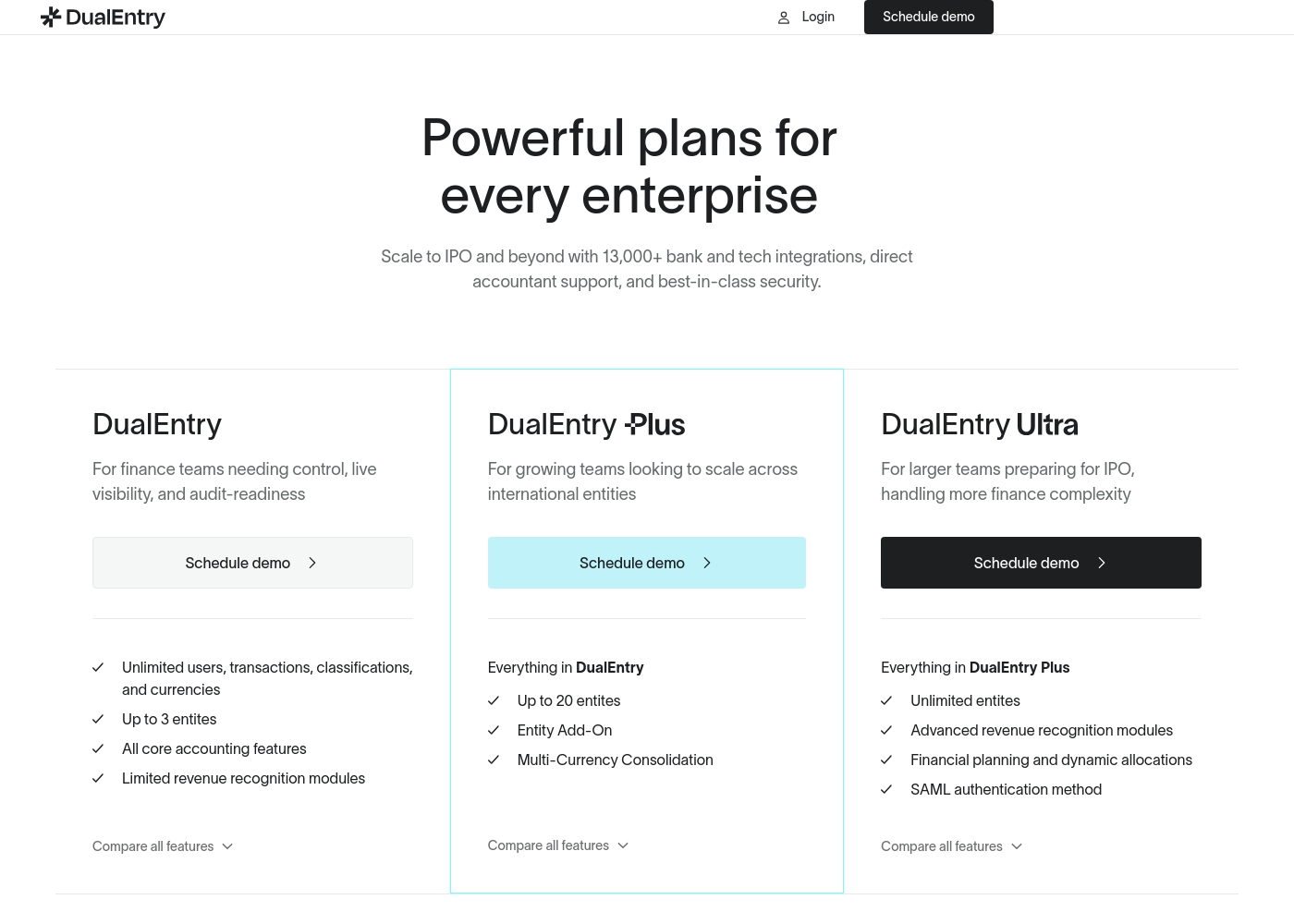
- Pricing is not transparent and requires a custom quote
- No accessible external user reviews to validate claims of reliability or support
- Specific details on implementation complexity or training are not provided
- The platform's actual performance and stability are unverified from user feedback
Flexible ERP, low total cost.
We find ERPNext to be an immensely powerful, open-source ERP solution that excels due to its lack of per-user fees and high customization capability. The platform handles complex enterprise needs, from manufacturing to multi-subsidiary accounting, offering remarkable flexibility compared to proprietary systems. Overall, it’s an outstanding value proposition, but organizations must weigh the reported inconsistencies in paid support against the potential cost savings.
Pros
- Open-source core software with high flexibility and no vendor lock-in.
- The pricing model excludes per-user fees, greatly reducing Total Cost of Ownership (TCO).
- Highly customizable platform adaptable to unique business workflows and needs.
- Supports complex functions like multi-currency accounting and handling global operations.
Cons
- Essential technical support often requires purchasing a separate, mandatory paid plan.
- Reliability issues reported, including unaddressed bugs created by the provider.
- Customer support response times can be significantly slow in critical cases.
- Enterprise deployments require budgeting for expensive dedicated servers ($200+/month).
AboutDualEntry
DualEntry is a modern, cloud-based ERP system built for finance teams, especially those handling multiple entities. 🧠 It's an all-in-one platform that consolidates your financial operations—from the general ledger and accounts payable to revenue recognition and reporting. It's designed for companies that have outgrown basic accounting software but need a more intuitive, integrated solution than traditional ERPs.
AboutERPNext
ERPNext is a powerful, comprehensive Enterprise Resource Planning (ERP) solution. It manages everything your business needs to operate and grow, including accounting, procurement, sales, manufacturing, and HR.
It works reliably out of the box across nearly every industry and country. Because it is completely open source, the software provides unmatched freedom and flexibility for customization. Over 30,000 companies have already adopted this robust solution. ✨
Highlights
Feature Comparison
Features Overview
We highlight the main differences and pick a winner for each feature.
User Interface
DualEntry emphasizes simplicity and speed for finance teams. ERPNext offers a comprehensive, customizable interface for all business functions.
DualEntry is designed to be seamless by design, with a focus on usability so your team can focus on the business. The platform promises a faster, friendlier ERP experience. ERPNext provides a comprehensive, modern interface that manages everything from accounting to manufacturing. Users can customize forms, reports, and dashboards with drag-and-drop simplicity. The key difference is focus. DualEntry prioritizes a clean, unified financial view, while ERPNext offers deep customization for diverse business processes. If your team needs a straightforward finance hub, DualEntry's simplicity wins. If you need to tailor the UI for sales, inventory, and HR, ERPNext's flexibility is unmatched.
Automation
DualEntry uses AI to automate financial tasks like categorization. ERPNext uses a low-code builder for custom process automation.
DualEntry automates tedious financial work with AI. It handles bank-fee automation, transaction categorization, and expense management. This frees up finance teams for strategic work. ERPNext provides a powerful low-code, no-code builder. You can automate complex tasks, build custom multi-level approval workflows, and tailor processes to your exact needs without writing code. DualEntry's AI focuses on finance-specific efficiency. ERPNext's automation is broader, covering any business process you need to streamline. For rapid financial automation, DualEntry is a strong choice. For building custom workflows across your entire operation, ERPNext's low-code tool is more versatile.
Reporting & Analytics
DualEntry provides real-time consolidated reports for multi-entity finance. ERPNext offers detailed reports across all business modules.
DualEntry gives you a single, unified view of all your entities in one place. You see the complete financial picture without stitching together reports from different systems. It provides granular reporting and KPI tracking. ERPNext offers comprehensive reporting and analytics across all its modules. You get detailed reports for accounting, inventory, manufacturing, sales, and more. The platform includes tools for financial statements, general ledgers, and stock ledger reporting. DualEntry's strength is consolidated financial reporting for multiple entities. ERPNext's strength is the breadth of reporting across all business functions. If your main need is cross-entity financial analysis, DualEntry excels. If you need deep analytics for manufacturing, sales, and HR, ERPNext covers more ground.
Mobile Experience
DualEntry's mobile capabilities are not specified. ERPNext states all modules are fully mobile-friendly.
DualEntry does not provide specific details about its mobile experience in the available data. The focus seems to be on a web-based platform for finance teams. ERPNext explicitly states that all its modules are fully mobile-friendly for use on any device. This means users can access accounting, CRM, inventory, and other functions from smartphones or tablets. The key difference is transparency. ERPNext confirms a mobile-ready design, while DualEntry's mobile features are unclear. If accessing your ERP on the go is critical, ERPNext has a stated advantage. DualEntry may lack a robust mobile offering.
Customer Support
DualEntry offers dedicated accountant support with multiple channels. ERPNext has free community resources but requires paid plans for priority support.
DualEntry includes dedicated accountant support as part of its service. Support is available via your dashboard, Slack/MS Teams, phone, video, email, or live chat. The implementation team also handles data migration. ERPNext offers free online documentation, video tutorials, and community forums for self-support. To get priority SLAs and faster response, you must purchase a paid support plan, which some users report is mandatory for resolving system bugs. DualEntry bundles support into its pricing, emphasizing a hands-on, accountant-led approach. ERPNext separates support as an add-on, which can lead to slower responses without a paid plan. For included, proactive support, DualEntry is more straightforward. ERPNext's support model may require extra budget and can be inconsistent without paid tiers.
Integration Ecosystem
DualEntry boasts 13,000+ native integrations. ERPNext uses an API-first approach for external connections.
DualEntry connects to over 13,000 other applications natively. This includes banks, payroll systems, and CRMs. An open API is also available for custom connections. This creates a connected ecosystem where data flows automatically. ERPNext is API-first, enabling seamless connections to external systems. It integrates easily with payment gateways like Stripe and PayPal, and e-commerce platforms such as Shopify and WooCommerce. You can also host it yourself to manage integrations. DualEntry's sheer number of native integrations is massive, promising compatibility with almost any tool. ERPNext's API-first approach offers flexibility but may require more setup for niche tools. If you need out-of-the-box connections to thousands of apps, DualEntry wins. If you prefer to build custom integrations via an open API, ERPNext is more adaptable.
Pricing Model
DualEntry uses tiered subscriptions with custom quotes. ERPNext offers free open-source software with managed hosting fees.
DualEntry pricing is not transparent; you must schedule a demo for a custom quote. All plans include unlimited users and transactions. The pricing ranges from $0 to $10,000. There is no free trial. ERPNext's core software is free and open-source. Managed hosting on Frappe Cloud starts at $5/month for Shared Hosting (small businesses) and $200/month for Dedicated Servers (enterprises). There are no per-user fees, so costs scale with infrastructure, not team size. A free trial is available for the Shared Hosting plan. The biggest difference is cost structure. DualEntry requires a custom quote and likely higher costs for its enterprise features. ERPNext is transparent and can be very affordable, especially if you self-host. If you want predictable, no-per-user pricing and flexibility, ERPNext is a strong value. If you prefer a bundled, implementation-included package, DualEntry's model may suit you, but you'll need to request pricing.
Learning Curve
DualEntry aims for a fast implementation with included training. ERPNext can require technical knowledge for self-hosting and customization.
DualEntry is designed for a fast implementation, with data ingested in 24 hours and live in 4-6 weeks. Implementation is included in all plans with no extra cost, and you get training sessions with an accountant team member. ERPNext's implementation time varies; small businesses often take 2-8 weeks. While you can self-setup with documentation, customizing it may require technical skills. Partner assistance or an SMB Success Pack is available for help. DualEntry focuses on a guided, hands-on onboarding process. ERPNext offers more self-service and community resources, which can be powerful but may require more technical know-how. For a guided, faster start with included support, DualEntry is more accessible. For teams comfortable with DIY or open-source customization, ERPNext offers deeper control.
Customization
ERPNext is highly customizable via its low-code builder and open-source code. DualEntry focuses on pre-built workflows and usability.
ERPNext is 100% open-source, giving you complete freedom to modify, customize, or even resell the software. The integrated low-code, no-code builder lets you automate tasks, build custom workflows, and tailor forms and reports with drag-and-drop simplicity. DualEntry provides a more structured, usability-focused platform. It offers configurable approval workflows and AI-powered automation, but customization details are less prominent. The focus is on a seamless, out-of-the-box experience. ERPNext's customization is deep and flexible, allowing for unique business processes. DualEntry's customization is more about fine-tuning a pre-built financial system. If you need to heavily tailor an ERP to complex, unique processes, ERPNext is unmatched. If you prefer a ready-to-use system with standard financial workflows, DualEntry is simpler.
Security
DualEntry highlights SOC 2, PCI, and encryption certifications. ERPNext relies on its open-source model and granular permissions.
DualEntry is built with security at every step. It is SOC 2, PCI, CCPA, and SSL certified. It uses AES-256 encryption and supports IFRS/GAAP compliance. This provides strong, audited security for financial data. ERPNext's security is based on its open-source model and granular roles and permissions. You can control who accesses or modifies critical data. While it doesn't list specific third-party certifications, its transparency allows for community security audits. DualEntry offers a clear, certified security framework, which is important for compliance-heavy finance. ERPNext's security is flexible and customizable but may require more internal setup. For guaranteed, certified security and compliance, DualEntry is more straightforward. ERPNext gives you control but may require more effort to ensure security standards.
Scalability
DualEntry scales with tiered plans and unlimited users. ERPNext scales via infrastructure and is open-source for unlimited growth.
DualEntry's plans scale with your business, from 3 entities on the base plan to unlimited on Ultra. All plans include unlimited users and transactions, so costs don't increase with team size. ERPNext scales through managed hosting or self-hosting. Since there are no per-user fees, your costs grow with infrastructure needs (CPU, storage) rather than users. The open-source model allows for unlimited customization and growth. Both tools avoid per-user fees, which is great for scaling teams. DualEntry's scaling is tied to entity count and plan tiers. ERPNext's scaling is more about technical infrastructure and customization. For predictable, finance-focused scaling, DualEntry's tiers are clear. For open-ended, technical scaling with full control, ERPNext offers more flexibility.
DualEntry pricing: DualEntry provides enterprise-grade accounting software with three distinct tiers designed to scale with your business. While specific rates are available via custom quotes, all plans include unlimited users and transactions to support growth without penalty fees or extra costs for implementation support and training sessions with an accountant team member and more for you and your business and more and more and more more more more more more more more more more more more more more more more more more more more more more more more more more more more more more more more more more more more and more more more more and more and more more more and more more more more more more more more and more more more and more more more more more more more more more more more more more more more more more more more more more more more more more more more more more more more more more more more more and more more more more and more and more more more and more more more more more more more more and more more more more more more more more more more more more more more more more more more more more and more more more and more more more more more more more more more more more more more more more more more more more more more more more more more more more more more more more more more more more more more and more more more more and more and more more more and more more more more more more more more and more more more more more more more more more more more more more more more more more more more more and more more more and more more more more more more more more more more more more more more more more more more more more more more more more more more more more more more more more more more more more more and more more more more and more and more more more and more more more more more more more more and more more more more more more more more more more more more more more more more more more more more and more more more and more more more more more more more more more mo
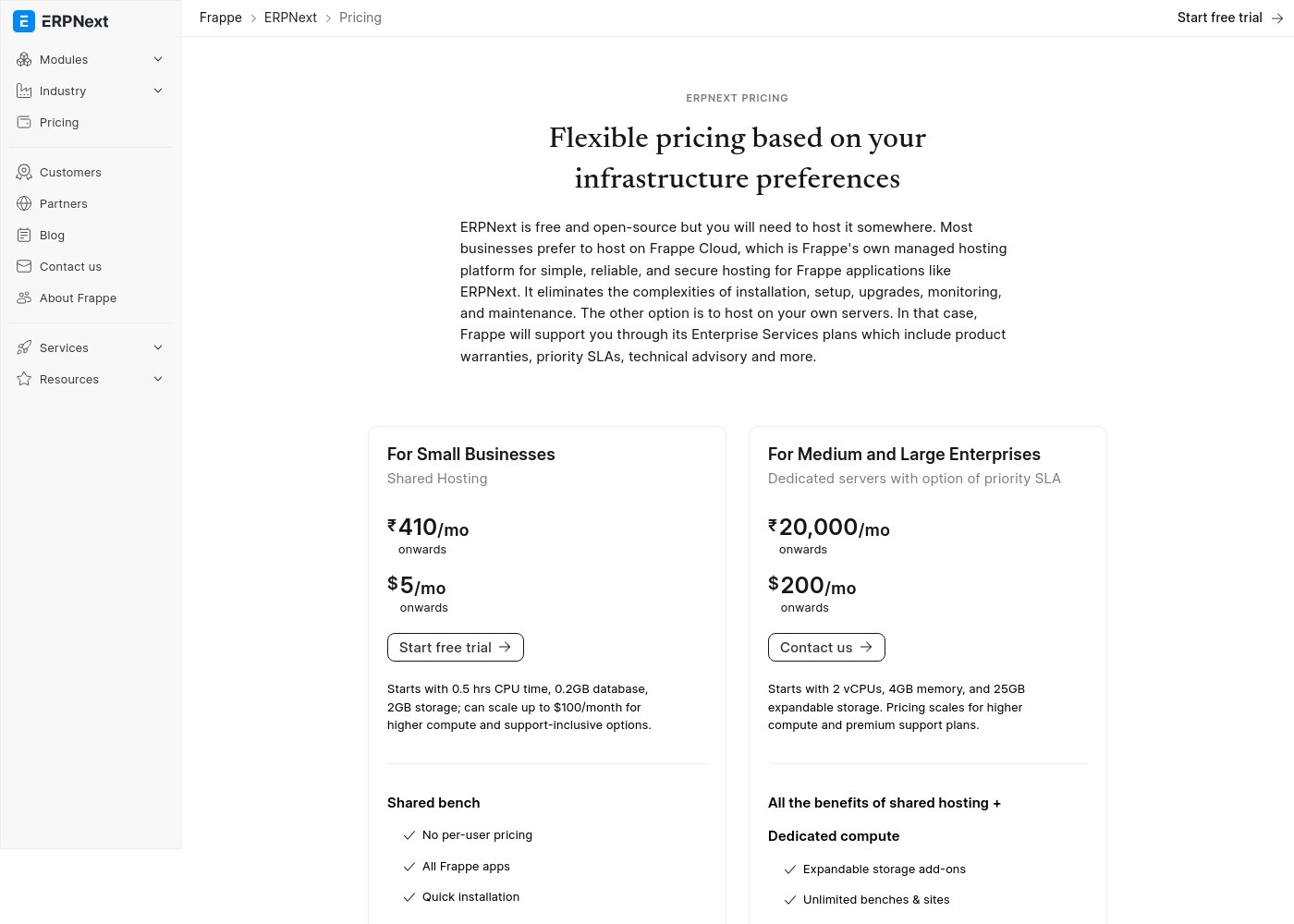
ERPNext managed cloud hosting costs between $5 and $200+ per month with two primary plans: Shared Hosting at $5/mo and Dedicated Servers at $200/mo.
These hosting plans offer flexible infrastructure tailored to fit different business sizes and technical needs.
Shared Hosting (For Small Businesses)
Price: $5/mo onwards Best For: Small Businesses Other Features:
- No per-user pricing
- Includes all Frappe apps
- Quick installation
- Starts with 0.5 hrs CPU time, 0.2GB database, and 2GB storage
- Scales up to $100/month for advanced support or compute
- No per-user pricing
- Includes all Frappe apps
- Quick installation
- 0.5 hrs CPU time, 0.2GB database, 2GB storage included
- All benefits of shared hosting + dedicated compute
- Expandable storage add-ons
- Unlimited benches & sites
- Starts with 2 vCPUs, 4GB memory, and 25GB expandable storage
Pricing Head-to-Head
User Reviews
We attempted to gather user feedback from Trustpilot and Capterra, but both sources were currently inaccessible due to security verification errors, preventing the collection of specific review snippets. This means we cannot synthesize external sentiment or identify recurring themes like accuracy, ease of use, or support responsiveness from user reviews. 🤔 Without these concrete data points, our final assessment relies solely on the provided product information from DualEntry's website.
User feedback highlights a sharp contrast in the ERPNext experience. On one hand, reviewers praise the system as an excellent, highly customizable suite for comprehensive business management, including accounting and project management.
Users found the well-designed, open-source platform successful in various business environments, like architecture firms and startups. This confirms the strong value proposition of free core software and flexible implementation.
This is an excellent, highly customizable suite for company management, accounting, and project needs. The platform is promising and well-designed. We have used it for about a year with much success in three different businesses.
Our Verdict
Here's the bottom line: DualEntry wins for multi-entity finance teams that need speed and simplicity. ERPNext is better if you want a full, customizable business suite. DualEntry's superpower is unified, AI-driven finance. It brings all entities into one view and uses AI to automate categorization and bank fees. Customers report cutting close time from 20 days to just one. ERPNext's superpower is its open-source flexibility. It covers accounting, manufacturing, sales, and HR in one system. With no per-user fees and a low-code builder, you can customize it without breaking the bank. The deciding factor is your core need. If your main pain is disjointed financials and slow closes, pick DualEntry. If you need a full ERP you can tailor to any business process, choose ERPNext. For most finance-led teams with multi-entity complexity, DualEntry is the focused choice. For growing businesses wanting a flexible, cost-effective all-in-one system, ERPNext is the winner.
Frequently Asked Questions
Which is better for small teams: DualEntry or ERPNext?
ERPNext is better for small teams on a budget, starting at $5/month with no per-user fees. DualEntry requires a custom quote and is geared more toward mid-market finance teams.
Does DualEntry have manufacturing features like ERPNext?
No, DualEntry focuses on multi-entity finance and accounting. ERPNext includes a full manufacturing module with Bills of Materials and production planning.
Is ERPNext worth the extra cost over DualEntry?
ERPNext's open-source core is free, but managed hosting costs $5-$200+/month. DualEntry's pricing is custom but may be higher for enterprise features. ERPNext offers more business modules for the cost.
Can I migrate from DualEntry to ERPNext easily?
Migration complexity depends on your data. DualEntry includes data migration in its implementation. ERPNext migration would require planning, but its open-source model gives you full control over data.
Does ERPNext charge per user like DualEntry?
Neither tool charges per user. DualEntry includes unlimited users on all plans. ERPNext has no per-user fees; its costs are based on infrastructure for managed hosting.
Which tool has better customer support?
DualEntry includes dedicated accountant support with multiple channels. ERPNext offers free community resources, but priority support requires a paid plan, which users report can be inconsistent.
Ready to Choose?
Both tools have their strengths. Choose based on your specific needs.