Demio vs Livestorm
Demio and Livestorm are top webinar platforms, but they cater to different priorities. Demio is obsessed with conversions and tracking specific lead actions. Livestorm focuses on security, team scale, and ultra-accessible browser-based hosting. Your choice hinges on technical stability versus maximum lead data.
Best for: Marketing teams prioritizing conversion analytics and lead intent tracking, Businesses focused purely on automated, evergreen lead generation
Best for: Organizations requiring strict GDPR and ISO security compliance, Large corporations requiring unlimited licenses for internal training/meetings
Powerful Engagement Features, Needs Reliability Improvements.
We note Demio's strong focus on engagement tools and comprehensive analytics designed to pinpoint conversion opportunities for revenue teams. However, we cannot overlook multiple serious reports detailing critical reliability failures, such as technical issues with core hardware and abrupt session terminations. Overall, Demio offers excellent lead generation capabilities but users must weigh this against potential operational instability during live events.
Pros
- Generates leads continuously using automated and on-demand events.
- Deep analytics track attendee intent (polls, downloads) for pipeline segmentation.
- Interface is simple and intuitive, allowing quick event setup (under 30 minutes).
- Focuses on driving conversions using embedded interactive tools like featured actions.
Cons
- Frequent critical technical instability (microphone/camera recognition failure).
- Reliability issues that can cause total session disruption or accidental termination.
- Users report difficulty with compatibility (e.g., Safari browser, Bluetooth devices).
- Customer support and refund policy are reported as unhelpful or punitive.
Comprehensive Webinar Tool, Complex Pricing.
We find Livestorm provides a robust, browser-based platform ideal for businesses needing strong data security and high automation capacity. The feature set is excellent, but we must note the recurrent serious concerns regarding subscription policies and dramatic, unannounced price hikes. Overall, Livestorm is a powerful tool with significant financial risk flags for long-term users.
Pros
- All-in-one browser-based platform (no software installation required).
- Strong data security (EU hosted, ISO 27001, GDPR compliant).
- Efficient automations and smooth event management processes.
- Good user experience delivers high attendance duration.
Cons
- Reports of sudden, major price increases for loyal customers (up to 350%).
- Rigid and unfriendly subscription/cancellation policies noted by users.
- Reliability issues reported, including constant freezing and delays.
- Video streaming quality is sometimes poor, especially for presenters.
AboutDemio
Demio is an all-in-one webinar platform focused on maximizing revenue and simplifying the hosting experience. It moves beyond standard virtual events to offer powerful tools designed specifically for business growth. You can easily automate events, capture essential lead data using custom registration fields, and make your brand highly memorable. This platform allows you to use your logo and color palette across the dedicated registration page, email notifications, and even the webinar room.
Demio is built to take the worry out of hosting. The user interface is simple and intuitive, ensuring you can rely on the platform to ‘just work’ so you can focus only on your content. Marketers use it to improve lead generation, Sales uses it to automate demos, and Customer Success uses it to retain customers and reduce churn. ✅
AboutLivestorm
Livestorm is a powerful, unified platform offering dynamic discussions for any kind of online event. It is designed to be the webinar leader, ready for immediate use. You access Livestorm right through your browser, which means there is no software to install and no credit card required to start. This accessibility ensures you can achieve maximum participation every time. This platform serves thousands of customers, scaling easily from startups to large enterprises.
Highlights
Feature Comparison
Features Overview
We highlight the main differences and pick a winner for each feature.
Platform Reliability
Demio faces recurrent user reports of critical mic/camera hardware failures. Livestorm’s reported issues are generally less catastrophic during live events.
Demio users frequently report severe glitches preventing them from starting sessions properly. Many testimonials describe microphone and camera recognition failures mid-stream, ruining events. The interface is simple, but the core technical stability of Demio seems highly suspect based on reviews. Livestorm also has stability issues, but reviews cite 'constant freezes and delays' rather than total session failure. Livestorm’s reliability concerns often center on presenter video quality being sub-optimal. Choosing Livestorm means accepting minor glitches, while Demio users risk critical event termination. For high-stakes events, Livestorm appears to be the safer operational choice. Demio needs to address these recurring technical failures to match the operational expectations of its users.
Pricing Structure
Demio charges per Host, complicating multi-event scheduling; Livestorm charges per Active Contact annually.
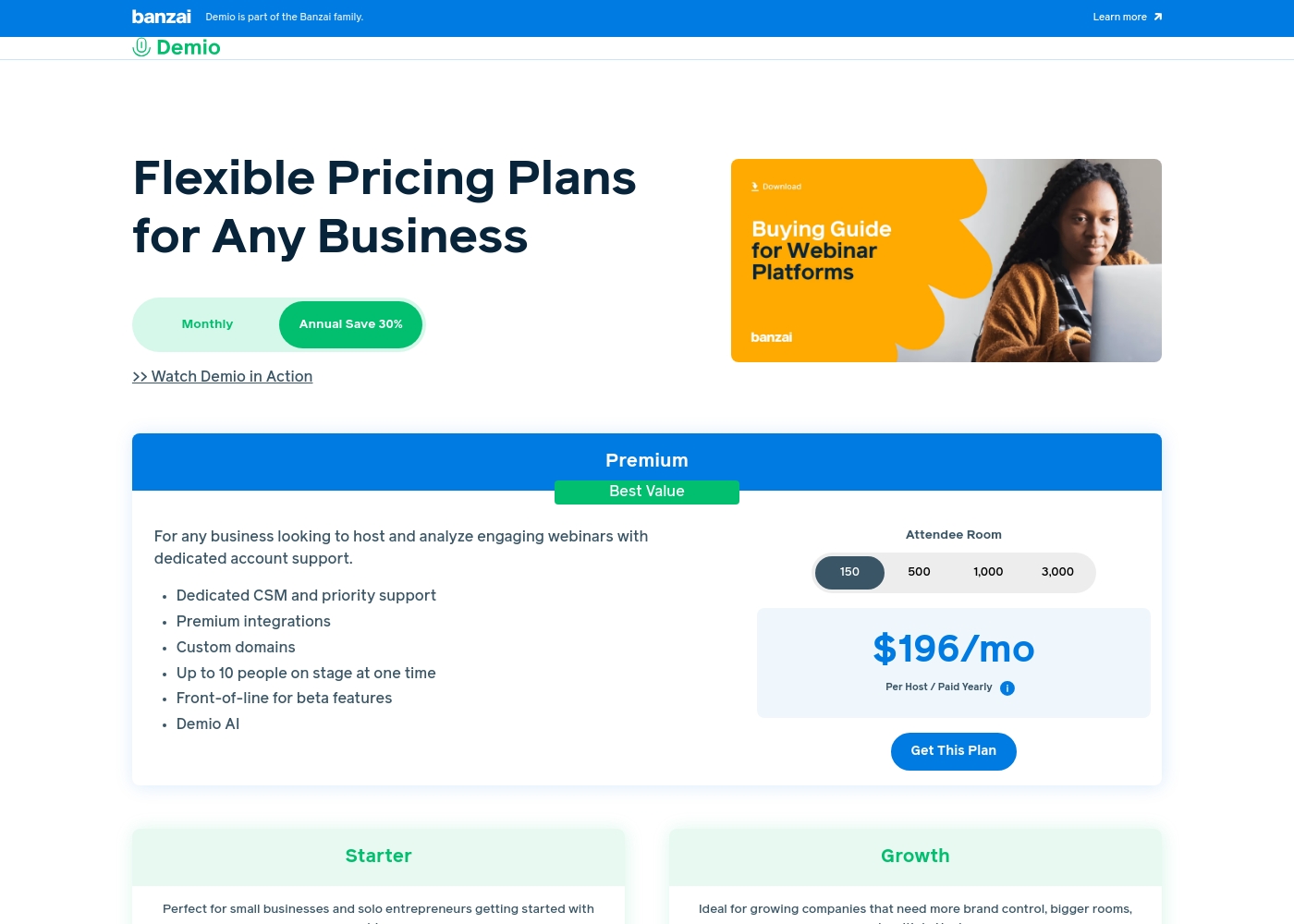
Demio uses a per-Host model starting at $45/month annually for the Starter plan. If you need two events live simultaneously, you must purchase a separate host license for Demio. Demio’s cost scales up based on the required room size, which can hold up to 3,000 attendees. Livestorm uses a usage-based 'Active Contacts' quota and offers unlimited team members. This means your Livestorm price scales only with the number of unique attendees across a year, not internal staff. The Livestorm model is attractive for large internal teams but requires careful monitoring of contact usage. However, Livestorm users strongly warn of unpredictable, massive price increases upon renewal. Demio’s pricing model is simpler but restricts team access based on licenses.
Scaling & Licensing
Livestorm provides unlimited team members on paid plans. Demio restricts team size based on host licenses and event administrators.
Livestorm offers a substantial advantage by including unlimited team members on all paid plans. This is perfect for large organizations with many staff who need access to hosting or managing events. Your cost with Livestorm only increases if you exceed your annual active contact quota. Demio is structured around the Host license, requiring purchase for each simultaneous event. While Demio allows up to 50 Event Admins on the Premium plan, Host licensing limits who can run the actual session. If you plan to onboard many employees or departments for training, Livestorm is the clear winner. Demio’s host-based licensing creates internal bottlenecks if multiple teams need to conduct webinars. For pure internal staff enablement, Livestorm’s unlimited seats make budget planning far easier than Demio’s restrictive model.
Security & Compliance
Livestorm is explicitly GDPR compliant and ISO 27001 certified. Demio does not publicly highlight these critical certifications.
Livestorm provides a strong foundation for businesses requiring high data governance standards. Livestorm is securely hosted within the European Union (EU) and is ISO 27001 certified by design. Large enterprises can rely on Livestorm for advanced security reviews and optional SAML SSO authentication. Demio focuses heavily on marketing and engagement tools but does not detail its specific regulatory compliance in the provided data. This lack of explicit certification can be a red flag for companies with strict data handling requirements. For organizations in heavily regulated industries or those concerned with EU data privacy, Livestorm is the safer choice. Livestorm clearly prioritizes enterprise-level data security and compliance. Demio users are left needing to confirm data residency and specific compliance levels themselves.
Lead Conversion Analytics
Demio provides deeply granular analytics on specific lead intent actions. Livestorm offers comprehensive reporting but is less focused on behavioral tracking.
Demio is specifically designed to maximize revenue and offers robust engagement analytics. It tracks exactly which individuals downloaded handouts or participated in polls during the live event. This behavioral data lets Demio users segment 'hot' leads ready for immediate sales follow-up. Livestorm provides detailed contact profiles and participation reports covering source tracking. However, Livestorm's focus is broader, covering full event management and efficiency. Livestorm reporting is comprehensive but lacks Demio’s dedicated behavioral intent markers. If your primary goal is generating qualified, prioritized sales leads, Demio offers superior tracking tools. Demio's analytics translate directly into funnel segmentation and priority outreach. Livestorm’s analytics often require more manual interpretation to determine purchasing intent.
Free Access Options
Livestorm provides a lifetime Free Plan to test core features. Demio only offers a time-limited 14-day free trial of their Growth plan.
The Livestorm Free Plan is available indefinitely, allowing up to 30 active contacts per month. This lets users test core features, though sessions are restricted to a maximum of 20 minutes each. This is an excellent way to host quick, small events at no cost. Demio offers a 14-day free trial that unlocks many Growth features, including premium integrations. The Demio trial is valuable for testing advanced tools, but it expires quickly. Demio requires moving to a paid plan immediately after this period. For small businesses testing the waters without immediate commitment, Livestorm's free-for-life model is far more user-friendly. Demio forces users into a buying decision after just two weeks.
These plans are tailored to varying business needs, particularly based on required attendee capacity and advanced features.
Starter
Price: $45/mo (Paid Yearly) or $63/mo (Paid Monthly) Best For: Small businesses and solo entrepreneurs getting started with webinars. Other Features:
- Single Host limit
- 50 Attendee Room capacity
- 3-Hour Session Limit
- Standard Support
- 4 people on stage
If you're running webinars for a smaller audience and only need a single host to manage events, the Starter plan is a great fit. It offers essential features like engagement tools and standard support to help you begin building your webinar strategy. This tier is excellent for testing the waters without major commitment.
- Standard Support
- Engagement Analytics
- Live & Event Series
- Pre-Recorded On-Demand and Automated Webinars
- Custom Room & Email Branding
- Priority Support
- Custom Form Fields
- Registration Source Tracking
- Sync Events with Showcase (limited to 2)
- Premium Integrations
- Dedicated CSM
- Priority Support
- Premium Integrations
- Custom Domains
- Front-of-Line for Beta Features
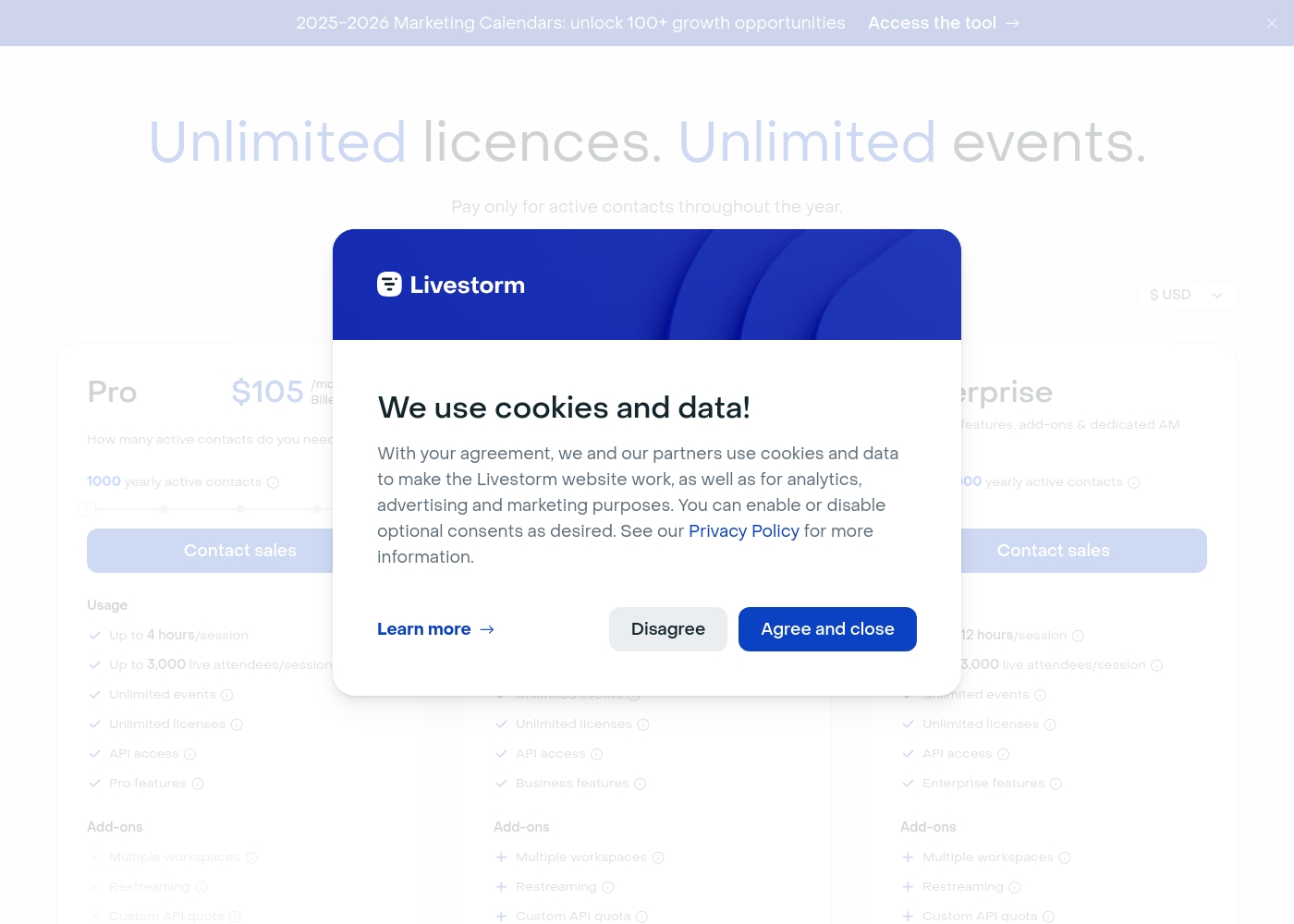
Livestorm costs between $0 and $105+ per month with four plans: Free at $0, Pro at $105/month (when billed annually), Business at Contact sales, and Enterprise at Contact sales.
Livestorm pricing is based primarily on your required annual quota of "Active Contacts." Here is a breakdown of what you get with each plan.
Free
Price: $0 Best For: Testing the platform or small, quick events Other Features:
- Up to 30 active contacts/month
- 20 minutes maximum per session
- Up to 30 live attendees
- Unlimited team members
- Email support only
- Up to 30 active contacts/month
- 20 minutes maximum per session
- Up to 30 live attendees
- Unlimited team members
- Email support only
- 1,000 yearly active contacts included
- Up to 4 hours per session
- Up to 3,000 live attendees
- Unlimited events and licenses
- Standard Support
- From 10,000 yearly active contacts
- Up to 4 hours per session
- VIP Support
- Dedicated Account Manager and VIP onboarding
- Custom data extracts & dashboards
- From 10,000 yearly active contacts
- Up to 12 hours per session
- VIP Support & SLA
- Advanced Enterprise features
- Access to Technical Solution Partners
Pricing Notes
- Livestorm uses the confusing 'Active Contacts' model, charging based on unique annual attendee quotas.
- Demio's pricing is host-based, requiring additional Host licenses for simultaneous events.
- Livestorm users strongly report massive, sudden price increases (up to 350%) upon renewal.
- Demio's lowest advertised rate ($45/mo Starter) is limited to 50 attendees and requires annual commitment.
- Livestorm offers a Free plan forever; Demio only offers a 14-day trial.
Pricing Head-to-Head
User Reviews
Demio markets itself as an intuitive, reliable solution focused on maximizing revenue through deep analytics. However, user reviews often focus heavily on significant technical instability.
Users frequently report that the platform fails to consistently recognize essential hardware like microphones and cameras, requiring stressful mid-session troubleshooting. Several users noted severe glitches, leading to critical meeting failures, including one instance where a host accidentally terminated the live session for all attendees.
This product often fails to recognize my microphone, requiring troubleshooting during live streams. I missed an important interview because of this, and they refused to offer any kind of refund.
The feedback for Livestorm is notably polarized, primarily focusing on pricing structure and technical reliability. Many users praise the platform's ease of use, describing it as a "good all around webinar software" with great design and efficient automations that help save time ⏱️.
Long-term users particularly value the streamlined invitation process and consistent performance for B2B organizations. However, the negative reviews are very strong, centered mostly on cost and customer service policies.
I use Livestorm at least twice weekly for customer outreach. It works reliably for me and has been great for reaching customers across Sweden. I have used the service for over three years consistently.
Our Verdict
Choosing between Demio and Livestorm is a choice between sophisticated lead tracking and operational stability. For most businesses, Livestorm edges out Demio due to its superior reliability and flexible scaling model. Livestorm’s browser-based accessibility and security compliance are massive wins. It is also suitable for internal training due to unlimited team members. Demio’s superpower lies in its dedication to lead conversion tracking and automation. If you need to monitor exactly who clicked a link or downloaded a specific handout, Demio provides the depth. Demio streamlines the setup process if you value speed and powerful conversion tools above all else. Livestorm is the better, safer choice for scaling and enterprise stability, despite the pricing model risks. Livestorm offers explicit GDPR compliance and unlimited seats for staff enablement. The maximum session time for Livestorm is 12 hours versus 10 hours for Demio. The deciding factor should be technical assurance: Demio users report constant, critical hardware failures during live events. Livestorm is simply more reliable during high-stakes sessions. If you cannot afford a microphone failure mid-demo, avoid Demio. Final verdict: Choose Livestorm if you are a large, security-conscious team or prioritize reliable hosting. Pick Demio if automated lead generation and deep behavioral conversion tracking are critical to your marketing success.
Frequently Asked Questions
Which is better for small teams: Demio or Livestorm?
Livestorm offers a Free Plan forever and unlimited team members, making it budget-friendly for small teams. Demio offers a 14-day trial, and its lowest plan is $45/mo for one host. If you host many short events, Livestorm is the low-cost solution.
Does Demio have security features like Livestorm?
Livestorm is ISO 27001 certified, GDPR compliant, and hosted in the EU. Demio does not publicly state these specific high-level compliance features. For maximum data security assurance, Livestorm is the clear winner.
Which tool is better for tracking lead intent during webinars?
Demio is superior for tracking lead intent. Demio provides specific analytics showing precisely who downloaded a handout or participated in a poll. This allows Demio users to prioritize 'hot' leads immediately post-event.
Is Livestorm worth the extra cost over Demio's Starter plan?
Livestorm's value is in reliability and team scale. Livestorm's user reports of critical hardware failures are less frequent than Demio’s. If you need unlimited staff access and longer, more reliable sessions, Livestorm justifies its price.
How does Livestorm's Active Contact pricing compare to Demio's Host pricing?
Demio charges per Host, which limits simultaneous events unless you pay for more licenses. Livestorm charges based on your annual quota of unique attendees. Livestorm excels for large, multi-department teams; Demio is better for single hosts.
Which platform offers the longest session duration?
Livestorm offers a longer maximum session for Enterprise users, allowing up to 12 hours. Demio’s maximum session time on the Premium plan is currently 10 hours. Both significantly surpass the standard 60-minute limit.
Ready to Choose?
Both tools have their strengths. Choose based on your specific needs.