Databox vs DualEntry
Databox and DualEntry tackle very different problems, but teams often compare them. Databox is an AI analytics platform for business performance, while DualEntry is a modern ERP for finance. The choice boils down to whether you need data insights or financial operations.
Best for: Marketing teams needing real-time campaign performance analysis, Agencies automating client reporting with live dashboards
Best for: Finance teams managing multiple business entities, Companies needing to accelerate month-end close processes
Smart AI analytics for growing teams.
We found Databox is a capable BI platform that connects to many data sources and uses AI to explain performance. Overall, it's a strong choice for teams needing fast, actionable insights from their data, especially with its unlimited user model.
Pros
- AI-powered Genie provides instant, plain-English answers to data questions.
- Connects to 130+ data sources, creating a single source of truth.
- Unlimited users and dashboards on all paid plans, removing seat-based costs.
- Offers a free plan and a 14-day trial for paid tiers.
Cons
- Pricing starts at $159/month for paid plans, which may be high for small budgets.
- Advanced features like white-labeling are available as paid add-ons.
- Limited external review data was accessible for a full sentiment check.
- The platform's depth might require an onboarding period for full adoption.
Powerful but unproven at scale
We find DualEntry to be a comprehensive, AI-driven ERP solution aimed at simplifying multi-entity financial operations. Overall, it promises significant efficiency gains like faster closes and unified reporting, but the lack of accessible external user reviews prevents us from validating core claims about reliability, support, and real-world performance.
Pros
- Claims to unify multi-entity financials into a single view
- Promises AI-powered automation for tedious tasks like transaction categorization
- Advertises a dramatic reduction in month-end close time
- Offers 13,000+ native integrations to connect with existing tools
Cons
- Pricing is not transparent and requires a custom quote
- No accessible external user reviews to validate claims of reliability or support
- Specific details on implementation complexity or training are not provided
- The platform's actual performance and stability are unverified from user feedback
AboutDatabox
Databox is a business intelligence and analytics platform built for teams that need clear, trusted answers fast. It connects directly to over 130 tools you already use, like CRMs and marketing platforms, and turns that data into shared metrics, dashboards, and AI-powered insights. Whether you're a marketing lead, a business analyst, or an agency owner, it's designed to help you understand performance without the technical headaches.
AboutDualEntry
DualEntry is a modern, cloud-based ERP system built for finance teams, especially those handling multiple entities. 🧠 It's an all-in-one platform that consolidates your financial operations—from the general ledger and accounts payable to revenue recognition and reporting. It's designed for companies that have outgrown basic accounting software but need a more intuitive, integrated solution than traditional ERPs.
Highlights
Feature Comparison
Features Overview
We highlight the main differences and pick a winner for each feature.
AI-Powered Analysis
Databox's AI answers business questions in plain English. DualEntry's AI automates financial tasks.
Databox features Genie, the AI Analyst, who provides clear answers to questions about sales, marketing, and performance in seconds. You ask in plain English, and it explains what's happening and why. This helps teams move from data to decisions instantly without digging through reports. DualEntry uses AI for transaction categorization, anomaly detection, and automating bank fees. It learns from your data to handle routine accounting tasks. The goal is to free finance teams from repetitive data entry. The key difference is focus. Databox's AI is for business insights and performance analysis. DualEntry's AI is for automating financial operations and accounting workflows. For a marketing lead needing campaign insights, Databox's AI is a game-changer. For a finance team drowning in manual reconciliations, DualEntry's automation is more impactful.
Integration Ecosystem
Databox connects to 130+ business tools. DualEntry boasts 13,000+ native financial integrations.
Databox offers direct connections to over 130 tools like CRMs, marketing platforms, and analytics. It creates a single source of truth by standardizing metrics across sources. You can have a live dashboard in minutes with its 300+ templates. DualEntry provides over 13,000 native integrations, primarily with banks and financial systems. It's designed to link to the existing tools a finance team uses, creating a connected ecosystem where data flows automatically. An open API is also available. The scale is different. Databox focuses on a curated set of high-impact business data sources. DualEntry has a massive, specialized library for financial connectivity. If your main goal is consolidating marketing and sales data, Databox is sufficient. If you need deep, automatic connections to thousands of banks and financial applications, DualEntry is more comprehensive.
Multi-Entity & Financial Operations
Databox is not designed for financial operations. DualEntry is built specifically for multi-entity financial management.
Databox is a business intelligence platform. It does not offer features like a general ledger, accounts payable, or revenue recognition. Its strength is in analyzing performance data from various sources, not managing financial transactions or entity consolidation. DualEntry is a modern ERP that unifies all financial operations for multiple entities. It provides a single, unified view, a full general ledger, automated bank-fee processing, and streamlined expense management. It's built to handle complex accounting needs. This is the core differentiator. Databox analyzes data; DualEntry manages financial operations. If you're a marketing agency needing to report on campaign performance for clients, Databox is perfect. If you're a company with 20 entities needing to close books quickly and manage revenue, DualEntry is the necessary tool.
Ease of Setup & Use
Databox offers self-service setup in minutes. DualEntry requires a hands-on, accountant-led implementation.
Databox is designed for self-service. You can connect data sources and build dashboards in minutes using templates. The AI helps non-technical users explore data. Implementation is fast, with minimal disruption. DualEntry involves a structured implementation process. Data can be ingested in 24 hours, but the system is typically live within 4-6 weeks. It includes dedicated accountant support for training and setup. It's not a self-service tool. The trade-off is speed vs. depth. Databox gets you insights quickly. DualEntry is a more complex system requiring professional onboarding. For a small team wanting to see data fast, Databox wins. For a finance team needing a robust, compliant ERP, DualEntry's thorough implementation is appropriate.
Reporting & Analytics
Databox excels at business performance dashboards and analytics. DualEntry provides financial reporting and KPI tracking.
Databox offers over 300 pre-built dashboard templates for marketing, sales, and more. You can create stunning visualizations without technical skills. It includes goal-setting, OKR tracking, and performance alerts to move from insight to action. DualEntry focuses on financial reporting and KPI tracking. It provides granular reporting across entities and real-time visibility into cash flow. Its features are centered on accounting accuracy and compliance, not business performance metrics. Databox's reporting is about business strategy and performance. DualEntry's reporting is about financial health and compliance. If you need to answer "How did our marketing campaigns perform?" Databox is built for that. If you need to answer "What is our consolidated revenue across all entities?" DualEntry is the right tool.
Pricing Model & Transparency
Databox has published tiers with a free plan. DualEntry uses custom quotes with no free trial.
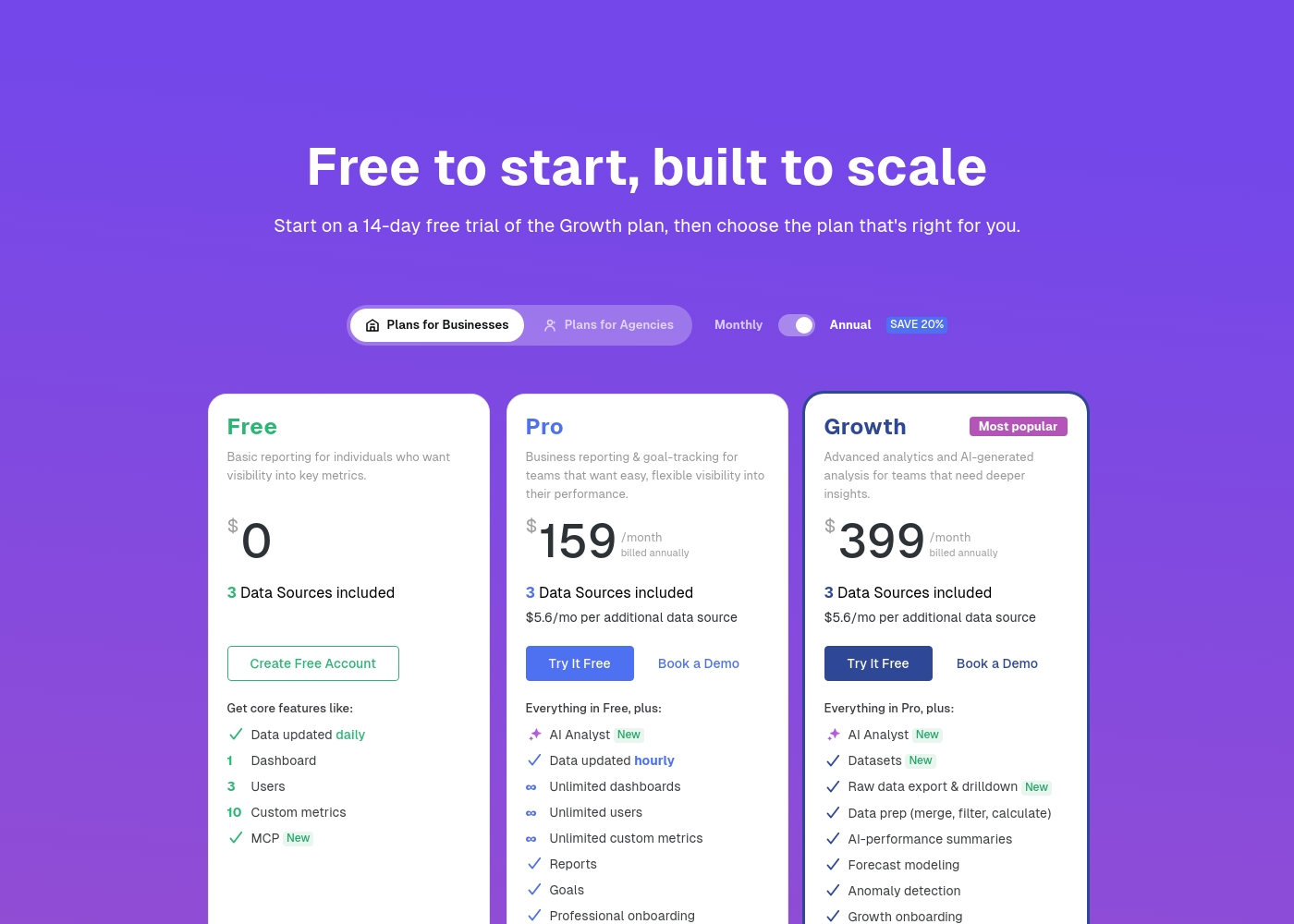
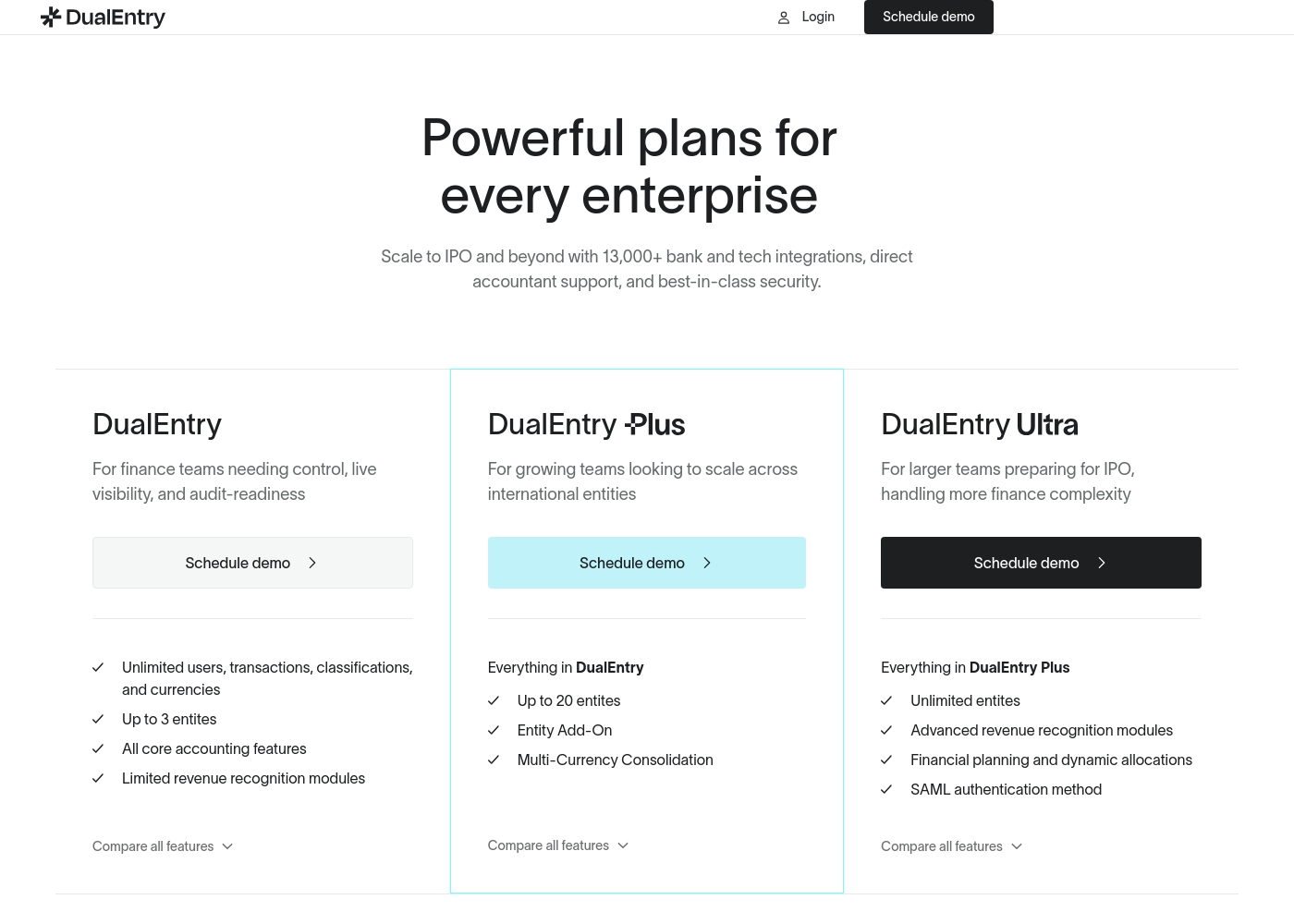
Databox pricing ranges from $0 to $8,230. It offers a forever-free plan and three paid tiers starting at $159/month (annually). All paid plans include unlimited users and dashboards. A 14-day free trial is available. Extra data sources are billed per month. DualEntry pricing ranges from $0 to $10,000 but requires custom quotes. All plans include unlimited users and transactions. There is no free trial. Implementation is included at no extra cost. Pricing is not transparent upfront. Databox is more accessible and transparent. DualEntry is an enterprise purchase requiring a sales conversation. For a budget-conscious team or one wanting to start small, Databox's free plan and clear pricing are better. For a larger organization ready to invest in an ERP, DualEntry's custom model may be standard.
Customer Support
Both offer support, but DualEntry provides more channels including dedicated accountant support.
Databox includes access to support via chat and a help center on all plans. The Premium plan includes priority support. There are add-ons for custom setup and dedicated support, but no specific SLA is stated on their website. DualEntry offers support via Slack/MS Teams channels, phone, video, email, or live chat. Dedicated accountant support is part of the service. This is a more comprehensive, multi-channel approach. DualEntry's support seems more robust and specialized for financial teams. Databox's support is adequate but less detailed in the provided data. If you need immediate, multi-channel help with complex financial issues, DualEntry's support structure is stronger. For general analytics questions, Databox's chat and help center may suffice.
Scalability
Both tools scale with unlimited users, but in different ways.
Databox scales by adding data sources and advanced features on higher plans. All paid plans include unlimited users and dashboards, so growing teams aren't penalized. It's built to grow from a free plan to enterprise needs. DualEntry scales by entity count. The base plan supports up to 3 entities, Plus supports 20, and Ultra offers unlimited. Unlimited users and transactions are included on all plans. It's designed for businesses growing in complexity and entity structure. Databox scales for data volume and user access. DualEntry scales for business entities and financial complexity. For a marketing agency with 50 analysts but a single entity, Databox's unlimited users are key. For a corporation with 15 subsidiaries, DualEntry's entity-based scaling is essential.
Databox pricing: Databox offers a forever-free plan and three paid tiers starting at $159/month when billed annually. Pricing is based on data features and bundled data sources, with a 20% discount on yearly subscriptions.
All paid plans include unlimited users and dashboards, but extra data sources are billed based on a per-source monthly fee. A 14-day free trial is available for all new users to explore the full-featured platform before committing to a paid plan.
Professional, Growth, and Premium tiers ensure high scalability for teams of any size by removing seat-based pricing and offering advanced analytics, AI-powered reports, and business intelligence features regardless of team complexity or user count. For even more power, you can also add on specialized services like OKRs and white-labeling to truly customize your dashboard experience for your organization or clients' needs and brand standards through their flexible dashboard portal.
DualEntry pricing: DualEntry provides enterprise-grade accounting software with three distinct tiers designed to scale with your business. While specific rates are available via custom quotes, all plans include unlimited users and transactions to support growth without penalty fees or extra costs for implementation support and training sessions with an accountant team member and more for you and your business and more and more and more more more more more more more more more more more more more more more more more more more more more more more more more more more more more more more more more more more more and more more more more and more and more more more and more more more more more more more more and more more more and more more more more more more more more more more more more more more more more more more more more more more more more more more more more more more more more more more more more and more more more more and more and more more more and more more more more more more more more and more more more more more more more more more more more more more more more more more more more more and more more more and more more more more more more more more more more more more more more more more more more more more more more more more more more more more more more more more more more more more more and more more more more and more and more more more and more more more more more more more more and more more more more more more more more more more more more more more more more more more more more and more more more and more more more more more more more more more more more more more more more more more more more more more more more more more more more more more more more more more more more more more and more more more more and more and more more more and more more more more more more more more and more more more more more more more more more more more more more more more more more more more more and more more more and more more more more more more more more more mo
Pricing Head-to-Head
User Reviews
We found external review snippets were blocked by security checks on both Trustpilot and Capterra, preventing us from gathering specific user feedback from these sources. Therefore, our assessment is based solely on the provided website content and pricing information, which highlights key features like AI-powered analytics, extensive integrations, and unlimited users on paid plans.
We attempted to gather user feedback from Trustpilot and Capterra, but both sources were currently inaccessible due to security verification errors, preventing the collection of specific review snippets. This means we cannot synthesize external sentiment or identify recurring themes like accuracy, ease of use, or support responsiveness from user reviews. 🤔 Without these concrete data points, our final assessment relies solely on the provided product information from DualEntry's website.
Our Verdict
This isn't a fair fight. Databox and DualEntry solve completely different problems, so the winner depends entirely on your needs. Databox's superpower is turning business data into instant, AI-powered insights. It connects to 130+ tools and lets anyone ask questions in plain English. It's built for marketing, sales, and agency teams. DualEntry's superpower is unifying complex financial operations. It automates the monthly close and manages multiple entities with 13,000+ integrations. It's built for finance teams at growing companies. The deciding factor is your core problem. If you need to answer "What happened with our performance?" choose Databox. If you need to answer "How do we close our books faster?" choose DualEntry. For marketing or sales analytics, go with Databox. For multi-entity financial management and ERP, go with DualEntry. Trying to use one for the other's purpose will lead to frustration.
Frequently Asked Questions
Which is better for small teams: Databox or DualEntry?
Databox is better for small teams needing business analytics. It has a free plan and starts at $159/month. DualEntry is an enterprise ERP without a free trial, making it less accessible for small teams.
Does Databox have multi-entity financial management like DualEntry?
No. Databox is a business intelligence tool, not an ERP. It doesn't have features like a general ledger or entity consolidation. For those needs, DualEntry is the right choice.
Is DualEntry worth the extra cost over Databox?
They serve different purposes. DualEntry's cost is for an ERP managing finances and entities. Databox's cost is for business analytics and dashboards. Compare based on whether you need financial operations or data insights.
Can I migrate from Databox to DualEntry easily?
They aren't direct competitors, so migrating between them isn't straightforward. Databox is for analytics; DualEntry is for ERP. You'd likely use both simultaneously for different functions, not replace one with the other.
Do both tools offer unlimited users?
Yes. Both Databox and DualEntry include unlimited users on their paid plans. This is a key similarity, though their pricing structures otherwise differ significantly.
Which has more integrations: Databox or DualEntry?
DualEntry has far more integrations at 13,000+, focused on banks and financial systems. Databox connects to 130+ business tools like CRMs and marketing platforms. The better choice depends on your specific tools.
Ready to Choose?
Both tools have their strengths. Choose based on your specific needs.