CyberGhost vs Windscribe
CyberGhost and Windscribe are highly secure VPN providers offering excellent performance. The key difference is often geographic coverage versus device flexibility. CyberGhost boasts a huge server count across 100 countries worldwide. Windscribe offers unique customization and unlimited device connections.
Best for: Long-term users seeking the deepest annual discount ($2.19/mo)., Users prioritizing access to the widest possible server network (100 countries).
Best for: Users needing unlimited simultaneous device coverage (large households)., Advanced users requiring R.O.B.E.R.T. ad/tracker blocking and Port Forwarding.
Strong Security and Excellent Value.
We found CyberGhost delivers high speeds and robust security, backed by an independent Deloitte No-Logs audit and excellent long-term pricing. The application is highly user-friendly across most major platforms and covers a generous seven devices simultaneously. Overall, the service is a strong choice for users prioritizing speed and privacy across multiple devices, though Linux users may face integration difficulties.
Pros
- Audited No-Logs policy verified by Deloitte adds major credibility.
- Blazing fast speeds supported by next-gen 10 Gbps servers.
- User-friendly interface and easy cross-platform installation.
- Extensive network of servers in 100 countries worldwide.
Cons
- Sub-optimal or obsolete support for certain Linux distributions (both CLI and GUI).
- Lack of clear details regarding auto-renewal and foreign currency pricing (e.g., USD vs. CAD) in subscription ads.
- The Windows application currently lacks a Split Tunneling feature.
Flexible, secure, and highly transparent VPN.
We found Windscribe to be a feature-rich and highly customizable VPN solution that excels in transparency and expansive user control, driven by its unique pricing and unlimited device support. Overall, the combination of advanced security tools and proven, reliable performance makes this an extremely competitive service worth serious consideration.
Pros
- Supports usage across unlimited simultaneous devices.
- Highly flexible Build A Plan starts at just $3.00 per month.
- Advanced features like R.O.B.E.R.T. blocking and advanced Firewall for superior leak protection.
- Known for outstanding reliability and effectiveness in bypassing censorship.
Cons
- No traditional free trial or formal money-back guarantee (only a permanent Free Plan is offered).
- Some users reported initial technical issues or API errors after upgrading to paid plans.
- Speeds might require optimization after installation for best performance.
AboutCyberGhost
A VPN, or Virtual Private Network, creates a secure tunnel for your data. CyberGhost VPN encrypts your traffic immediately after you connect to a server.
It masks your IP address so your real location stays hidden. This technology protects your digital identity everywhere you go.
It is an essential tool for avoiding snooping, tracking, and unwanted censorship online. Use it to keep sensitive information like passwords and financial transactions safe from cybercriminals, especially on public Wi-Fi.
AboutWindscribe
Windscribe is a specialized VPN service that is actually more than just a VPN. It provides a comprehensive suite of security tools to protect your identity and unblock restricted parts of the internet. This powerful service uses strong AES256 encryption to secure your connection wherever you are.
They have committed to being completely transparent by being open source and sharing audit reports. Importantly, Windscribe’s RAM disk infrastructure ensures that they never store any identifying data about your online activity. This approach makes it ideal for anyone who deeply values digital freedom and concrete evidence of privacy. 💡 You can use this service across an unlimited number of devices.
Highlights
Feature Comparison
Features Overview
We highlight the main differences and pick a winner for each feature.
Device Connection Limits
Windscribe supports unlimited devices; CyberGhost limits coverage to seven.
CyberGhost allows you to protect up to 7 devices simultaneously on one plan. This is generous coverage for most individual users and small families. If you have many gadgets at home, this limit might feel restrictive. Windscribe stands out by offering truly unlimited simultaneous connections for all users. You can install Windscribe on every device in your household without worry. If you are protecting multiple users or a large household, Windscribe offers superior value. Windscribe makes protecting every phone, laptop, and smart device simple. CyberGhost must be set up on a router to secure more than seven individual devices.
Pricing Flexibility
Windscribe offers customizable plans; CyberGhost uses standard commitment tiers.
CyberGhost offers traditional tiered pricing based on commitment length (1-month, 6-month, 26-month). The lowest price point is $2.19/month on the longest commitment plan. Windscribe pioneered the innovative “Build A Plan” pricing, starting at $3.00/month. This allows users to pay only $1.00 per required location and $1.00 for unlimited data. Windscribe is much more flexible, letting you tailor coverage exactly to your needs. This is ideal if you only need a few specific server locations. CyberGhost provides better savings if you know you need access to 100 countries and commit for over two years.
Server Network Size
CyberGhost spans 100 countries globally; Windscribe covers 69 countries.
CyberGhost features an impressive network with servers in over 100 countries worldwide. This extensive reach is excellent for global streaming access and geo-unblocking. You can almost always find a server in a region you need. Windscribe maintains a respectable network covering 69 countries and 134 cities globally. Windscribe specifies they use real physical server locations for reliability. CyberGhost is the better choice purely based on the sheer number of available global locations. If broad geographic access is critical, CyberGhost wins here easily. Windscribe focuses on the quality and reliability of its connections, especially for anti-censorship access in restricted areas.
Privacy Audit & Trust
CyberGhost has an official Deloitte Audit; Windscribe uses RAM infrastructure.
CyberGhost operates under a strict, independently audited No Logs policy. Their audit was performed by Deloitte, which adds significant, verifiable credibility. Windscribe also maintains a strict No-Logs policy using RAM disk infrastructure. This means data cannot be stored long-term, bolstering their privacy claim. CyberGhost gets a slight edge because the Deloitte audit is a public, third-party verification of privacy claims. This provides maximum confidence for security-conscious users. While Windscribe is highly transparent and open source, CyberGhost’s formal certification is hard to beat for trust assurance.
Advanced Security Tools
Windscribe offers R.O.B.E.R.T. and an Advanced Firewall; CyberGhost offers standard features.
CyberGhost includes standard, crucial features like Split Tunneling and an Automatic Kill Switch. They also offer Smart DNS for non-VPN devices like Smart TVs. Windscribe offers significantly more advanced security tools for power users. This includes R.O.B.E.R.T., a network-level ad/tracker blocker. Windscribe's proprietary Advanced Firewall blocks all traffic leaks and goes beyond a standard killswitch's capabilities. CyberGhost lacks this level of proprietary advanced external control. For users who need to fight digital fingerprinting and implement system-wide ad blocking, Windscribe provides deeper utility and control.
Refund & Assurance
CyberGhost promises a 45-day refund; Windscribe does not explicitly state a guarantee.
CyberGhost provides a generous 45-day money-back guarantee for all plans longer than one month. This allows ample time to test their speed and coverage risk-free. Windscribe's official site does not explicitly state a formal money-back guarantee for paid subscriptions. They encourage users to test their permanent Free Plan first. CyberGhost gives customers strong financial assurance before committing to a long-term plan. This makes the initial purchase decision much easier for new users. Windscribe stands by its product via the excellent Free Plan, but CyberGhost wins for buyer protection and clear refund terms.
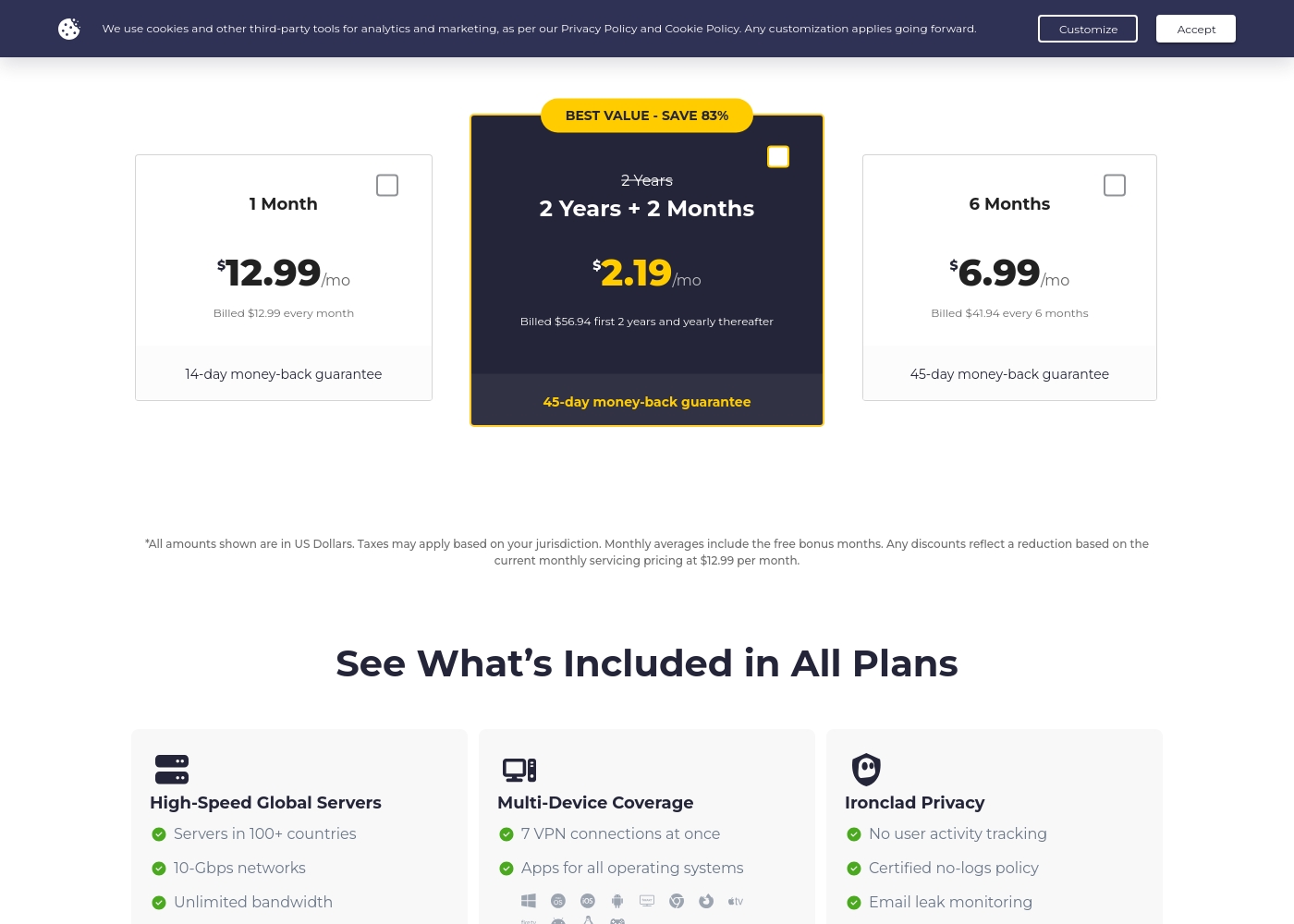
CyberGhost costs between $2.19 and $12.99 per month with three plans: 2 Years + 2 Months ($2.19/mo), 6 Months ($6.99/mo), and 1 Month ($12.99/mo).
You can select the plan that best fits your needs below. All options provide full access to our premium features, securing up to 7 devices simultaneously.
2 Years + 2 Months (Best Value)
Price: $2.19 per month (Billed $56.94 for the first 26 months, then $56.94 yearly thereafter) Best For: Users seeking the deepest discount for long-term protection Refund Policy: 45-day money-back guarantee Other Features:
- Save 83% off the standard monthly price
- Full VPN access with servers in 100+ countries
- Access to 10 Gbps networks and unlimited bandwidth
- Save 83%
- Best Value
- 45-day money-back guarantee
- 45-day money-back guarantee
- Billed semi-annually
- 14-day money-back guarantee
- Monthly billing
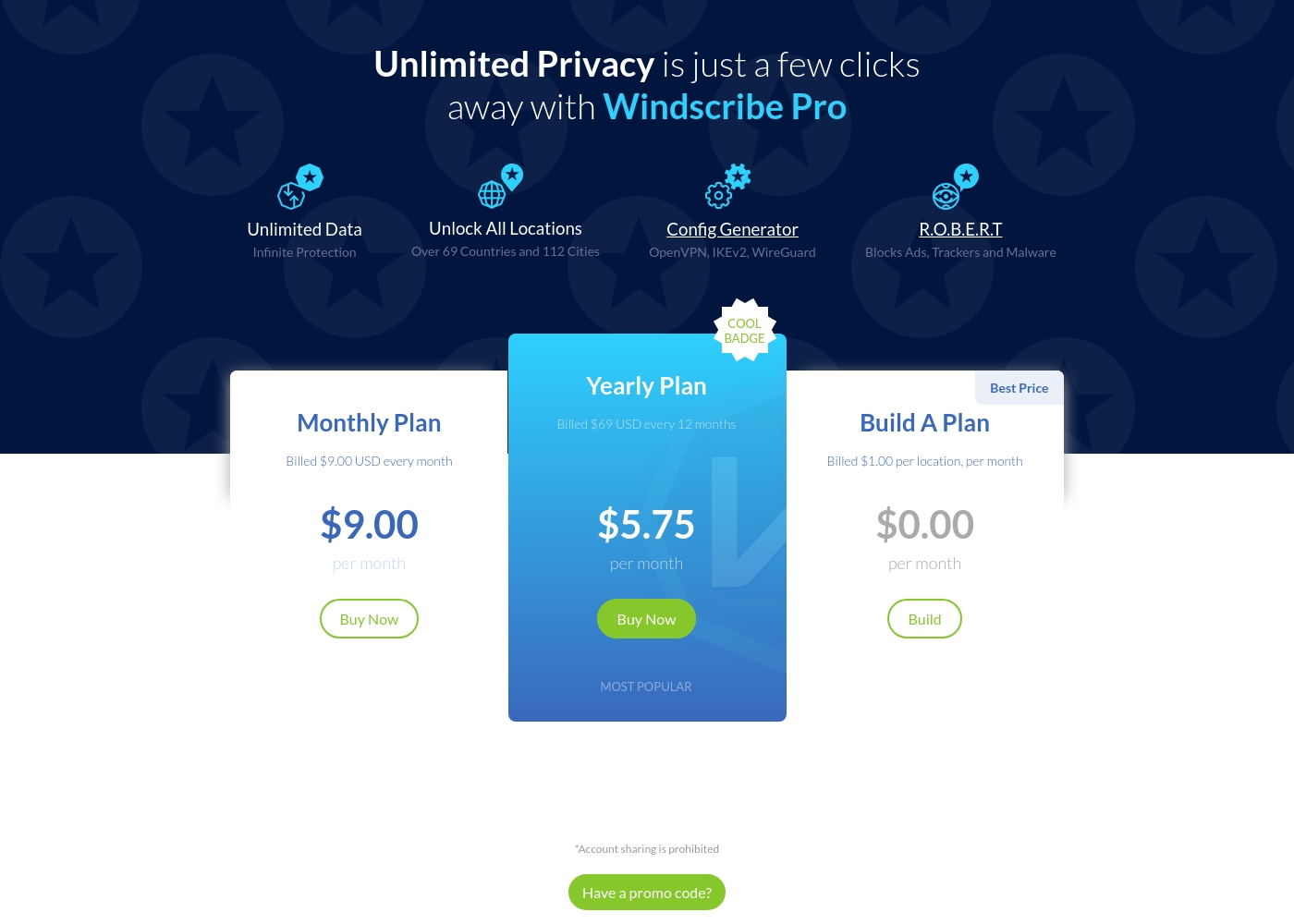
Windscribe costs between $3.00 and $9.00 per month with four main options: a Free plan (up to 10GB), the Build A Plan starting at $3.00/month, the Yearly Plan at $5.75/month (billed annually), and the Monthly Plan at $9.00/month.
Windscribe offers flexible ways to protect your privacy online. Here are the details for each subscription option.
Free Plan
Price: Free Best For: Light users and testing the service Refund Policy: Not applicable Other Features: Up to 10GB of data per month
- Up to 10GB data per month (with confirmed email)
- $1.00 per location, per month
- $1.00 add-on for unlimited data
- Customizable access to locations
- Unlimited Data
- Unlock All Locations (69+ countries)
- Config Generator (OpenVPN, IKEv2, WireGuard)
- R.O.B.E.R.T. (Blocks Ads, Trackers and Malware)
- Unlimited Data
- Unlock All Locations (69+ countries)
- Config Generator (OpenVPN, IKEv2, WireGuard)
- R.O.B.E.R.T. (Blocks Ads, Trackers and Malware)
- Best Price option
Pricing Notes
- CyberGhost offers a significantly lower entry price of $2.19/month when committing to the 26-month plan.
- Windscribe does not offer a free trial but provides a robust permanent Free Plan with 10GB of data per month.
- Windscribe features the unique 'Build A Plan' starting at $3.00/month for highly customized location access.
- CyberGhost provides a concrete 45-day money-back guarantee on longer terms for added purchase confidence.
Pricing Head-to-Head
User Reviews
CyberGhost generally receives positive feedback from consumers, earning a strong overall rating of 4.0 stars across over 23,000 reviews. Customers frequently praise the user-friendliness of the application across various operating systems, noting the ease of installation and simple navigation.
Many users highlight the fast connections, the vast array of reliable servers, and its effectiveness for specialized activities like streaming and torrenting. The support team is often described as pleasant, responsive, and efficient when contacted.
Switching from a competitor has been worthwhile. I notice improved user-friendliness, speed, and overall clarity. The connection is great, and the app is very simple to use.
Windscribe enjoys an outstanding reputation on Trustpilot, consistently earning high marks for reliability and user-friendliness. Users overwhelmingly praise the service's stability, speed, and effectiveness at bypassing geoblocks and censorship.
Many reviewers highlight the generous free plan and the unique, highly flexible "Build A Plan" pricing model as superior value propositions. A recurring theme is the exceptional customer support, often centered around "Gary," the helpful and humorous AI chatbot, which quickly solves technical issues like speed reduction or connection errors.
I have tested countless free VPNs, but Windscribe is the most reliable one I've used. The speeds are consistently fast, and the connection never randomly disconnects. Crucially, the servers actually work well for streaming services like Netflix.
Our Verdict
Choosing between CyberGhost and Windscribe is a battle of scale against customized utility. Both offer high security, but they target slightly different users. This requires you to prioritize device count or geographic reach. CyberGhost excels with its massive server network across 100 countries worldwide. Its independently audited No-Logs policy by Deloitte offers proven privacy confidence. It also boasts fast 10 Gbps servers, ensuring smooth 4K streaming and low lag gaming. CyberGhost is perfect for the user who streams internationally often. Windscribe's major advantage is its support for unlimited simultaneous device connections. It also provides advanced security features like the R.O.B.E.R.T. ad/tracker blocking and a custom firewall. The flexible "Build A Plan" option is excellent for tailoring protection and saving money. The main choice hinges on device limits and pricing flexibility. If you need 8 or more connected devices, Windscribe is the clear winner for device coverage. If you want the lowest annual entry price ($2.19/mo) and a strong 45-day refund policy, pick CyberGhost. Choose CyberGhost if you value the Deloitte audit and worldwide 100-country reach. Pick Windscribe if you need unlimited connections and powerful anti-tracking tools like R.O.B.E.R.T. Both offer top-tier security; your decision rests on specific usage logistics.
Frequently Asked Questions
Which is better for covering all my devices: CyberGhost or Windscribe?
Windscribe is the clear winner for device coverage and protection. It supports unlimited simultaneous connections under a single subscription. CyberGhost limits users to a maximum of 7 connected devices.
Does Windscribe offer a money-back guarantee like CyberGhost?
Windscribe does not explicitly state a formal money-back guarantee for paid plans. CyberGhost offers a concrete 45-day money-back guarantee on all long-term subscriptions they provide. You should test Windscribe with their permanent 10GB free plan instead.
Which provides better server coverage: CyberGhost or Windscribe?
CyberGhost has a larger geographic footprint covering 100 countries worldwide. Windscribe offers reliable servers in 69 countries. If you need connections in many diverse regions, CyberGhost is the better choice.
Does CyberGhost offer anti-tracking tools like Windscribe's R.O.B.E.R.T.?
CyberGhost does not offer a dedicated feature comparable to Windscribe's R.O.B.E.R.T. Windscribe uses R.O.B.E.R.T. for network-level ad, tracker, and malware blocking. This provides significant protection beyond standard encryption.
Which is cheaper: CyberGhost or Windscribe?
CyberGhost offers the lowest possible barrier to entry at $2.19 per month on its 26-month plan. Windscribe's cheapest Pro option is $5.75/month annually. However, Windscribe offers the free 10GB plan and custom 'Build A Plan' options.
Which VPN is better suited for users running Linux?
Windscribe appears better for Linux users, supporting protocols via its Config Generator. CyberGhost reviewers specifically noted sub-optimal or obsolete command-line interface support for Linux distributions.
Ready to Choose?
Both tools have their strengths. Choose based on your specific needs.