CyberGhost vs OpenVPN
CyberGhost and OpenVPN serve drastically different audiences and needs. CyberGhost is built for individual privacy, blazing speed, and global streaming access. OpenVPN focuses on enterprise security, regulatory compliance, and Zero Trust access control. Choosing depends entirely on if you need a personal privacy app or corporate infrastructure.
Best for: Individuals seeking cheapest long-term VPN protection ($2.19/mo), Users prioritizing 4K streaming and high speeds via 10 Gbps servers
Best for: Companies needing HIPAA or SOC 2 compliance for regulatory reasons, IT teams implementing Zero Trust Network Access (ZTNA) solutions
Strong Security and Excellent Value.
We found CyberGhost delivers high speeds and robust security, backed by an independent Deloitte No-Logs audit and excellent long-term pricing. The application is highly user-friendly across most major platforms and covers a generous seven devices simultaneously. Overall, the service is a strong choice for users prioritizing speed and privacy across multiple devices, though Linux users may face integration difficulties.
Pros
- Audited No-Logs policy verified by Deloitte adds major credibility.
- Blazing fast speeds supported by next-gen 10 Gbps servers.
- User-friendly interface and easy cross-platform installation.
- Extensive network of servers in 100 countries worldwide.
Cons
- Sub-optimal or obsolete support for certain Linux distributions (both CLI and GUI).
- Lack of clear details regarding auto-renewal and foreign currency pricing (e.g., USD vs. CAD) in subscription ads.
- The Windows application currently lacks a Split Tunneling feature.
Flexible security built for compliance.
We see OpenVPN provides a strong foundation for Zero Trust access, featuring flexible deployment options and robust security controls that meet strict compliance goals like HIPAA and SOC 2. Overall, it is a feature-rich solution economical for businesses, but they must weigh the compliance focus against reported issues related to functional reliability and performance lag.
Pros
- Provides flexible security solutions (CloudConnexa or Access Server).
- Robust Zero Trust features and access controls are implemented.
- Meets strict regulatory compliance standards (HIPAA, SOC 2).
- Feature-rich Free plan is available for up to three seats.
Cons
- External users report serious issues with platform lag and poor UX.
- Setup and onboarding can be difficult and time-consuming.
- Customer support responsiveness is reported as inadequate by users.
- Self-hosted Access Server is considered extremely overpriced by some clients.
AboutCyberGhost
A VPN, or Virtual Private Network, creates a secure tunnel for your data. CyberGhost VPN encrypts your traffic immediately after you connect to a server.
It masks your IP address so your real location stays hidden. This technology protects your digital identity everywhere you go.
It is an essential tool for avoiding snooping, tracking, and unwanted censorship online. Use it to keep sensitive information like passwords and financial transactions safe from cybercriminals, especially on public Wi-Fi.
AboutOpenVPN
OpenVPN is a trusted provider of secure networking solutions tailored for small, medium, and enterprise businesses. It's recognized as the #1 Business VPN and is specifically trusted by over 20,000 organizations. This widely used solution provides a protected, encrypted tunnel for sensitive data. It ensures your devices can securely connect to business assets, even when crossing unsecured public networks. The core product is a high-performance, fast-deploying Zero Trust VPN solution. 💡
Highlights
Feature Comparison
Features Overview
We highlight the main differences and pick a winner for each feature.
Target Audience
CyberGhost targets individual privacy; OpenVPN focuses entirely on business access. They are solving completely different problems.
CyberGhost is a classic consumer VPN built for streaming and general use. It aims to provide security for individual users on up to 7 devices. CyberGhost emphasizes global access and protection from common ISP tracking. OpenVPN is a secure remote access solution for businesses. It helps organize complex networks and manage employee access with ZTNA principles. OpenVPN is trusted by over 20,000 organizations globally. If you're buying for yourself or your family, choose CyberGhost for simplicity. If you manage an IT infrastructure or remote team, OpenVPN is the correct tool. CyberGhost focuses on personal freedom, whereas OpenVPN prioritizes corporate control and compliance standards.
Security Compliance
OpenVPN crushes compliance needs like HIPAA; CyberGhost focuses on general privacy assurance only.
CyberGhost offers robust 256-bit AES encryption and an automatic Kill Switch. Its key security guarantee is an independent audit confirming its No-Logs policy. CyberGhost satisfies basic personal and speed-driven security needs efficiently. OpenVPN is designed to meet strict regulatory compliance standards. It helps companies achieve HIPAA, SOC 2 Type 2, and GDPR requirements. OpenVPN provides the necessary proof and controls for regulated industries. OpenVPN’s compliance features are indispensable for healthcare or financial businesses. CyberGhost does not offer the advanced architectural controls required for these mandates. OpenVPN delivers formal, high-stakes security compliance that CyberGhost cannot match.
Deployment Flexibility
OpenVPN lets you choose self-hosted or cloud; CyberGhost is a pure managed consumer app. OpenVPN wins for architectural control.
CyberGhost is a fully managed service; you download the app and connect instantly. Setup is extremely easy across Windows, macOS, and mobile devices. CyberGhost offers Smart DNS for streaming on non-VPN native devices. OpenVPN provides two options: managed CloudConnexa or self-hosted Access Server. Access Server allows IT teams maximum architectural control over their deployment. You can deploy OpenVPN Access Server on IaaS providers, Docker, or Linux. The ability to self-host Access Server gives OpenVPN extreme flexibility for large organizations. CyberGhost's simplicity means minimal setup but zero architectural configuration control. OpenVPN is favored by IT professionals needing custom, controlled security environments, unlike CyberGhost's plug-and-play approach.
Speed & Network Reach
CyberGhost is engineered for blazing speed/global reach; OpenVPN's focus is access integrity, not speed. CyberGhost wins for performance.
CyberGhost engineered its network with next-gen 10 Gbps servers for speed. It has servers in 100 countries globally, offering superior global content access. CyberGhost users report consistently fast speeds for 4K streaming and gaming. OpenVPN's performance reports are mixed, with users citing platform lag and poor responsiveness. The network availability across specific countries is also much smaller. OpenVPN prioritizes secure access controls over raw speed or global server count. If speed and finding the right global server are critical, CyberGhost is the clear choice. OpenVPN's performance focus is on reliable connectivity for remote teams, regardless of latency. CyberGhost's massive commercial network means you can quickly bypass geotargeting and throttling globally.
Pricing Model
CyberGhost uses commitment pricing; OpenVPN uses a flexible per-seat model. CyberGhost is cheaper for individuals.
CyberGhost pricing is based on how long you commit, dropping to $2.19/month on the longest plan. All CyberGhost plans include access to all features and unlimited bandwidth. The pricing is fixed and predictable for the single user. OpenVPN (CloudConnexa) costs $11 per seat per month (billed annually). Businesses pay only for the exact number of active employees or connections needed. This model allows OpenVPN to scale costs efficiently with team size. An individual seeking long-term security will find CyberGhost vastly more affordable. OpenVPN's cost structure is only appealing when managing hundreds of users effectively. CyberGhost offers high value for money because one fixed price covers unlimited data and up to 7 devices.
Ease of Setup
CyberGhost is easy to install and run; OpenVPN is noted for difficult, complex setup. CyberGhost wins on immediate usability.
CyberGhost shines with a highly user-friendly interface and simple cross-platform apps. Installation across Windows, Mac, and mobile takes only minutes. CyberGhost is truly a one-click solution for privacy needs. OpenVPN users report severe difficulty and time investment needed for initial setup. Installation on platforms like AWS is cited as being complex and tedious. OpenVPN demands an IT background for smooth deployment. For general users, the friction required to successfully set up OpenVPN is a huge drawback. CyberGhost is designed specifically for ease of use by non-technical people. If you want to be protected in 5 minutes, use CyberGhost; if you have a sysadmin team, OpenVPN is manageable.
Customer Support
Both offer 24/7 support, but CyberGhost uses live chat; OpenVPN uses a support portal. OpenVPN offers priority support for enterprise clients.
CyberGhost offers 24/7 customer support accessible via live chat and email channels. Users often describe support staff as professional and responsive. Live chat ensures immediate attention for common issues. OpenVPN provides 24/7 technical support, typically accessed through their online support portal. Enterprise customers, however, benefit from dedicated 24/7 priority support services. Responses may be slower for standard Growth plan clients compared to Pro. The direct, instant accessibility of CyberGhost's 24/7 live chat is superior for consumers. OpenVPN reserves direct interaction support for its highest-paying customers. For a quick fix on a personal device, CyberGhost's live chat is likely faster and easier to use than OpenVPN's portal.
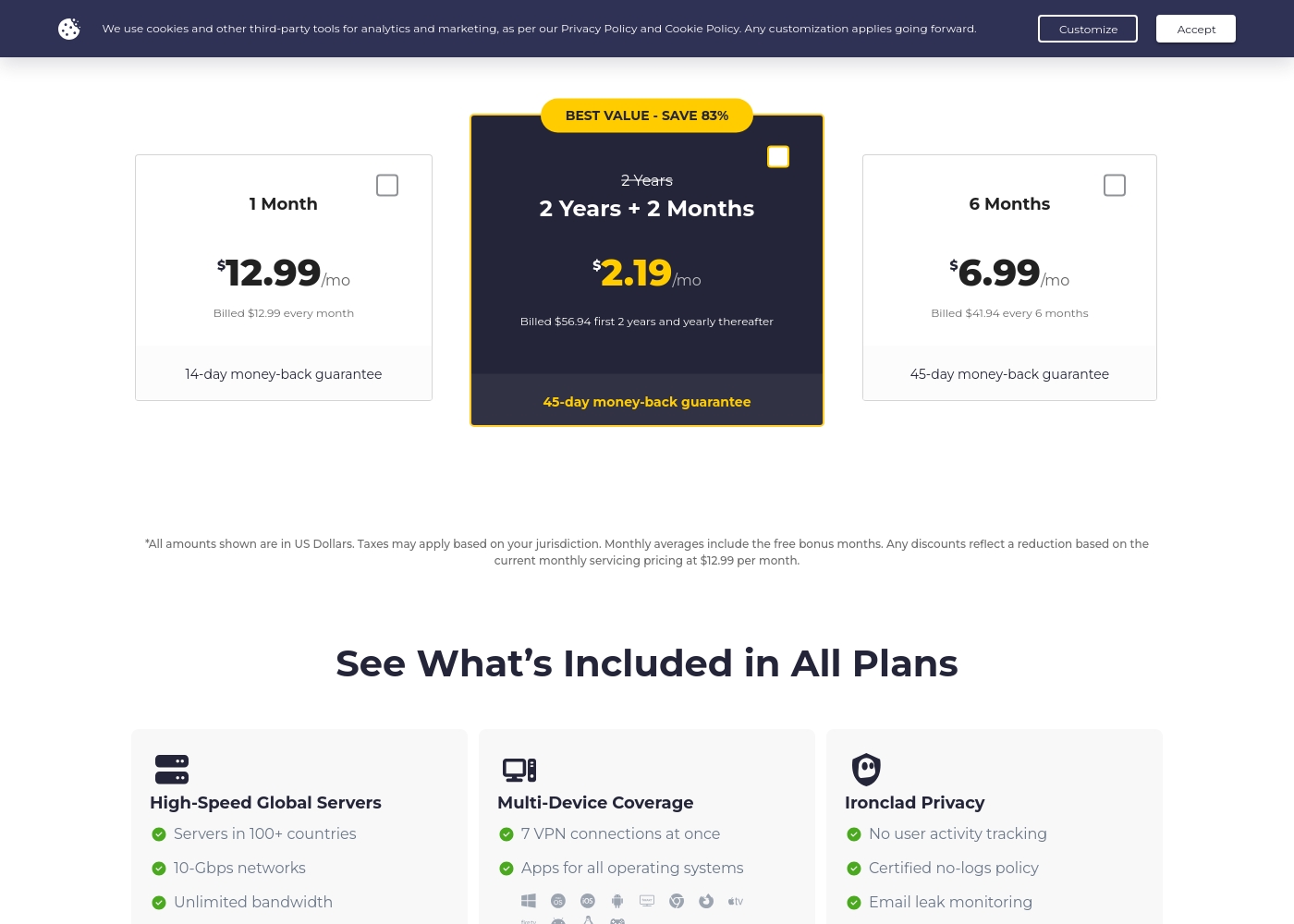
CyberGhost costs between $2.19 and $12.99 per month with three plans: 2 Years + 2 Months ($2.19/mo), 6 Months ($6.99/mo), and 1 Month ($12.99/mo).
You can select the plan that best fits your needs below. All options provide full access to our premium features, securing up to 7 devices simultaneously.
2 Years + 2 Months (Best Value)
Price: $2.19 per month (Billed $56.94 for the first 26 months, then $56.94 yearly thereafter) Best For: Users seeking the deepest discount for long-term protection Refund Policy: 45-day money-back guarantee Other Features:
- Save 83% off the standard monthly price
- Full VPN access with servers in 100+ countries
- Access to 10 Gbps networks and unlimited bandwidth
- Save 83%
- Best Value
- 45-day money-back guarantee
- 45-day money-back guarantee
- Billed semi-annually
- 14-day money-back guarantee
- Monthly billing
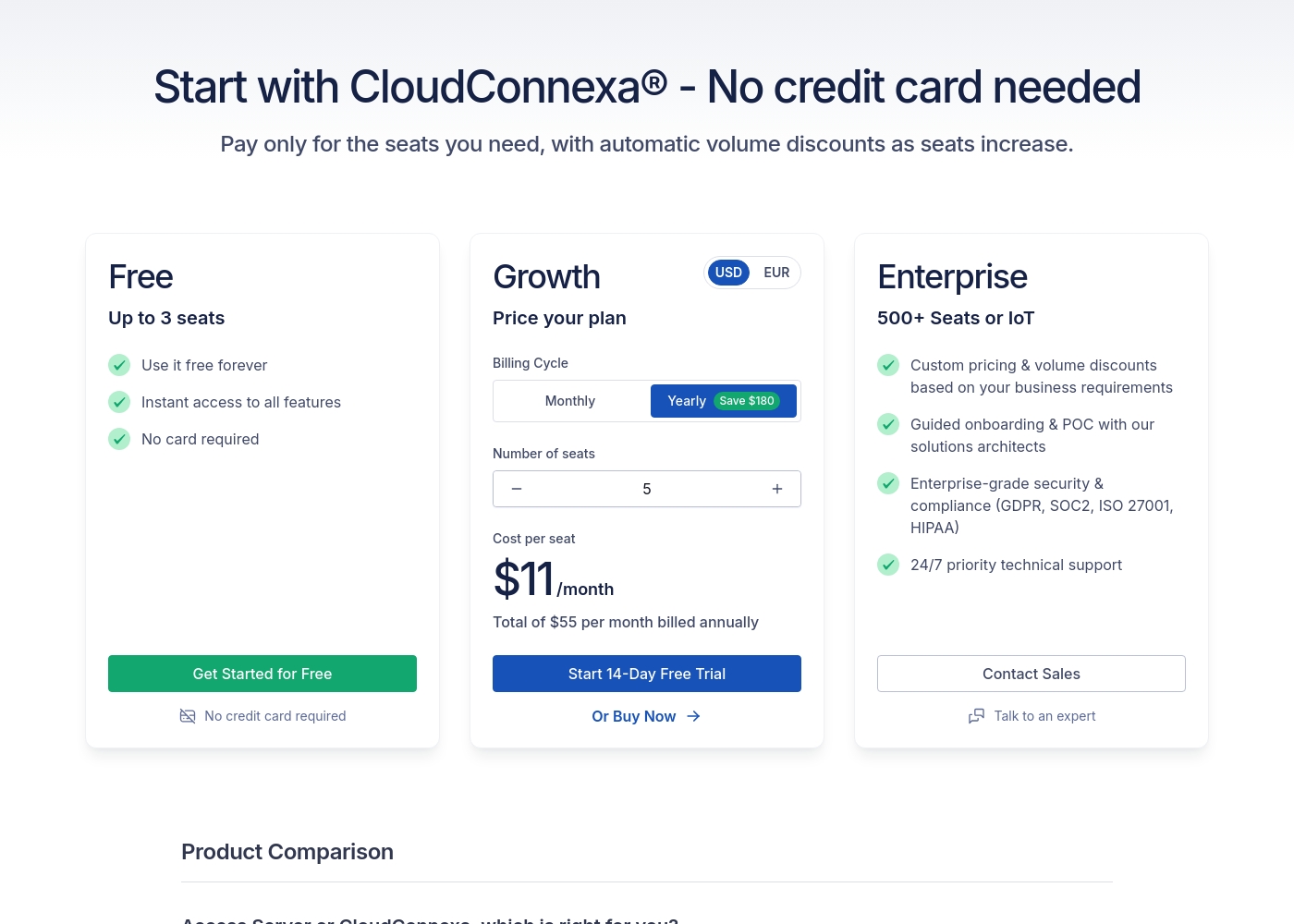
OpenVPN CloudConnexa costs between Free and Custom per year with 3 plans: Free (up to 3 seats), Growth ($11/seat/month billed annually), and Enterprise (Custom Pricing).
OpenVPN also offers two solutions—CloudConnexa and Access Server—but the most straightforward pricing structure is provided for the cloud-delivered CloudConnexa plans detailed below.
Free
Price: Free forever Best For: Small teams or testing Other Features:
- Up to 3 seats
- Use it free forever
- Instant access to all features
- No credit card required
- Up to 3 seats
- Use it free forever
- Instant access to all features
- No card required
- Pay only for the seats you need
- Automatic volume discounts
- Includes 14-Day Free Trial
- Scale seats up or down on demand
- Custom pricing & volume discounts
- Guided onboarding & POC with solution architects
- Enterprise-grade security & compliance (GDPR, SOC2, ISO 27001, HIPAA)
- 24/7 priority technical support
Pricing Notes
- CyberGhost offers huge savings with long-term 26-month plans, dropping the price significantly.
- OpenVPN uses a flexible per-seat or per-connection model which is ideal for scaling team sizes.
- The CyberGhost money-back guarantee period (up to 45 days) is vastly longer than OpenVPN’s 14-day trial.
- OpenVPN’s Free CloudConnexa plan offers 3 seats forever, unlike CyberGhost’s limited free trials.
- OpenVPN Access Server pricing is considered expensive by some users for small concurrent client counts.
Pricing Head-to-Head
User Reviews
CyberGhost generally receives positive feedback from consumers, earning a strong overall rating of 4.0 stars across over 23,000 reviews. Customers frequently praise the user-friendliness of the application across various operating systems, noting the ease of installation and simple navigation.
Many users highlight the fast connections, the vast array of reliable servers, and its effectiveness for specialized activities like streaming and torrenting. The support team is often described as pleasant, responsive, and efficient when contacted.
Switching from a competitor has been worthwhile. I notice improved user-friendliness, speed, and overall clarity. The connection is great, and the app is very simple to use.
User feedback on Trustpilot paints a largely negative picture, although this reflects a small sample size of nine reviews. The recurring themes critically focus on reliability and user experience.
Several users describe the platform as "extremely laggy," noting poor UX, especially with the browser authentication process. Functionality is also strongly challenged; one reviewer claimed the platform is fundamentally broken and fails to block expected threats like viruses or DDoS attacks, contradicting its advertising claims.
The user experience for the browser authentication is very poor and complex. It is constantly extremely laggy, which makes daily operations unnecessarily frustrating for mandated users.
Our Verdict
This isn't a fair fight; CyberGhost and OpenVPN target completely different users. They are both excellent tools, but for separate jobs entirely. If you are an individual wanting speed, privacy, and simplicity, CyberGhost is your winner. Its network is huge, offering servers in 100 countries for effortless streaming. CyberGhost’s superpower is making world-class privacy simple and fast. It offers 4K streaming support and the confidence of a Deloitte-audited no-logs policy. Plus, the price for CyberGhost is extraordinarily low on long-term plans, delivering amazing value. OpenVPN's superpower is providing enterprise-grade control and compliance. It offers Zero Trust Network Access (ZTNA) critical for modern corporate security. OpenVPN’s CloudConnexa meets strict mandates like HIPAA and SOC 2, essential for regulated businesses. The deciding factor is whether you purchase for a person or a company. Individuals should stick with CyberGhost for its speed and user-friendly experience. Businesses must choose OpenVPN for its architectural control and security compliance. Final verdict: Choose CyberGhost if you need the perfect consumer VPN for streaming and personal use. Choose OpenVPN if you are an IT professional securing a remote workforce or managing regulatory requirements.
Frequently Asked Questions
Which is more suitable for personal use: CyberGhost or OpenVPN?
CyberGhost is vastly more suitable for personal use and individual privacy. It is simple to install and has far superior speeds for consumer activities like streaming. OpenVPN is designed specifically for complex business network access control.
Does OpenVPN offer better compliance than CyberGhost?
Yes, OpenVPN offers superior compliance features vital for businesses. OpenVPN supports HIPAA, SOC 2, and GDPR requirements. CyberGhost focuses on general privacy and does not offer formal compliance tools.
How do the pricing models of CyberGhost and OpenVPN differ dramatically?
CyberGhost uses a simple, low subscription price based on commitment length. OpenVPN uses a flexible per-seat or per-connection model for scaling businesses. CyberGhost is cheaper for individuals; OpenVPN is efficient for scaling teams.
Does CyberGhost offer self-hosting like OpenVPN Access Server?
No, CyberGhost does not offer a self-hosted solution like OpenVPN Access Server. CyberGhost is a fully managed, simple application service. OpenVPN is the clear choice if you require architectural control or custom deployment.
Which tool offers a wider global network reach?
CyberGhost has a massively wider network, with servers available in 100 countries worldwide. OpenVPN focuses on fewer Points of Presence (POPs) optimized for business connectivity. CyberGhost is better for global content access.
Is CyberGhost truly faster than OpenVPN?
Independent data indicates CyberGhost is prioritized for speed, using 10 Gbps servers. OpenVPN user reviews frequently cite platform lag and performance issues. CyberGhost is usually faster for streaming and general browsing.
Ready to Choose?
Both tools have their strengths. Choose based on your specific needs.