Crowdcast vs Livestorm
Crowdcast and Livestorm are top event platforms but serve very different markets. Crowdcast shines for individual creators focused on community and direct monetization. Livestorm is optimized for B2B marketing automation and strict enterprise security. Here is how to find the right fit for your business goals.
Best for: Content creators monetizing access via memberships or ticket sales., Hosts who regularly bring attendees onto the screen for live discussion.
Best for: B2B organizations needing deep lead integration with HubSpot or Salesforce., Enterprises requiring guaranteed GDPR compliance and EU data hosting.
Advanced, Intuitive Livestreaming Platform for Creators
We found Crowdcast delivers on its promise to provide an advanced stage built specifically for modern creators focused on engagement and monetization. It offers a professional, intuitive interface with strong streaming stability and excellent audience interaction features. Overall, we recommend Crowdcast as a powerful tool for hosts looking to build and grow a dedicated live community.
Pros
- Highly intuitive interface, making it easy for beginners and guests to operate.
- Excellent audience engagement tools, including real-time Q&A and bringing attendees on screen.
- Designed specifically for creators with strong monetization and customized branding options.
- Reliable streaming stability and generally good audio/video quality reported by long-term users.
Cons
- Support responsiveness can be slow, especially for international users during critical live events.
- Full platform functionality may feel dated when compared to newer social streaming services.
- Offline video download is deliberately unavailable, as event hosts control access to replays.
- Overage fees apply if a plan’s limits for attendees or streaming hours are exceeded.
Comprehensive Webinar Tool, Complex Pricing.
We find Livestorm provides a robust, browser-based platform ideal for businesses needing strong data security and high automation capacity. The feature set is excellent, but we must note the recurrent serious concerns regarding subscription policies and dramatic, unannounced price hikes. Overall, Livestorm is a powerful tool with significant financial risk flags for long-term users.
Pros
- All-in-one browser-based platform (no software installation required).
- Strong data security (EU hosted, ISO 27001, GDPR compliant).
- Efficient automations and smooth event management processes.
- Good user experience delivers high attendance duration.
Cons
- Reports of sudden, major price increases for loyal customers (up to 350%).
- Rigid and unfriendly subscription/cancellation policies noted by users.
- Reliability issues reported, including constant freezing and delays.
- Video streaming quality is sometimes poor, especially for presenters.
AboutCrowdcast
Crowdcast is an advanced online event platform completely re-designed for today’s creators. After hosting over 10 million attendees, the platform offers a groundbreaking new experience. It moves beyond simple streaming; it gives you the tools to create a dedicated community hub. If you host live shows, teach online courses, or run large virtual summits, this platform is built with your specific needs in mind. You get a customized stage where you control the entire attendee experience, from branding to live interaction. 💡
AboutLivestorm
Livestorm is a powerful, unified platform offering dynamic discussions for any kind of online event. It is designed to be the webinar leader, ready for immediate use. You access Livestorm right through your browser, which means there is no software to install and no credit card required to start. This accessibility ensures you can achieve maximum participation every time. This platform serves thousands of customers, scaling easily from startups to large enterprises.
Highlights
Feature Comparison
Features Overview
We highlight the main differences and pick a winner for each feature.
Monetization & E-commerce
Crowdcast easily handles ticket sales, while Livestorm requires external tools for payments.
Crowdcast integrates directly with Stripe and Patreon for immediate payment collection. You can set up flexible ticketing options for paid livestreams instantly. The Business plan drops the transaction fee to an attractive 2%, maximizing revenue. Livestorm is built primarily for lead generation, not direct sales. Monetization must be handled externally before attendance is granted. Livestorm provides deep CRM integration to nurture leads post-event. Crowdcast is the definitive winner for creators needing built-in payment processing. If you sell events, Crowdcast streamlines your entire workflow significantly. This direct financial utility simplifies the process of launching paid courses or exclusive content series quickly.
B2B Integrations & CRM
Livestorm offers robust native CRM connections; Crowdcast relies mainly on Zapier.
Crowdcast relies on Zapier for connecting to marketing automation and CRMs. This provides basic data connectivity to thousands of apps. Data exports are generally limited to CSV files. Livestorm offers deep, secured, native integrations with HubSpot, Marketo, and Salesforce. It acts as a powerful data hub for lead tracking. The platform also offers access to API and custom data extracts. For enterprises who need seamless data flow into their sales and marketing funnels, Livestorm excels. Crowdcast focuses on the creator side, where this depth is less crucial. Livestorm ensures that leads generated during the webinar immediately enter sophisticated sales workflows for quick follow-up.
Audience Interaction
Crowdcast allows live on-screen audience participation; Livestorm is more structured.
Crowdcast's defining feature is bringing attendees onto the screen instantly. This creates dynamic, two-way conversational events and live Q&A sessions. It also features Q&A timestamping for replays. Livestorm provides a strong suite of in-event tools like polls, chat, and Q&A with upvotes. The browser-based access encourages maximum participation. It focuses on structured presentations with interactive elements. Crowdcast provides a more community-driven, less formal environment suitable for live discussions. Livestorm is better for formal, highly controlled webinar structures. If genuine, spontaneous interaction is necessary, Crowdcast's on-screen attendee feature makes it significantly more engaging.
Security & Compliance
Livestorm is ISO certified and GDPR compliant; Crowdcast lacks specified compliance guarantees.
Livestorm is securely hosted in the EU, ISO 27001 certified, and GDPR compliant by design. Enterprise plans offer a Service Level Agreement (SLA) and specialized security review support. Crowdcast focuses on creator efficiency and ease of use. It does not provide explicit compliance certifications or guarantees mentioned in the data. For organizations operating under strict regulatory requirements, Livestorm is the safer, more secure option. Crowdcast is more suitable for flexible, non-regulated content. Using Livestorm ensures that sensitive attendee data management meets high international security standards immediately upon deployment.
Pricing Structure Risk
Crowdcast has transparent usage fees; Livestorm’s contact model causes pricing volatility.
Crowdcast uses predictable monthly fees based on attendance and hours, with set overage rates. You pay 15¢ per extra live attendee if you exceed limits. This structure is very transparent. Livestorm charges based on 'Active Contacts,' which are unique monthly registrants or attendees. Users report severe, sudden price increases following unexpected growth in contacts. This introduces high financial risk. Crowdcast provides clearer, more controlled scaling costs for individual event hosts. Livestorm’s model favors predictable, steady marketing organizations with stable contact growth. The risk of a 350% price increase reported by Livestorm users demands extremely cautious usage monitoring compared to Crowdcast.
Team & User Scaling
Livestorm offers unlimited team seats; Crowdcast charges per additional host license.
Crowdcast limits host seats to 1-4, depending on the plan chosen. Additional host seats cost $29 per seat monthly. This is ideal for smaller teams or solo operations. Livestorm includes unlimited team members on all paid plans, even the lowest tier. Pricing only scales based on the 'Active Contacts' quota needed annually. For organizations with large, growing marketing or training teams, Livestorm is significantly more cost-effective internally. Crowdcast limits collaboration unless extra fees are paid. If you plan to have a dozen people managing events or communications, Livestorm removes administrative seat fees entirely.
Ease of Use / UX
Crowdcast is highly praised for ease of use; Livestorm is efficient but can feel unintuitive.
Crowdcast is consistently reviewed as incredibly user-friendly and intuitive to operate. It provides smooth setup for beginners hosting their first webinar or livestream. Users appreciate the simple controls. Livestorm is highly efficient and automates many processes, saving time for marketing teams. However, some user reviews mention the control panel is neither convenient nor intuitive. Crowdcast has the edge for UX simplicity and a lower learning curve, especially for non-technical creators. Livestorm sacrifices simplicity for feature depth. Beginners can launch a fully branded event faster and more confidently on the Crowdcast platform.
Content Lifespan & Replays
Livestorm provides unlimited storage and AI features; Crowdcast focuses on recording availability.
Crowdcast provides HD recordings and timestamping for Q&A answers, assisting replay viewers. This feature structures the content for learning purposes. Livestorm offers unlimited replay storage capacity for all sessions automatically. It includes AI-powered transcripts and captions for enhanced accessibility and searchability. Livestorm treats post-event content as a permanent asset with advanced accessibility features. Crowdcast's focus is on simplifying the immediate live interaction. For maximizing long-term SEO and content accessibility, Livestorm's unlimited replays and AI tools are superior.
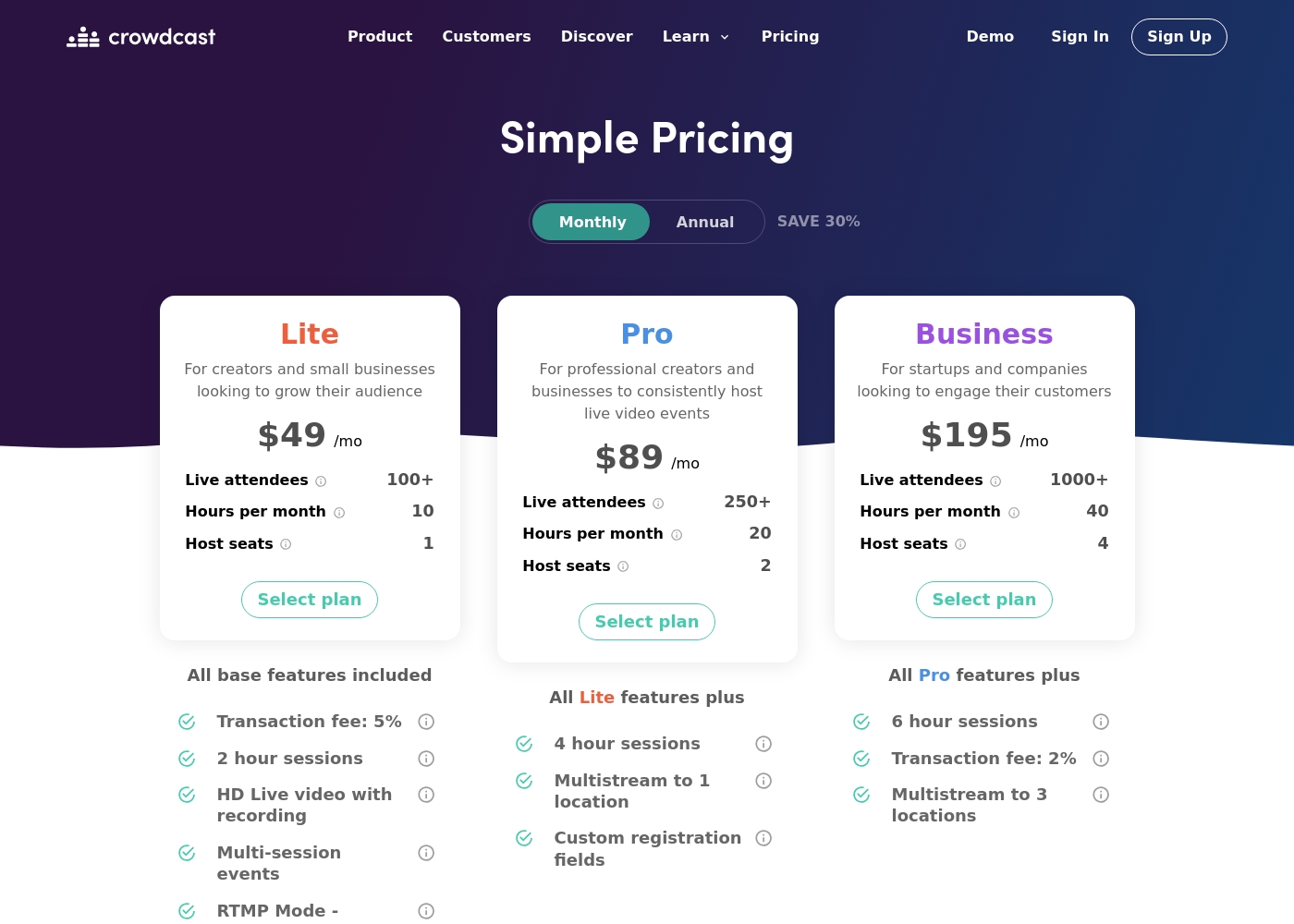
Crowdcast costs between $49 and $195 per month with three main plans: Lite at $49/mo, Pro at $89/mo, and Business at $195/mo. Annual billing is also available, offering a worthwhile 30% savings compared to the monthly rates.
Below is a clear overview of the features, limits, and specific costs associated with each plan.
Lite
Price: $49/mo Best For: Creators and small businesses looking to grow their audience Other Features:
- 100+ Live Attendees included
- 10 Streaming Hours per month
- 1 Host seat
- 5% Transaction fee on ticket sales (plus Stripe processing fees)
- 2-hour session limits
- 100+ Live Attendees
- 10 Hours per month
- 1 Host seat
- 5% Transaction fee (plus Stripe fee)
- 2 hour sessions
- 250+ Live Attendees
- 20 Hours per month
- 2 Host seats
- 4 hour sessions
- Multistream to 1 location
- 1000+ Live Attendees
- 40 Hours per month
- 4 Host seats
- 2% Transaction fee (plus Stripe fee)
- 6 hour sessions
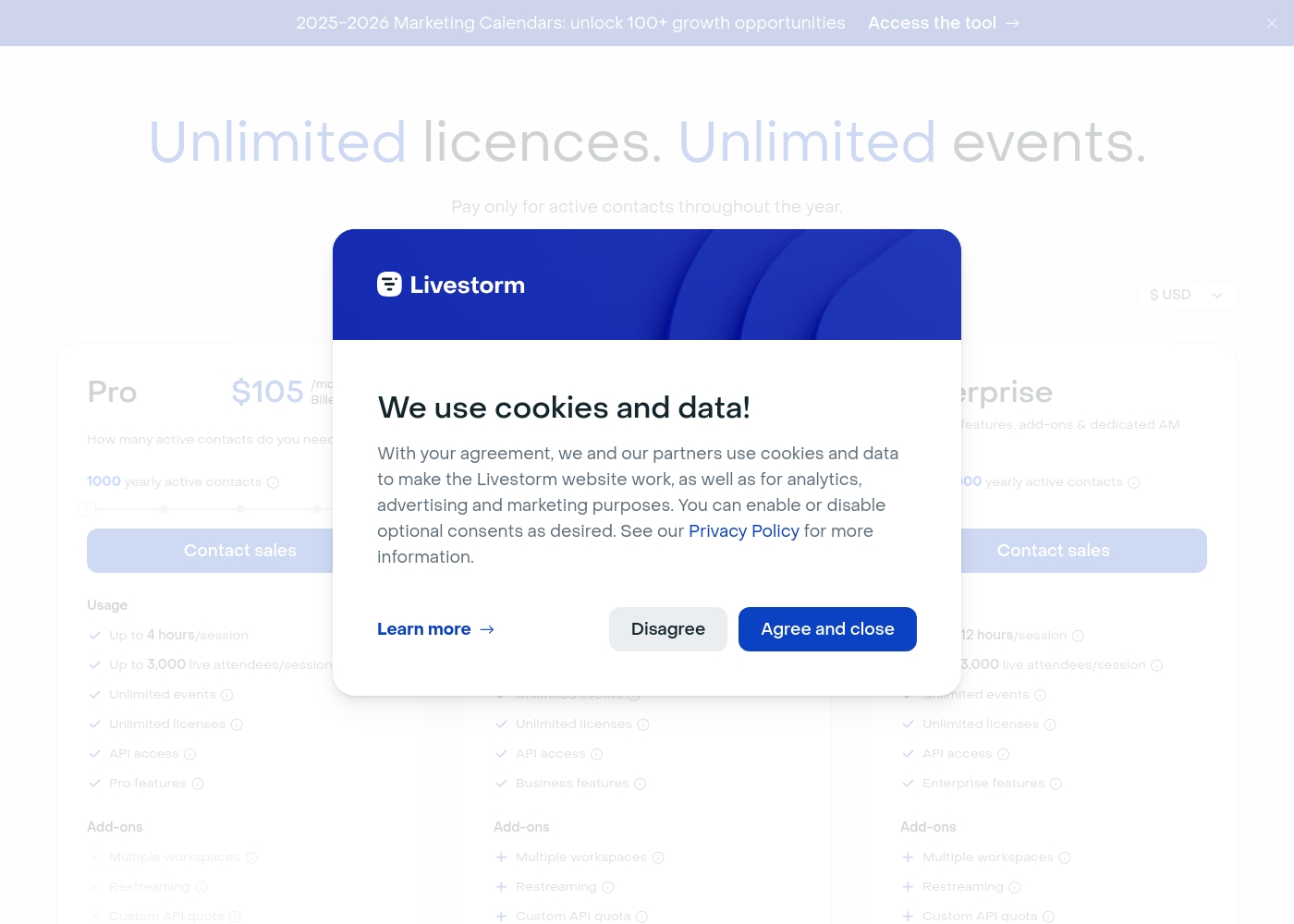
Livestorm costs between $0 and $105+ per month with four plans: Free at $0, Pro at $105/month (when billed annually), Business at Contact sales, and Enterprise at Contact sales.
Livestorm pricing is based primarily on your required annual quota of "Active Contacts." Here is a breakdown of what you get with each plan.
Free
Price: $0 Best For: Testing the platform or small, quick events Other Features:
- Up to 30 active contacts/month
- 20 minutes maximum per session
- Up to 30 live attendees
- Unlimited team members
- Email support only
- Up to 30 active contacts/month
- 20 minutes maximum per session
- Up to 30 live attendees
- Unlimited team members
- Email support only
- 1,000 yearly active contacts included
- Up to 4 hours per session
- Up to 3,000 live attendees
- Unlimited events and licenses
- Standard Support
- From 10,000 yearly active contacts
- Up to 4 hours per session
- VIP Support
- Dedicated Account Manager and VIP onboarding
- Custom data extracts & dashboards
- From 10,000 yearly active contacts
- Up to 12 hours per session
- VIP Support & SLA
- Advanced Enterprise features
- Access to Technical Solution Partners
Pricing Notes
- Crowdcast uses a clear, usage-based model with defined overage fees (15¢ per extra attendee).
- Livestorm's pricing is based on unpredictable 'Active Contacts,' which has led to user reports of sudden, massive price increases.
- Crowdcast charges significant transaction fees (2%-5%) when selling tickets directly through the platform.
- Livestorm offers unlimited team members included in all paid plans, unlike Crowdcast which charges per additional host seat monthly.
Pricing Head-to-Head
User Reviews
Crowdcast maintains a “Great” 4.1/5 rating on Trustpilot, largely due to its approachability and utility for live event hosting. Users frequently praise the seamless and intuitive experience, noting it effectively replaces traditional webinar tools like Zoom.
The platform is excellent for audience engagement, offering easy Q&A management and stable, high-quality audio and video streams. Many users find it a wonderful asset for widening their reach and appreciate the fair price relative to competitor quality.
This software has been a game changer for us. We were complete newcomers to webinars, but the platform is incredibly user-friendly and easy to operate. We went live without a single hitch—smooth sailing from start to finish!
The feedback for Livestorm is notably polarized, primarily focusing on pricing structure and technical reliability. Many users praise the platform's ease of use, describing it as a "good all around webinar software" with great design and efficient automations that help save time ⏱️.
Long-term users particularly value the streamlined invitation process and consistent performance for B2B organizations. However, the negative reviews are very strong, centered mostly on cost and customer service policies.
I use Livestorm at least twice weekly for customer outreach. It works reliably for me and has been great for reaching customers across Sweden. I have used the service for over three years consistently.
Our Verdict
Choosing between Livestorm and Crowdcast requires knowing your core business goal. Crowdcast is the top choice if your goal is community building and selling access. Livestorm dominates the structured B2B market focused on lead generation and data security. Crowdcast’s superpower is its highly engaging environment designed for creators. The platform makes monetization easy with direct Stripe and Patreon integration. Its ability to bring attendees on-screen creates unparalleled live group interaction. Crowdcast also offers better clarity with its usage-based pricing structure. Livestorm is ideal for professional marketing teams and security-conscious organizations. It provides robust native connections to CRMs like Salesforce and is guaranteed GDPR compliant. Additionally, Livestorm allows unlimited team members on all paid plans, scaling collaboration easily. The deciding factor is often the fundamental pricing model or security needs. Livestorm’s ‘Active Contacts’ model creates volatility and huge price risks for growing customers. Crowdcast’s costs are clearer. However, if GDPR compliance is a must, Livestorm is non-negotiable. Choose Crowdcast if you prioritize dynamic interaction and seamless event monetization. Commit to Livestorm if your operation requires strict security, EU data hosting, and deep integrations with enterprise marketing systems.
Frequently Asked Questions
Which is better for small teams: Crowdcast or Livestorm?
Crowdcast is generally better for ease of use and lower initial cost commitment. Livestorm offers a lifetime Free plan to test features. If your small team needs deep CRM integration, Livestorm is the choice.
Does Crowdcast have advanced CRM integration like Livestorm?
No, Crowdcast relies primarily on Zapier for integrations. Livestorm offers robust native, secured connections to major platforms. Livestorm is built specifically for streamlined lead data transfer to CRMs.
Is Livestorm’s unlimited user model cheaper than Crowdcast’s host seats?
For large organizations, yes, Livestorm is cheaper for team seats. Livestorm includes unlimited team licenses on all paid plans. Crowdcast charges $29 monthly per host seat beyond the included allowance.
Which platform is more secure and GDPR compliant?
Livestorm is much more secure for regulatory needs. It is ISO 27001 certified and hosted in the EU, ensuring GDPR compliance. Crowdcast does not publicly advertise these compliance assurances.
Does Livestorm offer direct ticket selling like Crowdcast?
No, Livestorm does not offer direct payment processing or ticketing tools. Crowdcast allows you to sell event access directly using its integrated Stripe and Patreon features.
Which tool is better for high attendee capacity and long sessions?
Livestorm generally handles higher capacity, supporting up to 3,000 live attendees on Pro. Livestorm also supports longer sessions, up to 12 hours on the Enterprise plan. Crowdcast sessions cap at 6 hours.
Ready to Choose?
Both tools have their strengths. Choose based on your specific needs.