Copyleaks vs Sapling
Copyleaks and Sapling both fight synthetic content, but they target different users. Copyleaks is built for institutional accuracy and high security compliance. Sapling is a strong writing assistant that includes budget-friendly AI detection for individuals.
Best for: Educational institutions ensuring academic integrity via LMS integration, Enterprise organizations needing GDPR and SOC 2/3 compliance
Best for: Individuals needing a powerful writing assistant tool (better than Grammarly), Writers seeking a budget-friendly detector with predictable monthly costs
Flawed Detection, Challenging User Experience
We observe a significant gap between Copyleaks’ marketed technical claims of over 99% accuracy and the frequent, severe false positives reported by professional users. Currently, the platform requires improved transparency regarding its complex credit-based pricing model and must urgently address widespread complaints about unhelpful customer support. Overall, while the core AI detection technology may hold promise, its poor implementation leads to frustrating and costly uncertainty for users.
Pros
- Validated by Cornell Tech researchers for LLM detection accuracy.
- Supports advanced features like cross-language translation detection.
- Provides strong enterprise compliance with GDPR and SOC 2/3 certifications.
- Detects AI outputs and plagiarism across over 100 languages.
Cons
- Reported high false-positive rates frequently flag human writing as 100% AI.
- Detection sometimes easily circumvented by minor content changes.
- Credit system and billing practices are perceived as misleading and costly.
- Customer support is often cited as unresponsive or automated.
Powerful Writing Assistant, Unreliable Detector.
We found Sapling offers powerful tools for improving grammar and making written text more concise, features that users often praise above competitors. Overall, the reported serious issues regarding the AI content detector's high false positive rate significantly undermine confidence in its primary specialized function.
Pros
- Offers significant savings with an annual discounted Pro plan ($12/month).
- Writing suggestions frequently cited as superior to Grammarly for corrections.
- High claimed detection accuracy (97%) for longer AI-generated texts.
- Identifies and highlights sentence segments indicative of simplistic phrasing.
Cons
- AI detector frequently reports significant false positives on human-written content.
- Citations of rigid or inconsistent detection results.
- Reports of high memory usage specifically for the browser extension.
- Interface described by some users as clunky.
AboutCopyleaks
Copyleaks is a robust platform focusing on digital authenticity. It uses advanced AI technology to analyze unique text patterns.
This focus allows the system to flag content created by various Large Language Models (LLMs), including GPT-5, Gemini, Claude, and dozens more. The tool helps you clearly identify AI writing because it looks for signals left behind by statistical modeling.
You can also get detailed reports that separate elements written by humans from AI-generated text, even when both are mixed. The platform is truly built for accuracy and scalability.
AboutSapling
The Sapling AI Content Detector is a powerful tool designed to check the probability that text was written by models such as ChatGPT or Gemini. It uses a specialized machine learning system—a Transformer—to analyze the input. This system specifically estimates the probability that each word or token is machine-generated. 💡
This utility is especially useful for educators concerned about learning integrity, or for practitioners reviewing large volumes of synthetic content. You're guided by visual results, seeing both the overall text score and highlighted portions. The detector also flags individual sentences with low perplexity, helping you catch simplistic or cliché phrasing.
Highlights
Feature Comparison
Features Overview
We highlight the main differences and pick a winner for each feature.
Security & Compliance
Copyleaks features enterprise security; Sapling uses standard web encryption.
Copyleaks is GDPR, SOC 2/3, and PCI DSS compliant for institutional needs. This robust security profile is necessary for handling sensitive client or student data. Sapling secures data using standard AES-256 and TLS (HTTPS) encryption. Sapling generally lacks the formal compliance certifications that large organizations mandate today. If data privacy is paramount, Copyleaks provides necessary verifiable assurances. Sapling is suitable for individuals but not ideal for high-stakes enterprise environments looking for verified compliance.
Integration Ecosystem
Copyleaks integrates with complex systems; Sapling focuses on browser extensions.
Copyleaks includes API access and deep integration with Learning Management Systems (LMS). This is perfect for educational institutions scanning massive batches of student papers. Copyleaks even offers specialized detection for AI-generated code, a niche but powerful feature. Sapling uses excellent browser extensions and supports quick integration with Word or Outlook add-ons. Sapling’s priority is enhancing the content creation workflow rather than institutional oversight. For complex system integration, Copyleaks is the superior, more robust choice.
Pricing Model & Value
Sapling offers predictable flat rates; Copyleaks uses confusing, costly credits.
Copyleaks uses a credit-based system, where 250 words costs one credit to scan. Users report this usage structure feels misleading, leading to unexpected costs. Sapling’s Pro plan is a transparent flat rate of $12/month when billed yearly. Sapling offers far better value and predictable spending for the individual user. The generous, no-credit-card 30-day Pro trial from Sapling seals the deal here. Copyleaks only offers limited free credits and a highly conditional refund window.
Writing Assistant
Sapling aids writing quality dramatically; Copyleaks is purely a detection tool.
Sapling is frequently praised for its superior grammar and style suggestions, often beating Grammarly. It helps users eliminate clichés and refine prose for better engagement. Sapling supports text expansion shortcuts called 'Snippets,' boosting productivity significantly. Copyleaks is designed only for authenticity verification and does not offer style or grammar guidance. If you want a tool that detects AI *and* makes you a stronger writer, Sapling is the clear winner.
Language Support
Copyleaks supports 100+ languages; Sapling is optimized mainly for English.
Copyleaks offers plagiarism detection in over 100 languages for global reach. Its AI detection works across 30+ non-English languages, including cross-language translation detection. Sapling's models are primarily English-centric, trained on standard LLMs like GPT or Gemini. Sapling does not guarantee performance accuracy when analyzing non-English content. For any multi-national or multi-lingual content verification, Copyleaks must be your default choice.
Content Volume Limits
Copyleaks manages 2,000 pages; Sapling stops at 100,000 characters.
Copyleaks is capable of scanning massive documents up to 2,000 pages in one go. This capacity is essential for large enterprises or institutions verifying entire reports. Sapling limits paid queries to a maximum of 100,000 characters at a time. This is enough for a long article, but not for book-length documents. Although Copyleaks bills by credit, its sheer volume capabilities exceed Sapling significantly.
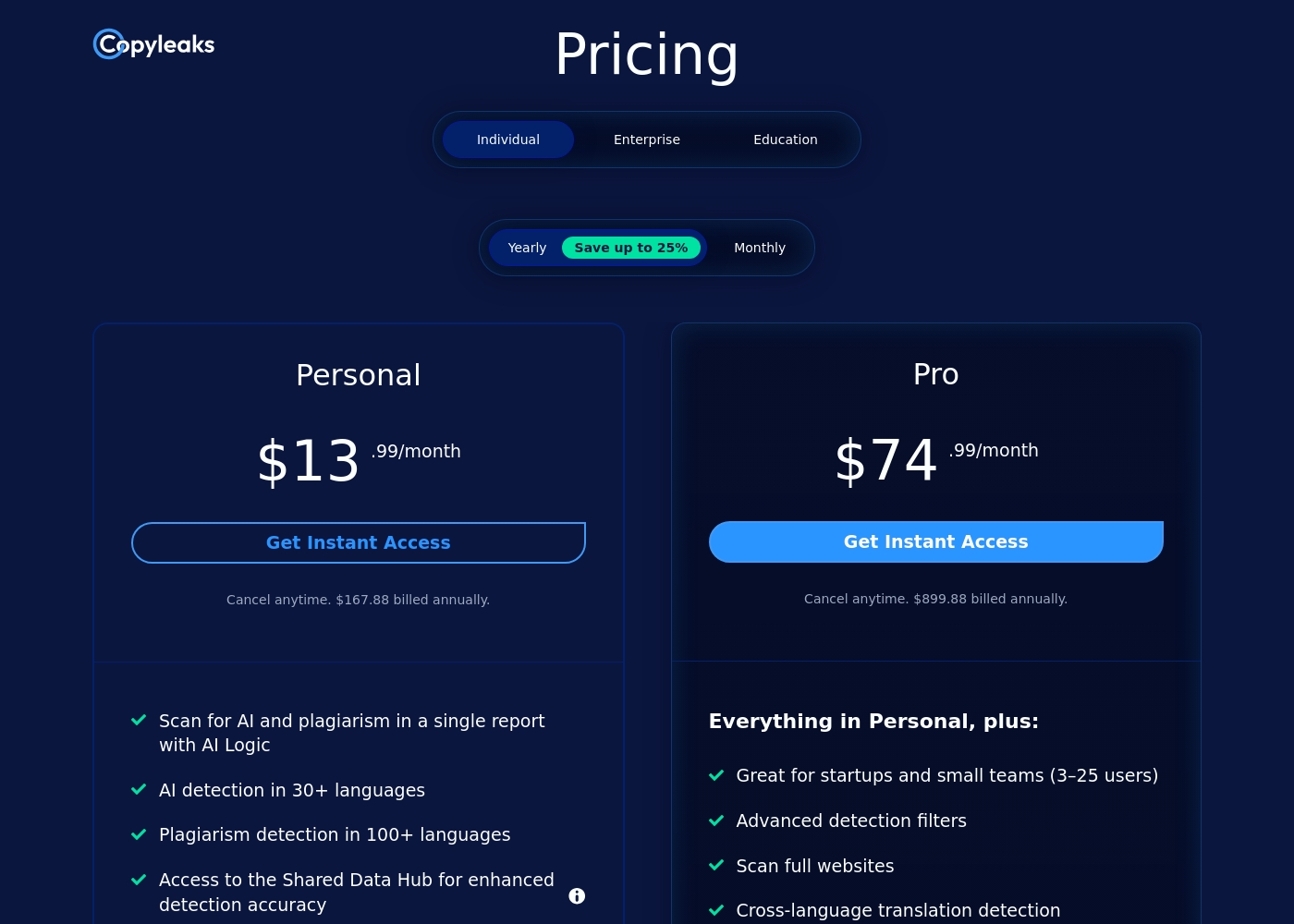
Copyleaks costs between $13.99 and $99.99 per month for individuals with four main pricing paths: Personal at $13.99/month, Pro at $74.99/month, and custom solutions for Enterprise and Education.
We provide detailed information about the individual subscription tiers below, based on the lower annual pricing.
Personal
Price: $13.99/month (billed annually at $167.88) Refund Policy: Limited 10-day conditional guarantee Other Features:
- Scan for AI and plagiarism in a single report with AI Logic
- AI detection in 30+ languages
- Plagiarism detection in 100+ languages
- Access to the Shared Data Hub for enhanced detection accuracy
- Scan for AI and plagiarism in a single report with AI Logic
- AI detection in 30+ languages
- Plagiarism detection in 100+ languages
- Access to the Shared Data Hub for enhanced detection accuracy
- Everything in Personal, plus:
- Great for startups and small teams (3-25 users)
- Advanced detection filters
- Scan full websites
- Cross-language translation detection
- Custom-tailored solution
- Includes API access and LMS integration
- Designed for large teams, institutions, or districts
- Custom-tailored solution
- Includes API access and LMS integration
- Designed for large teams, institutions, or districts
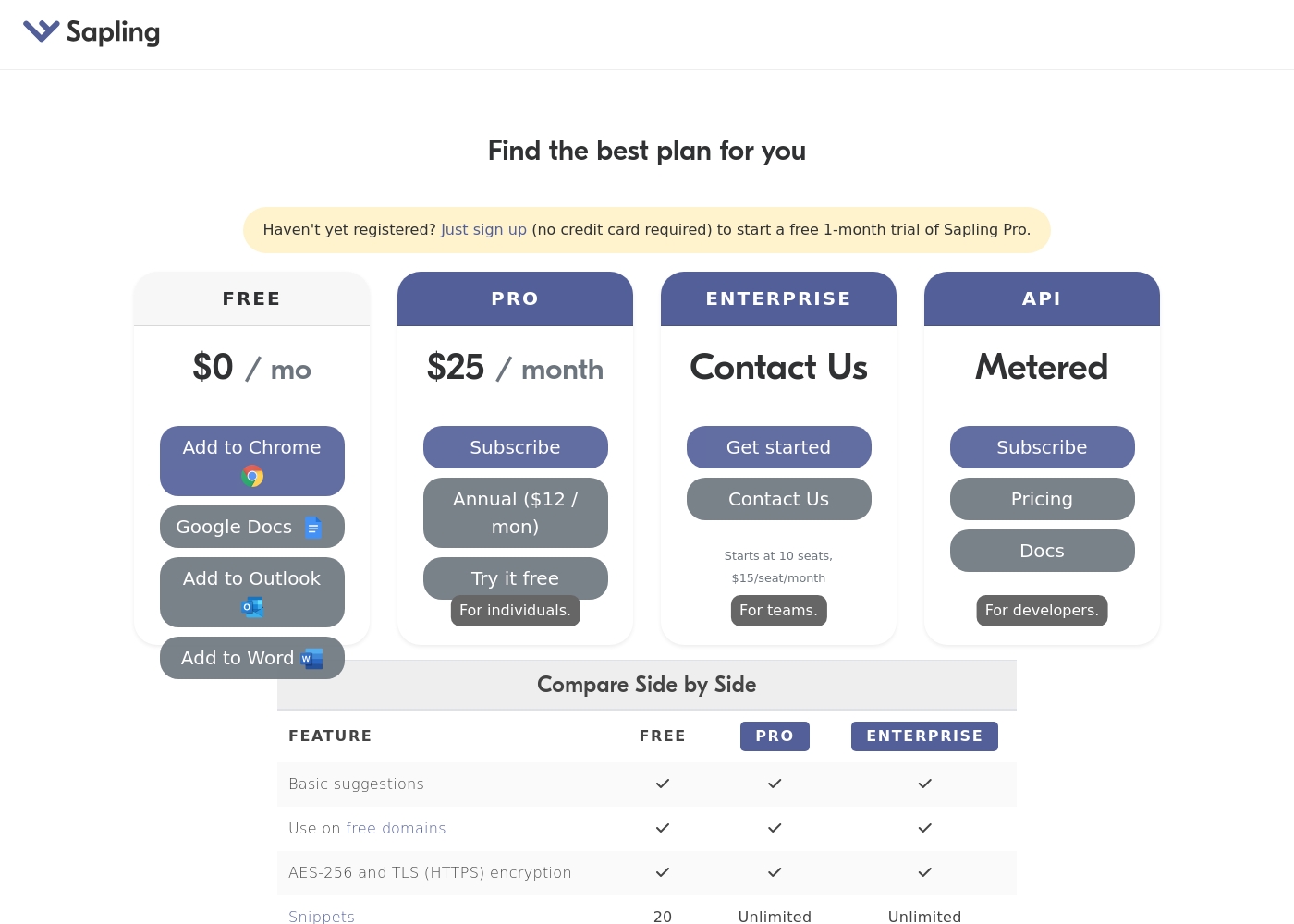
Sapling costs between $0 and $25 per month with four plans: Free at $0/month, Pro at $12/month (annual rate), Enterprise, and API.
You can compare the different options below to find the best fit for your precise writing needs.
Free
Price: $0 / month Best For: Basic individual use Other Features:
- Basic suggestions
- Use on free domains
- AES-256 and TLS (HTTPS) encryption
- 20 Snippets
- Basic suggestions
- Use on free domains
- AES-256 and TLS (HTTPS) encryption
- Basic suggestions
- Use on free domains
- AES-256 and TLS (HTTPS) encryption
- Unlimited Snippets
- Starts at 10 seats
- Priced at $15/seat/month
- Unlimited Snippets
- Basic suggestions and security features included
- Metered pricing structure
- For developers
- Access to full documentation
Pricing Notes
- Sapling offers a simple, flat-rate Pro plan ($12/month annually). Copyleaks uses a credit system that can lead to unpredictable usage costs.
- Sapling provides a generous, no-credit-card required 30-day Pro trial. Copyleaks only offers limited free credits and a highly conditional 10-day refund.
- Sapling's Enterprise requires a 10-seat minimum ($15/seat/month). Copyleaks' Pro plan handles smaller teams (3-25 users) on a credit basis.
- Copyleaks users frequently cite the credit system as confusing and sometimes unfair in external reviews related to billing.
Pricing Head-to-Head
User Reviews
Copyleaks reviews present a sharply divided user experience, reflected in its overall low Trustpilot score. The main criticism involves the tool's core function: accuracy.
Many users, including long-time professional writers, report frustrating experiences where clearly human-written content—even text drafted before LLMs existed—is flagged as 100% AI. These extremely high false-positive rates strongly undermine confidence in the tool’s reliability, causing users to call it a "fake AI detector." Furthermore, users highlight significant issues with the credit system and billing practices.
I have 35 years of writing experience, and when I put my journal entry into Copyleaks, it returned 100% AI content. Every other competing software says 100% Human. Copyleaks is an epic fail.
Sapling's AI Detector generates starkly contrasting feedback across external platforms, resulting in an overall poor rating on Trustpilot, largely due to major concerns regarding its accuracy. Several users report extreme false positives, where 100% human-written content was flagged as AI-generated 🤯.
This recurring reliability issue is a significant pain point for writers and editors. However, the reviews are not entirely negative.
I was a longtime Grammarly user but grew annoyed by missed basic corrections. I switched to Sapling and was pleasantly surprised by the improvement. It’s just much better at catching mistakes and suggesting concise edits that refine my messaging.
Our Verdict
Copyleaks and Sapling are in a heated battle for AI detection dominance today. The ultimate choice for you depends entirely on budget and institutional scale. If you operate at an enterprise level demanding high security, Copyleaks is the clear choice here. Copyleaks’ superpower is its uncompromising security and ability to scale for institutions. It offers GDPR and SOC 2/3 compliance, which is crucial for large corporate or academic clients. Copyleaks integrates directly with LMS systems and detects complex AI-generated code in reports. However, the costly credit system and persistent false positive reports are major user friction points. Sapling’s strength lies in its powerful core writing assistance combined with affordable detection. Sapling’s Pro plan is a predictable, flat $12/month annually, providing amazing value. It excels at refining prose, offering smart suggestions, and flagging low-perplexity text brilliantly. Sapling users also love the generous 30-day free trial requiring no initial credit card. The comparison boils down to organizational needs versus individual flexibility. Choose Copyleaks if compliance and massive document handling capacities are absolutely mandatory. Select Sapling if you primarily need a powerful writing aid and a budget-friendly, easy-to-use detector for individual daily use. Both Copyleaks and Sapling need vastly better accuracy, but Sapling offers a superior user experience.
Frequently Asked Questions
Which uses a confusing credit-based pricing model, Copyleaks or Sapling?
Copyleaks utilizes a credit system where scanning 250 words costs one credit. Sapling uses a simple flat-rate subscription model for its Pro plan. This often makes Copyleaks' pricing volatile based on your heavy scanning volume.
Which is better for large enterprise or academic institutions, Copyleaks or Sapling?
Copyleaks is superior and purpose-built for institutional use and enterprise clients. Copyleaks provides necessary GDPR and SOC 2/3 compliance certifications. It also integrates directly with Learning Management Systems (LMS) for easy academic checks.
Does Sapling detect languages other than English as accurately as Copyleaks?
Sapling’s detection accuracy is optimized primarily for English models (GPT, Gemini). Copyleaks offers strong AI detection support in over 30 languages globally. For multi-lingual content scanning, Copyleaks is definitively the stronger choice.
Can Copyleaks detect AI-generated code for developers?
Yes, Copyleaks can fully analyze and identify AI-generated code, even if the code has been slightly altered. Sapling focuses exclusively on text content analysis and does not offer this specialized code detection feature.
Which software provides a more generous free trial for new users?
Sapling offers a very generous 30-day Pro trial that requires absolutely no credit card input up front. Copyleaks provides customers with a limited number of free credits upon signup to test the tool's core functionality.
Which tool includes dedicated features for improving writing style and grammar?
Sapling operates as both a detector and a powerful writing assistant tool. It offers superior style suggestions and 'Snippets' for text expansion. Copyleaks is solely focused on authenticity detection and plagiarism checks.
Ready to Choose?
Both tools have their strengths. Choose based on your specific needs.