Cognism vs Proof
Cognism and Proof serve completely different growth needs. Cognism is a B2B data powerhouse for European sales teams. Proof is a website personalization tool for boosting conversions. Your choice depends entirely on whether you need better leads or a better website experience.
Best for: B2B sales and marketing teams targeting European markets., Mid-market and enterprise revenue operations teams scaling pipeline.
Best for: Startup marketers looking to increase website conversions., Growth teams wanting to personalize user experiences.
Strong European Data, But Pricy
We found Cognism to be a robust platform for B2B sales teams targeting Europe, with its phone-verified data and compliance focus standing out. Overall, it delivers real value for pipeline building, but the custom pricing and onboarding curve require careful consideration.
Pros
- Excellent phone-verified contact data for higher connect rates.
- Strong compliance and GDPR/CCPA adherence for European markets.
- Generally easy-to-use interface after initial setup.
- Responsive customer support is frequently praised.
Cons
- Pricing is opaque and generally considered expensive.
- Onboarding process can be challenging for new users.
- Data accuracy can be inconsistent or outdated in some cases.
- May not be ideal for very small teams or non-European markets.
Solid personalization tool, but reviews missing.
We reviewed Proof as a website personalization platform aimed at boosting conversions. It offers clear features and structured pricing for growth-focused teams. Overall, we find it a promising tool for targeted marketing, but the lack of accessible user reviews makes it hard to fully validate its real-world performance and support.
Pros
- Offers a 14-day free trial to test core features.
- Usage-based pricing scales with your monthly visitors.
- Features like A/B testing and analytics are included in higher tiers.
- Provides educational resources and case studies for learning.
Cons
- External user reviews are unavailable or inaccessible.
- No public money-back guarantee is stated.
- Pricing can become costly for high-traffic sites.
- May require a strategic setup, not a plug-and-play solution.
AboutCognism
Cognism is a B2B data and sales intelligence platform designed for revenue teams selling into European markets. 🎯 It focuses on providing accurate, compliant contact data—especially phone-verified mobile numbers—to help sales and marketing teams identify and reach decision-makers. The platform is built for SMBs, mid-market, and enterprise teams who need to navigate Europe's complex regulatory landscape and diverse local markets.
AboutProof
Proof is a platform focused on website personalization. 🎯
It's designed for marketers and growth teams at startups and fast-growing companies. The idea is to move beyond a one-size-fits-all website. Instead, you can tailor content, offers, and messaging to different visitor segments. This can help you increase conversions and engage your audience more effectively.
Highlights
Feature Comparison
Features Overview
We highlight the main differences and pick a winner for each feature.
Core Function & Value
Cognism provides verified B2B contact data. Proof personalizes your website to convert visitors.
Cognism's core value is providing accurate, compliant B2B data. It focuses on phone-verified mobile numbers for higher connect rates. The platform helps sales teams find and reach decision-makers in European markets. Proof's core value is website personalization. It lets you tailor content and offers to different visitor segments. The goal is to make your site feel more relevant and turn more traffic into leads or customers. The key difference is data vs. experience. Cognism gives you the leads to call. Proof helps your website convert the leads you already have. They solve different parts of the funnel.
Pricing & Transparency
Cognism requires a custom quote. Proof has clear, public pricing based on your traffic.
Cognism's pricing is custom-quoted. You must contact sales to get a price based on your team size and needs. The model combines a subscription with credits for data reveals. This lack of transparency is a common complaint. Proof's pricing is public and usage-based. Plans start at $29/month for up to 1,000 visitors. You can pay monthly or annually, with savings up to 20%. This makes costs predictable from the start. The trade-off is clarity versus customization. Cognism tailors the cost to your business but hides the numbers. Proof is simple but scales with your traffic, which can get expensive for high-traffic sites.
Target Audience & Use Case
Cognism is for B2B sales teams. Proof is for marketing and growth teams.
Cognism is built for B2B sales and marketing teams. It's ideal for companies with 5+ reps targeting European markets. The use case is building a high-quality sales pipeline with verified contacts. Proof is built for marketers and growth teams at startups. It's for anyone looking to increase website conversions. The use case is personalizing a website to engage different visitor segments. The platforms serve distinct roles. Cognism feeds the top of the sales funnel. Proof optimizes the middle and bottom by converting traffic that's already there.
Data Quality & Verification
Cognism offers phone-verified, compliance-first data. Proof tracks real-time website visitor behavior.
Cognism emphasizes data quality and verification. Its phone-verified mobile numbers go through extra checks, promising up to 3x higher connect rates. Data for senior roles is refreshed every 30 days. Proof's 'data' is about your website visitors. It tracks real-time activity to show social proof notifications. The accuracy is in tracking behavior, not verifying contact information. This is apples and oranges. Cognism verifies external B2B contact data for outreach. Proof collects internal website data to optimize the on-site experience. Their data serves completely different purposes.
Conversion Optimization Tools
Cognism does not offer website tools. Proof is built specifically for this purpose.
Cognism has no features for website conversion optimization. Its tools are for finding leads and enriching CRM data. It doesn't interact with your website visitors directly. Proof is entirely focused on conversion tools. It offers website personalization, social proof notifications, and A/B testing. These features are designed to make your website more effective at capturing leads. Proof wins this category by default. If your goal is to improve website conversions, Proof is the only relevant tool of the two. Cognism operates in a different software category.
Ease of Use & Onboarding
Both have learning curves. Cognism offers guided onboarding. Proof provides educational resources.
Cognism mentions an initial onboarding curve for new users. However, it provides a guided process and resources to start building lists quickly. After setup, the interface is designed to be easy to use. Proof focuses on learning. It offers a free 6-lesson course and case studies. This suggests a strategic setup that benefits from some planning, but is designed to be accessible for marketing teams. The learning curves are similar but different. Cognism's is about mastering a data platform. Proof's is about learning personalization strategy. Both require some upfront investment of time.
Integrations & Ecosystem
Cognism integrates with major CRMs. Proof's integrations are not clearly listed.
Cognism integrates with major CRMs like Salesforce and HubSpot. It also connects with engagement tools like Pipedrive. This lets you enrich records directly within your existing workflow. Proof's website does not explicitly list integrations. It's unclear how it connects with other marketing tools or CRMs. You would need to contact support to confirm compatibility with your platform. Cognism has a clear advantage in integration transparency. It plugs directly into the sales tech stack you likely already use. Proof's ecosystem is less defined from the available information.
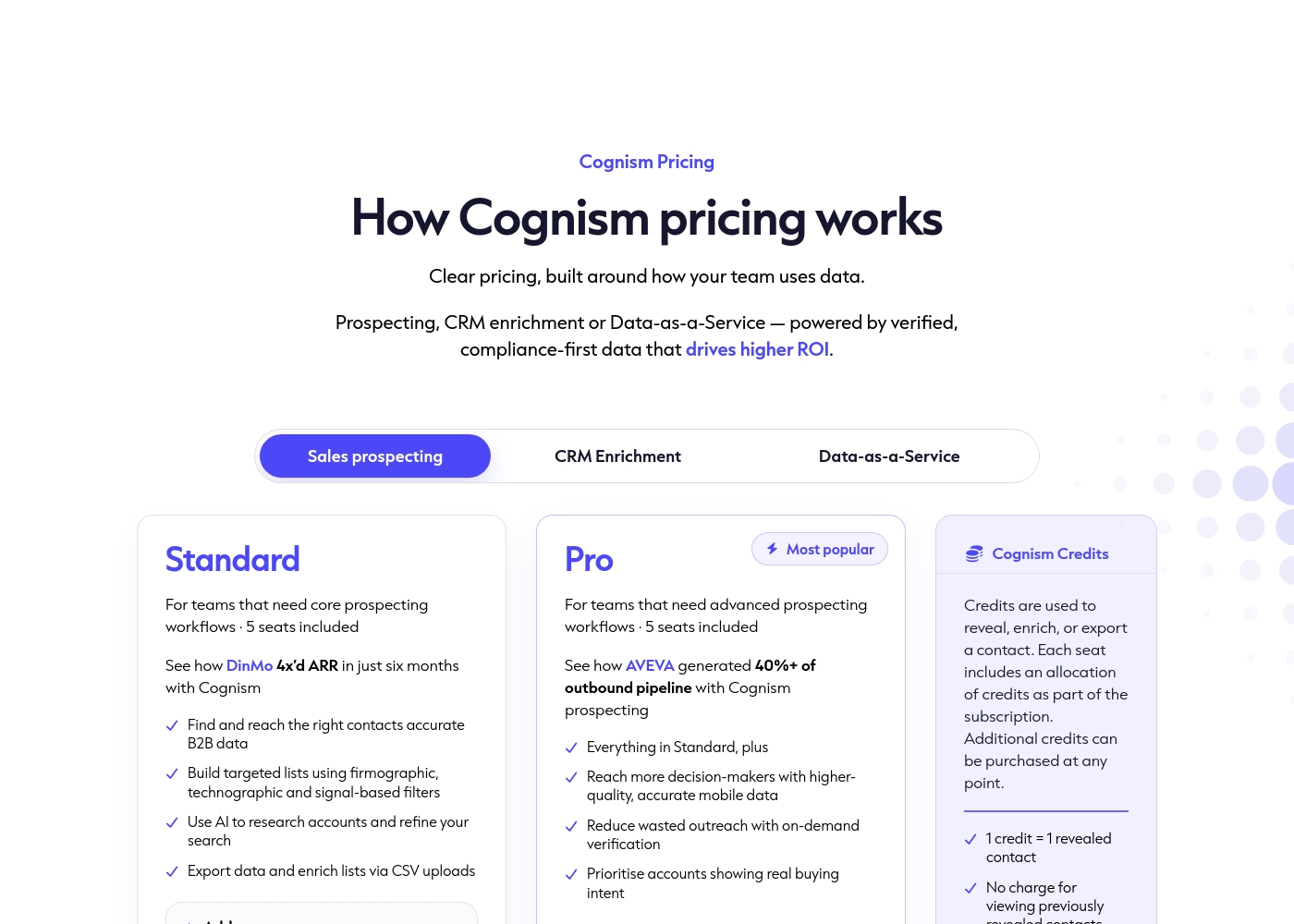
Cognism pricing: Cognism offers custom subscription-based pricing tailored to your team size and data needs. The platform features two core prospecting tiers, Standard and Pro, alongside available add-ons for CRM enrichment and API access segments to ensure you only pay for what you use.
All pricing and seats are designed to scale with your team's growth and data volume requirements. Please contact their sales team for a personalized quote tailored to your specific goals and seat requirements.
No prices are publicly listed, as each plan is custom-tailored to the business needs of the user. Their platform uses a credit-based model for revealing, enriching, or exporting company and contact records to keep your team up to date with the latest information.
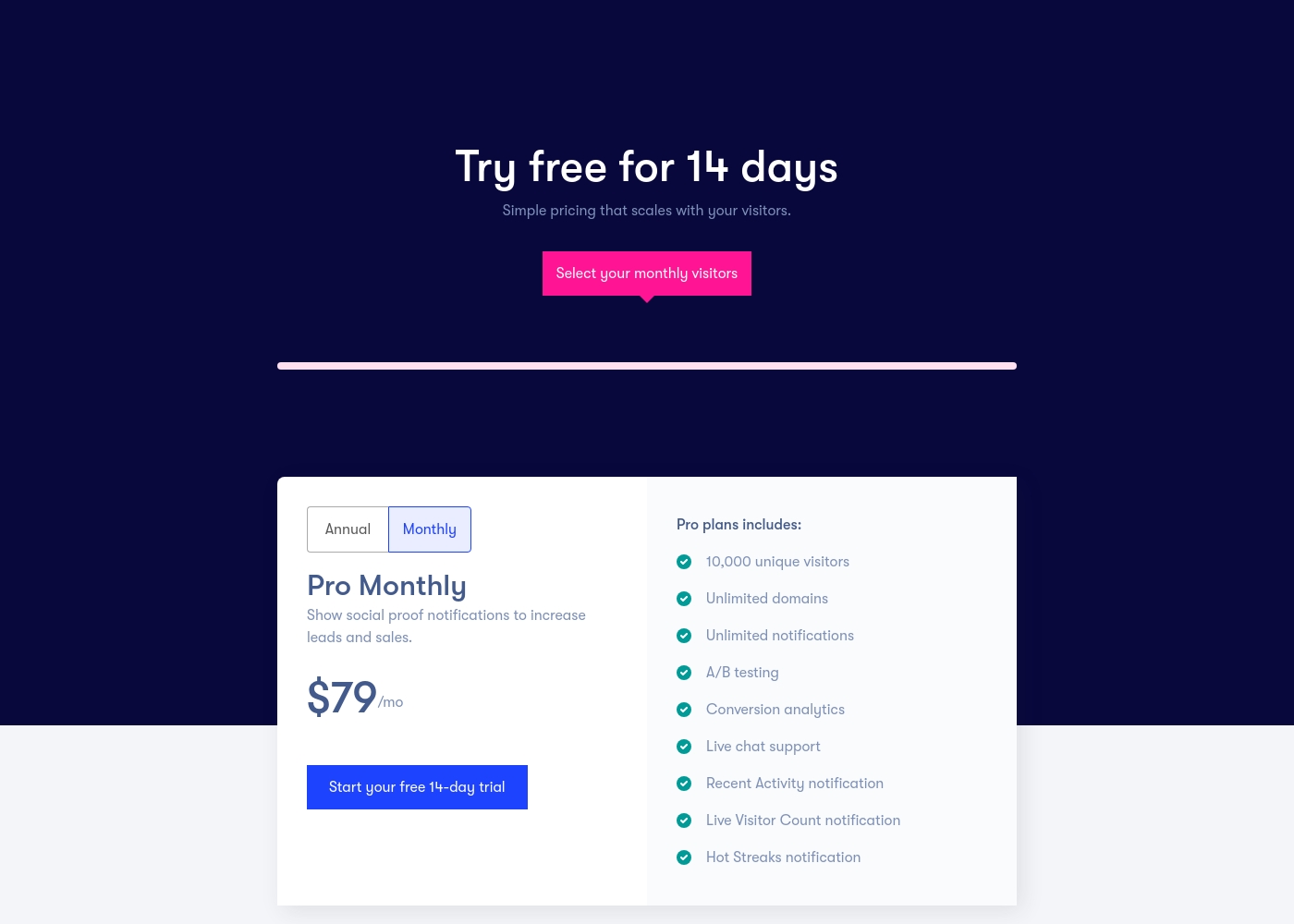
Proof costs between $24 and $108 per month billed annually with at least 5 plans: Basic at $24/mo, Pro at $66/mo, Business at $108/mo, Premium, and Platinum.
Choose the plan that fits your monthly traffic to start growing your conversion rates.
Basic
Price: $29/mo or $24/mo billed annually Best For: Small sites starting with social proof Other Features: Recent Activity notifications, Lead increase tools
- Show social proof notifications
- Recent Activity notifications
- Unlimited domains
- A/B testing
- Conversion analytics
- Live chat support
- Everything in Pro
- Unlimited notifications
- Hot Streaks notification
Pricing Notes
- Cognism uses opaque, custom-quoted pricing combining a subscription with a credit-based model.
- Proof has transparent, public pricing that scales with your monthly unique visitors.
- Proof offers a 14-day free trial; Cognism does not.
- Annual billing for Proof saves up to 20%.
- Cognism's pricing is generally considered expensive and is a common point of feedback.
Pricing Head-to-Head
User Reviews
We found mixed sentiment in external reviews for Cognism. Users consistently praise the high accuracy and quality of phone-verified data, which helps connect with decision-makers.
Many also highlight the platform's ease of use and strong customer support. However, recurring complaints focus on high pricing that isn't transparent, onboarding challenges, and occasional data reliability issues, like outdated contacts.
The data quality is top-notch, especially the mobile numbers. It's made a real difference in our outreach. Support has been helpful whenever we had questions.
We found external reviews for Proof to be limited and mixed, with a notable absence of substantive feedback from major review platforms. ⚠️ On Trustpilot, the profile is largely empty, offering no clear user sentiment.
Capterra returned a security error, preventing access to any reviews. Consequently, we lack concrete user feedback on key themes like accuracy, ease of use, or support.
Our Verdict
For most people, this isn't a direct comparison—it's about what you need. Cognism's superpower is providing verified B2B contact data for European sales. It promises up to 3x higher connect rates with phone-verified numbers. This is a huge deal for teams whose pipeline depends on cold outreach. Proof's superpower is personalizing your website to turn more visitors into leads. It can help you show the right message to the right person. One case study showed a 162% increase in content downloads. The deciding factor is your growth bottleneck. If you need better leads to call, Cognism is your tool. If you need your existing website traffic to convert better, Proof is the answer. Choose Cognism if you're a B2B sales team with 5+ reps building pipeline in Europe. Choose Proof if you're a marketing team at a startup focused on conversion rate optimization. They solve different problems, so pick the one that matches your biggest challenge.
Frequently Asked Questions
Which is better for small teams: Cognism or Proof?
Proof is likely better for small teams. Its public pricing starts at $29/month and scales with traffic. Cognism is designed for teams of 5+ salespeople and has opaque, custom-quoted pricing.
Does Cognism have website personalization features like Proof?
No. Cognism focuses on B2B data and sales intelligence. It does not offer website personalization tools. Proof is built specifically for that purpose.
Is Proof worth the extra cost over Cognism?
They aren't directly comparable in cost or function. Proof's cost is based on your website traffic. Cognism's cost is based on your team size and data needs. Value depends on whether you need better leads or a better website.
Can I migrate from Cognism to Proof easily?
They serve different functions, so migration isn't a direct concept. You'd use Cognism for lead generation and Proof for website conversion. They can be used together, not as replacements for each other.
Which tool offers a free trial?
Proof offers a 14-day free trial on all plans. Cognism does not offer a free trial; you must book a discovery demo to see the platform.
For which region is Cognism's data the strongest?
Cognism specializes in providing B2B data for European markets. It is built specifically for the regulatory complexity of regions like the UK, Germany, and France.
Ready to Choose?
Both tools have their strengths. Choose based on your specific needs.