Coast vs Zoho Books
Coast and Zoho Books solve completely different business problems. Coast is a specialized fuel and expense card for fleets. Zoho Books is a full accounting platform. Choosing the right one depends entirely on your core need: controlling fleet spend or managing your books.
Best for: Fleet managers and operations leaders in construction, landscaping, and field services, Small to mid-sized businesses seeking to consolidate fuel and corporate card programs
Best for: Solopreneurs and micro-businesses needing free accounting software, Small to medium businesses requiring invoicing, expenses, and inventory
Smart fuel card, real control.
We found Coast to be a strong, unified solution for fleet-based businesses tired of juggling separate fuel and expense cards. It delivers powerful controls and real-time tracking that can genuinely cut down on admin and prevent fraud. Overall, it's a compelling choice for teams ready to consolidate their spending into one efficient platform.
Pros
- All-in-one card for fuel, field, and office expenses simplifies tracking.
- Strong custom controls and telematics integrations help prevent fuel fraud.
- Real-time spending visibility and alerts for immediate oversight.
- Competitive fuel rebates and discounts at 30,000+ stations.
Cons
- $4 monthly fee per active user can become significant for large teams.
- 2.5% fee on foreign transactions limits international use.
- Customer support responsiveness is inconsistent according to some users.
- Requires integrations with telematics/accounting software for maximum value.
Scalable Accounting with Clear Value.
We find that Zoho Books provides a comprehensive and budget-friendly alternative to complex accounting systems. The scalability, permanent free tier, and full financial management capabilities are major strengths. Overall, this is a top recommendation for growing businesses needing feature-rich accounting without high legacy costs.
Pros
- Permanent Free plan available for micro-businesses.
- Highly scalable pricing structure with competitive annual rates.
- Cloud-based, comprehensive solution covering invoicing, inventory, and expenses.
- User-friendly interface simplifies daily financial tasks.
Cons
- Severe MFA reset issues reported across the Zoho suite can lock users out of accounts.
- Mixed reports regarding customer service responsiveness.
- All plans impose explicit annual limits on invoices and expenses.
- External accounting-specific feedback on accuracy and reliability is limited.
AboutCoast
Coast is an all-in-one fuel card, corporate card, and expense management platform built for businesses with fleets. It's designed to replace multiple card programs and manual processes, giving companies like landscaping, construction, and field service teams a single tool to control and track all their spending. The platform provides powerful fraud prevention, integrates with existing telematics and accounting software, and aims to help businesses save significantly on fuel and admin time.
AboutZoho Books
Zoho Books is comprehensive, cloud-based accounting software built specifically for growing businesses. It helps you manage your entire financial workflow seamlessly, integrating key functions into one place. You can handle everything from tracking expenses to controlling inventory and processing invoices. Because it’s available through mobile apps for iOS and Android, you can easily manage your books on the go. ✅
Highlights
Feature Comparison
Features Overview
We highlight the main differences and pick a winner for each feature.
Core Purpose
Coast is a fleet expense platform. Zoho Books is full accounting software.
Coast provides a smart Visa card and controls specifically for fuel, vehicle maintenance, and field expenses. It's designed to replace multiple corporate and fuel cards for fleet-based businesses. Zoho Books is comprehensive accounting software. It handles invoicing, expense tracking, bill management, inventory, payroll, and financial reporting for any type of business. The key difference is specialization versus breadth. Coast offers deep control for a specific financial flow (fleet spending), while Zoho Books offers a wide range of general accounting functions. A landscaping company needs Coast to manage crew fuel and supply purchases. A retail store needs Zoho Books to manage invoices, inventory, and taxes.
Pricing Model
Coast has a simple per-user fee. Zoho Books offers tiered plans and a free option.
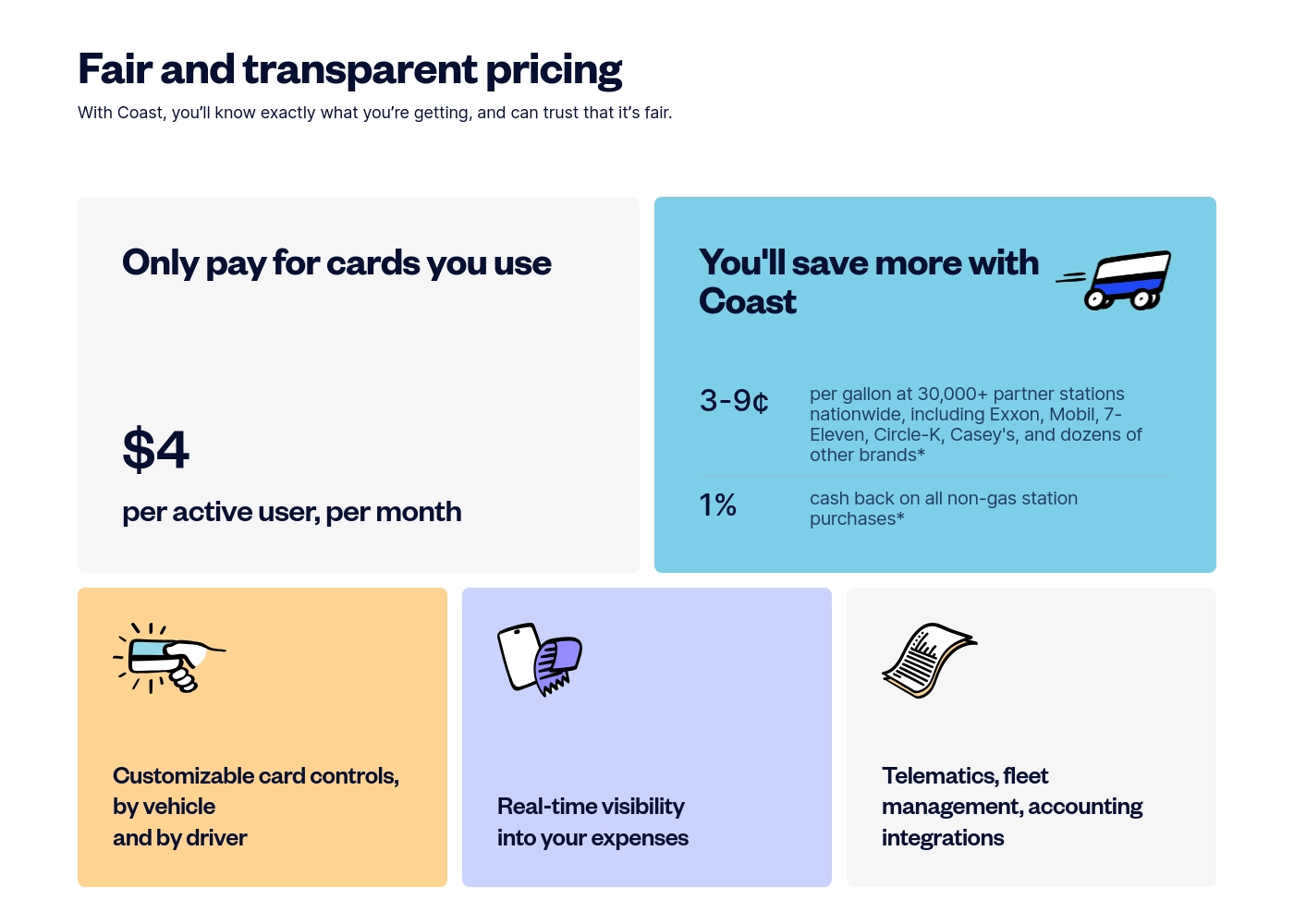
Coast charges $4 per active user per month. You only pay for users who make a transaction. There are no other plans or hidden setup fees. Zoho Books has six tiers, from a permanent Free plan (for <$50K revenue) up to Ultimate at $240/month. Annual billing saves about 20%. Coast's pricing is straightforward and scales with active users. Zoho's pricing scales with features and user counts, requiring you to pick the right tier. For a 10-person fleet, Coast costs $40/month total. Zoho Books Standard plan (3 users) costs $15/month, but you'd need the Professional plan ($40/month) for 5 users.
Ease of Use
Coast focuses on card controls. Zoho Books simplifies complex accounting.
Coast emphasizes a fast online application, approved in minutes. The platform is built for real-time spending visibility and simple rule-setting for cards. Zoho Books is noted for its intuitive interface that simplifies daily financial tasks. Users report it's easy to navigate through invoicing, expenses, and reports. Both tools aim to simplify their respective tasks. Coast makes managing fleet expenses easier. Zoho Books makes managing general finances easier. For a field crew, using the Coast app to unlock a card for gas is a quick, daily task. For an office manager, processing an invoice in Zoho Books is a routine task.
Customer Support
Coast provides US-based support. Zoho offers tiered support channels.
Coast offers 100% US-based customer support. Their goal is to resolve issues on the first call. There's no public SLA listed. Zoho Books provides support via Email, Voice, and Chat for paid plans. The Free plan includes email-only support. Availability is Monday through Friday. Coast's support is specialized for its card platform. Zoho's support covers a broad accounting ecosystem. Some Coast users report inconsistent support responsiveness. Zoho users report mixed experiences with support, including a serious MFA reset issue.
Automation
Coast automates expense categorization. Zoho Books automates full financial workflows.
Coast automates expense tracking by syncing transactions and receipts to your accounting software. It can auto-categorize and attach digital receipts. Zoho Books automates complex workflows. It can send payment reminders, generate recurring invoices, and trigger alerts based on custom rules. Coast's automation is focused on the expense data flow. Zoho's automation spans invoicing, payments, and internal notifications. A fleet manager using Coast saves hours on expense reports. A business owner using Zoho Books saves time chasing payments and entering data.
Reporting & Analytics
Coast shows real-time spending. Zoho Books provides deep financial analytics.
Coast provides real-time dashboards for all card transactions. You can see spending as it happens and spot patterns like fuel theft or poor mileage. Zoho Books offers over 50 standard reports, including P&L and Balance Sheet. Higher tiers add budgeting, cash flow forecasting, and advanced analytics. Coast's reporting is operational and immediate. Zoho's reporting is financial and strategic. With Coast, you instantly see a card used off-route. With Zoho Books, you analyze quarterly profitability by product line.
Integration Ecosystem
Coast connects to telematics and accounting. Zoho is an ecosystem hub.
Coast integrates with key telematics (Samsara, Geotab) and accounting systems (QuickBooks, NetSuite). These are essential for its advanced fraud prevention and bookkeeping. Zoho Books integrates with hundreds of apps through Zoho's marketplace and APIs. It connects to banks, payment gateways, and other Zoho apps. Coast's integrations are critical for its core value proposition. Zoho's integrations are for expanding functionality. Without a telematics integration, Coast loses its best fraud prevention feature. Without integrations, Zoho Books can still function as standalone accounting.
Mobile Experience
Both offer mobile apps for core functions on the go.
Coast has a mobile app for drivers to unlock cards, view transactions, and capture receipts. Some users note occasional app instability. Zoho Books has full-featured mobile apps for iOS and Android. Users can create invoices, record expenses, and manage finances from anywhere. Both apps provide essential mobile access. Coast's is for field use; Zoho's is for remote management. A driver uses the Coast app at the gas pump. A manager uses the Zoho Books app to approve a bill while traveling.
Coast costs $4 per active user per month with 1 plan: Coast Fleet & Fuel Card at $4 per active user per month.
Take a look at how our simple, usage-based model works for your team.
Coast Fleet & Fuel Card
Price: $4 per active user per month Best For: Growing fleets needing fuel and expense management Other Features: 3–9¢ fuel rebates per gallon, 1% cashback on non-gas purchases, customizable card controls, Visa acceptance everywhere, real-time expense visibility
- 3–9¢ per gallon rebates at 30,000+ partners
- 1% cash back on all non-gas station purchases
- Customizable card controls by vehicle and driver
- Real-time visibility into expenses
- Accounting and telematics integrations
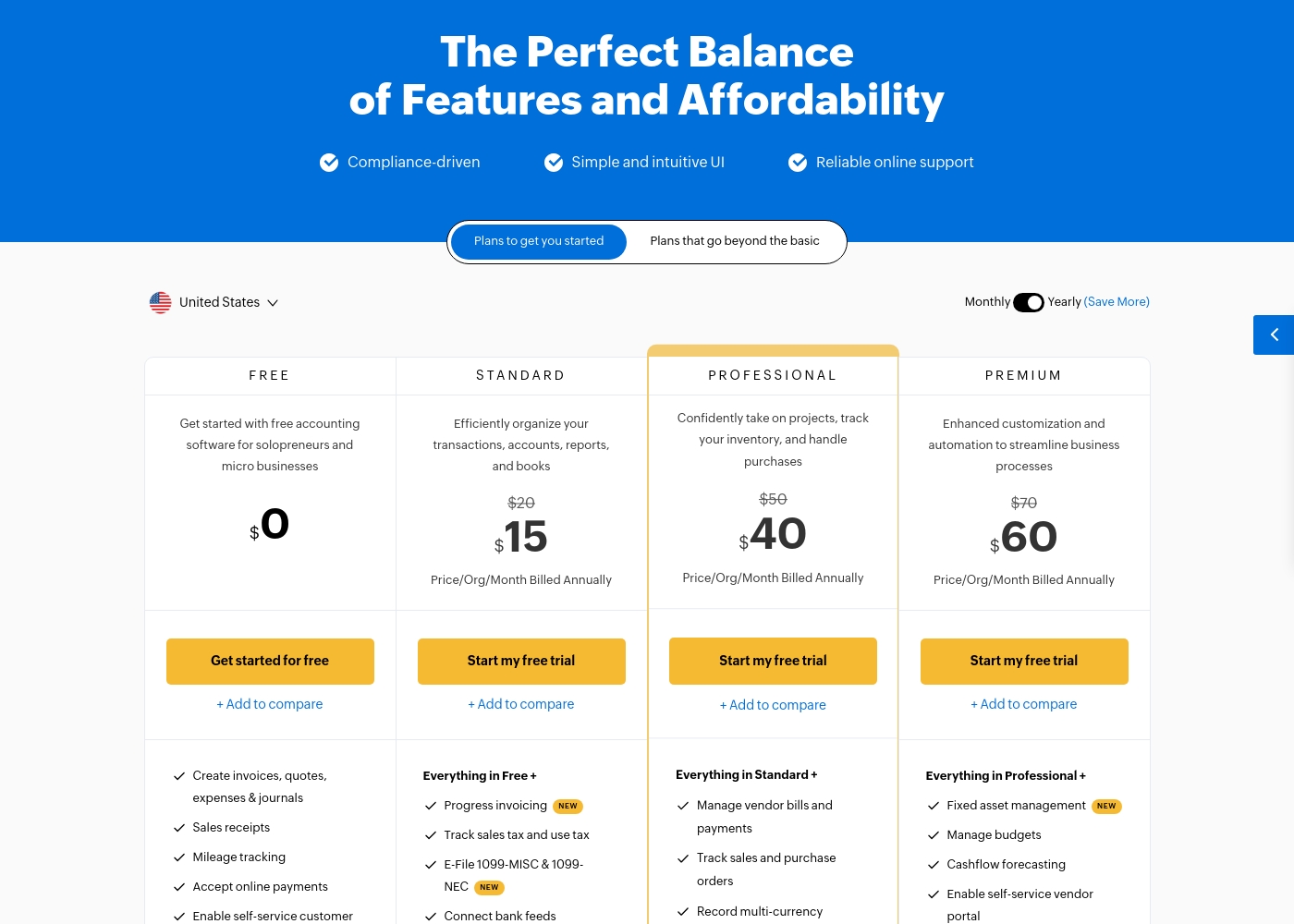
Zoho Books costs between $0 and $240 per month (billed annually) with six plans: FREE at $0, STANDARD at $15, PROFESSIONAL at $40, PREMIUM at $60, ELITE at $120, and ULTIMATE at $240.
Zoho Books offers plans built to grow with your company, from sole proprietors to large teams. Let's look closely at what is included in each option.
FREE
Price: $0.00 Best For: Solopreneurs and micro businesses (up to $50K annual revenue) Other Features:
- Create invoices, quotes, expenses, and journals
- Process sales receipts and track mileage
- Enable self-service customer portal
- Email Support (1 User + 1 Accountant)
- Create invoices, quotes, expenses & journals
- Sales receipts
- Mileage tracking
- Accept online payments
- Enable self-service customer portal
- Progress invoicing
- Track sales tax and use tax
- E-File 1099-MISC & 1099-NEC
- Connect bank feeds
- Generate divisional reports with reporting tags
- Manage vendor bills and payments
- Track sales and purchase orders
- Record multi-currency transactions
- Bill timesheets
- Project profitability
- Fixed asset management
- Manage budgets
- Cashflow forecasting
- Enable self-service vendor portal
- Set up custom domain
Pricing Notes
- Coast's $4 per user fee applies only to users who make at least one transaction that month.
- Zoho Books offers a permanent Free plan for businesses with under $50,000 in annual revenue.
- Zoho Books provides a 14-day free trial on all paid plans.
- Coast charges a 2.5% fee on international transactions.
- Zoho Books annual billing saves about 20% compared to monthly billing.
Pricing Head-to-Head
User Reviews
We couldn't access detailed reviews from Capterra due to a security block. From Trustpilot, users praise Coast's easy setup and the real-time visibility it provides over fleet spending.
Many highlight the fuel rebates and the simplicity of having one card for all expenses. However, some note that customer support can be slow to resolve issues and that the $4 per user monthly fee adds up for larger teams.
Signing up was incredibly fast. The card gives me real-time notifications for every purchase, which is perfect for managing my crew's spending. The fuel rebates are a nice bonus that adds up.
While Zoho maintains an overall positive rating of 4.1/5 across thousands of reviews, most specific feedback provided recently centers on the Zoho Social tool, not the Books accounting software. Regardless, the consensus affirms Zoho’s commitment to excellent ease of use and high functional value.
Users consistently praise the platform for its intuitive interface, which streamlines workflows and simplifies multi-account management. Many appreciate that Zoho provides advanced functionality for a fraction of the cost of competitors, representing significant value for startups and small teams.
This platform offers huge functionality without the huge price tag. I used managers that cost ten times more, but Zoho offers the same key features and is incredibly user-friendly. It’s excellent value.
Our Verdict
There's no single winner here. These tools solve entirely different problems. Your choice depends on whether you need to control fleet spending or manage your company's books. Coast's superpower is unified fleet expense control. It combines fuel cards, corporate cards, and real-time rules into one platform. This stops fraud before it happens and automates your expense reporting. Zoho Books's superpower is scalable accounting. It offers everything from a free plan to advanced inventory and analytics. This lets you manage your entire financial workflow without breaking the bank. The deciding factor is your core need. If your main pain is tracking gas receipts and preventing driver fraud, choose Coast. If your main pain is invoicing clients, tracking inventory, and balancing books, choose Zoho Books. For most businesses, Zoho Books is the more universal solution. Choose Coast only if you have a fleet-based operation with specific, complex expense management needs.
Frequently Asked Questions
Which is better for small teams: Coast or Zoho Books?
It depends on your business type. Zoho Books is better for small teams needing general accounting, with a free plan for up to $50K revenue. Coast is for small fleet-based teams, costing $4 per active user.
Does Coast handle invoicing like Zoho Books?
No, Coast is not an accounting tool. It manages fleet expenses and card controls. Zoho Books is dedicated accounting software that creates invoices, quotes, and handles all receivables.
Is Zoho Books worth the extra cost over Coast?
This isn't a direct cost comparison. Zoho Books offers accounting for as low as $0-$15/month. Coast costs $4/user but provides fleet expense management, not accounting. Value depends on your core need.
Can I migrate from Coast to Zoho Books easily?
They serve different functions, so migration isn't direct. You would use Zoho Books for accounting. You can connect Coast to Zoho Books via integration to auto-sync your expense transactions.
Which platform is better for preventing fraud?
Coast is built for fraud prevention, especially fuel fraud. It offers GPS-based card locking and custom spending rules. Zoho Books focuses on financial accuracy and accounting controls.
Do I need both Coast and Zoho Books?
Many fleet businesses do. Coast handles the field card spending and controls. Zoho Books handles the accounting. They integrate together to sync transactions automatically.
Ready to Choose?
Both tools have their strengths. Choose based on your specific needs.