Close CRM vs Salesforce
Close CRM and Salesforce tackle Customer Relationship Management very differently for sales teams. Close CRM offers a streamlined, sales-first communication hub to cut tool chaos. Salesforce provides a massive, customizable platform built for extreme enterprise scalability and specialized industries. Here is how to choose the right fit for your business.
Best for: Growing sales teams (5-50 users) focused on call and email outreach, Teams seeking reliable built-in automation to cut high Zapier costs
Best for: Enterprise organizations (500+ employees) needing total data unification, Businesses requiring industry-specific clouds (e.g., Healthcare, Financial Services)
Simple CRM with mixed user experiences.
We find Close CRM offers a solid, all-in-one platform for small sales teams needing built-in calling, email, and AI automation. Overall, it's a capable tool, but its reliability and support responsiveness have drawn significant criticism from some users, making it a mixed bag for certain teams.
Pros
- All-in-one platform for calling, email, SMS, and pipeline management.
- AI agent (Chloe) automates follow-ups and lead engagement.
- Built-in Power and Predictive Dialers for high-volume teams.
- Straightforward UI that's easy to learn without complex training.
Cons
- Auto-security system can lock trials or accounts without warning, causing data access issues.
- Support sometimes provides generic, copy-paste responses instead of personalized help.
- Recent interface updates have introduced bugs, high latency, and missing functions for some users.
- iPhone app has been reported as slow and prone to call stuttering.
Enterprise Power, Support Needs Fixing
We recognize Salesforce as a globally powerful, feature-rich platform offering expansive, industry-specific tools. However, feedback related to customer support, proprietary billing, and usability is substantially negative and concerning. Overall, the foundational product is essential for large enterprises, but the necessary customer service and contractual practices appear fundamentally broken for many users.
Pros
- Extensive, feature-rich platform capable of handling complex enterprise needs.
- Offers specialized products and industry-specific Cloud solutions.
- Strong ecosystem, community, and AppExchange support.
- Effective for complex data pulling and building detailed reports.
Cons
- Customer service and support are widely reported as nonexistent or abysmal.
- Billing practices are often described as predatory, inflexible, and costly.
- The software is cumbersome, time-consuming, and requires excessive clicks for daily tasks.
- Sales teams pressure long-term contracts (3+ years) and high annual price increases.
AboutClose CRM
Close is a sales CRM built for teams that sell. It combines calling, email, SMS, pipeline management, reporting, and an AI sales agent named Chloe into a single platform. ✅ It's designed for sales teams who want to act on their sales data quickly and efficiently, rather than juggling multiple tools. The platform is trusted by over 11,500 sales teams.
AboutSalesforce
Salesforce is a leading global software company recognized for providing integrated technology solutions. It helps businesses across many sectors, offering specific tools for Financial Services, Retail, Healthcare, and more.
This platform focuses on connecting proactively with customers, automating workflows, and unifying data. Importantly, Salesforce incorporates powerful AI agents like Agentforce to improve support, boost productivity, and drive business outcomes.
The system aims to give you a single, unified value chain approach. You can also leverage a strong ecosystem through the AppExchange for additional tools and partners.
Highlights
Feature Comparison
Features Overview
We highlight the main differences and pick a winner for each feature.
Target Audience
Close CRM serves fast-growing sales teams needing focus and speed. Salesforce is designed for complex, massive enterprise operations.
Close CRM targets teams looking to centralize communications and reduce external tool reliance. It is built specifically for selling, not just broad data management. Close CRM's Solo plan limits usage to one person and 10,000 leads. Salesforce is designed for large organizations requiring deep specialization. They offer dedicated clouds for manufacturing, finance, healthcare, and education. Salesforce handles massive scale and high complexity better than Close CRM. If your sales team is the core of your business, Close CRM is likely less bloated. If you need 1,000 users across five departments, Salesforce is the safer, albeit complex, choice. The decision hinges entirely on your current size and future scale expectations.
Pricing Structure
Close CRM has transparent, low-cost pricing; Salesforce uses opaque, customized quotes.
Close CRM clearly lists plans from $0 to $250/year per seat, offering excellent transparency. Plans can be purchased monthly or annually, providing flexibility. Close CRM aims to lower costs by replacing tools like Zapier with built-in automation. Salesforce pricing is quote-based and customized for each client's specific blend of 'Clouds.' Most Salesforce subscriptions require annual contracts paid entirely in advance. Salesforce’s structure can lead to unexpected add-on costs and high yearly renewal fees. Close CRM wins easily on upfront cost clarity and flexibility for smaller budgets. Salesforce requires serious budgeting and negotiation due to its complex custom quoting. Watch out for reported predatory billing practices with Salesforce.
Ease of Use
Close CRM prioritizes simplicity and efficient selling; Salesforce is widely criticized as cumbersome.
Close CRM features a 'sales-first design' focused on managing customers and closing deals quickly. The system centralizes context to help new reps onboard very fast. Close CRM specifically aims to minimize time spent on busywork and data entry. Salesforce users frequently report the software is cumbersome and unintuitive for daily use. Front-line staff often complain of excessive clicks required to complete simple tasks. Salesforce’s power comes at the cost of day-to-day usability for sales reps. If you prioritize staff usability and adoption speed, Close CRM is the clear winner for frontline employees. Salesforce demands more discipline and patience for necessary data input.
Advanced AI Features
Close CRM offers sales productivity AI; Salesforce focuses on service automation with Agentforce AI.
Close CRM uses AI Notetaker, AI Enrich, and AI Summaries to quickly assist reps during calls and emails. It also offers built-in integration with external tools like Claude and ChatGPT. This AI focus streamlines outreach and internal communication tasks. Salesforce promotes Agentforce AI for building autonomous agents that support employees and customers 24/7. Agentforce helps boost productivity and accelerate support case resolution. Structured learning paths are available to help teams master Agentforce implementation. Close CRM’s AI assists direct selling actions, whereas Salesforce uses AI to scale service and support capabilities. Both offer strong AI but target different functional areas. For core sales efficiency, Close CRM provides immediate value; for automated external support, Salesforce is the expert.
Integration Ecosystem
Salesforce has a massive, powerful ecosystem; Close CRM focuses on reliable internal automation.
Close CRM’s core value is reducing the need for extensive integrations and lowering high Zapier bills. It offers API access and supports standard tools like Zoom, Calendly, and Segment. Close CRM aims for reliable data flows by centralizing communications. Salesforce offers the vast AppExchange, connecting users to thousands of partners, apps, and add-ons. For complex data linking across large systems, Salesforce can leverage MuleSoft licenses. This makes Salesforce unmatched in connecting complex business systems. If connectivity to specialized tools (like industry finance software) is critical, choose Salesforce. If your aim is simple, reliable connectivity that “just works” for sales, Close CRM is preferable.
Customer Support
Close CRM offers standard email support; Salesforce customer support is widely reported as abysmal.
Close CRM provides a 24/7 knowledge base and email support options for its users. The smaller scale of Close CRM often correlates with higher support availability. Close CRM users rely on standard tiered support channels. Salesforce user reviews report support is terrible, nonexistent, and difficult to access. Users complain about unhelpful automated systems and difficulty connecting with account managers. This serious service lag is a major pain point after paying annual fees. Close CRM wins by not having the severely negative support sentiment plague issues of Salesforce. The promise of global power from Salesforce often seems broken regarding post-sale assistance.
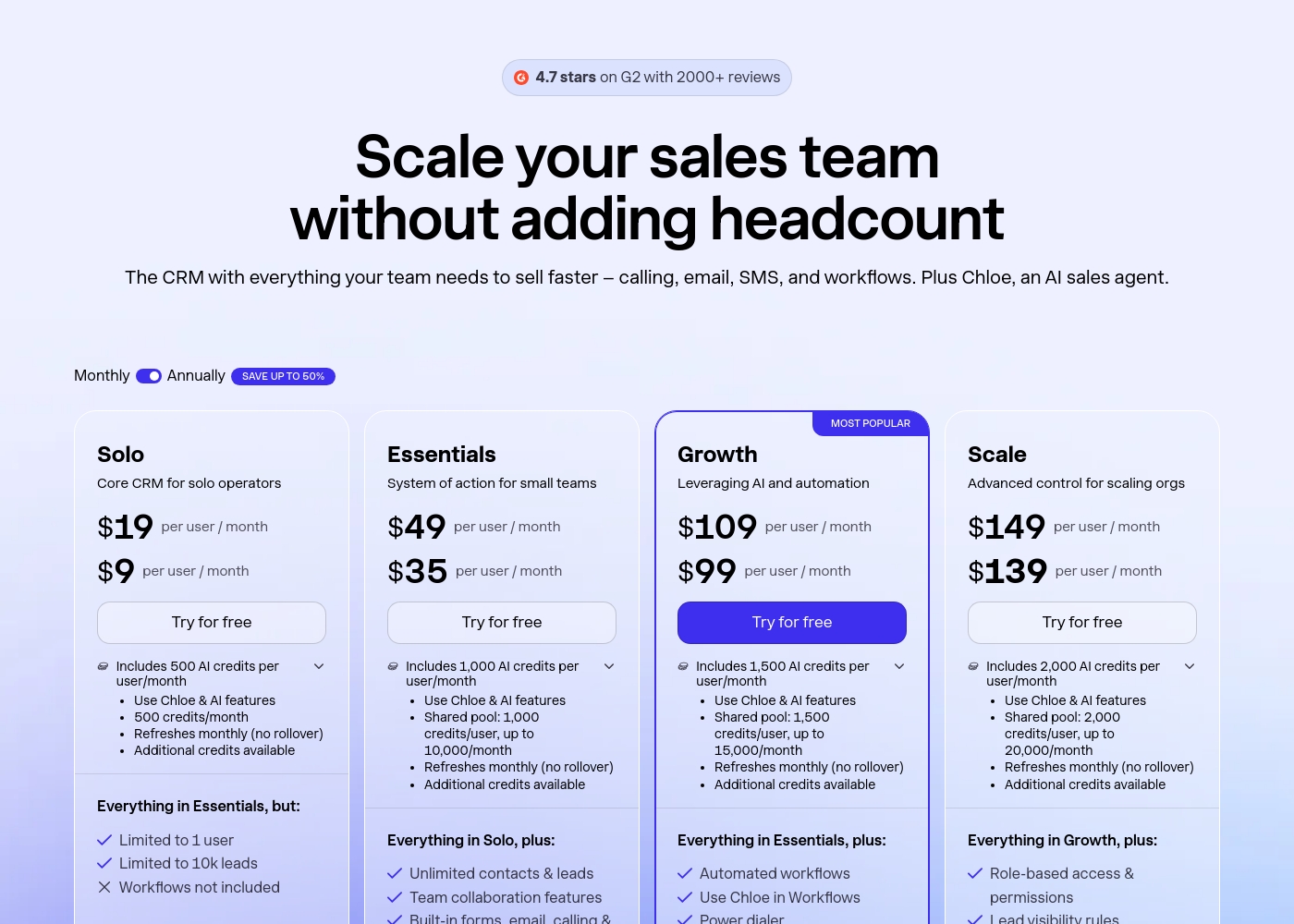
Close CRM costs between $9 and $139 per user/month with 4 plans: Solo at $9, Essentials at $35, Growth at $99, and Scale at $139.
Here is a quick breakdown to help you pick the best tier for your sales workflow.
Solo
Price: $9 per user/month (billed annually) Best For: Founders and solo reps who need a CRM instead of a spreadsheet Other Features:
- Includes 500 AI credits per user each month
- Limited to 1 user and up to 10,000 leads
- Core CRM tools for email, calling, and SMS
- Includes 500 AI credits per user/month
- Use Chloe & AI features
- 500 credits/month, refreshes monthly
- Limited to 1 user
- Limited to 10k leads
- Includes 1,000 AI credits per user/month
- Shared pool: 1,000 credits/user, up to 10,000/month
- Unlimited contacts & leads
- Team collaboration features
- Built-in forms, email, calling & SMS
- Includes 1,500 AI credits per user/month
- Shared pool: 1,500 credits/user, up to 15,000/month
- Automated workflows
- Use Chloe in Workflows
- Power dialer
- Includes 2,000 AI credits per user/month
- Shared pool: 2,000 credits/user, up to 20,000/month
- Role-based access & permissions
- Lead visibility settings
- Predictive dialer
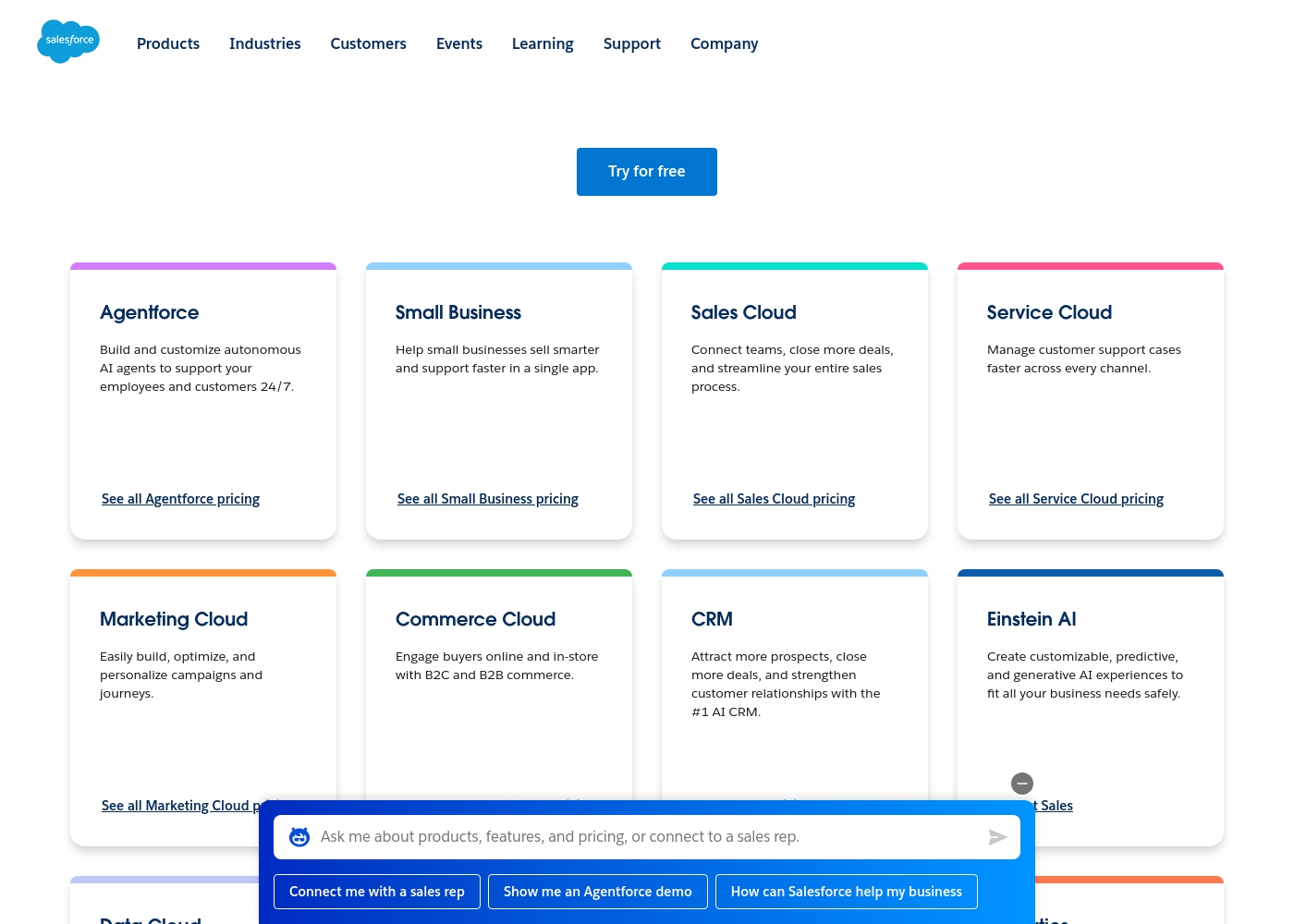
Salesforce pricing is determined on a quote-by-quote basis depending on the specific Cloud products chosen, such as Agentforce, Sales Cloud, and Marketing Cloud.
- Build and customize autonomous AI agents
- Support employees and customers 24/7
- Help small businesses sell smarter
- Faster support in a single app
- Connect sales teams and close more deals
- Streamline the entire sales process
- Manage customer support cases faster
- Manage support across every channel
Pricing Notes
- Close CRM offers transparent pricing starting with a $0/year Solo plan for single users.
- Salesforce requires custom quoting based on chosen 'Cloud' products like Sales Cloud or Agentforce.
- Most Salesforce contracts are annual and require payment annually in advance.
- Close CRM provides flexible monthly billing options, unlike the rigid annual structure of Salesforce.
Pricing Head-to-Head
User Reviews
On Trustpilot, Close CRM holds a rating of 2.8/5. Users praise its straightforward UI, built-in calling and SMS, and responsive support that resolves issues quickly.
Many appreciate it as a simple alternative to complex tools like HubSpot. However, recurring concerns include unreliable auto-security systems that lock trials or accounts without warning, poor onboarding with copy-paste support responses, and occasional bugs in the AI search and newer interface.
Close is an amazing CRM and company. Our users found other CRMs complicated and over featured. The features we needed like SMS, Calling, and call recording are built in, so you don't need to figure out how to setup and support that. And speaking of support, their support team is incredible.
User feedback on Salesforce is deeply polarized, leading to a very poor overall Trustpilot rating. While some users acknowledge the platform is a powerful tool with extensive features, the overwhelming sentiment focuses on severe issues with customer service and support responsiveness.
Users frequently describe support as "nonexistent" or "abysmal," reporting long waits, unhelpful automated systems, and difficulty reaching essential account managers. A significant pain point is the perceived lack of accountability and predatory billing practices; customers routinely mention inflexible contracts, mandatory annual price increases, and financial stress, especially for smaller businesses.
I strongly regret ever signing up with Salesforce. Their billing practices are predatory and completely inflexible, causing huge frustration and financial stress. I wish I had taken the time to read these reviews first.
Our Verdict
Deciding between Close CRM and Salesforce means choosing lean focus versus overwhelming breadth. Close CRM is the clear winner for teams needing fast, efficient selling now. Salesforce is the necessary engine for massive enterprise scale and complex regulated industries. Close CRM’s superpower is simplicity and reliable automation, helping teams cut Zapier dependency. It is explicitly built for selling, not data entry, which speeds up rep adoption. Close CRM’s AI tools (Notes, Summaries) integrate directly into the sales workflow, keeping reps focused. Salesforce’s superpower is its deep customization and robust industry-specific application. You gain access to dedicated clouds for industries like Healthcare and Retail, ensuring compliance and specific functionality. Salesforce handles vast, unified data schemes and massive user counts that Close CRM cannot match. The deciding factor should be complexity versus cost and risk. Salesforce requires high-cost annual contracts and involves significant risk due to poor support reports. Close CRM offers low entry costs and extremely high pricing transparency. If you are a growing business seeking core sales power under 50 users, stick with Close CRM. Only pick Salesforce if you are a multi-department enterprise requiring industry specialization and unparalleled integration capabilities across thousands of users.
Frequently Asked Questions
Which is better for small teams: Close CRM or Salesforce?
Close CRM is superior for small and growing teams, offering transparent pricing and a free Solo plan. It focuses on reducing busywork, making sales reps more efficient faster. Salesforce is too complex and expensive for most small business needs.
Is Salesforce hard to use compared to Close CRM?
Yes, Salesforce is often reported as cumbersome and requires too many clicks for daily sales tasks. Close CRM is designed specifically to be sales-first, maximizing speed and reducing data entry effort. New reps onboard much faster with Close CRM.
Does Close CRM have industry-specific versions like Salesforce?
No. Close CRM is a generalized, sales-focused CRM designed as a communication hub for all sectors. Salesforce offers dedicated industry clouds for specific verticals like Financial Services and Healthcare.
Which system is cheaper: Close CRM or Salesforce?
Close CRM is significantly cheaper and more transparent, with plans starting at $0/year. Salesforce requires high-cost, customized quotes and often locks users into annual contracts paid upfront. Cost clarity heavily favors Close CRM.
Does Close CRM offer AI features like Salesforce's Agentforce?
Close CRM offers AI for sales productivity, like generating notes, summaries, and email rewrites. Salesforce’s Agentforce AI is focused primarily on building autonomous agents for 24/7 customer and employee support. They focus on different AI use cases.
Is Salesforce customer support better than Close CRM support?
No. Salesforce receives overwhelming negative feedback regarding customer support, citing it as abysmal and hard to reach. While standard, Close CRM's support structure is reliable and does not carry that severe reputation.
Ready to Choose?
Both tools have their strengths. Choose based on your specific needs.