ClearVPN vs OpenVPN
ClearVPN and OpenVPN target completely different VPN users for completely different tasks. ClearVPN focuses on simple consumer privacy and low annual cost. OpenVPN is designed for enterprise secure remote access and strict compliance. Choosing one depends entirely on your specific security requirements.
Best for: Budget-conscious individuals needing multi-device protection (up to 6 devices), Basic users or families prioritizing one-tap simplicity and speed
Best for: Small businesses requiring 3 free employee seats forever (CloudConnexa), Organizations needing robust HIPAA and SOC 2 security compliance
Simple security hindered by operational friction.
We found ClearVPN delivers robust security features, like AES-256 encryption and a strict No-Logs policy, all wrapped in a sleek, simple interface. However, user feedback indicates high friction concerning connection reliability and inconsistent billing practices, particularly post-free trial. Overall, we recommend ClearVPN for its low cost and ease of use, but users should be prepared for potential technical hurdles and should closely monitor their subscription status.
Pros
- Extremely competitive annual pricing (effective $3.75 per month).
- Simple, modern user interface (UI) and easy installation process.
- Backed by a strict No-Logs policy and AES-256 encryption.
- Allows connectivity for up to six devices per account.
Cons
- Users report highly inconsistent connection reliability.
- Trial cancellation process is problematic; users report unauthorized charges.
- The 'shortcuts' connection method is often confusing and frustrating.
- Difficulty managing or updating subscriptions via the website.
Flexible security built for compliance.
We see OpenVPN provides a strong foundation for Zero Trust access, featuring flexible deployment options and robust security controls that meet strict compliance goals like HIPAA and SOC 2. Overall, it is a feature-rich solution economical for businesses, but they must weigh the compliance focus against reported issues related to functional reliability and performance lag.
Pros
- Provides flexible security solutions (CloudConnexa or Access Server).
- Robust Zero Trust features and access controls are implemented.
- Meets strict regulatory compliance standards (HIPAA, SOC 2).
- Feature-rich Free plan is available for up to three seats.
Cons
- External users report serious issues with platform lag and poor UX.
- Setup and onboarding can be difficult and time-consuming.
- Customer support responsiveness is reported as inadequate by users.
- Self-hosted Access Server is considered extremely overpriced by some clients.
AboutClearVPN
ClearVPN is an incredibly simple yet powerful VPN service. It’s the perfect choice for users who want to expand their digital horizons and achieve top-level protection without complexity. This app hides powerful technology behind a single button for a truly effortless experience. The eye-pleasing interface is simple and elegant, making your journey pleasant and smooth. You can also connect up to six devices per account. 💡
AboutOpenVPN
OpenVPN is a trusted provider of secure networking solutions tailored for small, medium, and enterprise businesses. It's recognized as the #1 Business VPN and is specifically trusted by over 20,000 organizations. This widely used solution provides a protected, encrypted tunnel for sensitive data. It ensures your devices can securely connect to business assets, even when crossing unsecured public networks. The core product is a high-performance, fast-deploying Zero Trust VPN solution. 💡
Highlights
Feature Comparison
Features Overview
We highlight the main differences and pick a winner for each feature.
Target Audience
ClearVPN serves individuals and families; OpenVPN is strictly for enterprise security.
ClearVPN is designed for consumers who need simplicity and anonymity. It allows connectivity for six personal devices under one inexpensive subscription. The user experience is meant to be joyful and effortless for everyday use. OpenVPN provides solutions like Access Server and CloudConnexa for organizations. Over 20,000 businesses trust OpenVPN for secure remote network access. Its features focus entirely on business infrastructure and team management. This comparison is between a direct-to-consumer product and a B2B network solution. They rarely compete head-to-head for the same dollars. ClearVPN simply sells encrypted connection access. OpenVPN sells secure network architecture.
Pricing & Value
ClearVPN is significantly cheaper for personal use; OpenVPN uses an expensive per-seat model.
ClearVPN offers an extremely low annual price of $44.99 for all six device connections. This equates to an effective rate of just $3.75 per month. It supports multi-device households well at a fixed cost. OpenVPN uses a per-seat model for CloudConnexa, starting at $11 per seat monthly. A family of four users would cost substantially more than ClearVPN’s single family rate. OpenVPN pricing starts high and scales with employee count. ClearVPN provides flat, consumer pricing for devices used by individuals. OpenVPN uses flexible, business-focused pricing based on active users. If budget is the primary driver, ClearVPN offers unbeatable value for individual or family use.
Ease of Use / Setup
ClearVPN is famous for one-tap simplicity; OpenVPN is reported as complex and laggy.
ClearVPN is built around effortless protection with a simple, elegant user interface. Users get instant connection and maximum security with a single tap. The application handles all complex technical configuration automatically. OpenVPN users frequently report issues with platform lag and poor user experience, especially authentication. Setting up OpenVPN, like Access Server on AWS, requires many tedious hours of work. It is designed for IT administrators, not general users. ClearVPN is plug-and-play and beginner-friendly right out of the box. OpenVPN demands significant technical knowledge for proper setup and maintenance. Users looking for zero-friction daily use should definitively choose ClearVPN for its speed and simplicity.
Regulatory Compliance
OpenVPN supports strict compliance standards; ClearVPN only focuses on basic consumer privacy.
ClearVPN’s security focus is a strict No-Logs policy and high-level encryption for anonymity. It does not advertise compliance with rigorous industry standards. It meets privacy expectations. OpenVPN is engineered to help organizations meet HIPAA, SOC 2 Type 2, and GDPR requirements. This capability is crucial for businesses in financial services and healthcare. It provides regulatory assurance to the business. OpenVPN is mandatory if your organization needs demonstrable compliance for audits and data protection. ClearVPN lacks these essential certifications. If security means regulatory adherence, OpenVPN is the only practical solution here.
Network Control
OpenVPN offers self-hosted and cloud deployment; ClearVPN is strictly a managed consumer service.
ClearVPN is exclusively a managed service using MacPaw’s global network across 45+ countries. Users have no control over the underlying architecture or deployment location. It prioritizes hands-off speed. OpenVPN offers the managed CloudConnexa service or the self-hosted Access Server platform. Access Server provides total architectural control, deployable on Docker, Linux, or VMware ESXi. OpenVPN gives IT teams maximum flexibility and control over how and where their security infrastructure is run. ClearVPN provides zero architectural choice. Only OpenVPN can satisfy an IT team that requires deep customization and infrastructure control.
Zero Trust Features
OpenVPN implements ZTNA with access controls; ClearVPN provides only traditional VPN encryption.
ClearVPN provides traditional encrypted tunneling to hide personal IP addresses and traffic. It focuses on individual device security and geo-unblocking content. It has no team-based access management structure. OpenVPN creates business networks that enforce least privilege access using ZTNA principles. It includes advanced protections like IDS/IPS and content filtering. This minimizes network attack surface area. OpenVPN securely builds organizational infrastructure by controlling user access by role. ClearVPN only protects the endpoint device passively.
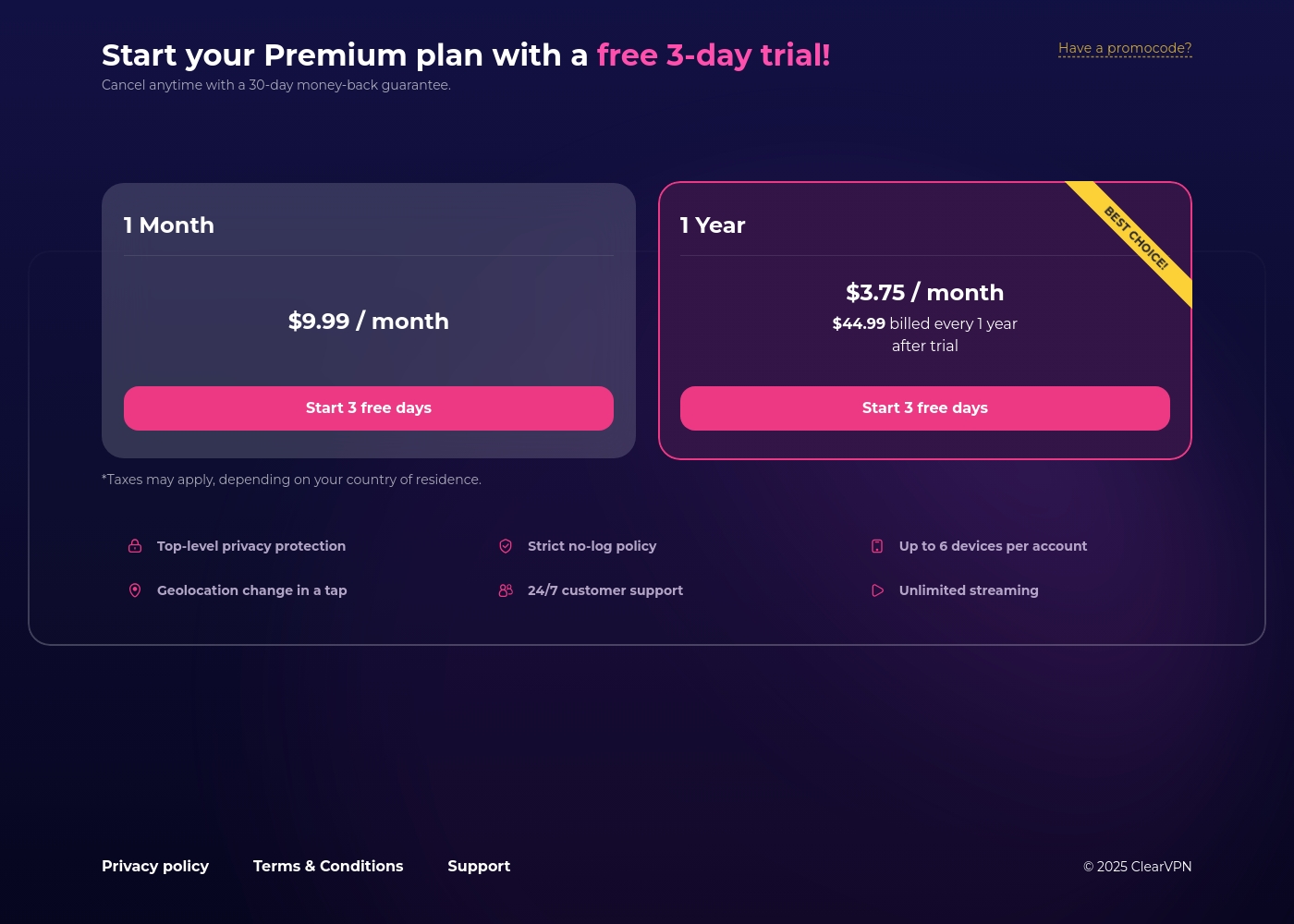
ClearVPN costs between $44.99 and $119.88 per year with two plans: 1 Year at $44.99, and 1 Month at $9.99/month.
Here is a detailed breakdown of the available premium subscription plans.
1 Month
Price: $9.99 / month Refund Policy: 30-day money-back Other Features:
- Top-level privacy protection
- Strict no-log policy
- Unlimited streaming
- 24/7 customer support
- Top-level privacy protection
- Strict no-log policy
- Up to 6 devices per account
- Geolocation change in a tap
- 24/7 customer support
- Top-level privacy protection
- Strict no-log policy
- Up to 6 devices per account
- Geolocation change in a tap
- 24/7 customer support
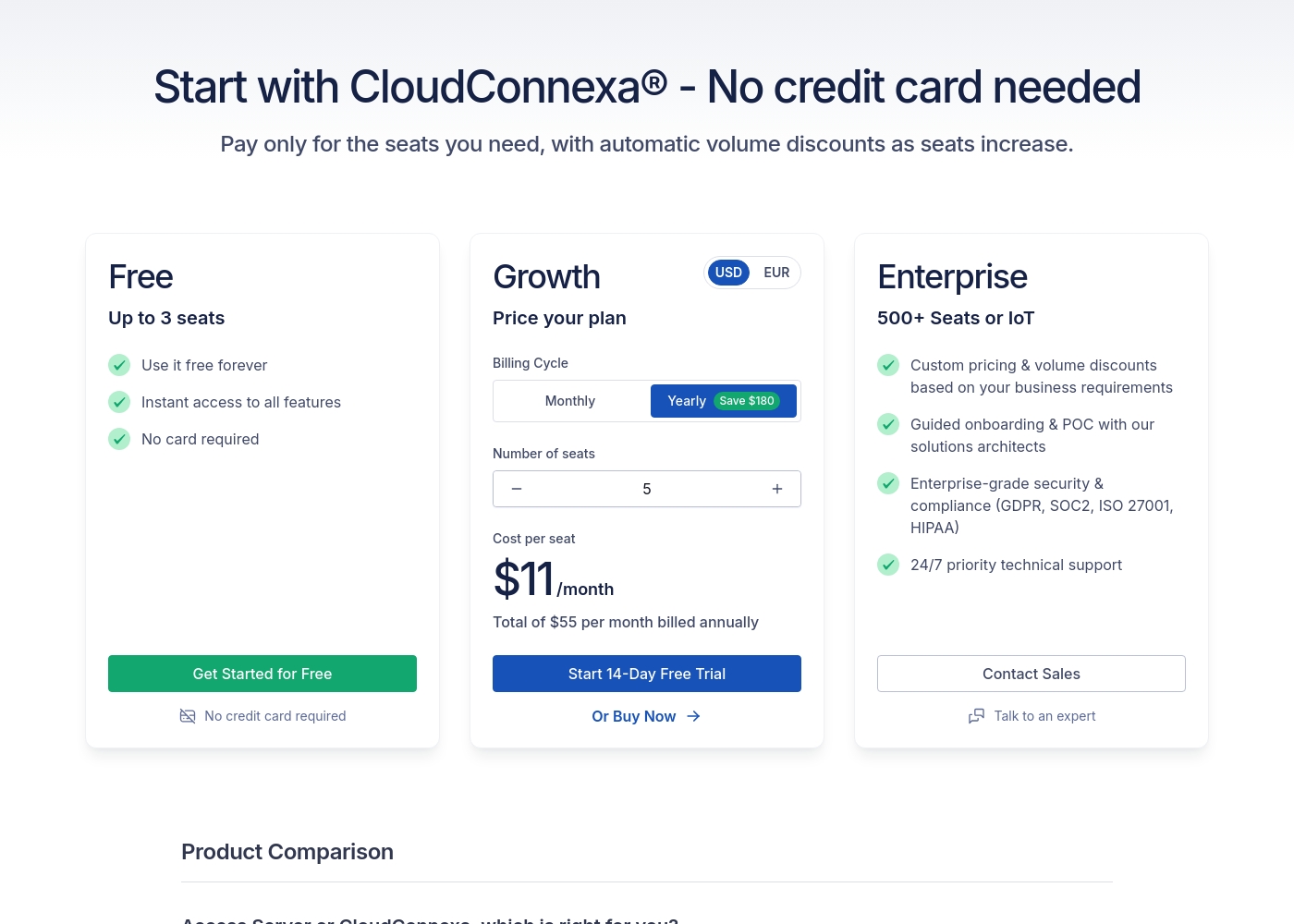
OpenVPN CloudConnexa costs between Free and Custom per year with 3 plans: Free (up to 3 seats), Growth ($11/seat/month billed annually), and Enterprise (Custom Pricing).
OpenVPN also offers two solutions—CloudConnexa and Access Server—but the most straightforward pricing structure is provided for the cloud-delivered CloudConnexa plans detailed below.
Free
Price: Free forever Best For: Small teams or testing Other Features:
- Up to 3 seats
- Use it free forever
- Instant access to all features
- No credit card required
- Up to 3 seats
- Use it free forever
- Instant access to all features
- No card required
- Pay only for the seats you need
- Automatic volume discounts
- Includes 14-Day Free Trial
- Scale seats up or down on demand
- Custom pricing & volume discounts
- Guided onboarding & POC with solution architects
- Enterprise-grade security & compliance (GDPR, SOC2, ISO 27001, HIPAA)
- 24/7 priority technical support
Pricing Notes
- ClearVPN's annual plan is extremely affordable for consumers at $44.99 total per year.
- OpenVPN offers a unique Free CloudConnexa plan for up to three seats forever.
- OpenVPN uses a costly per-seat model which is much more expensive than ClearVPN's flat yearly rate for multiple users.
- ClearVPN provides a full 30-day money-back guarantee, while OpenVPN only credits unused funds upon cancellation.
Pricing Head-to-Head
User Reviews
ClearVPN maintains a solid 4.1-star rating on Trustpilot, largely due to its focus on simplicity and affordability. Users frequently praise the service for its clean UI, easy installation, and competitive pricing, calling it an 'outstanding application.' However, external reviews reveal significant inconsistencies in reliability and customer service processes 🙁.
Multiple users report technical friction, including frustrating 'shortcut' concepts, connection failures, and being unable to sign in after purchase. The trial cancellation process is a major pain point; several customers report being charged for the annual plan despite canceling the 3-day free trial immediately.
This is a really nice and legit VPN service. The software provides a clean and good user interface. I honestly couldn't find anything better for this price point.
User feedback on Trustpilot paints a largely negative picture, although this reflects a small sample size of nine reviews. The recurring themes critically focus on reliability and user experience.
Several users describe the platform as "extremely laggy," noting poor UX, especially with the browser authentication process. Functionality is also strongly challenged; one reviewer claimed the platform is fundamentally broken and fails to block expected threats like viruses or DDoS attacks, contradicting its advertising claims.
The user experience for the browser authentication is very poor and complex. It is constantly extremely laggy, which makes daily operations unnecessarily frustrating for mandated users.
Our Verdict
ClearVPN and OpenVPN serve entirely different masters; they are not directly interchangeable tools. If you are a typical consumer, ClearVPN is the straightforward and highly affordable choice. If you require enterprise network security infrastructure, OpenVPN is built to meet those needs. ClearVPN's superpower is its incredible simplicity and unmatched affordability for the consumer market. It offers an elegant, one-tap interface for immediate security protection on up to six devices. The annual price of $44.99 is extremely competitive for comprehensive family coverage. ClearVPN is perfect for users who prioritize ease of use over complex technical controls. OpenVPN's strength lies in its enterprise-grade compliance features and its networking flexibility. It helps meet required standards like HIPAA, SOC 2, and GDPR for regulated industries. OpenVPN also allows IT teams to choose between cloud-managed CloudConnexa or the self-hosted Access Server. The deciding factor is whether your goal is personal privacy or corporate network architecture control. ClearVPN handles basic individual security tasks with speed and low friction. OpenVPN reliably builds secure, compliant networks for an entire organization like a business. Final verdict: Pick ClearVPN if you are a budget-conscious consumer seeking simple, fast, multi-device protection. Choose OpenVPN if you are an IT admin focused on implementing ZTNA or meeting strict industry compliance standards.
Frequently Asked Questions
Which is better for individual users: ClearVPN or OpenVPN?
ClearVPN is significantly better and cheaper for individual or family use. ClearVPN costs $44.99 annually for six devices with one-tap simplicity. OpenVPN uses a more expensive per-seat model designed for businesses.
Does OpenVPN offer a better free option than ClearVPN?
Yes, OpenVPN offers a robust Free CloudConnexa plan with up to three permanent user seats. ClearVPN only provides a limited-time 3-day free trial on its premium plans. OpenVPN allows small teams to start essential security for free.
Which VPN is designed for enterprise compliance like HIPAA and SOC 2?
OpenVPN is specifically engineered to achieve mandatory compliance with HIPAA, SOC 2, and GDPR standards. Organizations in regulated industries must choose OpenVPN for this feature. ClearVPN offers standard consumer privacy, but not regulatory compliance.
Is ClearVPN easier or harder to use than OpenVPN?
ClearVPN is dramatically easier to use, featuring one-tap connection and automated server selection. OpenVPN setup, especially with Access Server, is often reported as difficult, time-consuming, and requiring technical knowledge.
How do the pricing models of ClearVPN and OpenVPN differ dramatically?
ClearVPN charges a low, flat rate for device access, ideal for consumers. OpenVPN charges based on the number of seats or concurrent connections required. OpenVPN scales better for growing teams but ClearVPN is cheaper for families.
Can ClearVPN be used for Zero Trust networks like OpenVPN?
No, ClearVPN lacks the necessary infrastructure and identity controls for ZTNA implementation. OpenVPN is built around enforcing Zero Trust access based on identity, device, and role validation. ClearVPN is a traditional VPN connection.
Ready to Choose?
Both tools have their strengths. Choose based on your specific needs.