Chatbot vs Typewise
Chatbot and Typewise both use AI for customer service, but they're built for very different goals. Chatbot is a traditional chatbot builder focused on scale and templates. Typewise is an AI orchestration platform that automates complex workflows across your entire tech stack.
Best for: Companies needing a fast, scalable website chatbot for high traffic, Teams that prefer visual flow builders and templates
Best for: Support, sales, and commerce teams automating complex workflows, Organizations wanting to integrate AI across CRM, ERP, and other core systems
Unmatched scalability, challenged by poor support.
We found Chatbot offers powerful core features, emphasizing unmatched scalability and immediate deployment using advanced AI functions like multilingual support. But we must weigh these advantages against serious operational feedback regarding non-existent customer support and problematic billing practices reported by multiple users. Overall, Chatbot provides a strong technological solution, but the high risk associated with customer service and account management significantly hurts the user experience.
Pros
- Offers high scalability, suited for massive website traffic.
- Fast onboarding process due to instant AI chatbot setup.
- Highly customizable framework to meet specific service requirements.
- Includes advanced AI training features like multilingual support.
Cons
- Support is frequently reported as unresponsive or non-existent.
- Users have reported significant issues with unexpected billing and double charges.
- Subscription cancellation is difficult, requiring users to submit an email request.
- Advanced features sometimes have usage restrictions despite being marketed as unlimited.
Powerful AI for customer conversations.
We find Typewise offers a compelling AI orchestration layer that promises to automate support and sales workflows across your entire tech stack. Its strength lies in rapid deployment and outcome-based pricing, though teams should be prepared for an initial learning curve to maximize its potential.
Pros
- Promises fast 15-minute initial launch.
- Pricing model is outcome-based, starting at $1 per resolution.
- Integrates deeply with 200+ platforms like Salesforce and Zendesk.
- Allows workflow creation with natural language instructions.
Cons
- External feedback notes a potential steep learning curve.
- Success-based pricing may be costly for very high-volume teams.
- Some users report occasional reliability issues with complex tasks.
- Full value may require significant integration and setup effort.
AboutChatbot
ChatBot is an advanced AI-powered solution crafted to improve your customer service immediately. It guarantees an instant AI chatbot setup, making deployment quick and straightforward. This system is ideal for companies that prioritize customization and need seamless service across various platforms. The tool manages complex needs, like personalizing the experience based on specific language requirements for diverse audiences. ✅
AboutTypewise
✨ Typewise is an AI orchestration platform for customer-facing teams. It's designed for support, sales, and commerce departments that want to use AI across their whole operation. The platform acts as an intelligent supervisor, working across your CRM, billing, knowledge base, and more to handle complex workflows.
Highlights
Feature Comparison
Features Overview
We highlight the main differences and pick a winner for each feature.
Pricing Model
Chatbot uses fixed monthly plans based on chat volume. Typewise uses outcome-based pricing, charging only for successful resolutions.
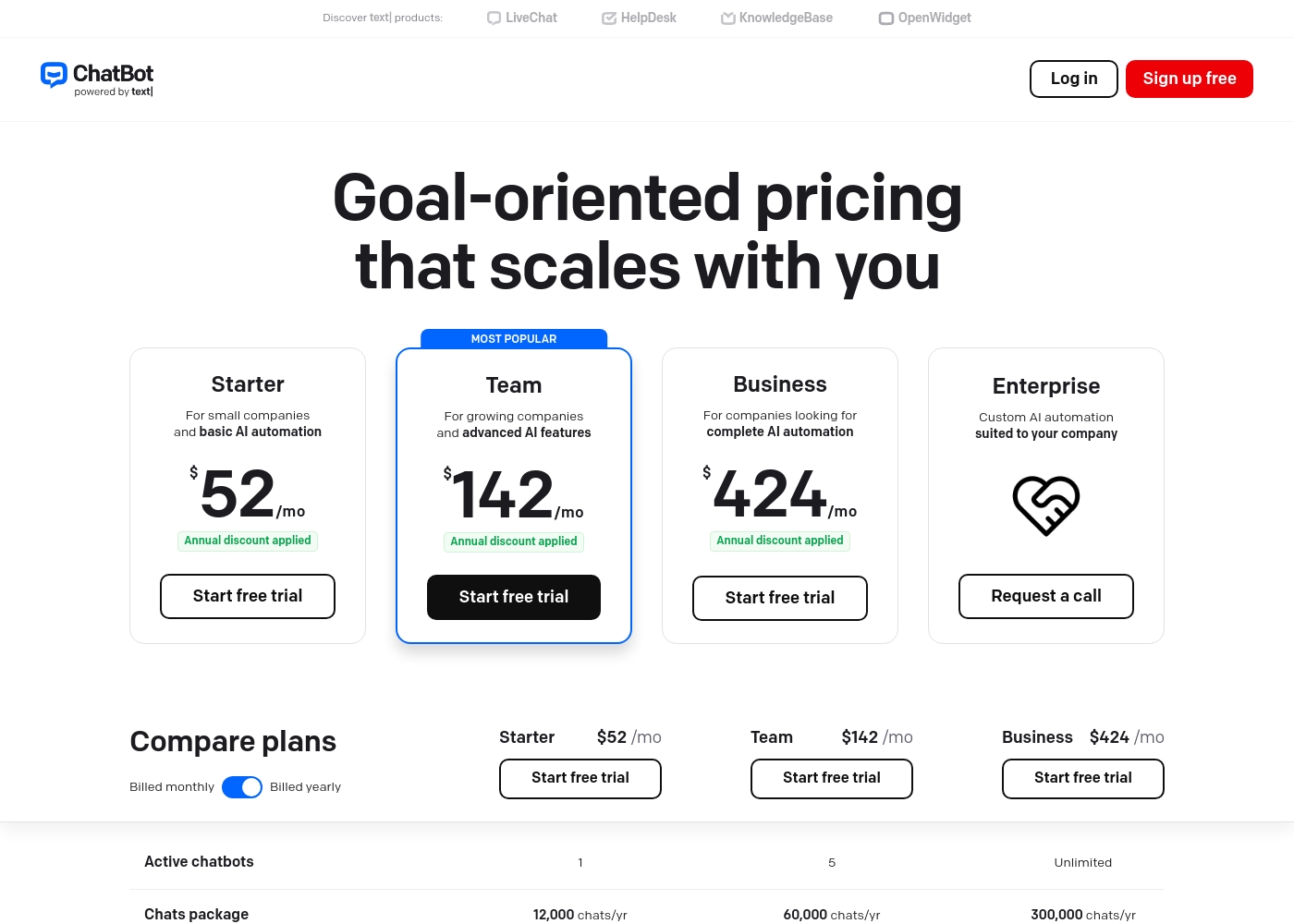
Chatbot offers four tiered plans: Starter ($52/mo), Team ($142/mo), Business ($424/mo), and Enterprise (custom). Prices reflect annual billing. Each plan includes a fixed annual chat package, from 12,000 chats on Starter to 300,000 on Business. Typewise uses a success-based model starting at $1 per resolution. You pay for actual outcomes, not seats or usage time. There are no tiered plans listed; the model is purely usage-based. The key difference is predictability versus outcome-alignment. Chatbot gives you a fixed cost, while Typewise's cost scales directly with the number of problems your AI solves. For a team with steady, predictable chat volume, Chatbot's pricing may be easier to budget. For a team focused on automating high-value, complex tasks, Typewise could offer better ROI.
Workflow Creation
Chatbot uses a visual builder and templates. Typewise allows business teams to create automations with plain English instructions.
Chatbot provides a Visual Builder and pre-made Templates to design chat flows. This is a traditional, drag-and-drop approach ideal for straightforward conversation paths. Typewise enables you to define and update workflows using natural language. Business teams can turn documents into live automations without coding or flowcharts. Chatbot's method is more visual and familiar for basic bots. Typewise's method is more flexible for complex, evolving business logic that changes frequently. This makes Typewise better for teams that need to rapidly adapt automations to new products or policies without IT help.
Integration Depth
Chatbot offers core website and support integrations. Typewise provides 200+ deep, two-way integrations with major business platforms.
Chatbot's core integrations include LiveChat, Slack, WordPress, and Shopify. Higher-tier plans add more options like Zapier, Zendesk, and Webflow. Typewise boasts over 200 deep, out-of-the-box integrations with platforms like Salesforce, Zendesk, and various ERPs. It also supports webhooks and REST APIs for custom connections. Typewise's integrations are designed for two-way data flow, allowing the AI to read and take actions across your entire tech stack. Chatbot's are primarily for connecting channels. For teams needing to automate tasks across CRM, billing, and knowledge bases, Typewise's integration ecosystem is significantly more powerful.
Scalability
Chatbot is engineered for massive website traffic. Typewise scales with your resolution volume across multiple teams and channels.
Chatbot is explicitly built for high availability and massive scale. It has a proven track record managing service for sites with over 800,000 unique monthly visitors. Typewise scales through its outcome-based model and multi-agent orchestration. It can handle increased volume across support, sales, and commerce workflows. Chatbot's scalability is focused on handling concurrent website visitor volume. Typewise's scalability is about expanding automated workflows across different business functions. If your primary concern is website chat performance during traffic spikes, Chatbot is the specialist. If you need to scale AI across departments, Typewise offers broader organizational scalability.
Human Oversight
Chatbot is primarily a fully automated bot. Typewise features Hybrid Intelligence for configurable human-in-the-loop control.
Chatbot's default operation is an autonomous AI chatbot. While you can set up flows, the system doesn't natively feature a hybrid automation-human handoff model. Typewise's Hybrid Intelligence is a core feature. You can set rules for when the AI should handle tasks alone, ask for human approval, or hand off completely. This gives Typewise users granular control over risk and quality. Chatbot offers less native flexibility for managing the automation boundary. For workflows involving sensitive data or complex judgment, Typewise's hybrid model provides a crucial safety layer that Chatbot lacks.
Setup & Deployment
Both promise fast deployment. Chatbot emphasizes an instant setup, while Typewise targets a 15-minute first-agent launch.
Chatbot advertises an 'Instant AI chatbot setup.' The goal is to get a bot live on your site in minutes, not weeks. Typewise states you can get your first AI agent live in about 15 minutes by connecting knowledge sources and defining a goal. Both platforms aim for rapid time-to-value. Chatbot's setup is geared toward a traditional website chat widget. Typewise's setup involves connecting broader business systems. The choice depends on your goal: a quick website bot (Chatbot) versus a quick workflow agent (Typewise).
Analytics & Insights
Chatbot offers detailed chat and interaction reports. Typewise provides an Insights Hub focused on outcome performance and CSAT.
Chatbot's reporting includes metrics like busiest period, interactions popularity, and version history for debugging flows. Typewise's Insights Hub tracks resolution rates, customer satisfaction (CSAT), and identifies where human escalation is needed. It measures AI performance against business outcomes. Chatbot's analytics help optimize a chatbot's conversation flow. Typewise's analytics measure the AI's actual impact on your operations. For teams managing chat support, Chatbot's reports are more relevant. For teams automating end-to-end processes, Typewise's outcome-based insights are more valuable.
Chatbot costs between $52/month and $424/month when billed annually, with four plans: Starter at $52/mo, Team at $142/mo, Business at $424/mo, and Enterprise (Custom Pricing).
Below, you'll find a detailed breakdown of what each plan offers, allowing you to choose the best fit for your automation goals.
Starter
Price: $52/month (Annual discount applied) Websites Supported: 1 active chatbot Best For: Small companies and basic AI automation Other Features:
- 12,000 chats per year (1,000 chats/mo)
- 7 days Training history
- Visual Builder and Templates
- Core integrations like LiveChat, Slack, and WordPress
- 1 active chatbot
- 12,000 chats/year package
- Training history of 7 days
- Visual Builder, Templates, Flows
- Core Integrations (LiveChat, Slack, WordPress, Shopify)
- 5 active chatbots
- 60,000 chats/year package
- Team collaboration
- Version history
- AI model training and Multilingual AI
- Unlimited active chatbots
- 300,000 chats/year package
- White label
- User management, Segments, A/B testing
- Advanced button actions
- Custom AI automation
- Service level agreements (SLAs)
- Dedicated account manager
- Custom SSO
- Priority support
Typewise costs from $1 per resolution with 1 plan: Success-Based Pricing at $1 per resolution.
Here's a breakdown of how our pricing works for your team.
Success-Based Pricing
Price: Starting from $1 per resolution Best For: Customer support and sales teams looking to automate resolutions responsibly. Other Features: Multi-Agent Orchestration, Knowledge & Actions Hub, Hybrid Intelligence, Automated Evaluations, Outcome performance tracking
- Multi-Agent Orchestration
- Natural Language Instructions
- Hybrid Intelligence & Approvals
- Knowledge & Actions Hub
- Outcome performance tracking
Pricing Notes
- Chatbot's listed prices are discounted annual rates. Monthly billing would cost more.
- Chatbot plans are limited by annual chat packages (e.g., 12,000 chats/year on Starter). Exceeding this may require an upgrade.
- Typewise's $1/resolution is a starting point. Costs could be higher for complex resolutions or at scale.
- Typewise's model aligns cost directly with AI productivity, offering potential savings for high-efficiency teams.
- Neither platform explicitly details refund policies or money-back guarantees on their public pages.
Pricing Head-to-Head
User Reviews
User feedback for Chatbot is highly polarized, resulting in a concerningly low Trustpilot average (2.8). Positive reviews praise the platform's ease of use and fast setup, noting it is highly intuitive and customizable.
Users reported that new AI features, such as automatic site scanning, make deployment extremely quick and efficient. However, the majority of critical feedback focuses on serious operational failures.
This is one of the best chatbot apps available. It's very intuitive, simple to use, and has many features. We scanned our site and had the bot ready in minutes. It only gets better as we teach it new things.
The limited external sentiment from Trustpilot suggests a generally positive view of Typewise, focusing on its powerful AI for email and chat. Users appreciate the significant accuracy improvements and time savings it brings to daily communication.
However, some note that the learning curve can be steep initially and the pricing model might feel expensive for smaller teams or occasional users. We see recurring mentions of strong support responsiveness when needed, but also feedback on occasional reliability hiccups with very complex requests.
Typewise has transformed how we handle customer emails. The AI suggestions are incredibly accurate and save us hours every day. It feels like having a super-smart assistant in our inbox.
Our Verdict
For most people, Typewise is the more powerful and modern choice. It's not just a chatbot; it's an AI brain for your entire operation. Chatbot's superpower is speed and simplicity. You can deploy a classic, visual chatbot on your website in minutes. It's built to handle massive traffic spikes and offers clear, template-based flows. Typewise's superpower is deep automation and integration. It uses natural language to create workflows that connect your CRM, billing, and knowledge base. Its hybrid model lets humans stay in control. The deciding factor is your goal. If you need a quick, standalone website chatbot for FAQs, Chatbot is simpler and more predictable. If you want to automate complex tasks across departments, Typewise is the specialist. Choose Chatbot if your main need is handling website visitor volume with basic AI. Choose Typewise if you want to transform support and sales with intelligent, integrated automation that grows with your business.
Frequently Asked Questions
Which is better for small teams: Chatbot or Typewise?
Chatbot may be more affordable for small teams with simple needs due to its fixed starter plan. Typewise's per-resolution cost could become expensive for low-volume teams. Consider your expected volume and task complexity.
Is Typewise worth the extra cost over Chatbot?
It depends on the value of your automations. Typewise's pricing aligns cost with results, which can offer high ROI for efficient teams. For simple chat, Chatbot's predictable subscription may be cheaper.
Does Chatbot integrate with Salesforce like Typewise?
Chatbot's native integrations focus on tools like LiveChat, Slack, and Shopify. It does not list Salesforce as a core integration. Typewise specifically highlights deep integration with Salesforce and other major CRMs.
Can I create workflows with plain English in Chatbot?
No. Chatbot uses a visual builder and templates for creating flows. Typewise allows business teams to define and update automations using natural language instructions without coding.
Which tool has better customer support?
Based on user reviews, Typewise is significantly better. Chatbot's support is frequently criticized as unresponsive or non-existent. Typewise's reviews generally note supportive help when needed.
Is there a free trial for both?
Yes, both Chatbot and Typewise offer free trials. This lets you test their core features before committing to a subscription or usage-based plan.
Ready to Choose?
Both tools have their strengths. Choose based on your specific needs.