CASTANET vs Lusha
This is a showdown between automated prospecting flow and sheer contact data volume. CASTANET offers reliable, continuous LinkedIn automation focused on prospect context. Lusha provides massive B2B data but faces significant user concerns regarding privacy and trust. Deciding between CASTANET and Lusha means weighing compliance against contact scaling.
Best for: Sales teams prioritizing compliant, steady LinkedIn outreach, Teams needing context-rich 'why fit' signals for personalization
Best for: RevOps teams needing massive B2B contact data enrichment (280M+), Marketers running ABM campaigns based on real-time buying signals
Flexible automation for relationship builders.
We find CASTANET offers powerful 24/7 LinkedIn lead generation tailored for sales professionals focusing on relationship building. It neatly integrates with Zapier across all tiers, streamlining CRM export immediately. Overall, this is a highly targeted tool ideal for users who are ready to invest in serious automated outreach.
Pros
- Lead generation runs automatically 24 hours a day, 7 days a week.
- Zapier integration is included in all three pricing plans for seamless data syncing.
- Provides deep, specific insights (schools, groups) to help qualify prospects.
- Offers a 7-day free trial to test full functionality risk-free.
Cons
- The $99 Basic plan heavily limits campaigns and automation steps.
- The popular Sales Pro plan ($199/month) supports only one LinkedIn profile.
- No mention of discounted annual pricing options.
- No explicit money-back guarantee is detailed after the 7-day trial period.
Serious questions about data privacy.
We observed extreme user concerns regarding Lusha’s data sourcing and privacy adherence, particularly concerning the alleged sharing of scraped personal contact numbers, which overshadows any intended utility. Overall, we cannot recommend a service facing such severe ethical and contractual complaints from its user base.
Pros
- Offers a generous Free plan to test basic functionality.
- Provides broad API and CRM integration options.
- Can be effective for prospecting when the data is accurate.
Cons
- Major concerns regarding the ethical sourcing and sharing of private contact data.
- Users struggle to opt-out or remove their personal information (GDPR violations alleged).
- Substantial complaints about high inaccuracy and obsolete contact details sold.
- Aggressive auto-renewal policies and opaque contract cancellation terms.
AboutCASTANET
CASTANET is an automated solution designed to simplify lead generation on LinkedIn. It is built for sales professionals who value relationship building over quick sales pitches 💡. The platform recognizes that building trust takes time, and it provides the tools to invest wisely in your prospects. You can communicate effectively with new connections and explain exactly why you are an excellent resource for them.
AboutLusha
Lusha powers up your entire Go-To-Market (GTM) engine. It provides access to a massive database of over 280 million verified B2B contacts, helping teams reach precise decision makers. Professionals across Sales, RevOps, Marketing, and Recruiting use Lusha to streamline their work and maximize return. 💡
For sales teams, Lusha helps the pipeline grow with live leads and faster closes. RevOps benefits by keeping data stacks clean, compliant, and connected for better ROI. Marketers power campaigns with enriched audiences, and Recruiters quickly find top talent using highly accurate contact data. This tool truly helps you scale up your business using trusted data.
Highlights
Feature Comparison
Features Overview
We highlight the main differences and pick a winner for each feature.
Data Trust & Compliance
Trust is the critical difference; CASTANET shows reliability while Lusha faces major privacy scrutiny.
CASTANET receives generally positive reviews for reliable functionality and steady lead flow. User feedback highlights CASTANET's strength in consistent, automated prospecting without major complaints. Lusha struggles immensely with user trust regarding data handling and unsolicited outreach. Its user rating is significantly low due to these serious privacy concerns and GDPR worries. The core trade-off: use CASTANET for trusted process automation or accept the trust risk with Lusha's data volume. Many users report difficulty with Lusha's opt-out processes and auto-renewal friction. If brand safety and compliance are paramount for your team, CASTANET is the much safer choice. Lusha's data quality and sourcing methodology are often questioned by frustrated users.
Lead Context Strategy
CASTANET targets relational context; Lusha targets real-time buying signals and intent.
CASTANET delivers unique 'why fit' signals for prospects, showing schools, groups, and events. This rich context helps sales teams tailor the outreach message effectively and avoid generic connections. Lusha’s strength is surfacing real-time leads and buying signals to shorten the entire sales pipeline. It focuses more on intent and immediate action rather than deep relational context. Use CASTANET when manual personalization based on LinkedIn activity is crucial for your outreach. Choose Lusha when timing your reach based on live buying signals is your priority. CASTANET is about quality, context-driven connections; Lusha is about speed and large-scale signal detection.
Contact Data Volume
Lusha commands a massive B2B database; CASTANET focuses only on reliable, automated LinkedIn activity.
Lusha impresses with its massive resource pool of 280M+ verified B2B contacts for global scaling. Lusha highlights high deliverability, claiming 85% phone and 98% email accuracy. CASTANET concentrates on automating LinkedIn actions and exporting profile details discovered during prospecting campaigns. It does not provide an external database of 280M+ contacts like Lusha does. Teams needing high-volume B2B contact enrichment across various channels should leverage Lusha’s scale. Teams primarily focused on LinkedIn pipeline generation will find CASTANET sufficient for data extraction. Lusha provides the raw material (data); CASTANET provides the automated factory (LinkedIn connector).
Integration & Workflows
Lusha offers native CRM embeds; CASTANET relies heavily on Zapier for synchronization pathways.
CASTANET’s integration backbone relies deeply on Zapier to connect lead export to thousands of apps, including Slack and CRMs. It also supports simple lead profile exports via Google Sheets. Lusha offers robust native connections to tools like Salesforce, HubSpot, and Outreach for direct data enrichment and syncing. Lusha also includes MCP and API support for highly custom workflows. If you prefer pre-built, native connections like Salesforce hooks, Lusha is generally the smoother option. CASTANET requires reliance on Zapier for complex, multi-step CRM synchronizations. Both tools support Slack notifications for team alignment, but Lusha offers deeper, more integrated data flow for RevOps teams.
Pricing Structure
CASTANET uses fixed tiers; Lusha employs a confusing, usage-based credit system.
CASTANET offers clear, fixed monthly pricing across three tiers: Basic ($99), Sales Pro ($199), and Team ($399). Pricing includes fixed limits on LinkedIn campaign access. Lusha uses a usage-based credit system, where an email costs 1 credit and a phone number costs 10 credits. While Lusha has a free plan, the costs scale quickly and can be unpredictable. If budget predictability is essential, CASTANET’s fixed monthly fee is much easier to manage. Lusha's credit usage demands careful tracking to prevent unexpected costs. Monthly unused Lusha credits roll over up to twice the plan limit, but annual credits reset, adding complexity to Lusha's budgeting process.
Deployment & Trial Experience
CASTANET offers a risk-free 7-day trial; Lusha starts with a limited, sustained Free plan.
CASTANET offers a 7-day free trial along with a 100% satisfaction guarantee for new users. This lets users test the 24/7 automation flow and CRM export capabilities quickly. Lusha provides a Free plan that includes 70 credits per month, covering basic prospecting features and the browser extension. You get sustained, low-level access immediately. The CASTANET trial is ideal for short, intensive testing of automated processes before committing to $99/month. Lusha’s free tier lets solo users manage low-volume needs indefinitely. If you need to test full functionality quickly, the CASTANET 7-day trial is superior to Lusha’s credit-limited Free plan.
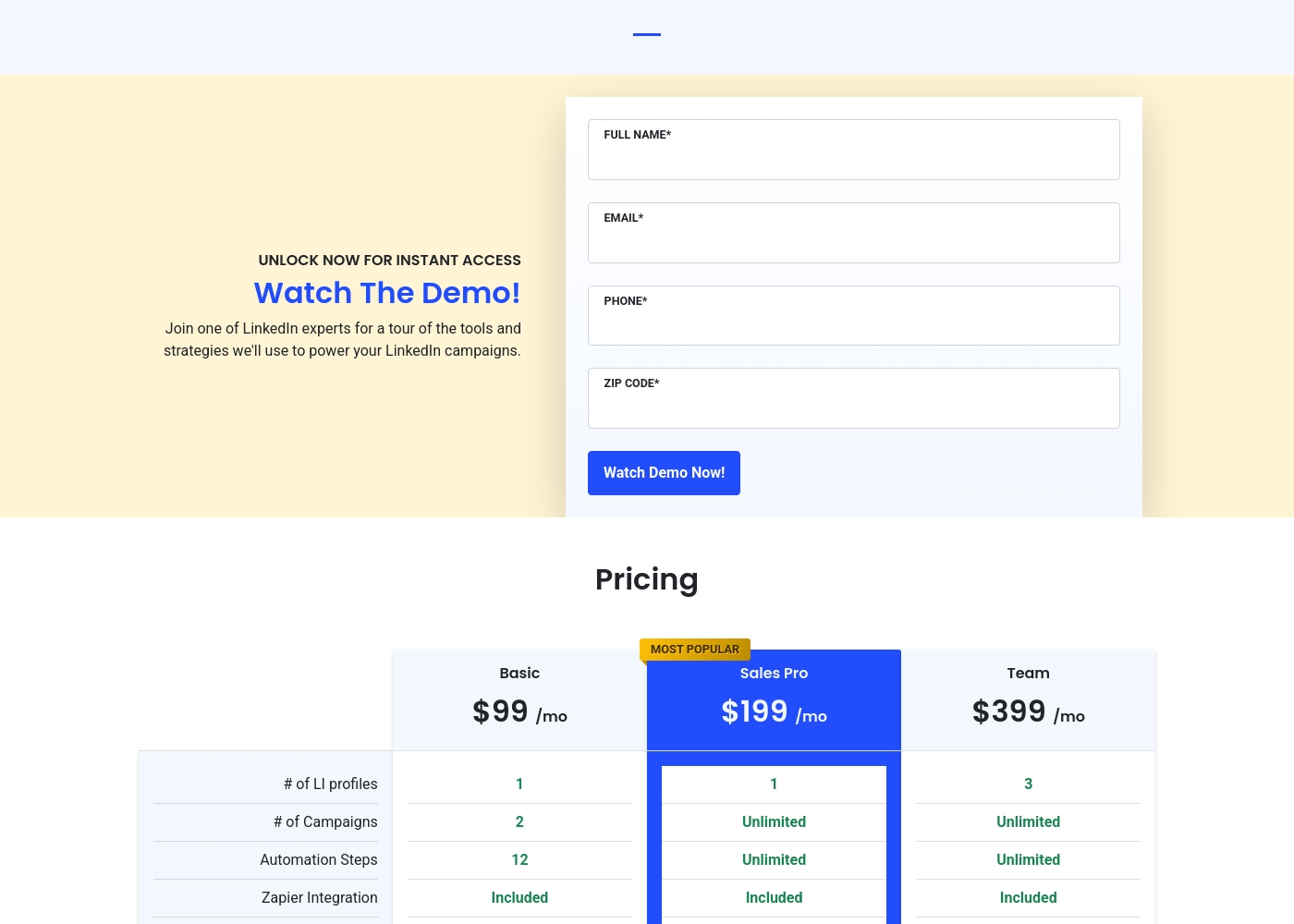
CASTANET costs between $99 and $399 per month with 3 plans: Basic at $99/mo, Sales Pro at $199/mo, and Team at $399/mo.
Let's break down what you get with each of the available monthly plans.
Basic
Price: $99/mo Websites Supported: 1 LI profile Other Features:
- 2 Campaigns
- 12 Automation Steps
- Zapier Integration
- 1 LinkedIn profile
- 2 Campaigns
- 12 Automation Steps
- Zapier Integration
- 1 LinkedIn profile
- Unlimited Campaigns
- Unlimited Automation Steps
- Zapier Integration
- 3 LinkedIn profiles
- Unlimited Campaigns
- Unlimited Automation Steps
- Zapier Integration
Lusha offers plans starting at Free, with paid plans requiring contact for pricing details.
Details for specific pricing tiers were unavailable due to a technical error on the Lusha website itself, but we can review the featured plans based on the available text.
Free plan
Price: Free Best For: Getting started with B2B prospecting Refund Policy: Not applicable Other Features:
- Up to 70 credits per month
- Access to basic prospecting features
- Browser extension
- CRM integrations
- Up to 70 credits per month
- Basic prospecting features
- Browser extension
- CRM integrations
- Fully customizable
- Ability to limit credit usage per user
- Includes annual credit rollover option
- Designed for teams larger than 5 users
Pricing Notes
- CASTANET offers clear fixed monthly pricing starting at $99, with simple limits on included LinkedIn profiles (1-3 profiles).
- Lusha has a complex credit-based system where retrieving a phone number costs 10 times more than an email (10 credits vs 1 credit).
- Lusha offers a perpetual Free plan with 70 credits; CASTANET uses a time-limited 7-day free trial.
- User reviews strongly link privacy issues and unsolicited outreach directly to Lusha’s pricing model and data sourcing.
- CASTANET is better for predictable monthly SaaS budgeting, while Lusha’s usage pricing can lead to large, variable costs.
Pricing Head-to-Head
User Reviews
We found no external user reviews on Trustpilot or Capterra at the time of this assessment, as evidenced by the lack of provided snippets. Therefore, we cannot synthesize common user themes, such as ease of use, support responsiveness, or the accuracy of lead generation, for CASTANET based on independent third-party feedback.
The platform’s capabilities must be evaluated solely based on its robust stated feature set and the clear pricing structure derived directly from the company’s website. Potential users should rely heavily on the 7-day free trial period offered by CASTANET to thoroughly test integration and performance before committing to a paid plan.
User feedback concerning Lusha is overwhelmingly negative, centering on severe data ethics and privacy violations. Many reviewers allege Lusha scrapes and distributes personal contact information—including private mobile numbers—without user consent, leading to a huge volume of unsolicited calls and spam.
Users feel this is a "scammy" or "spam-enabling" practice that violates GDPR. A major complaint is the difficulty in getting personal details removed; many requests for data deletion are reportedly ignored, or the information reappears soon after.
I keep receiving daily unsolicited calls to my personal phone number. When I ask where they got my details, they consistently cite Lusha. This company shows a blatant disregard for privacy.
Our Verdict
Choosing between CASTANET and Lusha means deciding between trust and massive scale. For most small to mid-sized sales teams, CASTANET is the recommended choice due to its stability and higher trust rating. Lusha offers a huge database, but its well-documented privacy risks are a significant detractor for many users. CASTANET absolutely dominates in the realm of reliable, automated LinkedIn flow. It gives you clear 'why fit' signals, using schools and groups to help tailor outreach effectively. CASTANET’s fixed pricing model also ensures your prospecting budget stays predictable and controlled every month. Lusha's superpower is its sheer volume and claimed data accuracy across 280 million B2B contacts. If your RevOps or Sales team focuses on high-volume lists and real-time buying signals, Lusha delivers that data. It also offers stronger native integration paths into CRMs like Salesforce. The deciding factor should be your risk tolerance regarding data provenance and compliance. CASTANET provides a steady, proven, and compliant automation experience. Lusha’s low 2.4 rating reflects major user anxiety over unsolicited calls and data handling practices. If you need trusted, automated LinkedIn lead flow, stick with CASTANET. If your priority is massive data enrichment and you can overlook serious user privacy concerns, Lusha can scale your contact lists aggressively.
Frequently Asked Questions
Which tool is cheaper for a small team: CASTANET or Lusha?
Lusha offers a perpetual Free plan with 70 credits per month. CASTANET does not have a free plan and starts at $99/month. However, Lusha’s credit system can lead to higher costs if you rely heavily on phone numbers.
Does Lusha offer the same automated LinkedIn outreach as CASTANET?
Lusha focuses on data access and timing via buying signals and extensions for LinkedIn. CASTANET specializes in 24/7 lead generation sequences and automated CRM exports through LinkedIn. CASTANET is purely focused on that process flow.
Which tool has better CRM integration options?
Lusha offers stronger native integration with major CRMs like Salesforce and HubSpot, plus API options. CASTANET relies heavily on Zapier and Google Sheets for lead profile exports and synchronization.
Is CASTANET a safer choice for data privacy compared to Lusha?
Based on user reviews, yes. CASTANET has a strong 4.3 rating with no significant privacy complaints listed. Lusha’s low 2.4 rating is highly attributed to user reports of privacy issues and unsolicited outreach.
Does CASTANET provide contact numbers like Lusha does?
Lusha provides access to a database offering phone numbers and emails for millions of contacts. CASTANET extracts available lead data from LinkedIn profiles during automated prospecting flow.
How often do credits reset on Lusha, and what about CASTANET?
Lusha credits reset monthly, and on the monthly plan, unused credits roll over up to double your limit. CASTANET does not use a credit system; its fixed features reset monthly subscription periods.
Ready to Choose?
Both tools have their strengths. Choose based on your specific needs.