Canny vs Sleekplan
Canny and Sleekplan both centralize product feedback, but they target different budgets and priorities. Canny focuses on advanced AI features and complex prioritization formulas for large enterprises. Sleekplan provides superior value as an all-in-one suite with integrated NPS and CSAT tools.
Best for: Enterprise organizations needing specialized SSO (Okta, OIDC) and detailed security reviews., Product teams prioritizing advanced AI automation for deduplication and summarizing high volumes of feedback.
Best for: Startups and small teams seeking maximum value and predictability (plans start at $13/month)., Teams needing an all-in-one tool including built-in NPS and CSAT measurement capacity.
Powerful feedback tools, problematic billing practices.
We find Canny offers robust tools for centralizing feedback and utilizing AI for effective prioritization, supported by a clean user interface. However, we must strongly caution users regarding the documented issues with sharp pricing increases and the overly burdensome subscription cancellation process designed to create friction. Overall, the powerful features are significantly undermined by poor billing transparency and questionable customer retention tactics.
Pros
- Centralizes feedback capture and organization effectively.
- Includes AI tools (Autopilot) for fast deduplication and smarter analysis.
- UI is reported as clean, simple, and straightforward to use.
- Allows creation of public roadmaps and changelogs easily.
Cons
- Users report sudden and substantial price increases without notice.
- Cancellation process is intentionally difficult, requiring contacting support.
- Support responsiveness for cancellation disputes is perceived as inadequate.
- Some users feel the platform lacks crucial, expected functionalities.
Feature-Rich Feedback Management, Excellent Value.
We find Sleekplan to be a powerful, integrated tool for managing the entire product feedback loop. It stands out by offering robust features, including anonymous voting and detailed analytics, at extremely competitive price points. Overall, this comprehensive platform is an excellent choice for teams prioritizing value and ultra-responsive support.
Pros
- Exceptional value and flexible pricing tiers compared to similar enterprise tools.
- All-in-one solution covering voting boards, roadmaps, changelogs, and satisfaction surveys (NPS/CSAT).
- Highly responsive customer support; product improvements are often implemented very quickly.
- Features like anonymous voting paired with admin moderation prevent spam and encourage fast feedback collection.
Cons
- Custom domains and the ability to remove the Sleekplan watermark are gated behind the Business plan ($38/mo annually).
- Lower plans have limited team seats, which may constrain growing teams quickly (1 seat on Indie, 3 on Starter).
AboutCanny
Canny is your complete customer feedback platform built to empower product teams. It's designed to organize all your incoming requests and help you prioritize what to build next. You can use it to gather, analyze, and organize feedback in one place. Moreover, you can create public or private roadmaps to keep everyone updated on your progress.
This system is trusted by both industry leaders and startups alike. Canny is scalable, making it perfect whether you're a small team or a large enterprise. It focuses on usability with a quick setup and a modern, intuitive UI. 💡
AboutSleekplan
Sleekplan is an easy-to-use, all-in-one feedback management solution. It organizes user requests and brings feature voting boards, roadmaps, changelogs, and satisfaction surveys directly to your website. It's more than just a feature voting tool; it covers the entire process from the initial idea to the final shipped feature. This comprehensive approach ensures that you turn raw user input into successful outcomes. Product, Support, and Development teams can use it to organize feedback in one centralized place. ✅
Highlights
Feature Comparison
Features Overview
We highlight the main differences and pick a winner for each feature.
Pricing Model & Scaling
Sleekplan offers predictable scaling based on team size, not user volume. Canny scales unpredictably based on tracked users.
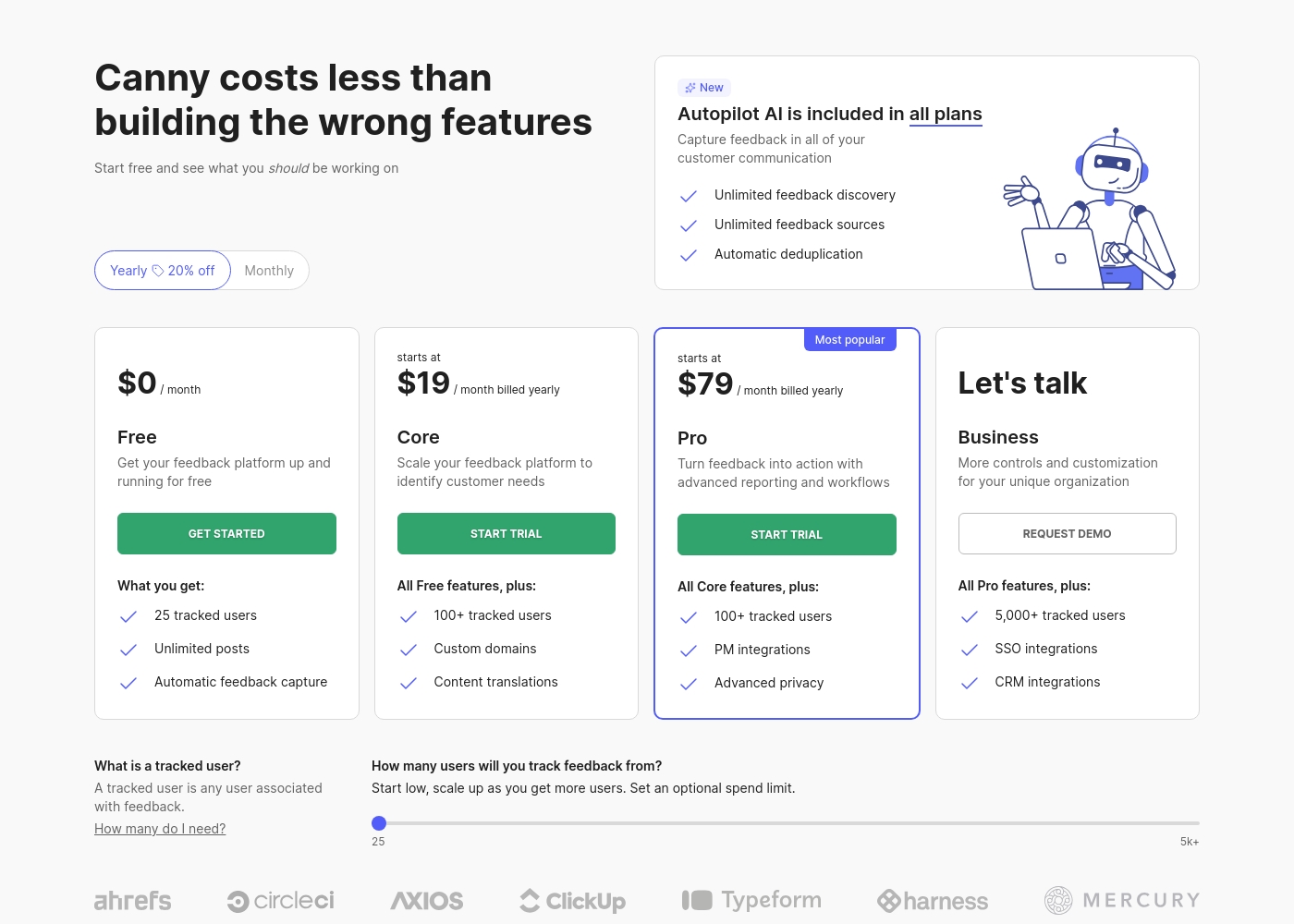
Canny's costs are strictly tied to 'tracked users,' which are defined as anyone who submits feedback. This model can lead to confusing and sharply increasing monthly bills for Canny customers. Sleekplan bases its pricing on the number of collaborating team seats required by your company. Sleekplan gives you unlimited end-users and subscribers across all paid plans, ensuring cost certainty. Sleekplan’s most expensive tiered plan, Business, is just $38/mo, whereas Canny’s Pro plan is $79/mo. Sleekplan provides markedly better value and transparency for price-sensitive teams.
AI Automation Power
Canny includes robust AI for automating feedback management. Sleekplan does not have native AI tools.
Canny stands out with its powerful Autopilot AI Suite, included even in the Free tier. The Autopilot handles automatic feedback capture and quickly merges duplicate requests. This powerful feature saves product teams significant manual effort and time. Sleekplan focuses on moderation tools and user segmentation but lacks native AI processing features. If you manage a very high volume of overlapping feedback, Canny's AI offers a strong competitive edge. Canny helps you quantify ideas faster and reduce the load on your team.
Satisfaction Tracking
Sleekplan integrates native NPS and CSAT surveys. Canny lacks integrated satisfaction metrics.
Sleekplan is designed as a complete management suite from idea submission to quantifying happiness. It includes built-in functions for both CSAT and NPS® tracking across all plan tiers. This lets you continuously measure product health effortlessly. Canny focuses solely on feedback collection, prioritization, and roadmapping tools. Canny users must integrate a separate third-party survey tool to gather NPS or CSAT data. Choose Sleekplan if you need an affordable, single system for both feedback and satisfaction monitoring.
Prioritization Depth
Canny provides deeper, customizable prioritization formulas. Sleekplan relies on user segmentation for decision making.
Canny allows you to define complex, custom formulas to automatically score feature requests. You can sync customer properties from HubSpot or Salesforce into Canny’s formulas. This enables prioritization based on potential opportunity revenue. Sleekplan uses user attributes and custom segments to focus input from high-value users. While effective, Sleekplan's prioritization lacks the mathematical depth and external data integration Canny offers. Canny is superior for strategic prioritization that depends on quantifiable business metrics.
Branding & Watermark
Canny offers custom domains at a lower cost. Sleekplan requires the Business tier to remove branding.
Canny enables custom domains starting on the Core plan at $19/mo, billed annually. The advanced privacy needed to remove branding starts on the Pro plan ($79/mo). Sleekplan requires the Business plan ($38/mo) to gain custom domain support. Crucially, Sleekplan users must reach the Business tier to remove the small promotional watermark. If white-labeling is essential but budget is tight, Sleekplan requires a larger investment than the very affordable Starter tier. Canny allows custom domains earlier, which is better for consistent branding.
Billing Transparency
Sleekplan provides clear, predictable pricing. Canny has recurring user reviews citing problematic billing practices.
Sleekplan's users praise its straightforward, transparent pricing and easy self-cancellation process. You can instantly downgrade or cancel directly in your workspace settings. Canny has multiple severe reviews complaining of sudden, substantial price increases without notice. Canny also forces users to contact support to cancel, often resulting in frustrating delays or continued billing. Sleekplan wins on reliability and user trust regarding financial interactions.
Project Integrations
Canny lists more direct PM tools like ClickUp and Asana. Sleekplan integrates essential tools like Jira and GitHub.
Canny has robust workflow integrations starting on the Pro tier, including Jira, ClickUp, and Asana. This ensures smooth hand-off from prioritized request to development task. Sleekplan integrates with Jira for development teams and supports GitHub integration. Sleekplan also offers a JavaScript SDK, API, and Webhooks for custom connections. Both tools can integrate well, but Canny provides slightly broader native support for various PM systems.
Team Capacity
Canny supports more managers on lower paid tiers. Sleekplan’s limited seats constrain growing teams more strictly.
Canny's Core plan starts with 5 managers, and the Pro plan includes 10 managers. This allows larger product teams to collaborate easily. Sleekplan’s Starter plan includes only 3 team seats before you must upgrade to the Business plan for 10 seats. If you have a small, budget-conscious team, Sleekplan offers unlimited end-users immediately. However, Canny is superior for internal scaling of product managers and collaborating staff.
Canny costs between $0 and a custom rate per month with four plans: Free at $0/month, Core starting at $19/month (billed yearly), Pro starting at $79/month (billed yearly), and Business (custom pricing).
Below are the details for each plan, designed to help you centralize feedback and make better product decisions.
Free
Price: $0/month Best For: Getting your feedback platform up and running for free Other Features:
- 25 tracked users
- Unlimited posts and boards
- 5 managers
- Automatic feedback capture
- 25 tracked users
- 5 managers
- Unlimited posts and boards
- Automatic feedback capture
- Autopilot AI
- All Free features
- 100+ tracked users
- Custom domains
- Content translations
- Changelog
- All Core features
- 100+ tracked users
- PM integrations (e.g., Jira, ClickUp)
- Advanced privacy (private boards, private comments)
- 10 managers
- All Pro features
- 5,000+ tracked users
- SSO integrations (Okta, OIDC)
- CRM integrations (HubSpot, Salesforce)
- Custom control and customization
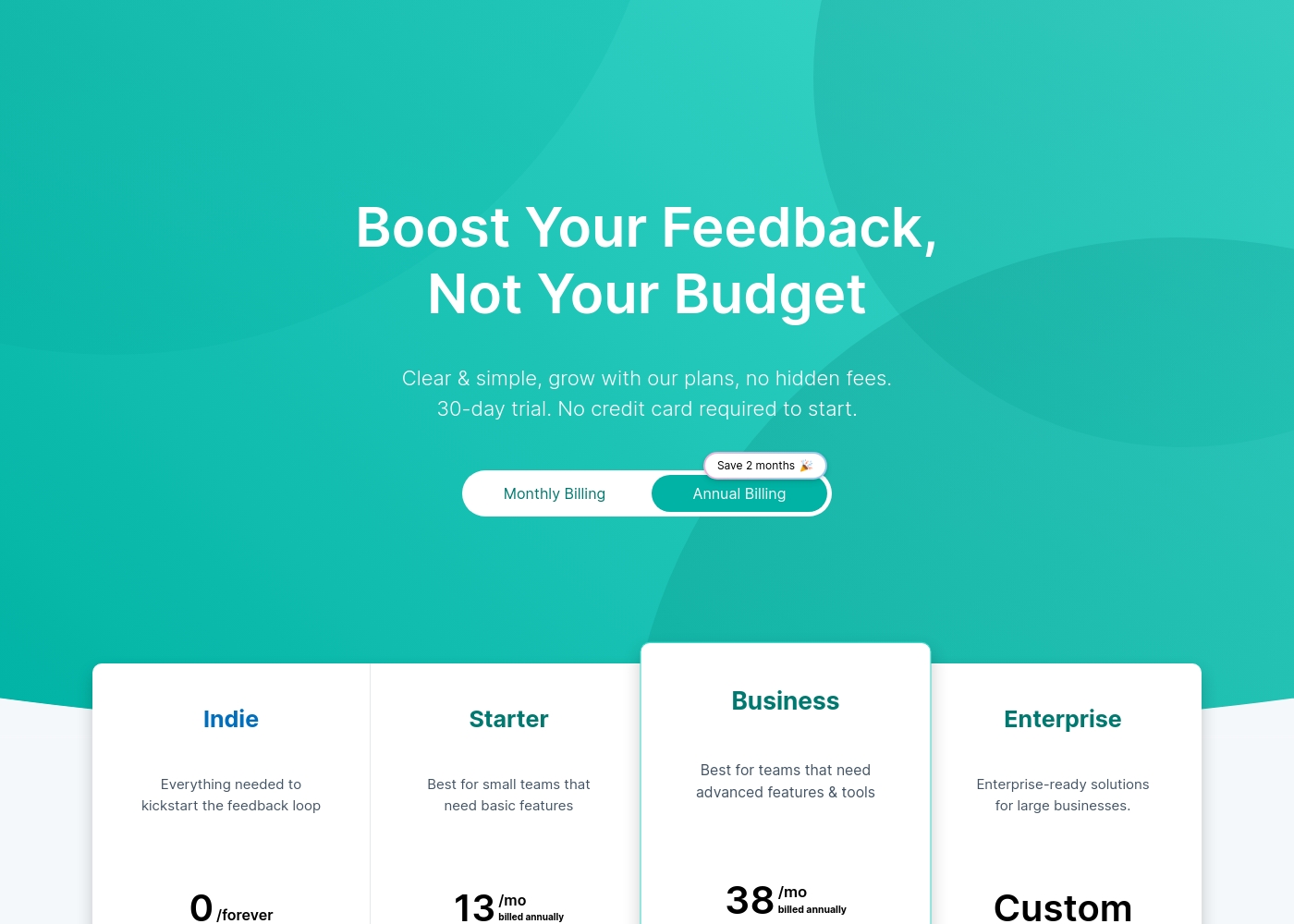
Sleekplan costs between $0 and Custom annually with four plans: Indie at $0/forever, Starter at $13/month (billed annually), Business at $38/month (billed annually), and Enterprise at Custom.
These plans are designed to grow with your team’s needs, offering clear features and flexible billing options. You save money by opting for the annual payment selection.
Indie
Price: $0 / forever Best For: Everything needed to kickstart the feedback loop Other Features:
- 1 team seat
- 500K Pageviews /month
- 300 Email Credits /month
- 1GB Storage Capacity
- Small watermark to promote the app
- 1 team seat
- Unlimited end-user/feedback/subscriber
- Includes Feedback Board, Changelog, Roadmap, CSAT, NPS®
- 3 team seats
- Unlimited tracked user/feedback/subscriber
- Full modules set
- Allows upload of custom file types
- 10 team seats
- Remove branding
- Custom domain
- User Segmentation
- Advanced analytics
- Unlimited team seats
- SAML Single sign-on (SSO)
- Custom payment terms and contracts
- Advanced support
- Organizational structure (multiple Workspaces)
Pricing Notes
- Sleekplan is significantly more affordable, with paid plans starting at $13/mo compared to Canny's Core plan at $19/mo (billed annually).
- Canny's pricing is based primarily on 'tracked users,' leading to unpredictable monthly cost scaling for the customer.
- Sleekplan paid plans include unlimited end-users for feedback tracking, basing limits on team seats and communication volume.
- Canny users report severe problems with billing transparency and an intentionally difficult cancellation process.
- Sleekplan offers a 30-day, no-credit-card-required trial giving full access to Business Plan features.
Pricing Head-to-Head
User Reviews
External feedback for Canny is heavily focused on operational issues, overshadowing the core product functionality, based on limited reviews. The most severe and recurring complaints strongly center on pricing and cancellation practices.
Users reported experiencing sudden and substantial price hikes, sometimes doubling their monthly costs from $200 to $400, calling the service 'overpriced' and citing a 'terrible pricing change.' While acknowledging the UI is straightforward and useful for creating public roadmaps, customers expressed frustration that the product lacks some important functionalities they needed. The cancellation process is strongly criticized as intentionally restrictive: users must contact support, leading to frustrating interactions with perceived 'AI robots' and even incorrect charging after cancellation attempts were made.
The product is simple and functional, but the price recently doubled from $200 to $400 a month, which is excessive for this type of software. We were charged again even after scheduling our cancellation through customer support.
The few, but highly positive, external reviews for Sleekplan primarily focus on its exceptional value and comprehensive feature set. Users consistently highlight that Sleekplan offers functionality comparable to high-end enterprise tools at a fraction of the cost, making it an extremely budget-friendly choice starting at just $13/month annually.
Reviewers praise the product's ability to act as an all-in-one feedback system, integrating feature request boards, roadmaps, and changelogs seamlessly. Specific features singled out for excellence include anonymous voting paired with moderation capabilities, advanced custom branding options (including custom CSS), and the ability to deploy feedback collection via both a standalone website and an in-app widget.
Sleekplan truly deserves 6 stars. It provides fantastic features like anonymous voting with moderation, plus both website and in-app widgets. I pay about $15 per month for this, which competing companies charge much more for.
Our Verdict
Choosing between Canny and Sleekplan comes down to balancing advanced features against cost and business practices. For most teams, Sleekplan offers the best combination of features, transparent pricing, and trusted customer support. Canny’s superpower is its exceptional Autopilot AI suite, which automatically captures and deduplicates high volumes of feedback. If your team is a large enterprise needing complex prioritization formulas linked to HubSpot or Salesforce, Canny handles that top-tier structure well. Sleekplan shines as the true all-in-one value champion, bundling everything you need, including native NPS/CSAT tracking. Sleekplan's significantly lower pricing and unlimited user tracking provide budget certainty and rapid scaling without cost surprises. The deciding factor here is predictability and trust. Sleekplan offers clear pricing and responsive support, while Canny has faced serious and recurring user complaints regarding price hikes and dishonest cancellation processes. If you prioritize predictable budget and require built-in satisfaction metrics, choose Sleekplan immediately. If your priority is maximum, complex AI automation and budget is secondary, Canny might justify the risk.
Frequently Asked Questions
Which tool offers built-in NPS and CSAT tracking: Canny or Sleekplan?
Sleekplan provides native, built-in functions for both CSAT and NPS® tracking across all plan tiers. Canny focuses instead on prioritization and organization tools. You would need to integrate a third-party tool if you chose Canny.
How does Canny's 'tracked users' pricing compare to Sleekplan?
Canny bases its pricing on the number of 'tracked users' who submit feedback, which can cause costs to fluctuate and increase sharply. Sleekplan uses a predictable model based on collaborating team seats. Sleekplan offers unlimited end-users/subscribers on all its paid plans.
Which software is less expensive for a small team of 3 users?
Sleekplan is significantly more affordable for small teams. The Starter plan is only $13/month annually, offering 3 seats and unlimited end-users. Canny's entry Core plan starts at $19/month, and the costs scale based on user activity.
Does Canny have advanced AI features like Sleekplan?
Yes, Canny includes the advanced Autopilot AI Suite across all plans, even the Free tier. The AI automates feedback capture and greatly simplifies deduplication. Sleekplan does not currently offer native AI features for feedback processing.
Which tool offers better reviews regarding customer support and billing?
Sleekplan consistently receives high praise for its highly responsive support and transparent pricing models. Canny users frequently cite major pricing disputes and an intrusive, difficult cancellation process.
Can I remove the branding watermark from Canny and Sleekplan?
You can remove the branding from Sleekplan when you subscribe to the Business plan ($38/mo). In Canny, the advanced privacy features that allow for private portals and better customization start at the Pro plan ($79/mo).
Ready to Choose?
Both tools have their strengths. Choose based on your specific needs.