BLACKBOX AI vs Splunk
BLACKBOX AI and Splunk solve very different problems. One automates code, the other analyzes data. The right pick depends on whether you're building software or securing systems.
Best for: Development teams of 5-50 engineers, Solo developers wanting to automate repetitive coding tasks
Best for: Security Operations Centers (SOCs), IT operations teams monitoring complex infrastructure
Powerful automation with unproven reliability.
We find BLACKBOX AI to be a feature-rich platform with ambitious automation for the full development lifecycle. Its multi-agent approach and broad integration options are compelling. Overall, we see strong potential for teams seeking AI-driven speed, but we await broader user validation to confirm its real-world support and value.
Pros
- Comprehensive automation from scaffolding to deployment.
- Multi-agent system for parallel task execution and evaluation.
- Wide accessibility via CLI, IDE, cloud, and API.
- Built-in safety features like security checks and schema validation.
Cons
- Lack of verified user reviews for real-world reliability assessment.
- Complex multi-agent workflows may have a steep learning curve.
- Enterprise pricing and onboarding details are not fully transparent.
Powerful but complex data platform.
We find Splunk offers a robust, unified platform for security and observability with extensive integrations and scalability. However, its pricing structure is opaque and usage-based, which can make cost planning challenging. Overall, it's a strong choice for enterprises needing deep data analysis, but smaller teams may find it complex and expensive.
Pros
- Unified platform for security and observability.
- Over 2,000 integrations with various data sources.
- AI and automation for threat response.
- Handles massive data volumes at scale.
Cons
- Opaque pricing requires consultation with sales.
- Can be complex to set up and learn.
- Usage-based models may lead to unpredictable costs.
- External review access was blocked, limiting user sentiment data.
AboutBLACKBOX AI
💡 BLACKBOX AI is an enterprise-grade agent platform for software development. 🤖 It lets you run autonomous coding agents from a single API, your terminal, IDE, or the cloud.
Whether you use Claude Code, Codex, or its own models, the platform orchestrates them to compete, collaborate, and complete tasks like refactoring, testing, and deployment.
AboutSplunk
Splunk is a unified platform for security and observability. It's designed for teams that need to search, analyze, and act on data from any source. Whether you're a security analyst hunting threats or an engineer troubleshooting app performance, it brings everything together in one place. ✨
Highlights
Feature Comparison
Features Overview
We highlight the main differences and pick a winner for each feature.
Automation Scope
BLACKBOX AI automates code creation. Splunk automates data analysis and threat response.
BLACKBOX AI's agents handle full development cycles. They scaffold services, write tests, refactor code, and create pull requests. You can run a task from an idea to a deployed feature in minutes. Splunk's automation focuses on security operations. It uses AI to create high-fidelity alerts and automated workflows. These workflows investigate and contain threats across your entire IT environment. The core difference is target: BLACKBOX AI targets your codebase. Splunk targets your infrastructure data. One builds software, the other protects it.
Data Handling
Splunk is built for massive data ingestion. BLACKBOX AI focuses on structured code data.
Splunk ingests logs, metrics, and traces from over 2,000 sources. It's designed for petabyte-scale analysis. You can search any machine data in real time. BLACKBOX AI works with code repositories and your development environment. It scans entire codebases to plan and execute changes. Its data scope is narrower but highly specialized. If your primary challenge is making sense of operational data, Splunk wins. If your challenge is accelerating development, BLACKBOX AI is the tool.
User Interface
BLACKBOX AI offers multiple developer-centric interfaces. Splunk provides a powerful search UI.
BLACKBOX AI is accessed via CLI, VS Code, a cloud dashboard, or an API. This lets developers work from their preferred terminal or editor. The experience is integrated into the dev workflow. Splunk's primary interface is its powerful web-based search and dashboard system. It's built for analysts to query and visualize data. The platform is complex but feature-rich. BLACKBOX AI's UI is for builders. Splunk's UI is for investigators. Your team's daily tools will determine which feels more natural.
Integration Ecosystem
Splunk has a massive library of data integrations. BLACKBOX AI integrates deeply with dev tools.
Splunk offers over 2,000 apps and add-ons on Splunkbase. These connect to everything from AWS to SAP. The ecosystem is vast for data ingestion and visualization. BLACKBOX AI integrates with 35+ IDEs, including VS Code. It also offers Slack, Figma, and a full REST API. The focus is on connecting to your development toolchain. Splunk's ecosystem is broader for general IT. BLACKBOX AI's is deeper for software engineering tasks.
Pricing Model
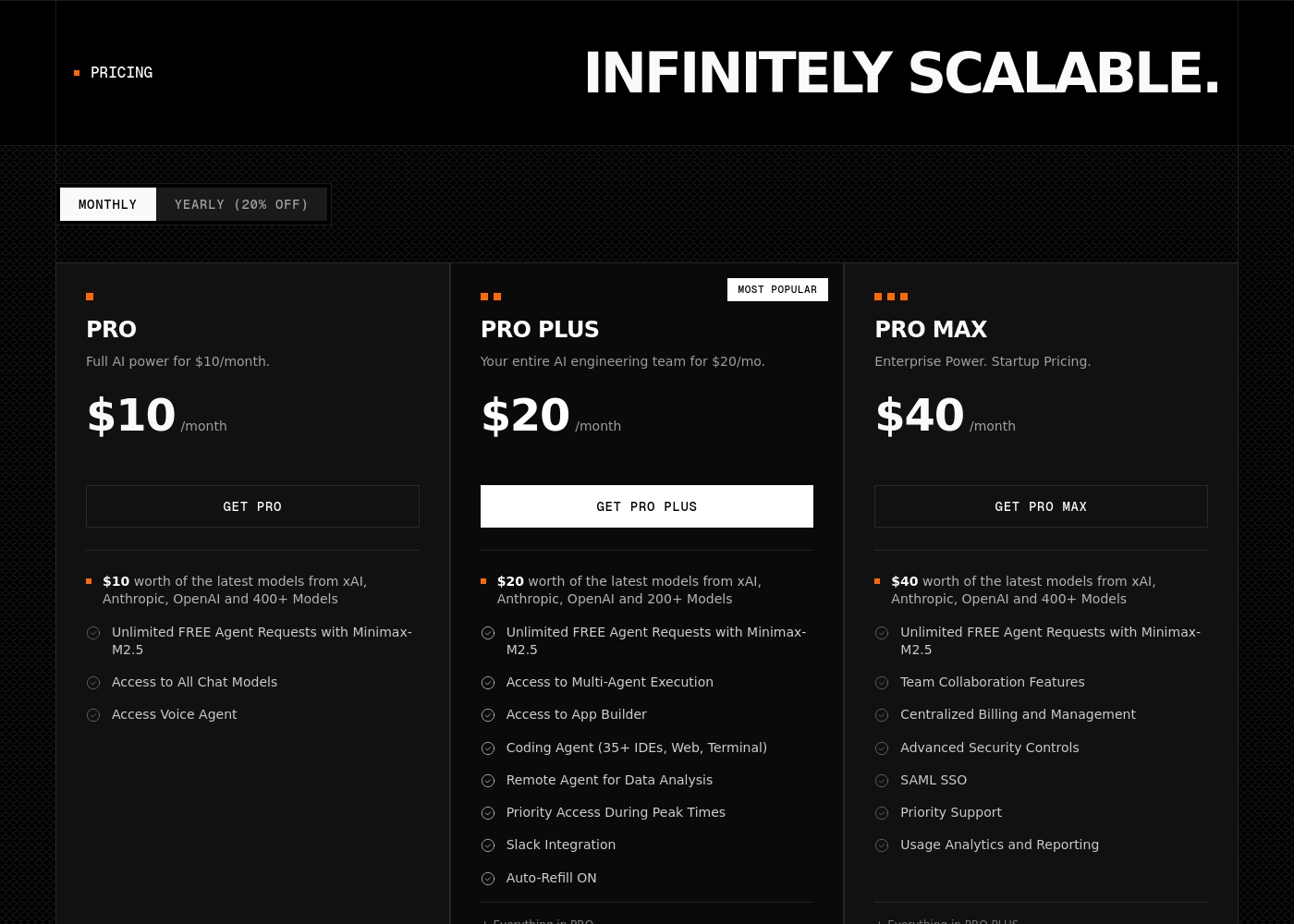
BLACKBOX AI has clear per-seat pricing. Splunk's pricing is customized and usage-based.
BLACKBOX AI starts at $8/month per seat with annual billing. Tiers vary by features and AI model credits. Enterprise plans have custom pricing. Splunk uses ingest-based or activity-based pricing. Costs depend on data volume or metrics like uptime requests. You must contact sales for a quote. BLACKBOX AI's model is simpler to predict. Splunk's can scale with your data growth, leading to potentially high, variable costs.
Customer Support
BLACKBOX AI offers tiered support with SLAs. Splunk's public support details are limited.
BLACKBOX AI has standard support for Pro plans. Pro Max includes priority support. Enterprise plans offer dedicated support with SLAs as fast as 4 hours. Splunk's public pages do not detail support response times or SLAs. You need to contact their sales team for specific support plan information. For predictable, documented support commitments, BLACKBOX AI is more transparent.
Learning Curve
Both platforms are complex, targeting specialized roles. Expect a significant learning investment.
BLACKBOX AI involves learning multi-agent workflows and its platform concepts. Understanding how agents collaborate and evaluate results takes time. Splunk requires learning its Search Processing Language (SPL) and how to build effective dashboards. The platform's breadth adds to the complexity. Neither is a plug-and-play solution. BLACKBOX AI is for devs comfortable with AI orchestration. Splunk is for data-savvy analysts and engineers.
Security & Compliance
Splunk is a unified security platform. BLACKBOX AI provides code-specific security audits.
Splunk is built for security operations. It detects threats, automates response, and helps prove compliance across your entire IT stack. BLACKBOX AI's security features are focused on code. Agents can scan dependencies for vulnerabilities, check for exposed secrets, and audit for anti-patterns. Splunk secures your infrastructure and data. BLACKBOX AI helps you write more secure code. They address different layers of the security stack.
BLACKBOX AI pricing: BLACKBOX AI offers scalable subscription plans starting at $8/month (billed annually) for individual developers and teams. Professional tiers vary by feature access, with custom enterprise solutions available for larger organizations needing on-premise deployment and advanced security controls. Plans range: 2–35 Billing options: Usage-based pricing
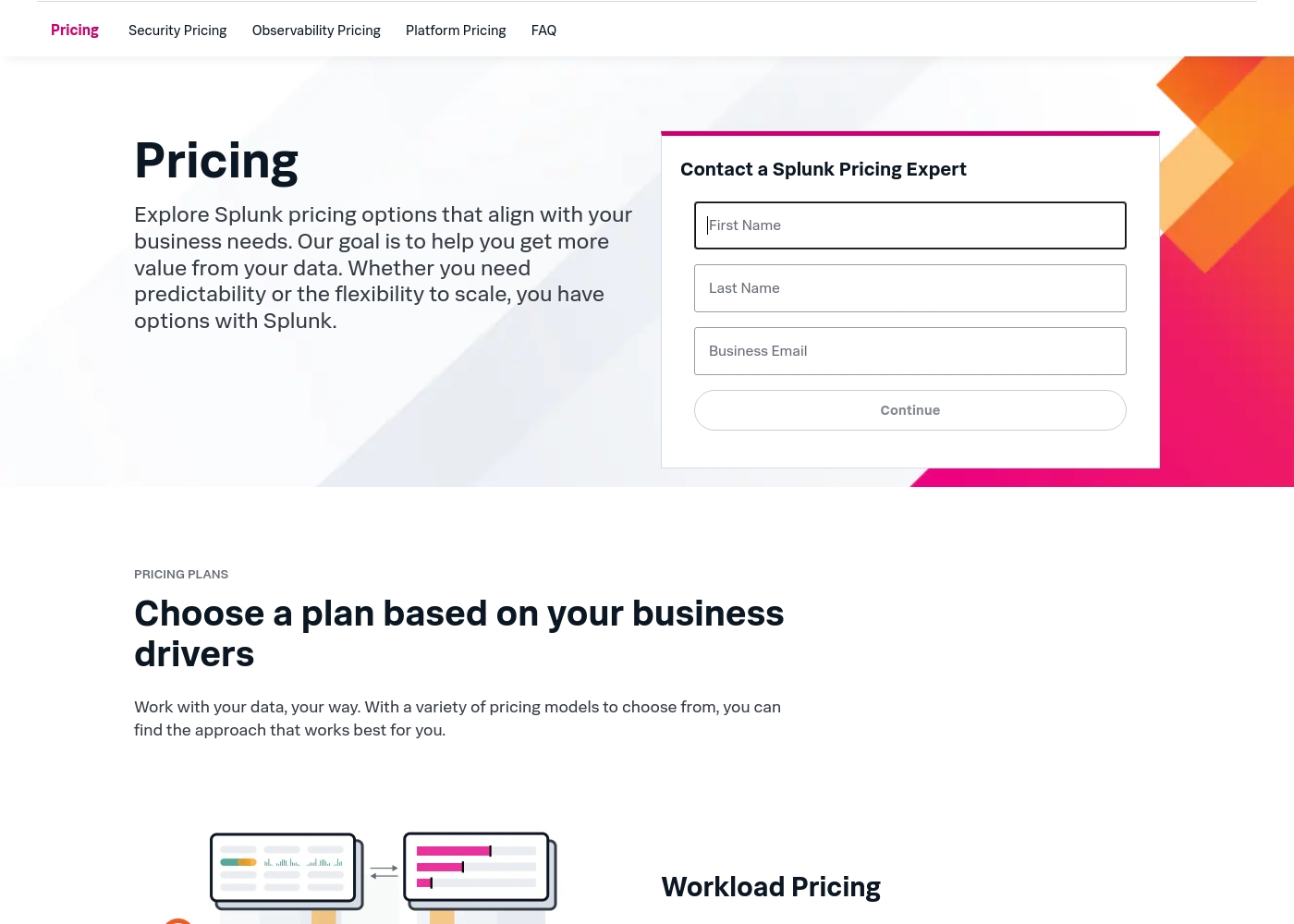
Take a look at the different ways you can manage your data costs below.
Ingest Pricing
Best For: Teams needing predictable costs for high-volume data ingestion Other Features: Simple predictable approach, Economical search scaling, Broad data ingestion
This plan is a great fit if you want a straightforward bill based on the amount of data you bring into the platform. It makes it easy to run extra searches without worrying about hidden fees. It's built for consistency and long-term planning.
- Search and analyze machine data
- Expanded use cases on ingested data
- Standard data ingestion
- Metric time series (MTS)
- Traces analyzed per minute
- Sessions monitoring
- Uptime requests
Pricing Notes
- BLACKBOX AI pricing is transparent and starts at $8/month billed annually for individuals.
- Splunk's pricing is not public and requires a sales consultation to get a quote.
- BLACKBOX AI plans are based on user seats and feature tiers.
- Splunk's costs scale with the volume of data you ingest or the number of activities you monitor.
- A free trial is mentioned for Splunk, allowing you to explore the UI before committing.
Pricing Head-to-Head
User Reviews
Based on the available Trustpilot review snippet, the sentiment is currently inconclusive due to a verification error preventing full access to user feedback. ⚠️ This means we cannot synthesize specific recurring themes about accuracy, ease of use, or support. Our final rating will therefore rely primarily on our assessment of the platform's features and stated value proposition, as external review data is not accessible for a balanced analysis.
Based on the provided external sources, we couldn't retrieve detailed user reviews for Splunk due to access restrictions. Trustpilot and Capterra both returned verification or security pages, preventing us from gathering specific sentiment on accuracy, ease of use, support, or pricing.
This means our review is based solely on the official product information and pricing details provided. We recommend checking these review sites directly for the latest user feedback before making a decision.
Our Verdict
For most developers and software teams, BLACKBOX AI is the clear choice. It solves a specific, daily problem: writing and shipping code faster. BLACKBOX AI's superpower is parallel automation. It can dispatch the same coding task to multiple AI agents at once. The best solution is then automatically selected and packaged into a pull request. Splunk's superpower is unified data analysis. It ingests and correlates data from thousands of sources. This gives security and operations teams a single pane of glass for threat detection and troubleshooting. The deciding factor is your primary pain point. Are you struggling with development velocity and manual coding tasks? Pick BLACKBOX AI. Are you drowning in operational data with blind spots across your IT stack? Pick Splunk. Final verdict: Choose BLACKBOX AI if your goal is to ship features faster by automating the development lifecycle. Choose Splunk if your goal is to secure and monitor your entire digital infrastructure with data-driven insights.
Frequently Asked Questions
Can I use BLACKBOX AI and Splunk together?
Yes, they serve different purposes. BLACKBOX AI automates coding tasks. Splunk analyzes logs from your running application. You could use BLACKBOX AI to build features and Splunk to monitor their performance and security in production.
Is Splunk worth the extra cost over BLACKBOX AI?
It depends on your needs. Splunk's cost isn't necessarily higher—it's just different. If you need enterprise-grade security and observability for massive data, Splunk is the investment. If you need to automate coding, BLACKBOX AI's per-seat model is more cost-effective.
Which tool has a gentler learning curve?
Both are complex platforms. BLACKBOX AI might be easier for a developer already comfortable with IDEs and command lines. Splunk requires learning its search language and dashboarding, which can be steep for non-analysts.
Does Splunk handle software development tasks like BLACKBOX AI?
No. Splunk is not a code generation or automation tool. It analyzes machine data generated by your software and infrastructure. BLACKBOX AI is specifically designed to write, test, and refactor code.
What happens if my team size grows with BLACKBOX AI?
You would scale your subscription by adding more per-seat licenses. BLACKBOX AI's pricing model is based on the number of users, making growth predictable in terms of user cost.
Can Splunk replace our other monitoring tools?
Splunk aims to be a unified platform for security and observability. For many enterprises, it can replace multiple disparate tools by centralizing logs, metrics, and traces from over 2,000 sources into one system.
Ready to Choose?
Both tools have their strengths. Choose based on your specific needs.