BLACKBOX AI vs Quadient
BLACKBOX AI and Quadient solve totally different problems. BLACKBOX AI automates code with AI agents. Quadient automates business processes like AP/AR and customer docs. They're not really direct competitors.
Best for: Software development teams automating repetitive coding tasks, Individual developers wanting AI assistance with refactoring, testing, and deployment
Best for: Enterprise finance teams automating AP and AR workflows, Customer communications managers handling omnichannel document delivery
Powerful automation with unproven reliability.
We find BLACKBOX AI to be a feature-rich platform with ambitious automation for the full development lifecycle. Its multi-agent approach and broad integration options are compelling. Overall, we see strong potential for teams seeking AI-driven speed, but we await broader user validation to confirm its real-world support and value.
Pros
- Comprehensive automation from scaffolding to deployment.
- Multi-agent system for parallel task execution and evaluation.
- Wide accessibility via CLI, IDE, cloud, and API.
- Built-in safety features like security checks and schema validation.
Cons
- Lack of verified user reviews for real-world reliability assessment.
- Complex multi-agent workflows may have a steep learning curve.
- Enterprise pricing and onboarding details are not fully transparent.
Powerful automation, but support concerns us.
We find Quadient offers robust tools for automating AP/AR and managing customer communications at scale. However, persistent user complaints about customer support and contract flexibility temper our recommendation. Overall, it's a capable suite for larger enterprises, but smaller teams should proceed with caution.
Pros
- Automates end-to-end AP and AR workflows.
- Strong omnichannel document creation and delivery.
- Empowers business users, reducing IT dependency.
- Scales well for high-volume, complex needs.
Cons
- Significant concerns about customer service and support responsiveness.
- Contracts and billing terms can be rigid or difficult.
- May be too complex or costly for small businesses.
- Onboarding and integration can present challenges.
AboutBLACKBOX AI
💡 BLACKBOX AI is an enterprise-grade agent platform for software development. 🤖 It lets you run autonomous coding agents from a single API, your terminal, IDE, or the cloud.
Whether you use Claude Code, Codex, or its own models, the platform orchestrates them to compete, collaborate, and complete tasks like refactoring, testing, and deployment.
AboutQuadient
Quadient is a suite of process automation solutions focused on two core areas: customer communications management (CCM) and financial workflow automation. It's designed for mid-to-large enterprises that need to design, manage, and deliver personalized documents and messages across digital, print, and mobile channels, while also automating key AP and AR processes. 💡
Highlights
Feature Comparison
Features Overview
We highlight the main differences and pick a winner for each feature.
Core Automation
BLACKBOX AI automates code. Quadient automates business processes.
BLACKBOX AI uses autonomous AI agents to handle entire development tasks. You can run agents to refactor code, write tests, deploy to staging, and create pull requests. It's built for developer speed. Quadient automates end-to-end financial and communication workflows. It handles everything from purchase orders and invoices to designing and sending personalized customer documents across channels. The key difference is the target user and task. BLACKBOX AI is for engineers. Quadient is for finance and operations teams.
AI & Intelligence
BLACKBOX AI is all about AI agents. Quadient uses automation rules.
BLACKBOX AI's core is its multi-agent system. It can dispatch the same task to multiple AI models (like Claude Code and Codex) and have a 'Chairman LLM' automatically pick the best solution. It's advanced AI orchestration. Quadient's automation is powerful but rule-based. It streamflows steps like invoice approval and document delivery. It empowers users to create templates without IT, but doesn't use generative AI agents for tasks. For cutting-edge AI-driven automation, BLACKBOX AI is the clear leader. Quadient offers robust, proven process automation.
User Interface
BLACKBOX AI works in your code editor. Quadient has business dashboards.
You access BLACKBOX AI where you already work: in your IDE (like VS Code), via the command line, or on a cloud dashboard. It's designed to fit into a developer's workflow without context switching. Quadient provides web-based dashboards for managing AP workflows, designing communications, and reviewing analytics. It's designed for business users to manage processes and content. The interfaces are built for completely different jobs. BLACKBOX AI is for coding. Quadient is for business management.
Collaboration
BLACKBOX AI is for team code reviews. Quadient is for cross-team workflows.
BLACKBOX AI facilitates developer collaboration through automated pull requests and code reviews. Agents can commit work to branches, and teams review the AI-generated changes together. Quadient is built for cross-functional business collaboration. Finance teams approve invoices, marketing designs templates, and customer service reviews communications—all within structured workflows. BLACKBOX AI enhances developer teamwork. Quadient connects entire business departments.
Reporting & Analytics
BLACKBOX AI shows agent metrics. Quadient provides business insights.
BLACKBOX AI offers real-time dashboards showing agent status, session costs, system metrics, and task performance. It's operational data for engineering teams. Quadient provides analytics on business processes. You can track invoice processing times, Days Sales Outstanding (DSO), and communication delivery metrics. It includes journey mapping to analyze customer experience. Both offer analytics, but for different domains: BLACKBOX AI for dev ops, Quadient for business ops.
Integration Ecosystem
BLACKBOX AI connects to dev tools. Quadient connects to business systems.
BLACKBOX AI integrates with 35+ IDEs and tools like VS Code, Slack, and Figma. It offers an OpenAI-compatible API for custom workflows. Enterprise plans include custom integrations. Quadient integrates with financial systems and ERPs to automate AP/AR. It also connects to print and digital delivery channels. Specific connectors aren't listed, and you need to confirm with sales. BLACKBOX AI has a broad, developer-focused integration list. Quadient's integrations are deep but specific to financial and communication ecosystems.
Customer Support
BLACKBOX AI offers tiered support. Quadient has mixed reviews.
BLACKBOX AI provides standard support on Pro plans. Pro Max and Enterprise plans include priority and dedicated support with custom SLAs, including response times as fast as 4 hours. Quadient's support reviews are concerning. Users on Trustpilot complain about slow responses and unhelpful service. Standard support has a 16-hour response window, with upgrades available. BLACKBOX AI offers clear, tiered support options. Quadient's support quality appears to be a significant pain point for customers.
Pricing & Value
BLACKBOX AI starts low. Quadient requires a custom quote.
BLACKBOX AI has transparent, usage-based pricing starting at $8/month for individuals. Professional and Enterprise tiers scale up with features and support. You can see costs in real-time. Quadient uses a custom pricing model based on your specific workflow. All plans include unlimited users, but you must contact sales for a quote. This suggests a higher, enterprise-level investment. For cost predictability and a low entry point, BLACKBOX AI wins. Quadient is likely more expensive but offers unlimited users per quote.
Learning Curve
BLACKBOX AI requires coding knowledge. Quadient requires process understanding.
Learning BLACKBOX AI involves understanding AI agent concepts, CLI commands, and how to prompt for tasks. The multi-agent system may have a steep curve for some developers. Learning Quadient involves understanding business processes like AP workflows, communication design, and template management. It aims to reduce IT dependency, but complex implementations need planning. The learning curve is job-specific. You'll need technical skills for BLACKBOX AI and business process knowledge for Quadient.
Security & Compliance
BLACKBOX AI focuses on code security. Quadient's details are unclear.
BLACKBOX AI includes automated security scans, dependency audits, and type validation as part of agent actions. Enterprise plans add SAML SSO and training data opt-out. It can be deployed on-premise for data sovereignty. Quadient is a Leader in analyst reports, implying strong standards, but its site doesn't detail specific security protocols or compliance certifications. You must request this documentation. BLACKBOX AI provides clear, built-in security features. For Quadient, you need to verify their security posture directly.
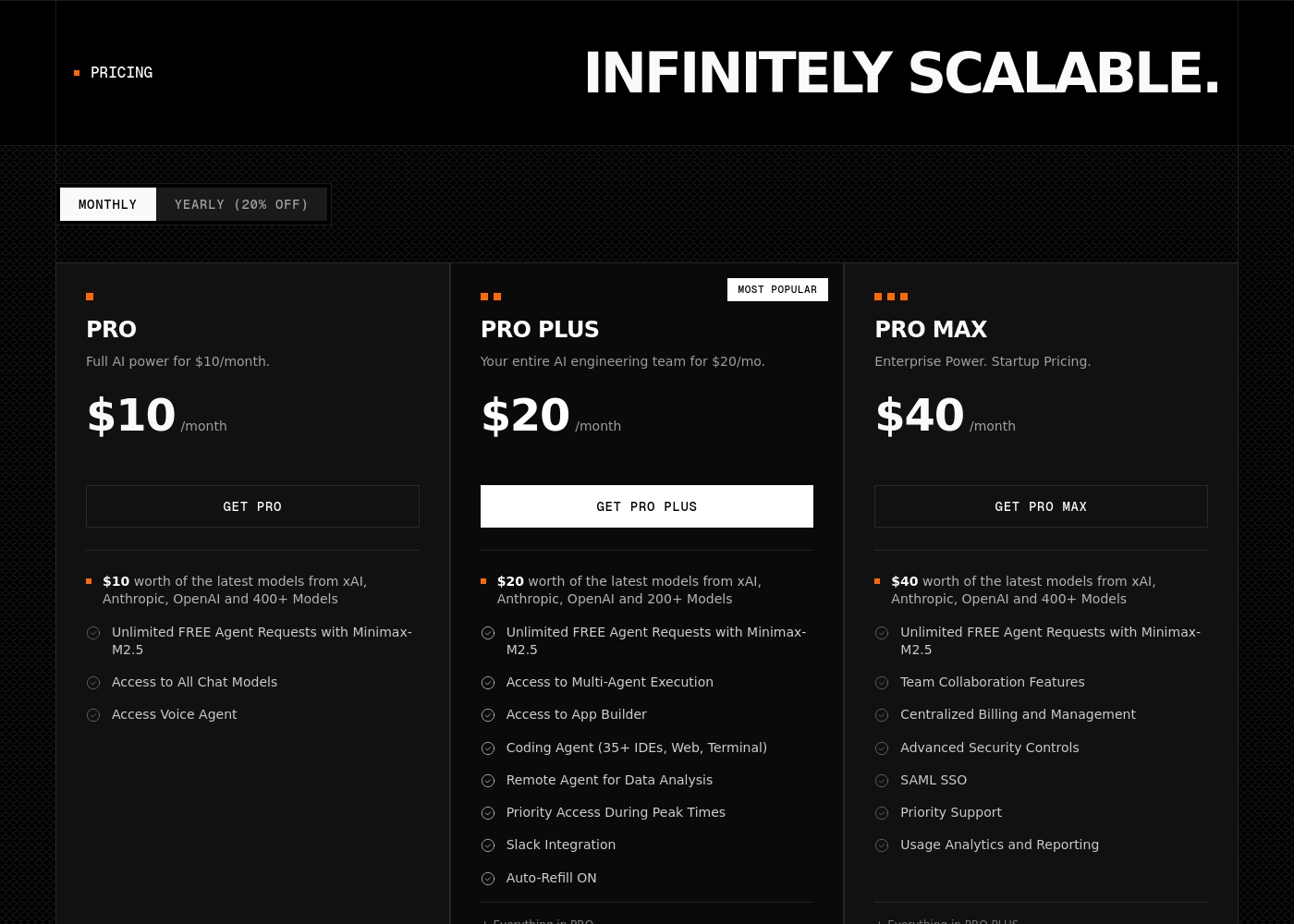
BLACKBOX AI pricing: BLACKBOX AI offers scalable subscription plans starting at $8/month (billed annually) for individual developers and teams. Professional tiers vary by feature access, with custom enterprise solutions available for larger organizations needing on-premise deployment and advanced security controls. Plans range: 2–35 Billing options: Usage-based pricing
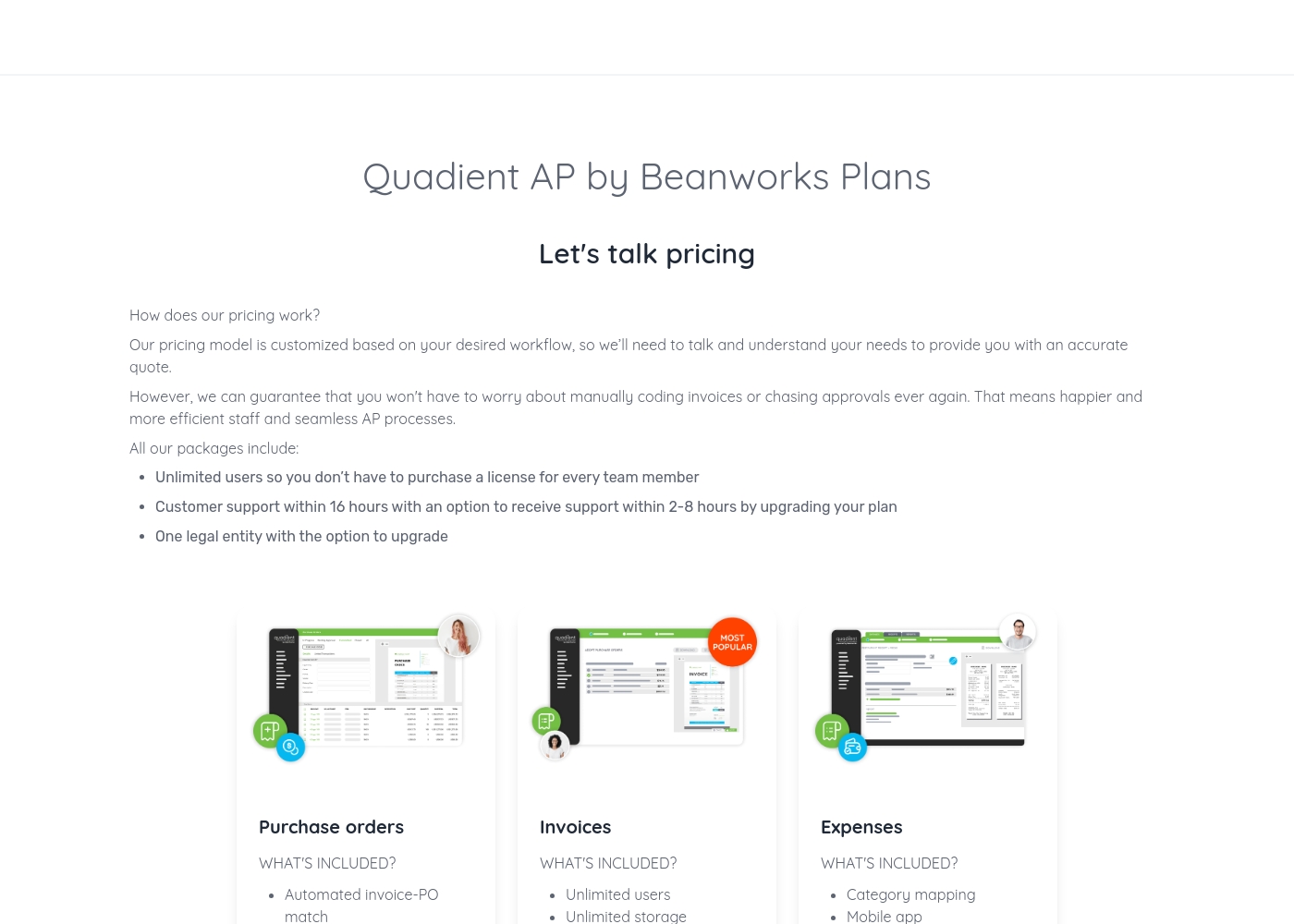
Quadient pricing: Quadient AP by Beanworks uses a custom pricing model based on your specific workflow and needs. They offer feature-specific packages for purchase orders, invoices, and expenses to ensure you only pay for what you use.
All plans include unlimited users and standard support, with the option to upgrade for faster response times or more entities. This tailored approach allows the platform to scale with your business while removing the burden of manual AP processes once and for all.
Contact them for a personalized quote today and discover how much you could save by automating your business's workflows. Their team of experts is ready to help you find the perfect solution for your accounts payable needs, whether you're a small business or a large corporation.
Pricing Notes
- BLACKBOX AI has transparent, tiered pricing starting at $8/month. Higher tiers unlock more features and support.
- Quadient does not list public pricing. Costs are customized based on your workflow, and all plans include unlimited users.
- Neither platform explicitly advertises a free trial. You may need to sign up or contact sales to evaluate them.
- BLACKBOX AI's real-time cost tracking helps manage usage. Quadient's model removes per-user fees but may involve annual contracts.
Pricing Head-to-Head
User Reviews
Based on the available Trustpilot review snippet, the sentiment is currently inconclusive due to a verification error preventing full access to user feedback. ⚠️ This means we cannot synthesize specific recurring themes about accuracy, ease of use, or support. Our final rating will therefore rely primarily on our assessment of the platform's features and stated value proposition, as external review data is not accessible for a balanced analysis.
External reviews for Quadient are mixed. On Trustpilot, users frequently complain about poor customer service, slow support, and billing issues, creating a frustrating experience.
💔 Some mention difficult contracts and a lack of responsiveness. However, on Capterra, the limited feedback for the Impress platform is more positive, with a user praising its document creation capabilities and template management as highly important features.
The software itself might work, but the customer service is a nightmare. Getting any help or a simple question answered takes forever. We've wasted so much time trying to get support.
Our Verdict
Here's the bottom line: BLACKBOX AI and Quadient are not competitors. They're tools for completely different jobs. BLACKBOX AI's superpower is AI-driven development automation. It lets you dispatch coding tasks to multiple AI agents, compare the results, and ship the best solution automatically. It's built for speed. Quadient's superpower is automating critical business processes. It streamlines AP/AR workflows and manages complex customer communications at scale. It's built for operational efficiency. The deciding factor is simple: What problem are you trying to solve? If it's a coding bottleneck, BLACKBOX AI is your tool. If it's a finance or communication workflow, Quadient is your solution. Pick BLACKBOX AI if you're a developer or team that wants to automate coding chores and ship features faster. Pick Quadient if you're an enterprise that needs to automate financial workflows or manage personalized document delivery.
Frequently Asked Questions
Can I use BLACKBOX AI instead of Quadient for my business automation?
No, they serve different purposes. BLACKBOX AI automates software development tasks. Quadient automates business processes like accounts payable and customer communications.
Which is better for a small business: BLACKBOX AI or Quadient?
For a small software team, BLACKBOX AI's low starting price ($8/month) is accessible. Quadient is designed for mid-to-large enterprises and may be too complex or costly for small businesses.
Does Quadient use AI agents like BLACKBOX AI?
No. Quadient uses rule-based automation for workflows. BLACKBOX AI is built around advanced, autonomous AI agents that can plan and execute complex coding tasks.
Is Quadient's support really as bad as the reviews say?
External reviews on Trustpilot are very negative about Quadient's support, citing slow responses and poor help. BLACKBOX AI offers clear support tiers with stated response times for paid plans.
Which tool offers better value for money?
BLACKBOX AI offers more transparent value with public, usage-based pricing starting at $8/month. Quadient requires a custom quote, making cost comparison difficult upfront.
Can I deploy either tool on my own servers?
Yes, but with caveats. BLACKBOX AI's on-premise deployment is for Enterprise plans. Quadient also offers on-premise or managed service options as part of its flexible deployment.
Ready to Choose?
Both tools have their strengths. Choose based on your specific needs.